IN FOCUS: Why Singapore's workplace culture remains a stubborn barrier to its fertility push聚焦:新加坡的职场文化为何仍是其生育政策推进的顽固障碍
Despite Singapore’s pro-family policies, employees argue that Singapore’s entrenched “hustle culture” makes it difficult to feel confident about starting a family while building their careers.
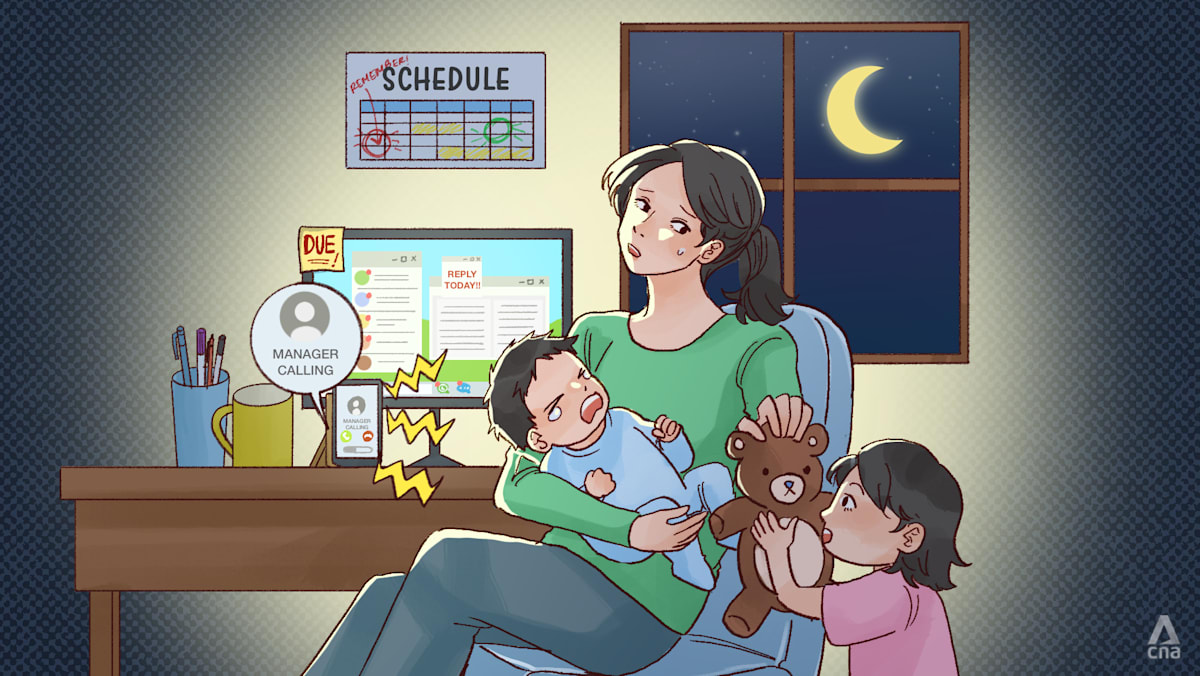
Despite Singapore’s pro-family policies, employees argue that Singapore’s entrenched “hustle culture” makes it difficult to feel confident about starting a family while building their careers.
Long hours, in-office requirements, frequent travel and a lack of flexibility are common sticking points for parents working in Singapore. (Illustration: CNA/Clara Ho)
This audio is generated by an AI tool.
SINGAPORE: When Ms M Low’s newborn was fighting for his life in the intensive care unit (ICU) last year, she was still fielding calls and messages from her team despite being on maternity leave.
She asked them to contact her after she left the hospital, and they agreed, but the experience left a bad taste in her mouth.
“My son was in a critical stage in the ICU, and I felt that I should be left alone, because every day I’m worried about my son, every day I’m hearing grim news about my son,” said Ms Low.
Her son died after a month in hospital. But back at work, the persistent cycle of business travel and after-hours drinks went on unchanged.
When Ms Low, 38, became pregnant again, instead of trying to negotiate for a slower pace at work, she simply resigned. “Forget it, let’s take care of this pregnancy,” she recalled her husband saying.
While the recent National Day Rally announcements are helpful, progressive national policies, such as increased childcare leave and higher grants of almost S$70,000 (US$55,000) for each child, do not address the root of the issue for her.
The work culture in Singapore is “intense” and lacks boundaries, she said, adding that it actively prevents couples from starting families safely without having to sacrifice their careers.
On its end, the government has stated that measures announced at the National Day Rally are early moves in its reforms to support parents, and recognises that there is also a need to address workplace culture issues in Singapore.
In his rally speech, Prime Minister Lawrence Wong encouraged employers to do their part.
“Support parents in your organisations and give them confidence to take the leave they are entitled to. Help them settle back into work afterwards. Make sure that becoming a parent never becomes a disadvantage in someone’s career,” he said.
The Marriage and Parenthood Reset Workgroup, which is headed by Minister in the Prime Minister’s Office Indranee Rajah, is set to release a fuller set of recommendations in early 2027 that is expected to tackle workplace culture issues.
Ahead of the rally, Ms Indranee said these issues could not be addressed earlier because more time is needed to balance the interests of employers and employees.
Adding that changing mindsets and attitudes at workplaces is “the much harder part to do”, Ms Indranee said employers, human resource professionals and line managers can shape the experience of employees.
CNA Games Guess Word Crack the word, one row at a time Buzzword Create words using the given letters Mini Sudoku Tiny puzzle, mighty brain teaser Mini Crossword Small grid, big challenge Word Search Spot as many words as you can Show More Show Less
A line manager who is empathetic and happy for you makes it much easier, while a manager who behaves like the employee taking leave is an imposition sends a different signal, she said.
“So, learning how to create better workplace norms and cultures, I think, is a very important part of this.”
EFFECT ON FAMILY PLANNING
For many working parents, the attitudes they observe at work are precisely what stall plans to grow their families.
One mother who declined to be named said she would be open to having a third child, but finds her current workplace unsuitable for such an endeavour.
After a change in management when she was pregnant with her second child, her work hours have become less flexible and her bosses are less understanding.
Her manager, for example, asked her not to take childcare leave at the last minute so often.
“How would I know that my child will be sick?” asked the mother, who works as an operations executive. “It doesn’t make sense for me to plan my leave, as if I know my child will be sick next month.”
She also felt that the company was not fair in their appraisal of her performance when she was pregnant.
During her appraisal, her manager said she was not reliable because she missed a work event, even though he knew that she missed the event because she experienced bleeding during her pregnancy and went to see a doctor.
“I had a hard time towards the end of my pregnancy, and I don't think they understood,” she said, adding that she sometimes felt guilty for missing work, but wanted to prioritise her health and her child.
“With the flexibility that I used to get from my old management, I think I would have another kid. But with this kind of situation, new management and so many new people around me at work, I don't think so,” she said.
She is not alone in her hesitation to expand her family because of rigid work hours and intolerant bosses.
Dr Tan Poh Lin, a senior research fellow at the Institute of Policy Studies, said work-life balance and office culture are “critical” factors affecting Singapore’s total fertility rate, which hit a record low of 0.87 last year.
She said couples typically want to be financially stable and hence prioritise career progression.
“In the event that work-life balance is poor and families are forced to choose, many would choose having fewer children,” she said.
Associate Professor Mu Zheng noted that workplace conditions can affect fertility at several stages: whether young adults have the time and energy to form relationships, whether couples feel ready to have their first child, and whether parents feel capable of having another.
“Importantly, workplace pressures may affect fertility not because people no longer value parenthood, but because they perceive it as increasingly difficult to combine being a good parent with being a good employee,” said Assoc Prof Mu, who is from the National University of Singapore’s (NUS) department of sociology and anthropology.
WORKPLACE CHALLENGES FOR PARENTS
Long hours, in-office requirements, frequent travel and a lack of flexibility are common sticking points for parents working in Singapore.
There is also a pervasive expectation that staff remain contactable outside of office hours, several parents told CNA.
Most workplaces and companies in Singapore have a “hustle” culture,” said Mr Daniel Yoong, who runs an HR advisory firm.
“Employees work hard, they're expected to work hard compared to other countries,” he said, adding that people want to advance their careers and earn more if they want to own a home and raise a family due to the high cost of living here.
“Everyone wants to strive for excellence,” said Ms Nicole Chan, a civil servant and mother of one.
“We want to be excellent in our jobs, and it always requires us to work beyond what is on paper,” she said, adding that her colleagues and friends rarely draw strict boundaries around work.
When she became a parent, she realised she needed to protect her time after office hours - a shift that left her feeling guilty.
Ms Michelle Yan, a centre success manager at co-working space operator Arcc Spaces, described Singapore’s general workplace culture as traditional.
Following the COVID-19 pandemic, many organisations gradually rolled back work-from-home policies, especially small- and medium-size enterprises (SMEs) and local firms, she said.
“Bosses would still prefer to see their employees come into office as a form of their commitment to work, they need to see you around,” she said, adding that this creates friction whenever parents need urgent leave to care for their children.
Meanwhile, those working for larger, multinational companies may need to travel frequently because of Singapore’s role as a business hub, said Ms Maybelline Tan, a regional marketing manager who travels at least twice a month.
They may also need to take part in work calls at night if they are working with colleagues based in Europe or the US, she said.
With work life being so demanding, Ms Tan decided to have pets instead of children.
“I feel very worried and I feel very upset if I have to leave my pets, (what more) if I have actual human kids?” she said.
Ms Sher-Li Torrey, who founded career portal Mums@Work, said she has received several requests from women who are not yet mothers asking if they can become a member of the network.
"They will write and say, because my current work environment does not suit it, I need to leave so that I can have a kid," she said, adding that some will indicate that their existing job requires them to travel frequently.
In search of a better environment to work and raise their children in, some Singaporeans told CNA they ended up moving abroad to find the right balance.
Ms Irene Cheong, who is in her 50s now, applied for permanent residency in Australia before starting a family. Had she not succeeded in her application, the Singaporean mother of one said she may not have had children at all.
She lived and worked in Australia from the time her son was three, until he was around 10 years old.
She worked so-called “mum hours” that allowed her to send her son to school in the morning, pick him up around 3pm, cook dinner and spend quality time with her family.
This level of work-life integration seems uncommon in Singapore, said Ms Cheong, who works in HR information systems.
Professor of Economics Christine Ho said it is better to consider what constraints families face, rather than to find fault for the falling fertility rate.
“Housing costs, gender norms that leave working mothers doing a double shift at home and at work, competition in education and at work, and a definition of success measured by whose children get the best grades or earn the most – those are constraints, and constraints can be targeted,” she said.
CAN SINGAPORE BE ‘MADE FOR FAMILIES’?
At a policy level, parents and experts who spoke to CNA agreed that strides have been made toward fostering a more supportive workplace.
In recent years, there have been increases to paternity leave and shared parental leave, as well as efforts to encourage flexible work arrangements.
But family-friendly policies may not always translate into changes on the ground.
A 2025 survey of more than 1,500 people found that workers are worried that taking parental leave, requesting for flexible work arrangements or adjusting their schedules for caregiving could signal a lack of commitment and affect their career progression.
The survey, which was conducted by the National Trades Unions Congress (NTUC) Women and Family and the People’s Action Party Women’s Wing, reported that 41 per cent of respondents felt stronger leadership support would make flexible work arrangements more effective.
“That tells us something important,” said NTUC assistant secretary-general Yeo Wan Ling. “Family-friendly policies will only work fully when workers feel safe using them.”
A manager who tells an employee to “take the time you need” sends a very different signal from a manager who approves the leave but makes the worker feel guilty, said Ms Yeo, who is also director of NTUC Women and Family.
“These everyday interactions matter. They shape whether workers believe that having children and progressing in their careers can genuinely coexist,” she said.
For example, Ms Low, who had to handle work while her son was in the ICU, said she found out she was pregnant just four months after starting a new job.
When she shared the news with her boss, he asked her why she did not inform him earlier of her intention to start a family.
A policy can only be as effective as its implementation, said Mr Aslam Sardar, chief executive of the Institute for Human Resource Professionals.
He said manager capability and workplace trust are important because an employee’s experience of a family-friendly policy hinges on how comfortable they feel discussing their needs with their manager.
It also depends on whether their managers focus on outcomes rather than an employee’s physical presence, he said.
“That does not necessarily mean managers are unsupportive. Many managers are themselves balancing business pressures, team capacity and individual needs,” he said, adding that they can be equipped with skills and frameworks to navigate different situations fairly and consistently.
Beyond business owners, colleagues who are single or do not intend to have children have also voiced concern about the workload that falls on them when parents take extended leave.
To this, Mr Marcus Lam, honorary treasurer of the Singapore National Employers Federation, said openness between employers and employees will help in tackling operational challenges when a staff member goes away for a longer stretch.
Employers can plan ahead to find a temporary cover, split the work among existing colleagues or defer projects that are not time sensitive.
They can also help to foster relationships between colleagues and initiate conversations, said Mr Lam, adding that it is worse if one colleague makes assumptions because the employer did not communicate well.
“The organisation needs to communicate upfront, or during the assessment, to be able to say okay, I reward you for that, thanks for the extra effort,” he said.
Earlier in the process, the rest of the team can be included in discussions on how to manage both the trade-offs and the benefits collectively, Mr Lam said.
WHAT A SUPPORTIVE WORKPLACE SHOULD LOOK LIKE
For many parents, genuine support ultimately comes down to day-to-day flexibility.
One mother, who declined to be named, recalled working at an international bank where she was scolded for taking leave to bring her child to the doctor, and told that her performance rating was low because she was not working nights and weekends.
One of her colleagues was also reprimanded when she was unable to log in to work systems during her maternity leave, even though the security system had locked her access automatically after a month away from work.
“At least three of us left because we wanted to have another kid, but you definitely can’t have a kid there,” she said.
At her new workplace, she only needs to be in office from 11am to 4pm, and her colleagues are mindful of not contacting her when she is on leave or unwell.
When she expressed hesitation at having another child so soon after starting a new job, her colleagues encouraged her not to hold back
“It’s really very different. You are happier, your kids are happier, then you would want to have another kid,” she said.
Mr Kevin Goh, group head of engagements and programmes at the Centre for Fathering, said the charity cannot pay their employees as much as the private sector, but offers a strong pro-family environment.
In his team, employees do not need to apply for time off if they need to pick up their children or bring their parents for appointments.
“I know that my team works hard already, so I don’t nitpick,” he said, noting that the team does work nights and weekends given the nature of their roles.
He gave an example of someone from his team who was allowed to come late to a staff meeting because he had to pick his son up. The team member even brought his son to the office for the day.
The organisation also rescheduled a work-from-office day when it coincided with early school dismissals for Teachers’ Day.
Mr Yoong, the HR consultant, said extending flexibility across the board would help managers to build a good environment and culture in the team.
That means accommodating workers whether they are parents, married without children, or single.
“If somebody else in the team needs to take time off to go and send their mother to the hospital, or if you feel like working from home today, go ahead,” he said.
Get our pick of top stories and thought-provoking articles in your inbox
Stay updated with notifications for breaking news and our best stories
Join our channel for the top reads for the day on your preferred chat app
尽管新加坡推行了有利于家庭的政策,但员工们认为,新加坡根深蒂固的“奋斗文化”让他们很难在发展事业的同时安心组建家庭。
长时间工作、必须到办公室上班、频繁出差以及缺乏灵活性是新加坡职场父母普遍面临的难题。(插图:CNA/Clara Ho)
这段音频是由人工智能工具生成的。
新加坡:去年,当 M Low 女士的新生儿在重症监护室 (ICU) 与死神搏斗时,尽管她正在休产假,但她仍然接听团队打来的电话和回复信息。
她要求他们在她出院后与她联系,他们也同意了,但这次经历让她感觉很不好。
“我的儿子在重症监护室病情危重,我觉得我应该一个人待着,因为我每天都担心我的儿子,每天都听到关于我儿子的噩耗,”罗女士说。
她的儿子在医院住了一个月后去世了。但回到工作岗位后,她依然过着朝九晚五、下班后喝酒的恶性循环。
38岁的罗女士再次怀孕后,没有试图与公司协商放慢工作节奏,而是直接辞职了。“算了,咱们先把怀孕当成大事吧。”她回忆起丈夫当时说的话。
虽然最近的国庆群众大会宣布的政策很有帮助,但诸如增加育儿假和为每个孩子提供近 7 万新元(5.5 万美元)的更高补助等进步的国家政策,并没有解决她问题的根源。
她表示,新加坡的工作文化“压力很大”,缺乏界限,这实际上阻碍了夫妇在不牺牲事业的情况下安全地组建家庭。
政府方面表示,在国庆群众大会上宣布的措施是其支持父母改革的早期举措,并承认新加坡也需要解决工作场所文化问题。
黄循财总理在集会演讲中鼓励雇主尽到自己的责任。
“要支持你们单位的父母,让他们有信心休完应有的假期。帮助他们产后重返工作岗位。确保为人父母永远不会成为任何人职业生涯的劣势,”他说道。
由总理公署部长英兰妮·拉贾领导的婚姻与育儿重置工作组将于 2027 年初发布一套更全面的建议,预计将解决工作场所文化问题。
在集会前,英德拉妮女士表示,这些问题无法提前解决,因为需要更多时间来平衡雇主和雇员的利益。
Indranee 女士补充说,改变工作场所的思维方式和态度是“更难做到的事情”,雇主、人力资源专业人员和一线经理可以塑造员工的体验。
CNA游戏 猜词游戏 逐行破解单词 流行词游戏 用给定的字母组成单词 迷你数独 小小谜题,挑战你的大脑 迷你填字游戏 小方格,大挑战 单词搜索 尽可能多地找出单词 显示更多 显示更少
她说,如果一位直属经理能够体谅员工,并为你感到高兴,那么事情就会容易得多;而如果一位经理表现得好像员工请假是一种负担,则会发出不同的信号。
“所以,我认为,学习如何创造更好的工作场所规范和文化是其中非常重要的一部分。”
对计划生育的影响
对于许多职场父母来说,他们在工作中观察到的态度恰恰阻碍了他们组建家庭的计划。
一位不愿透露姓名的母亲表示,她愿意生第三个孩子,但她觉得目前的工作环境不适合这样做。
在她怀第二个孩子期间,公司管理层发生了变动,她的工作时间变得不那么灵活,她的老板也变得不那么体谅她了。
例如,她的经理要求她不要经常在最后一刻请育儿假。
“我怎么知道我的孩子会生病呢?”这位担任运营主管的母亲问道,“如果我知道孩子下个月会生病,那我提前安排休假就毫无意义了。”
她还认为,在她怀孕期间,公司对她的工作表现评价并不公平。
在绩效评估期间,她的经理说她不可靠,因为她缺席了一次工作活动,尽管他知道她缺席是因为怀孕期间出血并去看医生。
“我怀孕后期过得很艰难,我觉得他们并不理解,”她说,并补充说,她有时会因为请假而感到内疚,但她想把自己的健康和孩子放在首位。
“如果像以前的管理层那样灵活,我想我会再生一个孩子。但现在的情况是,新的管理层,工作中也多了这么多新同事,我觉得不会了。”她说道。
由于工作时间固定、老板不宽容,她并非唯一一个对扩大家庭犹豫不决的人。
政策研究所高级研究员陈宝琳博士表示,工作与生活平衡以及办公室文化是影响新加坡总和生育率的“关键”因素,该生育率去年跌至0.87的历史新低。
她说,夫妻通常都希望经济稳定,因此会优先考虑职业发展。
“如果工作与生活难以平衡,家庭被迫做出选择,许多家庭会选择少生孩子,”她说。
副教授穆正指出,工作场所的条件会在几个阶段影响生育能力:年轻人是否有时间和精力建立恋爱关系,夫妇是否准备好要第一个孩子,以及父母是否有能力再要一个孩子。
“重要的是,工作场所的压力可能会影响生育能力,这并不是因为人们不再重视为人父母,而是因为他们觉得越来越难以兼顾好父母和好员工这两个角色,”新加坡国立大学(NUS)社会学和人类学系副教授穆说。
职场父母面临的挑战
长时间工作、办公室工作要求、频繁出差和缺乏灵活性是新加坡职场父母常见的难题。
几位家长告诉 CNA,人们普遍希望工作人员在办公时间之外也能保持联系。
“新加坡大多数工作场所和公司都有一种‘拼搏’文化,”经营一家人力资源咨询公司的丹尼尔·杨先生说。
“与其他国家相比,这里的员工工作很努力,人们也期望他们更努力工作,”他说道,并补充说,由于这里的生活成本很高,人们如果想拥有自己的房子和养家糊口,就希望提升自己的职业生涯并赚更多的钱。
“每个人都想追求卓越,”公务员兼单亲妈妈陈妮可女士说道。
“我们都想在工作中做到优秀,而这总是要求我们超越纸面上的职责范围,”她说道,并补充说她的同事和朋友很少在工作上划定严格的界限。
当她成为母亲后,她意识到自己需要在下班后保护好自己的时间——这种转变让她感到内疚。
联合办公空间运营商 Arcc Spaces 的中心成功经理 Michelle Yan 女士将新加坡的总体工作场所文化描述为传统的。
她表示,新冠疫情爆发后,许多机构逐渐取消了居家办公政策,尤其是中小企业和本地企业。
“老板们仍然希望看到员工来上班,以此作为对工作的承诺,他们需要看到你在岗,”她说道,并补充说,每当父母需要紧急请假照顾孩子时,这就会造成摩擦。
与此同时,在大型跨国公司工作的人可能需要经常出差,因为新加坡是商业中心,区域营销经理梅贝琳·谭女士表示,她自己每月至少出差两次。
她表示,如果他们与位于欧洲或美国的同事一起工作,可能还需要在夜间参加工作电话会议。
由于工作压力巨大,谭女士决定养宠物而不是生孩子。
“如果我不得不离开我的宠物,我会感到非常担心和难过,(更何况)如果我还有孩子呢?”她说。
创办职业门户网站 Mums@Work 的 Sher-Li Torrey 女士表示,她收到了一些尚未成为母亲的女性的请求,询问她们是否可以加入该网络。
“他们会写信说,因为我目前的工作环境不适合我,我需要离开去生孩子,”她说道,并补充说,有些人还会表示他们目前的工作需要他们经常出差。
为了寻找更好的工作和养育子女的环境,一些新加坡人告诉亚洲新闻台,他们最终移居国外以寻求合适的平衡。
现年五十多岁的张女士在组建家庭之前就申请了澳大利亚永久居留权。这位新加坡籍母亲表示,如果申请没有成功,她可能根本不会要孩子。
从儿子三岁到他十岁左右,她一直在澳大利亚生活和工作。
她实行所谓的“妈妈时间”,这样她早上可以送儿子上学,下午3点左右接他回家,做晚饭,并与家人共度美好时光。
在新加坡从事人力资源信息系统工作的张女士表示,这种程度的工作与生活融合在新加坡似乎并不常见。
经济学教授何慧玲表示,与其指责生育率下降的原因,不如考虑家庭面临的制约因素。
“住房成本、导致职业母亲在家和工作中承担双重责任的性别规范、教育和工作中的竞争,以及以子女成绩最好或收入最高来衡量成功的定义——这些都是制约因素,而这些制约因素是可以针对性解决的,”她说。
新加坡可以称得上是“家庭之选”吗?
在政策层面,与 CNA 交谈的家长和专家一致认为,在营造更具支持性的工作场所方面已经取得了长足进步。
近年来,陪产假和共享育儿假有所增加,同时也努力鼓励灵活的工作安排。
但有利于家庭的政策未必总能转化为实际的改变。
2025 年一项针对 1500 多人的调查发现,员工担心休育儿假、申请灵活的工作安排或调整工作时间照顾家人可能会表明缺乏责任心,并影响他们的职业发展。
这项由全国职工总会(NTUC)妇女及家庭部和人民行动党妇女部进行的调查显示,41%的受访者认为,更强有力的领导支持将使灵活的工作安排更加有效。
“这告诉我们一些重要的信息,”全国职工总会助理秘书长杨婉玲说,“只有当员工感到使用这些政策是安全的,家庭友好型政策才能充分发挥作用。”
全国职工总会妇女及家庭协会理事杨女士表示,一位经理告诉员工“你需要休息的时间就休息”,这与一位批准休假但让员工感到内疚的经理所传递的信息截然不同。
“这些日常互动至关重要。它们会影响员工是否相信生育子女和事业发展可以真正并存,”她说。
例如,罗女士在儿子住进重症监护室期间不得不处理工作,她说她在开始新工作仅仅四个月后就发现自己怀孕了。
当她把这个消息告诉老板时,老板问她为什么没有早点告诉他她打算组建家庭。
人力资源专业人士协会首席执行官阿斯拉姆·萨达尔先生表示,一项政策的有效性取决于其执行情况。
他表示,经理的能力和工作场所的信任非常重要,因为员工对家庭友好政策的体验取决于他们与经理讨论自身需求时的舒适程度。
他还表示,这还取决于他们的管理者是更注重结果还是更注重员工的实际出勤情况。
“这并不一定意味着管理者不支持员工。许多管理者自身也在努力平衡业务压力、团队能力和个人需求,”他说道,并补充说,他们可以通过学习相关技能和方法,公平、一致地应对不同的情况。
除了企业主之外,单身或不打算生育子女的同事也对父母休长假时落在他们身上的工作量表示担忧。
对此,新加坡全国雇主联合会名誉司库马库斯·林先生表示,雇主和雇员之间的坦诚沟通将有助于应对员工长期休假时带来的运营挑战。
雇主可以提前做好计划,寻找临时替补人员,将工作分配给现有同事,或者推迟一些没有时间紧迫性的项目。
林先生表示,它们还可以帮助促进同事之间的关系,并开启对话。他还补充说,如果因为雇主沟通不畅而导致一位同事妄下结论,情况会更糟。
他说:“组织需要提前沟通,或者在评估过程中沟通,以便能够说,好的,我会奖励你,感谢你付出的额外努力。”
林先生表示,在流程的早期阶段,可以邀请团队其他成员参与讨论,共同权衡利弊,兼顾收益。
一个支持型的工作场所应该是什么样的?
对许多父母来说,真正的支持最终体现在日常生活的灵活性上。
一位不愿透露姓名的母亲回忆起她在一家国际银行工作时,因为请假带孩子去看医生而受到训斥,并被告知她的绩效评分很低,因为她没有上夜班和周末班。
她的一位同事在产假期间无法登录工作系统,尽管安全系统在她休假一个月后自动锁定了她的访问权限,但她仍然受到了训斥。
“我们当中至少有三个人离开是因为想再生一个孩子,但在那里肯定生不了孩子,”她说。
在新工作单位,她只需要上午 11 点到下午 4 点在办公室上班,同事们也都很注意在她休假或生病时不要联系她。
当她对刚开始新工作不久就再生一个孩子感到犹豫时,她的同事们鼓励她不要犹豫。
“这真的非常不一样。你会更快乐,你的孩子也会更快乐,这样你就不会想要再生一个孩子了,”她说。
父亲中心(Centre for Fathering)的团体联络和项目主管吴凯文先生表示,该慈善机构无法像私营部门那样支付员工高薪,但提供了一个强大的亲家庭环境。
在他的团队里,员工如果需要接孩子或陪父母去看医生,不需要请假。
“我知道我的团队已经很努力了,所以我不会吹毛求疵,”他说,并指出鉴于他们工作的性质,团队成员确实需要在晚上和周末工作。
他举例说,他团队里有人因为要接儿子,所以被允许迟到参加员工会议。这位团队成员甚至当天还把儿子带到了办公室。
该组织还重新安排了一次在办公室工作日,因为那天恰逢教师节学校提前放学。
人力资源顾问Yoong先生表示,全面放宽灵活性将有助于管理者在团队中建立良好的环境和文化。
这意味着要照顾到所有员工,无论他们是为人父母、已婚但没有孩子还是单身。
他说:“如果团队中的其他人需要请假去医院送母亲,或者如果你今天想在家工作,那就去做吧。”
订阅我们的邮件,即可获取精选热点新闻和引人深思的文章。
订阅通知,第一时间获取突发新闻和精彩报道。
加入我们的频道,即可在您常用的聊天应用上获取当日热门文章。