Drug Cartel Now Assassinates Its Enemies With Bomb-Toting Drones贩毒集团现在用携带炸弹的无人机暗杀敌人
The tactic has become widespread on battlefields overseas and now appears to be proliferating to organized crime.
By Joseph Trevithick
Updated Nov 27, 2020 6:27 PM EST
Mexico’s drug cartels are notoriously well armed and equipped, with some possessing very heavy weaponry, including armored gun trucks sporting heavy machine guns. Now at least one of these groups appears to be increasingly making use of small quadcopter-type drones carrying small explosive devices to attack its enemies. This is just the latest example of a trend that has been growing worldwide in recent years, including among non-state actors, such as terrorists and criminals , which underscores the potential threats commercially-available unmanned systems pose on and off the battlefield.
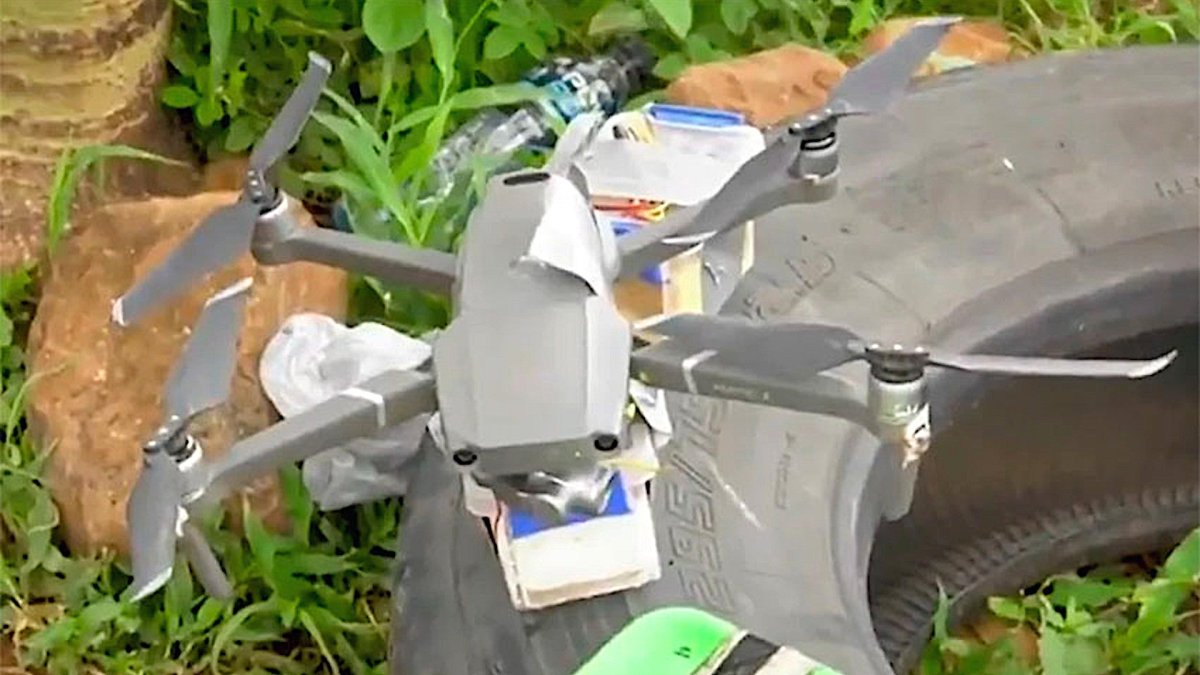
A civilian self-defense militia in the city of Tepalcatepec, in Mexico’s southwestern Michoacan state, reportedly recovered two dozen explosive-laden quadcopters from a car that a team of sicarios – cartel hitmen – had apparently abandoned, possibly after a failed or aborted hit, on July 25, 2020. The bombs attached to the drones consisted of Tupperware-like containers filled with C4 charges and ball bearings to act as shrapnel.
One of the armed drones reportedly recovered in Tepalcatepec., video capture via Mexico News Daily
The vehicle and its contents were said to be tied to the Cártel de Jalisco Nueva Generación (CJNG), or Jalisco New Generation Cartel, which has its main hub in neighboring Jalisco state, but exerts control over a wider swatch of territory. This includes areas much further down Mexico’s southwestern Pacific coastline and along the Gulf of Mexico on the opposite side of the country.
CJNG first emerged in 2009 as an offshoot of the Milenio Cartel and has since waged a particularly violent campaign against many of Mexico’s other drug cartels, as well as Mexican authorities and civilian self-defense organizations, growing in size and scope in the process. As of July, American authorities estimated that CJNG was responsible for the movement of approximately one-third of all drugs from Mexico into the United States. It has also been working to expand its operations into Europe and Asia.
A map of cartel areas of control as of 2015, with the CJNG in yellow., DEA
That revenue has clearly translated into new weapons, vehicles, and equipment for the CJNG’s sicarios and other footsoldiers. In July, the cartel released a particularly striking video of a convoy of camouflage-painted trucks, pickups, and SUVs, some with mounted weapons and very visible add-on armor, together with heavily armed personnel in tactical gear, that all looked more like a military unit than a criminal gang.
These personnel, who all shouted of the nickname of their top boss, Nemesio “El Mencho” Oseguera Cervantes, throughout the footage, reportedly belong to a “special forces” contingent within the cartel’s overall force structure. This video followed a failed CJNG assassination attempt against Mexico City’s police chief Omar Garcia Harfuch in June. Harfuch was wounded in the shootout and two of his bodyguard’s died.
CJNG’s growing resources have also translated into its new aerial capabilities. There were reports in April that CJNG had been dropping improvised explosive devices from small, conventional manned aircraft in attacks on members of the Tepalcatepec self-defense militia. The cartel apparently dropped this tactic quickly after Mexican authorities stepped up aerial surveillance in the region and has since shifted to using the diminutive drones.
Quadcopters with explosives believed to belong CJNG were recovered in the city of Puebla, in the state of the same name, southeast of Mexico City, in April, as well. Mexican officials said they believed those had been destined for attacks on the Santa Rosa de Lima Cartel in Guanajuato state to the northwest. The discovery of those drones led to raids that found more quadcopters, as well as various electronics and bomb-making supplies, including more C4.
One of the armed drones recovered during a raid earlier in the year., Mexican Federal Police
It’s not surprising at all that CJNG, especially, has turned to small unmanned systems as a means of carrying out its various violent campaigns throughout Mexico. Mexican cartels, among other criminal groups, have already been using them to carry drugs over walls and past other barriers, as well as conduct surveillance . There have been more sporadic reports of other cartels using small explosive-armed drones since at least 2017, too.
The barrier to entry when it comes to crafting small bomb-carrying quad and hexcopter-type drones is notably low, in general. This is something The War Zone has highlighted on multiple occasions in the past , which makes the concept particularly attractive to non-state actors.
In 2018, a group opposed to dictatorial Venezuelan President Nicolas Maduro attempted to assassinate him at a public rally using a commercially available multi-rotor drone system. This came years after ISIS terrorists had very much brought the concept to an actual battlefield in Iraq.
Small drones of various kinds of improvised munitions had steadily proliferated among terrorists and other armed groups in Iraq and Syria since then. Russia’s Syrian outpost at Khmeimim Air Base has been subjected to a regular stream of drone attacks since 2018.
In July, authorities in the Iraqi capital Baghdad recovered a quadcopter drone with a very purpose-built-looking looking bomb underneath in a neighboring near the heavily fortified Green Zone area that is home to various government buildings and Embassies, including that of the United States. Iranian-backed militias often use these adjacent areas to stage rocket attacks on the U.S. Embassy compound .
These are just a small number of the readily available examples of this tactic being employed. In fact, when it comes to the danger of drones being used for gangland assassinations, Japanese authorities warned back in 2015 about Yakuza families doing exactly what CJNG is doing right now in Mexico.
Even larger nation-state militaries are starting to leverage the relative simplicity of hobby-like quadcopter drones as a starting place for more complex weaponized systems, including designs capable of operating cooperatively in autonomous swarms. Turkey is now putting such a drone system into production, which you read all about here .
This reality has left the United States, among others, scrambling to catch up when it comes to developing countermeasures. The U.S. military, as a whole, has been investigating a wide array of different counter-drone technologies to handle these lower-tier threats, ranging from jammers to directed-energy weapons, including both lasers and high-power microwave beams .
“I argue all the time with my Air Force friends that the future of flight is vertical and it’s unmanned,” U.S. Marine General Kenneth McKenzie, head of U.S. Central Command, said at a public event in June . “I’m not talking about large unmanned platforms, which are the size of a conventional fighter jet that we can see and deal with, as we would any other platform. I’m talking about the one you can go out and buy at Costco right now in the United States for a thousand dollars, four quad, rotorcraft, or something like that that can be launched and flown,” he added. “And with very simple modifications, it can make made into something that can drop a weapon like a hand grenade or something else.”
CJNG’s recent activities only underscore that there is a serious need for countermeasures off the battlefield to safeguard VIPs, critical infrastructure , and more from spying and potentially dangerous harassment , as well as deliberate lethal attacks. The U.S. Department of Homeland Security identified the need for some kind of mobile counter-drone capability as an “ emerging requirement ” just this week.
If this cartel successfully adds small armed drones to its already significant arsenal, and shows that they can be useful on a more regular basis, it could easily lead to an explosion of other criminal groups in the country, and elsewhere, adopting this tactic, as well.
Contact the author: joe@thedrive.com
Comments couldn’t be loaded. Please refresh the page.
作者:约瑟夫·特雷维西克
更新于美国东部时间2020年11月27日下午6:27。
墨西哥的贩毒集团以其精良的武器装备而臭名昭著,其中一些集团甚至拥有重型武器,包括配备重机枪的装甲卡车。如今,至少有一个贩毒集团似乎越来越多地使用携带小型爆炸装置的小型四旋翼无人机来攻击敌人。这只是近年来在全球范围内日益增长的无人机使用趋势的最新例证,这种趋势也出现在非国家行为体(例如恐怖分子和犯罪分子)中。这凸显了市售无人系统在战场内外构成的潜在威胁。
据报道,2020年7月25日,墨西哥西南部米却肯州特帕尔卡特佩克市的一支民间自卫队从一辆汽车中缴获了24架装满炸药的四轴飞行器。这辆汽车显然是一群杀手(卡特尔的职业杀手)遗弃的,可能是因为一次暗杀行动失败或中止。无人机上安装的炸弹由类似特百惠的容器组成,里面装满了C4炸药和用作弹片的滚珠轴承。
据报道,在特帕尔卡特佩克缴获的一架武装无人机中,有一架已被找到。视频截图来自《墨西哥新闻日报》。
据称,这辆车及其车内物品与哈利斯科新一代贩毒集团(Cártel de Jalisco Nueva Generación,简称CJNG)有关。该集团的主要据点位于邻近的哈利斯科州,但其控制范围更为广泛,包括墨西哥西南太平洋沿岸更南端的地区以及墨西哥湾沿岸的地区。
哈利斯科新一代贩毒集团(CJNG)于2009年由米莱尼奥贩毒集团(Milenio Cartel)衍生而来,此后对墨西哥其他贩毒集团、墨西哥当局以及民间自卫组织发动了极其暴力的袭击,其规模和影响力也随之不断扩大。截至7月,美国当局估计,CJNG负责将约三分之一的毒品从墨西哥运往美国。该集团还一直在努力将其业务拓展至欧洲和亚洲。
2015年卡特尔控制区分布图,其中哈利斯科新一代卡特尔(CJNG)以黄色标示。(图片来源:美国缉毒局)
这笔收入显然转化为了哈利斯科新一代贩毒集团(CJNG)杀手和其他喽啰所需的新武器、车辆和装备。7月,该集团发布了一段引人注目的视频,视频中一支由迷彩涂装的卡车、皮卡和SUV组成的车队,其中一些车辆装有武器和非常显眼的附加装甲,车队中还有全副武装、身着战术装备的人员,看起来更像是一支军事单位,而不是一个犯罪团伙。
视频中,这些人全程高喊着他们头目内梅西奥·“埃尔·门乔”·奥塞格拉·塞尔万特斯的绰号,据报道,他们隶属于该贩毒集团整体力量结构中的一个“特种部队”。这段视频拍摄于6月,此前CJNG曾试图暗杀墨西哥城警察局长奥马尔·加西亚·哈尔富奇,但未能成功。哈尔富奇在枪战中受伤,他的两名保镖丧生。
哈利斯科新一代贩毒集团(CJNG)不断增长的资源也转化为其新的空中作战能力。今年4月有报道称,CJNG曾使用小型常规有人驾驶飞机向特帕尔卡特佩克自卫民兵成员投掷简易爆炸装置。墨西哥当局加强了该地区的空中监视后,该贩毒集团显然很快放弃了这种战术,转而使用小型无人机。
今年4月,在墨西哥城东南部的普埃布拉州普埃布拉市,警方缴获了疑似属于哈利斯科新一代贩毒集团(CJNG)的装有爆炸物的四轴飞行器。墨西哥官员表示,他们认为这些飞行器原本计划用于袭击位于西北部瓜纳华托州的圣罗莎·德·利马贩毒集团。这些无人机的发现引发了后续的突袭行动,警方在行动中缴获了更多四轴飞行器,以及各种电子设备和炸弹制造材料,其中包括更多的C4炸药。
墨西哥联邦警察:今年早些时候的一次突袭行动中缴获的一架武装无人机。
毫不奇怪,哈利斯科新一代贩毒集团(CJNG)尤其倾向于使用小型无人机系统来开展其在墨西哥各地的暴力活动。墨西哥贩毒集团以及其他犯罪集团早已开始使用无人机翻越围墙和其他障碍物运送毒品,并进行监视。此外,自2017年以来,也有零星报道称其他贩毒集团使用小型携带爆炸物的无人机。
总体而言,制造小型载弹四旋翼和六旋翼无人机的门槛非常低。《战区》杂志过去曾多次强调这一点,这使得该概念对非国家行为体尤其具有吸引力。
2018年,一个反对委内瑞拉独裁总统尼古拉斯·马杜罗的团体试图在一次公开集会上利用市售的多旋翼无人机系统刺杀他。而就在几年前,ISIS恐怖分子就已经在伊拉克战场上实际运用了这种技术。
此后,伊拉克和叙利亚境内恐怖分子和其他武装团体使用的小型无人机,尤其是搭载各种简易弹药的无人机,数量持续增长。自2018年以来,俄罗斯位于叙利亚赫梅米姆空军基地的前哨基地一直遭受无人机袭击。
7月,伊拉克首都巴格达当局在戒备森严的绿区附近发现一架四旋翼无人机,无人机底部装有一枚疑似特制炸弹。绿区内坐落着包括美国大使馆在内的多个政府机构和使馆。伊朗支持的民兵组织经常利用这些邻近区域对美国大使馆发动火箭弹袭击。
以上仅列举了这种战术应用的一小部分实例。事实上,早在2015年,日本当局就曾警告过,黑帮家族利用无人机进行暗杀的危险性,他们所采取的行动与墨西哥的哈利斯科新一代黑帮(CJNG)目前正在做的如出一辙。
就连一些规模更大的国家军队也开始利用类似业余爱好者使用的四旋翼无人机的相对简易性,作为开发更复杂武器系统的起点,包括能够在自主集群中协同作战的设计。土耳其目前正在生产这样一套无人机系统,您可以在这里阅读相关报道。
这一现实使得包括美国在内的许多国家不得不争分夺秒地研发反制措施。美国军方一直在研究各种不同的反无人机技术,以应对这些低级别威胁,其范围涵盖干扰器和定向能武器,包括激光和高功率微波束。
“我一直和空军的朋友们争论,飞行的未来在于垂直起降和无人驾驶,”美国中央司令部司令、海军陆战队上将肯尼斯·麦肯齐在六月份的一次公开活动上说道。“我说的不是那种大型无人平台,它们体型和传统战斗机差不多,我们能看到并像对待其他平台一样应对它们。我说的是那种你现在在美国好市多花一千美元就能买到的四旋翼飞行器之类的东西,可以发射升空,”他补充道。“而且只需进行一些简单的改装,它就能变成可以投掷手榴弹或其他武器的飞行器。”
CJNG近期的活动更加凸显了在战场之外采取反制措施的迫切性,以保护重要人物、关键基础设施等免受间谍活动、潜在的危险骚扰以及蓄意致命袭击。就在本周,美国国土安全部也指出,某种移动式反无人机能力的需求已成为一项“新兴需求”。
如果这个犯罪集团成功地将小型武装无人机添加到其已经相当庞大的武器库中,并证明它们可以更频繁地发挥作用,那么很容易导致该国乃至其他地方的其他犯罪集团也纷纷效仿这种策略。
联系作者:joe@thedrive.com
评论加载失败,请刷新页面。