US Army tests fresh drones, 3D printers at ‘Balikatan’ drill in the Philippines美国陆军在菲律宾举行的“肩并肩”联合军演中测试新型无人机和3D打印机
In addition, the lab was testing a containerized solar-panel micro grid to generate electricity, a quieter alternative to diesel generators.
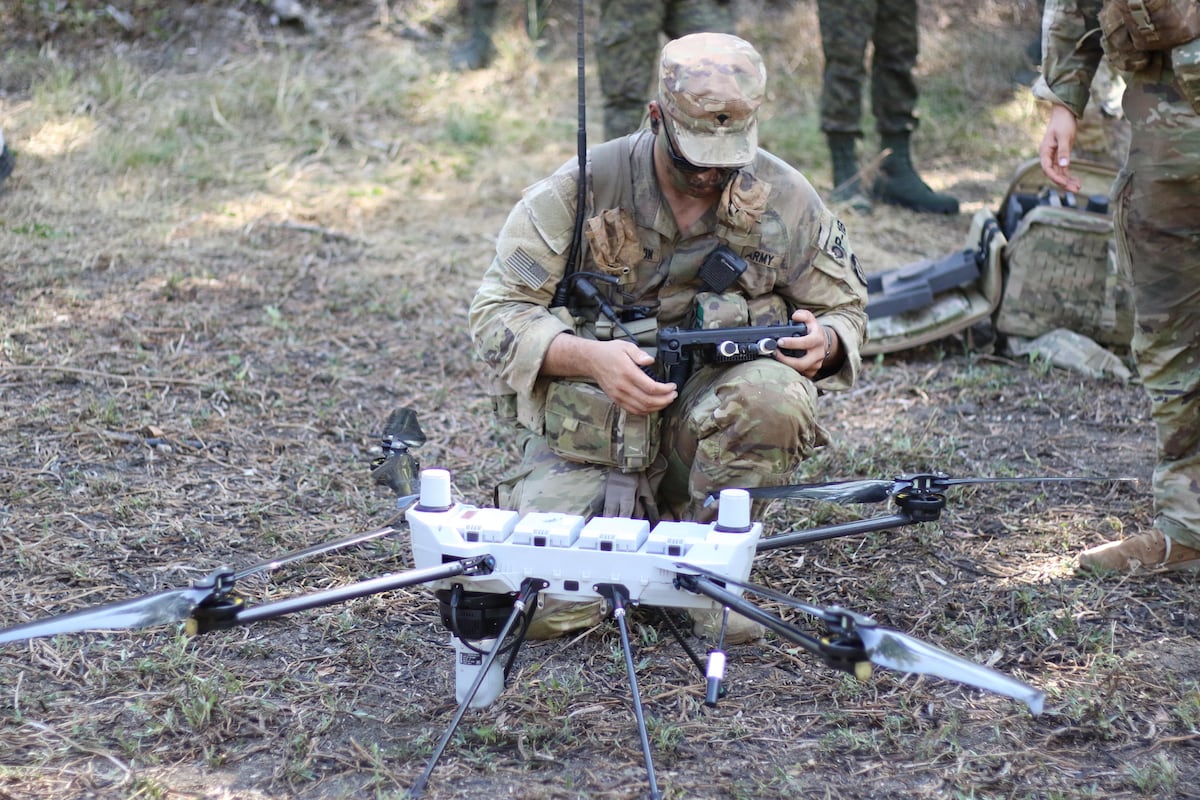
FORT MAGSAYAY, Philippines — As an American reconnaissance drone hummed overhead, soldiers of the U.S. and Philippine armies stormed forward through the jungle terrain, laying down suppressive fire on enemy positions.
Finishing off the foe’s stubborn resistance, a Kestrel first-person-view (FPV) drone carrying an explosive payload slammed into the enemy bunker. Afterwards, sweating profusely in the 97ºF heat, the Americans and Filipinos secured the area.
This jungle patrol in the thickly vegetated training area of Fort Magsaysay, located 75 miles north of Manila, was just one of many events taking place across the Philippines in Exercise Balikatan 2026.
More than 17,000 troops from seven countries are participating in this multilateral exercise being held from Apr. 20 to May 8.
The major U.S. Army contingent in Balikatan is the 3rd Mobile Brigade of the Hawaii-based 25th Infantry Division. The soldiers conducting this realistic drill were from Alpha Company, 2nd Battalion, 27th Infantry Regiment, alongside troops from the Philippine Army’s 1st Brigade Combat Team.
This engagement integrating new tech underscored how the “Tropic Lightning” division is transforming and adopting new technologies as one of the Army’s two original Transformation in Contact divisions. It is required to do so by the changing nature of modern warfare.
Col. Adisa King, the 3rd Mobile Brigade commander, told Defense News that technology does help: “It reduces risk a little bit, but it allows you to see farther.”
“The challenge is how do you mass that? What if I had ten of those [drones]?” King asked. “They go up to disrupt or they go up to help me see, and we push them all the way down to lower levels. But sustainment is the issue.”
The 25th Infantry Division is now widely equipped with M1301 Infantry Squad Vehicles. (Gordon Arthur/staff)
Indeed, the technology can be fickle, King pointed out: Drones can overheat in the tropical climate, soldiers have to lug extra equipment around, jungles are often too thick for FPVs, and recharging batteries is another challenge.
Yet King listed three things his brigade gains from participating in Balikatan: becoming familiar with an environment the soldiers might one day fight in; learning from partners; and rehearsing how to fight together.
Underscoring their modernization push, these Hawaii-based soldiers were carrying the latest M7 assault rifles, and new M1301 Infantry Squad Vehicles (ISV) provided them rapid maneuverability.
Lightning Lab innovation
Elsewhere, Lightning Labs illustrates how the 25th Infantry Division is prioritizing innovation and iteration. This cell was designed to accelerate the adoption of new technologies.
The Kestrel “killer” FPV quadcopter, measuring five inches across and capable of swarming, is one such fruit. CW3 Aaron Dunson, Operations Officer of Lightning Labs, said the Kestrel is designed for mass production. The aim is to get them into the hands of soldiers so they can identify their capabilities and limitations.
Lightning Labs is also developing a high-speed drone interceptor. In addition, the lab was testing a containerized solar-panel micro grid to generate electricity, a quieter alternative to diesel generators. Dunson described it as “a very viable solution” in the Philippines.
He shared that his cell is covering capability gaps while industry races to catch up. “Our piece of this pie is to identify the opportunity and then present it to the subject matter experts within the division and say, ‘Is this usable?’”
Another innovation appeared last year – the Forge – an INDOPACOM initiative where a dozen Army and Marine personnel run an expeditionary manufacturing capability based at Schofield Barracks, Hawaii. It is armed with deployable equipment like industrial-grade 3D printers (polymer and metal), milling machines and 3D scanners.
The Forge comes up with rapid solutions. During Balikatan, for example, a road grader from an engineering unit was disabled due to broken bolts. Instead of waiting ten weeks for spares to arrive from the U.S., the Forge reverse-engineered and manufactured them in six hours.
Likewise, soldiers complained of broken bipods on their new M50 machine guns, so the unit came up with a 3D-printed solution to fix that too.
The Forge’s services have been in demand throughout Balikatan. It had 36 projects on the go, with twelve completed by halfway through the exercise. One of them was producing 300 Kestrel drone frames.
The Forge saves soldiers time and money. CW2 Kevin Ton, officer in charge of the Forge, said it had saved $23,000 and a cumulative 96 months in waiting time for spare parts in the first week of Balikatan alone.
With multiple security challenges in Asia-Pacific – high among them being Chinese belligerence – there is a need for the Army to adapt quickly and to speedily field the latest technologies.
The 25th Infantry Division epitomizes this rapid change that United States Army Pacific is undergoing. Another example is that it is the Army’s only infantry division to possess HIMARS rocket launchers.
Gordon Arthur is an Asia correspondent for Defense News. After a 20-year stint working in Hong Kong, he now resides in New Zealand. He has attended military exercises and defense exhibitions in about 20 countries around the Asia-Pacific region.
菲律宾马格萨亚伊堡——一架美国侦察无人机在头顶嗡嗡作响,美菲两国军队的士兵冲过丛林地形,向敌方阵地倾泻火力。
为了彻底粉碎敌人的顽强抵抗,一架携带爆炸载荷的“红隼”第一人称视角(FPV)无人机猛烈撞击了敌方碉堡。随后,在36摄氏度的高温下,美菲联军汗流浃背地控制了该区域。
这次在马尼拉以北 75 英里处的马格赛赛堡茂密的训练区进行的丛林巡逻,只是在菲律宾各地举行的“肩并肩 2026”联合军演中的众多活动之一。
4月20日至5月8日举行的此次多边演习,共有来自七个国家的17000多名士兵参加。
参加“肩并肩”联合军演的美军主力部队是驻扎在夏威夷的第25步兵师第3机动旅。参与此次实战演练的士兵来自第27步兵团第2营A连,与菲律宾陆军第1旅战斗队的官兵共同演练。
此次新技术应用凸显了“热带闪电”师作为陆军最初两支“接触转型”师之一,如何进行转型并采用新技术。这是现代战争性质变化所要求的。
第3机动旅指挥官阿迪萨·金上校告诉《防务新闻》,科技确实有所帮助:“它能降低一些风险,还能让你看得更远。”
“难点在于如何大规模部署?如果我有十架这样的无人机呢?”金问道。“它们可以升空进行干扰,也可以升空协助我侦察,然后我们再把它们降到较低高度。但问题在于如何维持它们的飞行。”
第25步兵师目前已广泛装备M1301步兵班用车。(戈登·阿瑟/本报)
金指出,这项技术确实不太稳定:无人机在热带气候下可能会过热,士兵们不得不携带额外的装备,丛林通常太茂密,FPV无人机难以进入,而且给电池充电也是另一个挑战。
然而,金列举了他的旅参加“肩并肩”演习所获得的三个好处:熟悉士兵们将来可能作战的环境;向伙伴学习;以及演练如何共同作战。
为了强调其现代化进程,这些驻扎在夏威夷的士兵携带了最新的 M7 突击步枪,而新型 M1301 步兵班组车辆 (ISV) 则为他们提供了快速机动能力。
闪电实验室创新
此外,闪电实验室也展现了第25步兵师如何优先考虑创新和迭代。该部门旨在加速新技术的应用。
这款名为“隼”(Kestrel)的“杀手级”FPV四轴飞行器,直径仅五英寸,具备集群飞行能力,正是此类成果之一。闪电实验室(Lightning Labs)作战官亚伦·邓森准尉表示,“隼”的设计旨在实现大规模生产。其目标是让士兵们尽快上手,以便他们了解其性能和局限性。
Lightning Labs公司还在研发一种高速无人机拦截器。此外,该实验室还在测试一种集装箱式太阳能微电网,用于发电,这是一种比柴油发电机更安静的替代方案。邓森称其在菲律宾“是一个非常可行的解决方案”。
他表示,他的团队正在弥补行业竞相追赶的能力缺口。“我们的任务是发现机会,然后将其提交给部门内的专家,询问他们‘这是否可行?’”
去年又出现了一项创新——“锻造厂”(Forge),这是印太司令部的一项计划,由十几名陆军和海军陆战队人员在夏威夷斯科菲尔德兵营运营一支远征制造力量。它配备了可部署的设备,例如工业级3D打印机(聚合物和金属)、铣床和3D扫描仪。
“锻造厂”能够迅速提出解决方案。例如,在“肩并肩”联合军演期间,一个工程部队的平地机因螺栓断裂而无法使用。与其等待十周才能从美国运来备件,“锻造厂”不如进行逆向工程,并在六小时内制造出了所需的零件。
同样,士兵们抱怨他们新买的 M50 机枪的两脚架坏了,所以该部队想出了一个 3D 打印的解决方案来解决这个问题。
在整个“肩并肩”联合军演期间,“锻造厂”的服务需求量很大。该厂同时进行着36个项目,到演习过半时已完成12个。其中一个项目是生产300套“隼”无人机机架。
“锻造车间”为士兵们节省了时间和金钱。负责“锻造车间”的二级准尉凯文·顿表示,仅在“肩并肩”联合军演的第一周,该车间就节省了23000美元,并累计缩短了96个月的备件等待时间。
亚太地区面临多重安全挑战——其中最主要的挑战是中国的挑衅行为——因此,陆军需要迅速适应并快速部署最新技术。
第25步兵师正是美国太平洋陆军正在经历的这种快速变革的典型代表。另一个例子是,它是陆军唯一装备HIMARS火箭炮的步兵师。
戈登·阿瑟是《防务新闻》的亚洲特派记者。在香港工作20年后,他现居新西兰。他曾到访亚太地区约20个国家,参加过军事演习和防务展览。