After tragedy, US Air Force probes English training for foreign pilots悲剧发生后,美国空军调查外国飞行员的英语培训情况
The 2021 incident prompted Air Force leaders to take a close look at the quality of instruction and how to better accommodate foreign students.
JOINT BASE SAN ANTONIO-LACKLAND, Texas — Two years after a Japanese air force pilot and his American instructor died in a military jet crash in Alabama, officials are mulling whether a U.S.-run program that teaches English to foreign aviators is partly to blame.
The incident has prompted U.S. Air Force leaders to take a closer look at the quality of the instruction they provide, and consider how to better accommodate foreign students. It has opened fresh discussion of how much time and money the program needs to succeed.
It has also highlighted a breakdown in communication between the Air Force-led Defense Language Institute’s English Language Center here, the organizations that oversee it, pilot training units across the service, and the nations that send their students to Texas.
“The Japanese are nervous because of what happened,” said Terry Harsh, an instructor at the center, in a recent interview here. “They come through here, asking, ‘I don’t want the same thing to happen to me — why did he die? Why did a professional American instructor pilot die with him?’ These are language issues, and they’re very concerning.”
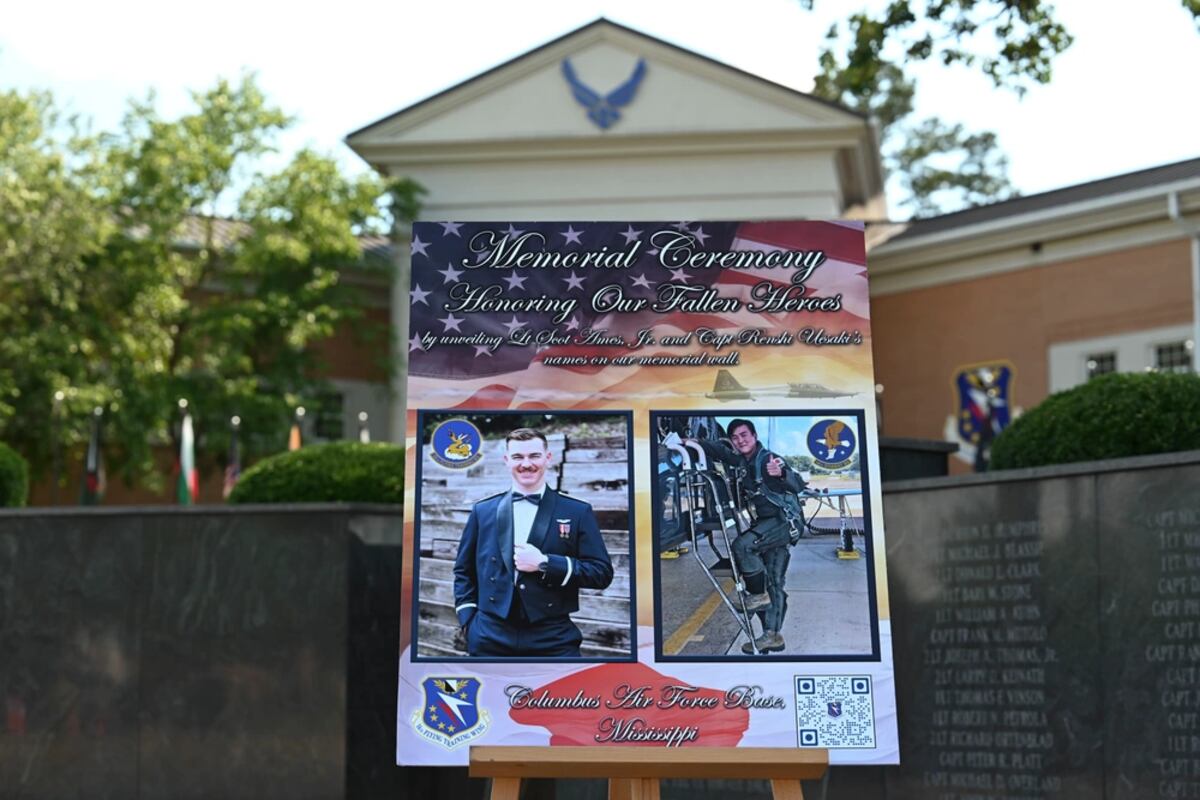
The fatal T-38C Talon training sortie on Feb. 19, 2021, killed 24-year-old 1st Lt. Scot Ames, an instructor pilot at Mississippi’s Columbus Air Force Base, and his 25-year-old Japanese trainee, Capt. Renshi Uesaki.
An official accident investigation concluded that Ames and Uesaki made errors in judgment that caused the crash. Investigators noted that Uesaki struggled with the language barrier despite completing six months of English training in 2019.
That “directly impacted his ability to receive and process instruction as well as listen and talk on the radios,” the report said. “This challenge was exacerbated while flying instrument sorties, which required more frequent communications” with air traffic control.
Uesaki passed his English comprehension test upon arriving at Lackland but needed more time to improve in conversation. He finished the course as an “‘average’ to ‘slightly above average’” student, according to the accident report.
But he continued having difficulty speaking and understanding technical aviation vocabulary, which affected his ability to comprehend instructions and make radio calls while flying. Those communication challenges often overwhelmed Uesaki and caused him to lose focus in the cockpit, the report said.
“The cause of the mishap was [Ames’s] loss of situational awareness on final approach and failure to take timely and necessary actions as a dangerous situation developed,” the Air Force wrote in its accident report. “[Uesaki] substantially contributed to the mishap after becoming task-saturated in the traffic pattern and placing and leaving the throttles in idle.”
Foreign pilot deaths in U.S.-led military training are infrequent, but they do occur. At least four foreign airmen have died in the U.S. in the past decade: Uesaki; two Iraqi pilots, Brig. Gen. Rasid Mohammed Sadiq and Capt. Noor Faleh Rassan Al-Khazali ; and a Taiwanese airman, Maj. Kao Ting-cheng .
All but Uesaki were flying F-16 Fighting Falcon jets over Arizona when they crashed in separate incidents in 2015, 2016 and 2017.
Foreign deaths account for around 6% of the 80 people who have died in U.S. Air Force-affiliated aircraft mishaps since 2013, according to the Air Force Safety Center.
But losing an American instructor pilot brought scrutiny of the program to a new level, Harsh said. The crash sparked meetings across the U.S. Air Force’s training enterprise and with Japanese military officials to discuss what went wrong — and how to stop it from happening again.
“The Air Force command structure went into a different gear,” said Harsh, a former scout helicopter pilot who has taught at the center for over a decade. “They were like, ‘What do you teach? What’s going on at DLI?’”
Teaching the world to fly
The English Language Center has been the first step on the path to a military air career for thousands of people around the world.
Its college-level aviation program is one piece of the center’s broader security cooperation mission that reaches around 6,000 students from more than 100 countries each year. The school offers a general English curriculum and remedial classes ahead of more difficult courses that prepare troops for military jobs.
Each country picks the airmen it wants to send to the U.S., where they receive a more in-depth education in English — the official language of the skies — than they may otherwise get at home.
To join, people must pass a series of proficiency tests that judge their speaking and listening abilities. They have to score at least a two — meaning they could shop for groceries or rent a car — on a scale where three is fluent, Harsh said.
The nine-week aviation course prepares airmen to hold conversations with pilots in flight, crew members in the back of an aircraft, and air traffic control towers. Anyone from air traffic controllers to flight nurses can attend the course, which offers fixed-wing and rotary-wing specialties.
Around 350 foreigners from about 50 countries go through the aviation program each year, Harsh said. NATO airmen don’t often attend because they tend to be more fluent in English than people from other parts of the world.
Students are drilled on NATO’s “alpha-zulu” phonetic alphabet and the niche vocabulary, acronyms and scenarios that crackle across U.S. military radios — no accents allowed.
“These little differences have led to accidents in the past, and we really want to emphasize the importance of being clear on the radio,” Harsh said.
They take lessons on subjects like crew management and leadership, with occasional time in simulators, while learning from American airmen and their foreign classmates.
The center also tries to work through the cultural differences that can lead to safety issues, like deference to older or higher-ranking airmen. Teachers urge the international students to get comfortable asking questions.
“It’s not really a rank thing when you get in the cockpit,” Harsh said. “If you don’t ask, the instructor pilot is going to assume you know.”
If something seems amiss, he added, “Don’t assume that the IP is not making a mistake.”
“You have the right — it’s your life — to challenge that instructor pilot respectfully,” he said.
The goal is to get students up to speed so they can enter the next phase of training, like undergraduate pilot school, without a significant language barrier.
But Harsh said there’s a big difference between how fluent they need to be to finish the program and how fluent they should be to fly safely. He estimates that airmen need at least another six months of class time to be comfortably proficient, for which the United States or the partner countries would need to foot the bill.
“We’ve tried to emphasize to the military departments, this does not succeed without you,” he said. “You’ve determined the language prerequisites. DLI wildly succeeds in meeting that mark. But that’s not what the students need.”
Nearly everyone who arrives at the center passes, Harsh said. But when they reach their next stop, like undergraduate pilot training, that completion rate falls to around 78%.
“That training gap is a safety issue,” he said. “[The solution is] time and money. And nobody wants to pay that.”
The Defense Language Institute is updating the aviation English program, a process that will take another few years to come to fruition.
One of the biggest changes the English Language Center could make is forging closer ties between military experts, the follow-on training units and the curriculum team, Harsh said.
The curriculum is largely written by civilians without expertise in real-world military aviation, he said. That creates an artificial standard that makes students feel prepared until they reach their training unit.
He argues the solution is to embed military experts in the curriculum department who can act as a liaison between the training unit and the English program. That way, the expert could keep the English program apprised of what instructor pilots need and vice versa.
Harsh wishes the school had a better system in place to collect feedback from its students, like interviews, but acknowledges that it would add time and effort for already busy staffers and stressed students.
Once a year, center staff visits the follow-on training units that take its students to see how well the foreigners do within the first month. That still doesn’t paint the full picture, Harsh said.
He wants more qualitative and quantitative data on how students are faring: Why did someone need to log extra hours in the cockpit? What have their instructors said in post-flight reports?
“That is gold to us. I’ve never seen it,” Harsh said. “Without that feedback loop, we’re shooting arrows in the dark.”
And he wants the instructors that receive the students down the line to be more aware of who they’re getting.
Airmen need to establish “safe words” before they fly, he said. If an international student gets overwhelmed in the air, they can use the safe word to let their instructor know they need to pause to discuss what they’re doing.
Those simple steps can protect the instructor pilots, too.
“Be somewhat accommodating,” he said. “This is incredibly difficult. Imagine going to Japan or Korea or an Arab community to try to learn how to fly.”
Now the Air Force is trying to make clearer how proficient a student will be when they leave the language program, and what should be expected of students who finish it.
In February, Air Force international affairs staffers, flight instructors, and members of the Defense Language Institute, Air Education and Training Command and 19th Air Force — a subunit that manages pilot training — met to review the English language course’s curriculum and how it is delivered, said Air Force spokesperson Marilyn Holliday.
The English Language Center has worked on a rubric for instructor pilots to gauge how well their international students communicate, she said. Instructor pilots are helping the center make videos to familiarize international students with pre- and post-flight briefings, and pilot training bases have also provided the center with scripts so that students can rehearse conversations about take-off, flight patterns and landing.
“The visit … served as a forum to identify and bridge training and academic gaps between English language curriculum and instruction as it applies to international students,” Holliday said. “The working group will reconvene in mid-April to re-engage and assess progress on all tasks.”
The Japanese Self-Defense Forces did not respond to a request for comment on their discussions with American air training officials.
Business has continued as usual after the 2021 crash, said Col. Joe Schaefer, commandant of the English Language Center.
The U.S. Air Force still graduates around 50 foreign pilots each year; Schaefer said the program has maintained its relationship with Japan, a key ally in the Pacific. It retains a Japanese liaison officer who looks out for the country’s students while in the U.S.
On the first anniversary of Uesaki’s death, Schaefer said the Japanese liaison delivered a letter to Lt. Gen. Brad Webb, then the head of Air Education and Training Command.
It was a note from the pilot’s mother: Thank you for caring.
Rachel Cohen is the editor of Air Force Times. She joined the publication as its senior reporter in March 2021. Her work has appeared in the Washington Post, the Frederick News-Post (Md.), Air and Space Forces Magazine, Inside Defense, Inside Health Policy and elsewhere.
德克萨斯州圣安东尼奥-拉克兰联合基地——两年前,一名日本空军飞行员和他的美国教官在阿拉巴马州的一次军用喷气式飞机坠毁事故中丧生。如今,官员们正在考虑,一项由美国运营的、教授外国飞行员英语的项目是否是造成此次事故的部分原因。
这一事件促使美国空军领导人更加重视教学质量,并思考如何更好地为外国学员提供服务。它也引发了关于该项目需要多少时间和资金才能取得成功的讨论。
这也凸显了空军主导的国防语言学院英语语言中心与监管该中心的组织、全军飞行员训练单位以及向德克萨斯州派遣学员的国家之间的沟通障碍。
“日本人因为这件事感到紧张,”该中心的一名教官特里·哈什在最近接受采访时说。“他们来到这里,问:‘我不想同样的事情发生在我身上——他为什么会死?为什么一位专业的美国飞行教官会和他一起丧生?’这些都是语言问题,而且非常令人担忧。”
2021 年 2 月 19 日,一架 T-38C“鹰爪”教练机在执行训练任务时发生致命事故,导致密西西比州哥伦布空军基地的 24 岁少尉斯科特·艾姆斯和他的 25 岁日本学员上崎廉史上尉丧生。
官方事故调查结论认为,艾姆斯和上崎的判断失误导致了这起事故。调查人员指出,尽管上崎在2019年完成了六个月的英语培训,但他仍然难以克服语言障碍。
报告称,这“直接影响了他接收和处理指令以及通过无线电进行收发的能力”。“在执行仪表飞行任务时,由于需要与空中交通管制部门更频繁地通信,这一挑战更加严重”。
上崎抵达拉克兰空军基地后通过了英语理解测试,但口语能力需要更多时间提高。根据事故报告,他最终的成绩为“中等偏上”。
但他在说和理解航空专业术语方面仍然存在困难,这影响了他理解指令和在飞行中进行无线电通话的能力。报告称,这些沟通障碍常常令上崎感到不知所措,导致他在驾驶舱内注意力不集中。
空军在事故报告中写道:“事故原因是艾姆斯在最后进近阶段失去了对周围环境的感知,并且未能及时采取必要措施应对危险情况的发生。上崎在飞行航线中因任务繁重而导致油门杆处于怠速状态,从而对事故的发生负有重大责任。”
外国飞行员在美国主导的军事训练中丧生的事件并不常见,但确实存在。过去十年中,至少有四名外国飞行员在美国丧生:上崎;两名伊拉克飞行员,拉希德·穆罕默德·萨迪克准将和努尔·法莱赫·拉桑·哈扎利上尉;以及一名台湾飞行员,高廷成少校。
除了上崎之外,其他三人都是在2015年、2016年和2017年驾驶F-16“战隼”战斗机飞越亚利桑那州时,在不同的事故中坠毁。
据美国空军安全中心统计,自 2013 年以来,美国空军相关飞机事故造成的 80 人死亡中,约有 6% 为外国人。
哈什表示,失去一名美国教官飞行员使该项目受到的审查提升到了一个新的高度。这次坠机事件促使美国空军训练部门与日本军方官员召开会议,讨论事故原因以及如何防止类似事件再次发生。
“空军指挥系统进入了另一个阶段,”哈什说道,他曾是一名侦察直升机飞行员,在该中心任教十余年。“他们会问,‘你们教什么?国防语言学院(DLI)现在怎么样了?’”
教会世界飞翔
英语语言中心是世界各地成千上万人迈向军事航空职业生涯的第一步。
该中心的大学航空课程是其更广泛的安全合作使命的一部分,每年惠及来自100多个国家的约6000名学生。该校提供通用英语课程和预备课程,为学员进入更高级的军事课程做好准备。
每个国家都会挑选自己想派往美国的飞行员,在那里,他们可以接受比在本国更深入的英语教育——英语是天空的官方语言。
哈什说,要加入该组织,人们必须通过一系列能力测试,这些测试会评估他们的听说能力。他们的得分必须至少达到2分——这意味着他们可以去超市购物或租车——而3分代表流利。
为期九周的航空课程旨在帮助飞行员掌握与飞行中的飞行员、机舱内的机组人员以及空中交通管制塔台人员进行有效沟通的技能。从空中交通管制员到飞行护士,任何人都可以参加该课程,课程涵盖固定翼飞机和旋翼飞机两个专业方向。
哈什说,每年大约有来自50个国家的350名外国人参加这个航空培训项目。北约空军人员很少参加,因为他们的英语通常比世界其他地区的人更流利。
学生们要学习北约的“阿尔法-祖鲁”语音字母表,以及美国军用无线电中频繁出现的专业词汇、缩写和场景——不允许有任何口音。
“这些细微的差别过去曾导致过事故,我们真的想强调在无线电通话中保持清晰的重要性,”哈什说。
他们学习机组管理和领导力等课程,偶尔也会进行模拟器训练,同时向美国空军人员和他们的外国同学学习。
该中心还努力消除可能导致安全问题的文化差异,例如对年长或军衔更高的空军人员的尊重。教师鼓励国际学生大胆提问。
“当你进入驾驶舱后,这其实跟等级无关,”哈什说。“如果你不问,教官飞行员会默认你知道。”
他补充说,如果发现有什么不对劲,“不要想当然地认为知识产权所有者没有犯错。”
他说:“你有权——这是你的人生——以尊重的方式质疑那位飞行教官。”
目标是让学生尽快跟上进度,以便他们能够进入下一阶段的培训,例如本科飞行员学校,而不会有严重的语言障碍。
但哈什表示,飞行员完成培训项目所需的熟练程度与安全飞行所需的熟练程度之间存在很大差异。他估计,飞行员至少还需要六个月的课堂学习才能达到熟练水平,而这笔费用将由美国或伙伴国承担。
他说:“我们一直向各军种强调,没有你们的参与,这个项目不可能成功。你们制定了语言先决条件。国防语言学院(DLI)在这方面做得非常出色。但这并非学生们真正需要的。”
哈什说,几乎所有到达中心的人都能通过考核。但当他们到达下一站,比如本科飞行员培训时,通过率就会下降到78%左右。
他说:“这种培训差距是一个安全问题。(解决办法)需要时间和金钱。但没人愿意为此付出代价。”
国防语言学院正在更新航空英语课程,这一过程还需要几年时间才能完成。
哈什表示,英语语言中心可以做出的最大改变之一是加强军事专家、后续训练单位和课程团队之间的联系。
他说,课程内容大多由缺乏实际军事航空专业知识的平民编写。这人为地制造了一种标准,让学员们误以为自己已经准备就绪,直到他们真正进入训练部队。
他认为解决办法是在课程部门安排军事专家,让他们充当训练单位和英语课程之间的联络人。这样,专家就可以让英语课程了解教官飞行员的需求,反之亦然。
哈什希望学校能建立更好的系统来收集学生的反馈,比如进行访谈,但他承认,这会给已经很忙的教职工和压力很大的学生增加时间和精力。
中心工作人员每年都会走访接收学员的后续培训单位,了解外国学员在第一个月的表现。哈什表示,但这仍然无法反映全貌。
他希望获得更多关于学生表现的定性和定量数据:为什么有人需要在驾驶舱内积累额外的飞行时间?他们的教员在飞行后报告中说了些什么?
“这对我们来说至关重要。我以前从未见过这样的机会,”哈什说。“如果没有这种反馈机制,我们就如同盲人摸象。”
他还希望后续接收学生的老师们能够更加清楚地了解他们接收的是什么类型的学生。
他说,空军人员在飞行前需要约定“安全词”。如果国际学员在飞行途中感到不知所措,他们可以使用安全词告知教官需要暂停飞行,以便讨论当前的情况。
这些简单的措施也能保护教员飞行员。
“请尽量体谅他们,”他说。“这非常困难。想象一下,你要去日本、韩国或者阿拉伯社区学习如何开飞机。”
现在,空军正试图更清楚地说明学生离开语言课程时将达到的熟练程度,以及对完成课程的学生应该抱有什么样的期望。
空军发言人玛丽莲·霍利迪表示,今年2月,空军国际事务工作人员、飞行教官以及国防语言学院、空军教育训练司令部和第19航空队(负责飞行员训练的一个分队)的成员开会审查了英语语言课程的课程设置和授课方式。
她说,英语语言中心已经制定了一套评估标准,供飞行教员用来衡量国际学生的沟通能力。飞行教员正在协助中心制作视频,帮助国际学生熟悉飞行前和飞行后的简报流程;飞行员训练基地也向中心提供了脚本,以便学生可以练习有关起飞、飞行路线和着陆的对话。
霍利迪表示:“此次访问……旨在为国际学生提供平台,以发现并弥合英语课程与教学在培训和学术方面的差距。工作组将于四月中旬再次召开会议,继续推进各项任务并评估进展情况。”
日本自卫队没有回应有关其与美国空军训练官员讨论情况的置评请求。
英语语言中心指挥官乔·谢弗上校表示,2021 年的事故发生后,业务照常进行。
美国空军每年仍然招收约50名外国飞行员;谢弗表示,该项目一直与太平洋地区的重要盟友日本保持着联系。该项目保留了一名日本联络官,负责照顾在美国的日本学员。
在植崎逝世一周年之际,谢弗表示,日本联络官向时任空军教育训练司令部司令布拉德·韦伯中将递交了一封信。
这是飞行员母亲留下的字条:谢谢你们的关心。
瑞秋·科恩是《空军时报》的编辑。她于2021年3月加入该刊物,担任高级记者。她的作品曾发表在《华盛顿邮报》、《弗雷德里克新闻邮报》(马里兰州)、《空军与太空部队杂志》、《国防内幕》、《卫生政策内幕》等刊物上。