North Korea says it tested new solid-fuel long-range missile朝鲜称试射了新型固体燃料远程导弹
North Korea says it successfully test-launched a new intercontinental ballistic missile powered by solid propellants.
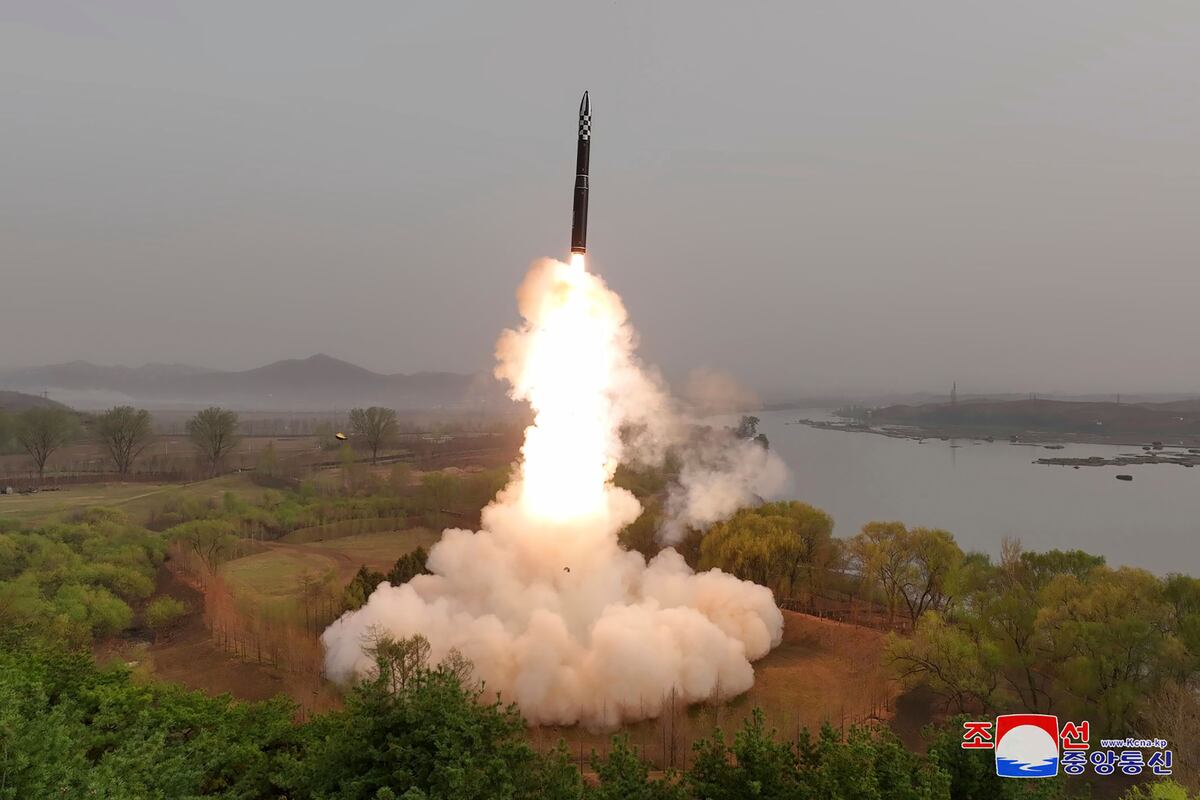
SEOUL, South Korea — North Korea said Friday it has successfully test-launched a new intercontinental ballistic missile powered by solid propellants, a development that if confirmed could provide the country with a harder-to-detect weapon targeting the continental United States.
North Korea’s official Korean Central News Agency issued the report a day after the country’s neighbors detected a launch of a long-range missile from near Pyongyang, which extended a run of weapons displays involving more than 100 missiles fired into sea since the start of 2022.
KCNA said the launch was supervised on site by North Korean leader Kim Jong Un , who described the missile — named Hwasong-18 — as the most powerful weapon of his nuclear forces that would enhance its counterattack abilities in the face of external threats created by the military activities of the United States and its regional allies.
This photo provided April 14, 2023, by the North Korean government, shows North Korean leader Kim Jong Un, center, his daughter, inspect what it says is the test-launch of Hwasong-18 intercontinental ballistic missile Thursday, April 13, 2023 at an undisclosed location, North Korea. Independent journalists were not given access to cover the event depicted in this image distributed by the North Korean government. The content of this image is as provided and cannot be independently verified. Korean language watermark on image as provided by source reads: "KCNA" which is the abbreviation for Korean Central News Agency. (Korean Central News Agency/Korea News Service via AP)
Kim pledged to further expand his nuclear arsenal so that his rivals “suffer from extreme anxiety and fear while facing an insurmountable threat, and be plunged into regrets and despair over their decisions.”
North Korea has justified its weapons demonstrations as a response to the expanding military exercises between the United States and South Korea , which the North condemns as invasion rehearsals while using them as a pretext to push further its own weapons development.
“Respected comrade Kim Jong Un said speeding up the development of evolving and more advanced and powerful weapons systems is our party and government’s consistent policy to respond to military threats and worsening security situation on the Korean Peninsula,” KCNA said.
It cited Kim as saying that the Hwasong-18 would rapidly advance North Korea’s nuclear response posture and further support an aggressive military strategy that vows to maintain “nuke for nuke and an all-out confrontation for an all-out confrontation” against its rivals.
North Korea has tested various intercontinental missiles since 2017 that demonstrated the potential range to reach the U.S. mainland, but the others use liquid fuel that must be added relatively close to the launch and they cannot remain fueled for prolonged periods.
An ICBM with built-in solid propellants would be easier to move and hide and could be fired faster, reducing the opportunities for opponents to detect and counter the launch. It’s not immediately clear how close the North is to having a functional solid-fuel ICBM capable of striking the U.S. mainland.
South Korea’s Defense Ministry maintains North Korea’s technological advancements haven’t reached the point where it can protect its ICMB warheads from the harsh conditions of atmospheric reentry. Last month, South Korean Defense Minister Lee Jong-Sup also told lawmakers that North Korea likely hasn’t yet mastered the technology to place nuclear warheads on its most advanced short-range missiles targeting South Korea, though he acknowledged the country was making considerable progress on it.
“This is a significant breakthrough for the North Koreans, but not an unexpected one,” said Ankit Panda, an expert with the Carnegie Endowment for International Peace.
“The primary significance of solid-fuel ICBMs is in terms of what they’ll do for the survivability of North Korea’s overall ICBM force,” he said.
“Because these missiles are fueled at the time of manufacture and are thus ready to use as needed, they will be much more rapidly useable in a crisis or conflict, depriving South Korea and the United States of valuable time that could be useful to preemptively hunt and destroy such missiles.”
North Korean state media published photos of the missile blasting off from a launch vehicle at a test site inside a forest as Kim watched from an observation post along with military officials and his daughter.
KCNA described the Hwasong-18 as a three-stage missile with the first stage tested at a standard ballistic trajectory and the others programmed to fly at higher angles after separation to avoid North Korea’s neighbors. It wasn’t immediately clear how the third stage was tested, where the warhead would theoretically be placed.
The agency said the test didn’t threaten the security of other countries as the first and second stages fell into waters off the country’s eastern coast. It provided no details about what happened to the third stage, although the official Rodong Sinmun newspaper published an aerial photo of an object it described as the third stage following separation.
Kim Dong-yub, a professor at the University of North Korean Studies in Seoul, said North Korea for the test likely designed the third stage as an empty device and simply let it fall after separation.
Solid-fuel ICBMs highlighted an extensive wish list Kim announced under a five-year arms development plan in 2021, which also included tactical nuclear weapons, hypersonic missiles, nuclear-powered submarines and spy satellites.
The North has fired around 30 missiles this year alone over 12 different launch events as both the pace of its weapons development and the U.S.-South Korean military exercises increase in a cycle of tit-for-tat. The U.S. and South Korean militaries conducted their biggest field exercises in years last month and separately held joint naval and air force drills involving a U.S. aircraft carrier strike group and nuclear-capable U.S. bombers.
North Korea claimed the drills simulated an all-out war against North Korea and communicated threats against it. The United States and South Korea have said their exercises are defensive in nature and expanding them was necessary to cope with the North’s evolving threats.
韩国首尔——朝鲜周五表示,已成功试射一枚新型固体推进剂洲际弹道导弹。如果消息属实,这一进展将使朝鲜拥有更难探测的武器,目标是美国本土。
朝鲜官方的朝中社在朝鲜邻国探测到平壤附近发射远程导弹的第二天发布了该报道。自 2022 年初以来,朝鲜已向海中发射了 100 多枚导弹,这标志着一系列武器展示活动又向前迈进了一步。
朝中社称,朝鲜领导人金正恩在现场监督了此次发射。金正恩称,这枚名为“火星-18”的导弹是朝鲜核力量中最强大的武器,将增强朝鲜应对美国及其地区盟友军事活动所造成的外部威胁的反击能力。
这张照片由朝鲜政府于2023年4月14日提供,照片显示朝鲜领导人金正恩(中)及其女儿视察据称于2023年4月13日星期四在朝鲜某未公开地点进行的“火星-18”洲际弹道导弹试射。独立记者被禁止进入现场报道朝鲜政府发布的这张照片所描绘的事件。照片内容未经核实。照片上的韩文水印为“KCNA”,即朝鲜中央通讯社的缩写。(朝鲜中央通讯社/韩国新闻社,经美联社发布)
金正恩承诺将进一步扩充其核武库,以便让他的对手“在面临无法克服的威胁时遭受极度的焦虑和恐惧,并因其决定而陷入后悔和绝望之中”。
朝鲜将其武器展示辩解为对美韩之间不断扩大的军事演习的回应,朝鲜谴责这些演习是入侵演习,并以此为借口进一步推进自身的武器研发。
朝中社报道:“尊敬的金正恩同志表示,加快研发更先进、更强大的武器系统,是我们党和政府应对朝鲜半岛军事威胁和日益恶化的安全局势的一贯政策。”
报道援引金正恩的话说,“火星-18”导弹将迅速提升朝鲜的核反应能力,并进一步支持其咄咄逼人的军事战略,该战略誓言要对对手保持“以核还核,以全面对抗还全面对抗”。
自 2017 年以来,朝鲜测试了各种洲际导弹,证明了其射程足以到达美国本土,但其他导弹使用液体燃料,必须在发射前相对较近的时间添加燃料,而且不能长时间保持燃料供应。
使用固体推进剂的洲际弹道导弹更易于运输和隐藏,发射速度也更快,从而降低了对手探测和反制的机会。目前尚不清楚朝鲜距离拥有能够打击美国本土的固体燃料洲际弹道导弹还有多远。
韩国国防部坚称,朝鲜的技术进步尚未达到能够保护其洲际弹道导弹弹头免受大气层再入恶劣环境影响的程度。上个月,韩国国防部长李钟燮也向国会议员表示,朝鲜可能尚未掌握在其最先进的、瞄准韩国的短程导弹上安装核弹头的技术,但他承认朝鲜在这方面取得了显著进展。
“这对朝鲜来说是一个重大突破,但并非意料之外,”卡内基国际和平基金会的专家安基特·潘达说。
他说:“固体燃料洲际弹道导弹的主要意义在于它们对朝鲜整个洲际弹道导弹部队生存能力的影响。”
“由于这些导弹在制造时就已加注燃料,因此可以根据需要随时使用,它们在危机或冲突中将能更快地投入使用,从而剥夺韩国和美国宝贵的时间,而这些时间本可以用来先发制人地搜寻和摧毁此类导弹。”
朝鲜官方媒体发布了导弹从森林试验场的发射车上发射升空的照片,金正恩与军方官员和他的女儿一起在观察哨观看了这一幕。
朝中社将“火星-18”导弹描述为三级导弹,第一级按照标准弹道轨迹进行测试,其余两级分离后以更高的角度飞行,以避开朝鲜邻国。目前尚不清楚第三级是如何测试的,以及弹头理论上会安装在何处。
该机构表示,此次试验并未对其他国家的安全构成威胁,因为火箭的第一级和第二级落入了该国东部沿海水域。该机构没有提供关于第三级火箭下落的任何细节,尽管官方报纸《劳动新闻》刊登了一张据称是分离后第三级火箭的航拍照片。
首尔朝鲜大学教授金东烨表示,朝鲜在这次试验中很可能将第三级火箭设计成空的,并在分离后直接让它坠落。
固体燃料洲际弹道导弹是金正恩在 2021 年公布的五年武器发展计划中列出的众多愿望清单中的重点,该清单还包括战术核武器、高超音速导弹、核动力潜艇和间谍卫星。
今年以来,朝鲜已进行了约30枚导弹的发射,共计12次。随着朝鲜武器研发步伐加快,美韩联合军演也日益频繁,双方形成了一种针锋相对的局面。上个月,美韩军队举行了近年来规模最大的实地演习,并分别与美军进行了联合海空演习,美军航母打击群和具备核打击能力的轰炸机均参与其中。
朝鲜声称这些演习模拟了一场针对朝鲜的全面战争,并向其发出威胁。美国和韩国则表示,他们的演习本质上是防御性的,扩大演习规模是为了应对朝鲜不断演变的威胁。