The B-21’s Three Decade Old Shape Hints At New High Altitude CapabilitiesB-21轰炸机沿用三十年的外形暗示着其新的高空飞行能力
Northrop Grumman seems to have gone "back to the future" with their next generation stealth bomber design, and that's actually really exciting.
Updated Oct 6, 2017 4:56 PM EDT
Detailed information on the B-21 Raider is still scarce to say the least , but for over a year and a half we have had a rendering supposedly depicting the multi-role strategic stealth platform’s basic shape and features. Recently, other simple planform renderings have trickled out from the marketing department of the stealth bomber’s manufacturer, Northrop Grumman. Although there can be no doubt that the aircraft will feature a whole slew of cutting edge technologies, will be constructed using the latest manufacturing techniques, and will be covered in the most advanced radar absorbent coatings, the general configuration of the aircraft doesn’t seem to be new at all, in fact it appears to date back over three decades to the dawn of the stealth bomber revolution.
This rendering was released on February 26th, 2016. , USAF
At first glance the B-21 looks very much like the Northrop’s B-2 Spirit, and that’s for good reason. It seems that the Northrop team got the B-2’s design amazingly right over thirty years ago, and they would have gotten it even closer to the B-21’s design if the USAF hadn’t thrown the demand for low-altitude penetration capability onto the program—then called the Advanced Technology Bomber—when it was so far along in its design process.
The same planform design of the B-21 was seen in this marketing banner from the Air Force Association’s annual conference in September of 2017:
The call to add low-level flying capability came out of fears that Russia would field increasingly more advanced radars that would neutralize the B-2’s low observable attributes. As such, being able to sneak in below radar via flying nap of the earth flight profiles like its B-52 and B-1 brethren became a requirement for what was a high-flying strategic bomber that relied primarily on its stealthy design and careful mission planning for survival.
Not only did this useless addition make the B-2 less stealthy from certain aspects and against certain radar bandwidths (most notably from behind against longer wavelengths), but it also added weight and dropped the aircraft’s altitude ceiling substantially, from roughly 60,000 feet to under 50,000 feet. The change also impacted the design’s range and most of all it added substantially to the cost and complexity of the already very high-end and expensive aircraft.
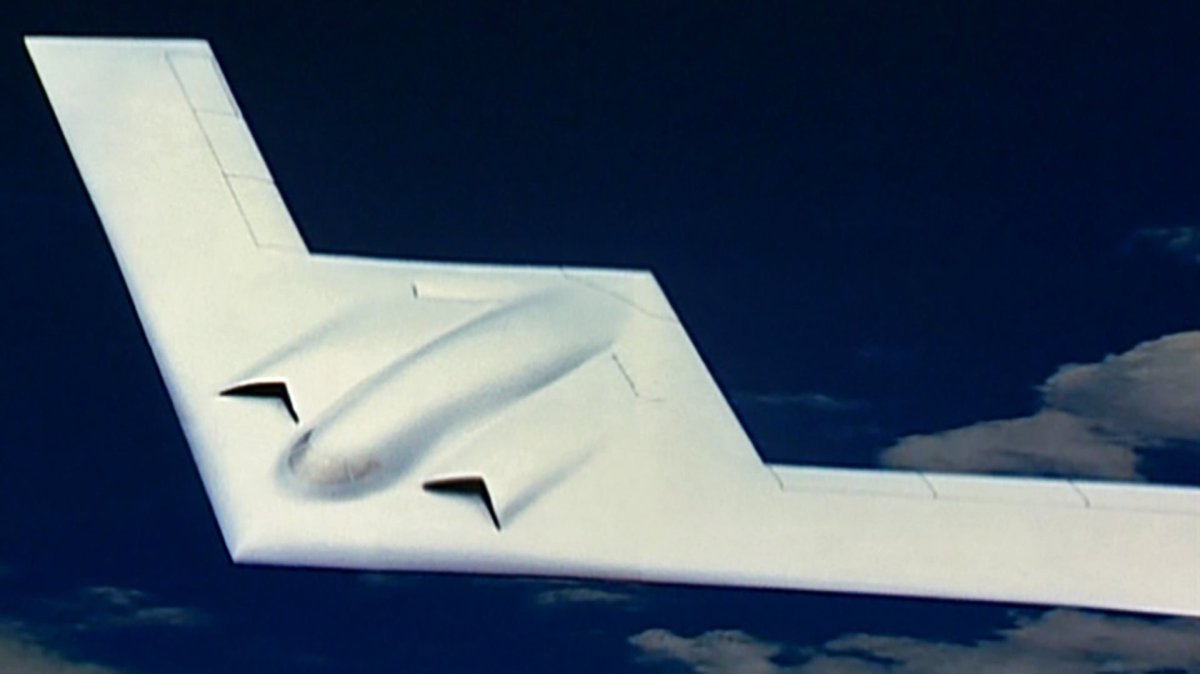
So Northrop’s Advanced Technology Bomber design that would eventually become the B-2, named “Senior Ice” during its development, didn’t originally have its trademark sawtooth trailing edge, instead it had a large wedge shaped empennage just like the B-21 Raider. The sawtooth feature only came about as a result of the USAF’s aforementioned late change in requirements that demanded the ATB have low-level penetration capabilities.
The original ATB configuration before the USAF’s low-level penetration requirements change. , Public Domain
All this was taking place in the mid 1980s, at the height of the Reagan era defense spending boom and at a time when the Soviet Union’s war machine was still a very real threat. But just half a decade later, the production cost of the B-2, which had ballooned due in part to dwindling production numbers funded by congress as a result of the fall of Soviet Union, would cause the program to enter a procurement “death spiral,” with production ending after just 21 units were built.
You can read all about the ATB program and Lockheed’s competing aircraft to Northrop in this past feature of mine .
As Northrop’s original ATB design progressed, canted vertical tails, and even pivoting vertical surfaces on the aircraft’s outer wing surfaces were experimented with to provide yaw control for the flying wing design. Eventually split rudder “elevons” were chosen. Note that the B-2 retained its “V” shaped tail. The added low altitude requirement would hamper the design in multiple ways. , Northrop/Public Domain
Today the B-2 remains a “silver bullet” weapon system—truly a low-density, high demand asset and an American treasure—that has proven its worth time and time again, including most recently in Libya for the second time . The tiny fleet continues to get upgrades that will allow it to remain relevant into the second half of the 21st Century.
No exhausts are shown on the B-21 rendering, and it is very unlikely they are located within the jet’s trailing edge or especially below the aircraft where the jet is most vulnerable to detection by infrared search and track systems. But that’s not really that strange because the first public B-2 renderings didn’t show an exhaust system either as it was one of the aircraft’s most sensitive features and remains so till this very day (if you are shooting B-2s on a USAF base, shots from the rear remain prohibited).
Early B-2 renderings omitted its planar exhaust system and the B-21 rendering also has its exhaust omitted. Notice the B-2 is shown as at a similar angle and has similar shadowing as the 2016 B-21 rendering., USAF
It is abundantly clear (see above) that the USAF and Northrop Grumman looked back to the late 1980s to see how they handled early disclosure of the B-2’s design when coming up with a rendering of the B-21.
Beyond telling us that Northrop got the stealth bomber design uncannily right some 30 years ago, even when computing power was just a fraction of today, the B-21’s similar design to the earlier Senior Ice derivatives tells us some really interesting things about the new bomber’s potential capabilities.
The fact that the B-21’s planform is extremely similar to the High Altitude Penetrator Senior Ice concept tells us that the B-21 will be a high-flying and extremely aerodynamically efficient weapons and sensor platform, and this is very important. If Northrop’s original ATB design had a targeted operational altitude of 60,000 feet than it is very likely that the B-21 will meet the same high flying goal. This makes a lot of sense because the aircraft will be able to achieve its range goals on less fuel and thrust than otherwise, and most importantly, being able to fly up in RQ-4 Global Hawk flight envelope territory means the B-21 can put its sensor suite to work over long ranges, taking advantage of its extreme line of sight.
The B-2 Spirit’s ceiling was impacted due to late requirements changes for the ATB program that gave birth to it. This won’t be the case with the B-21 Raider., USAF
It also means the B-21 will be able to loiter above the tactical aircraft air combat environment below. As such it could act as a communications and data link connectivity node, sucking up information from the F-35’s, F-22’s, and one unmanned combat air vehicle’s proprietary and stealthy data links. It can then connect these aircraft below by rebroadcasting updates of a “fused” common battlefield picture on each of their individual waveforms.
They could also convey the battlefield information from stealthy assets below up to satellites above where it can be pushed around the theater and beyond for real time exploitation. In essence, this will allow the B-21 to act in a similar role as a Battlefield Airborne Communications Node (BACN) for stealthy assets whose sensor information will be among the most critical as these assets will be deployed the farthest forward over the battlefield.
This concept, which has been cryptically touted in multiple organizational concept charts in recent years, solves a number of problems and fits in with two high priority USAF initiatives. Those include focusing on networks and information sharing, as well as morphing from a platform-centric fires and intelligence gathering strategy to a “distributed” one.
Notice how a stealthy flying wing (shown as a B-2) is pictured above the stealth assets (F-35, F-22, UCAVS) acting as a communications gateway. It is likely that just as the EQ-4 Global Hawk works in a similar role as a BACN platform, a B-21 and or RQ-180 like craft would do the same for stealth assets and their directional and low-probability of intercept data-links. , Lockheed Martin
It also means, like the high-flying F-22 Raptor, that many of the B-21s weapons, which will include everything from JDAMs, to Massive Ordnance Penetrators, to ultra long-range air-to-air missiles, will benefit from the Raider’s high perch. Even potentially lasers in the future will have more range due to this performance attribute. This equals farther standoff attack capability and as a result enhanced survivability, as well as increased weapons range for offensive attacks.
The bottom line is that the B-21, which is really a stealth multi-role platform of sorts, not “just” a bomber in the traditional sense, will be able to be more effective across a wide range of missions by operating at higher altitudes. It also means the aircraft will cost less to construct as it will require less cumbersome structures and less powerful engines, and even reduced fuel carrying capabilities, to accomplish its mission.
This is also likely a major factor in Northrop Grumman’s ability to keep the cost down even under heavy USAF scrutiny. Additionally, the use of this planform design is clearly a contributing factor as to how Northrop Grumman can claim substantial wide band low observability. Generally speaking, the larger a stealthy aircraft’s structures are, and the minimization of them all together (horizontal and vertical tails, discreet wings, nose structures and so on) the better it will be able to blend in with background radiation when even being painted by lower frequency radars.
Pre LRS-B renderings from Northrop Grumman for a next generation stealth bomber show the company’s “cranked kite” planfrom being used instead of a B-2 like flying wing., Northrop Grumman
This high-flying requirement is also likely a contributing factor as to why Northrop Grumman didn’t put forward their signature “cranked kite” design concept for the B-21 tender—similar to that used on the X-47B demonstrators. The company produced multiple renderings over the years of that planform being applied to their earlier Next Generation Bomber designs. But once the LRS-B program was underway this seems to have changed.
We have talked multiple times about Northrop Grumman’s all but officially disclosed RQ-180 high altitude long endurance (HALE), very stealthy unmanned aircraft. This aircraft very likely influenced not only Northrop Grumman’s design but also the USAF requirements for the B-21. In the late 2000s there was a massive shift in course by the Department of Defense under Secretary Of Defense Robert Gates when it came to developing a new bomber.
The B-2 remains an imposing and very futuristic looking machine. Although the B-21 will likely be lighter and smaller, it’s capabilities will eclipse the B-2’s in many ways. , USAF
It is heavily implied that the RQ-180 and possibly a next generation bomber technology demonstrator proved that such a program, which had stumbled for nearly a decade, was well worth pursuing. This same aircraft, which are likely highly limited in numbers, could also serve as a companion to the B-21 in a similar manner as how the E-11 and EQ-4 BACN platforms perform the networking gateway mission, and the U-2S Dragon Lady and RQ-4B perform similar surveillance missions.
We also know that the Long Range Strike Bomber requirements that followed this change specified a lighter aircraft with less payload than the B-2—also indicative of trying to reach a high-altitude capability at an affordable price. In fact, even Boeing’s renderings of their LRS-B concept featured a very similar design as the B-21 and the earlier Senior Ice configuration.
The design Boeing touted as its LRS-B concept in both rendering and model form have a very similar planform as the B-21 and the High Altitude Penetrator “Senior Ice” design., Boeing
With all fingers pointing to the high probability that Northrop Grumman went “back to the future” with their B-21 Raider design, we are reminded that this aircraft will be like no other in terms of its intended capabilities, with the B-2 being an inaccurate analog for direct comparison purposes. It will do much more in terms of missions than its predecessor, and will prowl the skies more deeply into the stratosphere. Maybe most exciting of all is that after 30 years of experience with the world’s first stealth bomber, Northrop Grumman’s B-21 will in many ways be the bomber that should have been, and so much more.
We’ll know more when new information, or a long awaited better illustration or an actual photo is released of Northrop Grumman’s shadowy new creation.
The stealth jet is rumored to be under construction now at the company’s Plant 42 facility in Palmdale, CA.
Contact the author: Tyler@thedrive.com
Comments couldn’t be loaded. Please refresh the page.
更新于美国东部时间2017年10月6日下午4:56
关于B-21“突袭者”轰炸机的详细信息仍然非常有限,但一年半以来,我们一直能看到一张据称描绘了这款多用途战略隐形平台基本外形和特征的效果图。最近,隐形轰炸机制造商诺斯罗普·格鲁曼公司的市场部门又陆续发布了一些简单的平面图。虽然毫无疑问,这款飞机将采用一系列尖端技术,运用最新的制造工艺,并覆盖最先进的雷达吸波涂层,但其总体布局似乎并不新颖,实际上,它似乎可以追溯到三十多年前隐形轰炸机革命的初期。
此渲染图于2016年2月26日发布。美国空军
乍一看,B-21 与诺斯罗普公司的 B-2“幽灵”轰炸机非常相似,这并非偶然。三十多年前,诺斯罗普团队似乎已经非常成功地完成了 B-2 的设计,如果不是美国空军在 B-2 项目(当时名为“先进技术轰炸机”)设计进行到相当深入的阶段时,突然提出需要具备低空突防能力,那么 B-21 的设计本可以更加接近 B-21。
在2017年9月空军协会年会上发布的这张宣传横幅中,也出现了与B-21相同的平面布局设计:
之所以要求增加低空飞行能力,是因为担心俄罗斯会部署越来越先进的雷达,从而使B-2的低可探测性优势失效。因此,对于这款主要依靠隐身设计和周密任务计划来生存的高空战略轰炸机而言,能够像B-52和B-1那样以超低空飞行的方式接近目标,从而避开雷达探测,就成了一项必要条件。
这一无用的改动不仅降低了B-2在某些方面和特定雷达频段(尤其是在后方面对长波长雷达时)的隐身性能,而且还增加了飞机重量,并大幅降低了其飞行高度上限,从大约60,000英尺降至50,000英尺以下。此外,这一改动还影响了飞机的航程,最重要的是,它显著增加了这款原本就非常高端且昂贵的飞机的成本和复杂性。
因此,诺斯罗普公司最终发展成为B-2的先进技术轰炸机设计方案(在研发阶段代号为“高级冰”)最初并没有标志性的锯齿状后缘,而是像B-21“突袭者”一样,采用了大型楔形尾翼。锯齿状后缘的出现,完全是由于美国空军后期修改了需求,要求ATB具备低空突防能力。
美国空军低空突防需求变更前的原始ATB配置。(公共领域)
这一切都发生在20世纪80年代中期,正值里根时代国防开支激增的高峰期,苏联的战争机器仍然构成非常现实的威胁。然而仅仅五年后,由于苏联解体后国会拨款减少,B-2轰炸机的生产成本大幅飙升,导致该项目陷入采购“死亡螺旋”,最终仅生产了21架便宣告终止。
您可以在我之前的这篇专题文章中了解有关 ATB 项目以及洛克希德公司与诺斯罗普公司竞争的飞机的全部信息。
随着诺斯罗普公司最初的ATB设计不断推进,为了给飞翼式飞机提供偏航控制,他们尝试了倾斜的垂直尾翼,甚至在飞机外翼面上安装了可旋转的垂直翼面。最终,他们选择了分离式方向舵“升降副翼”。值得注意的是,B-2保留了其“V”形尾翼。新增的低空飞行要求在多个方面限制了该设计。,诺斯罗普/公共领域
如今,B-2轰炸机依然是一款“银弹”武器系统——真正意义上的低密度、高需求资产,也是美国的宝贵财富——它一次又一次地证明了自己的价值,包括最近在利比亚的第二次行动。这支规模不大的机队仍在不断升级,以确保其在21世纪下半叶继续发挥重要作用。
B-21渲染图中没有显示排气管,而且排气管极不可能位于飞机后缘,尤其是飞机下方——这些位置最容易被红外搜索和跟踪系统探测到。但这其实并不奇怪,因为最早公开的B-2渲染图也没有显示排气系统,因为排气系统是飞机最敏感的部位之一,直到今天依然如此(如果你在美国空军基地拍摄B-2,从后方拍摄仍然是被禁止的)。
早期的B-2渲染图省略了其平面排气系统,B-21渲染图也省略了排气系统。请注意,B-2的渲染图与2016年的B-21渲染图角度相似,阴影效果也类似。(美国空军)
显而易见(见上文),美国空军和诺斯罗普·格鲁曼公司在设计 B-21 时,回顾了 20 世纪 80 年代末期 B-2 设计早期泄露的情况。
除了告诉我们诺斯罗普公司在大约 30 年前就不可思议地正确地设计出了隐形轰炸机(即使当时的计算能力只是今天的几分之一)之外,B-21 与早期高级冰衍生型的相似设计也告诉我们一些关于这种新型轰炸机潜在能力的非常有趣的事情。
B-21的平面布局与高空穿透高级冰概念机(High Altitude Penetrator Senior Ice concept)极其相似,这表明B-21将是一款高空飞行且气动效率极高的武器和传感器平台,这一点至关重要。如果诺斯罗普公司最初的ATB设计目标作战高度为60,000英尺,那么B-21很可能也能达到同样的飞行高度目标。这合情合理,因为与同类飞机相比,B-21能够以更少的燃料和推力实现其航程目标。更重要的是,B-21能够在RQ-4“全球鹰”无人机的飞行包线范围内飞行,这意味着它可以利用其超远的视距,在远距离范围内有效部署其传感器系统。
B-2“幽灵”隐形轰炸机的飞行高度上限受到其研发初期阶段(ATB项目)后期需求变更的影响。这种情况不会发生在B-21“突袭者”轰炸机上。——美国空军
这也意味着B-21轰炸机能够盘旋在下方战术飞机空战环境的上空。因此,它可以作为通信和数据链路连接节点,从F-35、F-22以及一架无人作战飞机的专用隐蔽数据链路中获取信息。然后,它可以通过在每架飞机的各自波形上重新广播“融合”的通用战场态势图的更新信息,将下方的这些飞机连接起来。
它们还可以将下方隐形装备的战场信息传输到上方的卫星,然后将信息推送至战区内外,进行实时利用。本质上,这将使B-21轰炸机能够扮演战场空中通信节点(BACN)的角色,为那些部署在战场最前沿的隐形装备提供至关重要的传感器信息。
近年来,这一概念在多份组织结构图中被隐晦地提及,它解决了一系列问题,并契合了美国空军的两项高优先级计划。这两项计划包括:重点发展网络和信息共享,以及从以平台为中心的火力支援和情报收集战略转向“分布式”战略。
请注意,图中一架隐形飞翼(图中所示为B-2)位于隐形资产(F-35、F-22、无人作战飞行器)上方,充当通信网关。正如EQ-4“全球鹰”无人机作为BACN平台发挥类似作用一样,B-21或RQ-180等飞行器也可能为隐形资产及其定向且低截获概率的数据链提供通信支持。——洛克希德·马丁公司
这也意味着,就像高空飞行的F-22猛禽战斗机一样,B-21轰炸机的许多武器,包括联合直接攻击弹药(JDAM)、巨型穿甲弹(MOP)和超远程空空导弹等,都将受益于“突袭者”轰炸机的高空飞行能力。未来,激光武器的射程也可能因这一性能优势而更远。这意味着更远的防区外攻击能力,从而增强了生存能力,并扩大了进攻性攻击的武器射程。
归根结底,B-21 轰炸机实际上是一种隐形多用途平台,而不仅仅是传统意义上的轰炸机。通过在高空作战,它将能够在更广泛的任务中发挥更大的作用。这也意味着,由于其结构更简洁、发动机功率更小,甚至燃油携带量也相应减少,因此建造成本也会更低。
这很可能也是诺斯罗普·格鲁曼公司即使在美国空军的严格审查下也能将成本控制在较低水平的一个重要因素。此外,这种平面布局设计显然也是诺斯罗普·格鲁曼公司能够宣称其飞机具备显著的宽带低可探测性的重要原因之一。一般来说,隐形飞机的结构越大,其整体结构(水平尾翼和垂直尾翼、隐蔽机翼、机头结构等)越小,即使被低频雷达探测到,也能更好地与背景辐射融为一体。
诺斯罗普·格鲁曼公司公布的下一代隐形轰炸机LRS-B原型机渲染图显示,该公司采用了“曲柄风筝”式布局,而非类似B-2的飞翼式布局。
这种高空飞行要求很可能也是诺斯罗普·格鲁曼公司没有为B-21中型轰炸机方案采用其标志性的“曲柄风筝”设计理念(类似于X-47B验证机所使用的设计)的原因之一。多年来,该公司曾多次绘制该平面布局应用于其早期下一代轰炸机设计的效果图。但LRS-B项目启动后,情况似乎发生了变化。
我们曾多次讨论过诺斯罗普·格鲁曼公司几乎已正式公开的RQ-180高空长航时(HALE)隐形无人机。这款飞机很可能不仅影响了诺斯罗普·格鲁曼公司的设计,也影响了美国空军对B-21轰炸机的需求。在2000年代后期,国防部长罗伯特·盖茨领导下的国防部在新型轰炸机的研发方向上发生了重大转变。
B-2轰炸机依然是一款气势恢宏、极具未来感的机型。尽管B-21轰炸机可能更轻更小,但其性能将在许多方面超越B-2。——美国空军
这强烈暗示RQ-180以及可能还有下一代轰炸机技术验证机证明了这项停滞了近十年的项目是值得继续推进的。这种飞机数量可能非常有限,它还可以像E-11和EQ-4 BACN平台执行网络网关任务、U-2S“龙夫人”和RQ-4B执行类似侦察任务那样,作为B-21的辅助机型。
我们还知道,在此变更之后提出的远程打击轰炸机(LRS-B)要求,要求飞机重量更轻,有效载荷也比B-2少——这也表明当时的目标是在保证飞机具备高空作战能力的同时,尽可能降低成本。事实上,波音公司最初公布的LRS-B概念图,其设计就与B-21以及早期的“高级冰”(Senior Ice)配置非常相似。
波音公司在其渲染图和模型中宣称的LRS-B概念设计,其平面形状与B-21和高空穿透者“高级冰”设计非常相似。
种种迹象表明,诺斯罗普·格鲁曼公司很可能凭借其B-21“突袭者”轰炸机的设计“回到了未来”。然而,我们必须记住,就其预期性能而言,这款飞机将与以往任何机型都截然不同,B-2轰炸机作为直接比较的参照物并不准确。B-21在执行任务方面将远超其前身,并能深入平流层更深处。或许最令人兴奋的是,在经历了30年世界首款隐形轰炸机的研发经验之后,诺斯罗普·格鲁曼公司的B-21在许多方面都将是人们期待已久的理想轰炸机,甚至远超预期。
当诺斯罗普·格鲁曼公司发布新的信息、期待已久的更清晰的插图或实际照片时,我们就会知道更多关于这款神秘新产品的信息。
据传,这款隐形喷气式飞机目前正在该公司位于加州帕姆代尔的 42 号工厂建造中。
联系作者:Tyler@thedrive.com
评论加载失败,请刷新页面。