Long-sought manufacturing gains are boosting North Korea arms buildup朝鲜长期以来寻求的制造业进步正在推动其武器建设。
The decade-long drive for automation is paying dividends for North Korea’s defense industry at large.
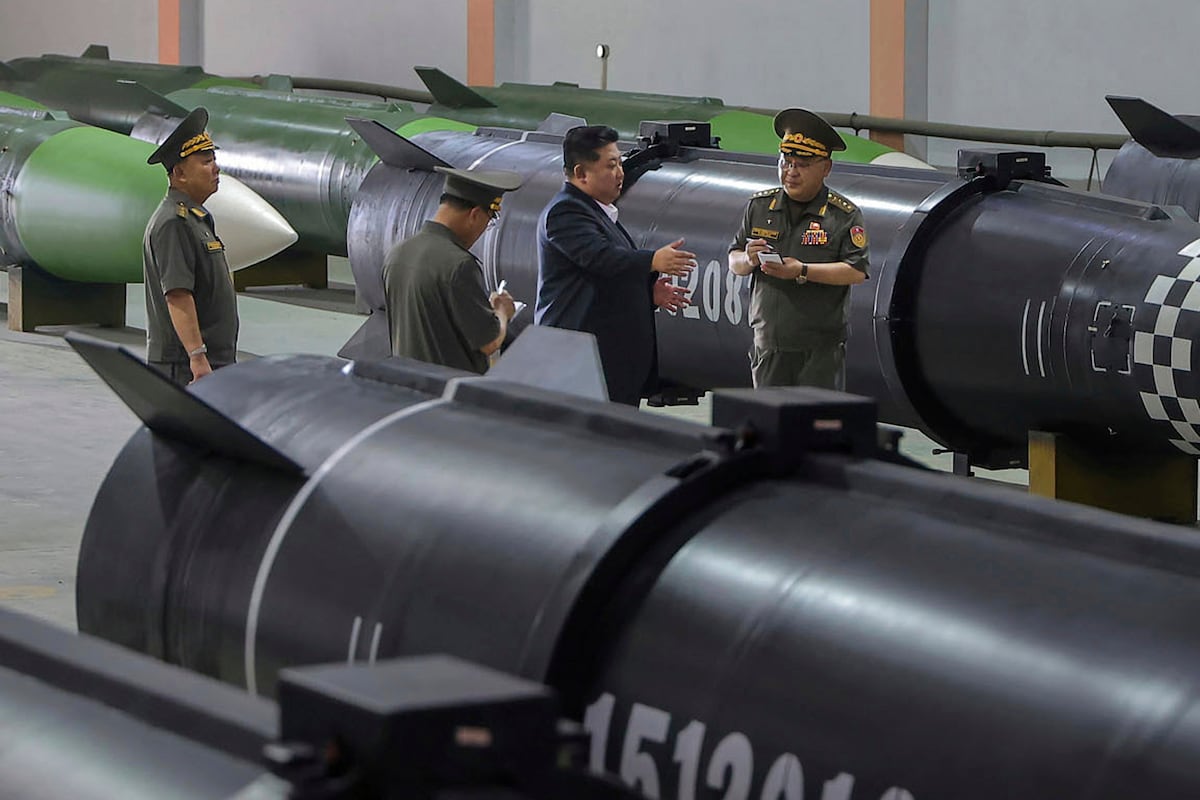
BERLIN — When North Korean dictator Kim Jong Un visited what state media called an “automated missile factory” in late August, he pranced past endless rows of ballistic missiles, each capable of accurately delivering a nuclear warhead to Seoul with minutes’ notice.
The remarkable success of the hermit regime’s missile program is a direct consequence of Pyongyang’s concerted effort to make up for decades of shortcomings in defense manufacturing processes, according to experts and open-source information.
Visiting the unnamed missile facility days before heading to China to watch a big military parade in Beijing , North Korean state media said Kim Jong Un “was greatly satisfied to hear the report that the automated assembly-line production system was established.”
According to the Korean Central News Agency, North Korea’s tightly controlled foreign news outlet, the automated equipment in the factory dealt with “precision processing, measuring and assembling different parts,” included quality control stations, and resulted in “increasing the productivity and ensuring the qualitative character of the products.”
The focus on automated machining that North Korean leadership has preached for the past decade, experts say, has played a key role in allowing the country to develop a missile-based nuclear deterrent much faster than the Soviet Union and the U.S. did during the Cold War, despite Pyongyang being under strict international sanctions.
What’s more, there are indications that the drive for automation is paying dividends for North Korea’s defense industry at large.
“While previous policies focused heavily on nuclear and missile development, the current approach has expanded to include the modernization of conventional weapon systems, innovation in production processes, and the incorporation of advanced technologies such as unmanned systems and artificial intelligence,” wrote Sang-jung Byun and Seungwoo Kim, researchers with South Korea’s Institute for National Security Strategy.
“These accelerated and diversified modernization efforts, especially in conjunction with technology transfers from Russia, have the potential to significantly enhance not only North Korea’s nuclear and missile capabilities but also its conventional military forces,” they assessed.
The sharing of knowledge and technology that could be used for military purposes with North Korea remains illegal under UN rules passed with Moscow’s support.
From lathes to computers
For most of its existence, North Korea’s weapons industry – the “second economy,” as it is often called in domestic parlance – was built on cheap mass labor and support from the Soviet Union. And while at least the former still exists today, it presented a natural upper limit for both the quality and quantity of military production that the country could output.
This started to change in the 2000s under Kim Jong Il, the father of the current leader and also the man who oversaw the development of North Korea’s own nuclear weapons.
Jong Il emphasized the development of computerized machine tools, both for the domestic economy and, crucially, as a money maker in the form of exports. The country, officially known as the Democratic People’s Republic of Korea, has been chronically cash-strapped for decades, and the situation has been worsened by UN-imposed sanctions in response to its weapons of mass destruction programs.
So great was the enthusiasm about the new technology that the state even produced a bizarrely upbeat propaganda song exalting the glory of the CNC machine.
Unfortunately for the father Kim, the domestic CNC machining industry reached maturity just as the world plunged into the depths of the years-long Great Recession and the financial crisis that began in 2007. He died in 2011.
After Kim Jong Un’s accession to power in 2012, the focus for North Korea’s newfound domestic CNC abilities appears to have shifted from being an export endeavor to being used as a boost for the domestic industry. This shift coincided with a rethinking of the country’s defense doctrine: Instead of relying on 20th-century weapons, Kim Jong Un placed a much heavier emphasis on missiles, strategic deterrence and cutting-edge technology than previous leaders.
Missiles, however, are tough to get right even for the most technologically advanced countries, said John Ford, a research associate at the California-based James Martin Center for Nonproliferation Studies who studies North Korea and has kept abreast of its propaganda output for years.
Manual production processes were simply too imprecise – and too slow – to build up an effective missile force.
“For something as complex and as explosive as a missile, minor differences in components can lead to rapid unscheduled disassembly … your missile can just blow up because a bolt that’s supposed to be this size is actually slightly too small because your lathe operator has a different idea of what a bolt looks like,” said Ford.
Enter: the CNC machine
CNC tools provide uniform components and better reliability across production cycles. Previously, North Korea had to clandestinely import foreign CNC machines for the most critical components.
For example, propaganda photographs released from inside the Chamjin Missile Factory showed a German-made, five-axis machine tool that was imported in violation of sanctions, possibly by way of Taiwan, and likely used to produce impellers, a key part of the turbopump powering the engine of liquid-fueled missiles.
By the mid-2010s, North Korea had developed a reliable domestic supply of machine tools, allowing it to systematically upgrade its industry. In 2015, Pyongyang’s Automation Institute at Kim Chaek University of Technology received a fancy new glass and steel building, and the organization began sending consultants around the country to re-skill factories from lathes to CNC machines, according to Ford.
While likely not the sole factor, missile testing success rates have improved in parallel with the automation efforts, and North Korea made big strides toward the ultimate goal of a nuclear-tipped intercontinental ballistic missile – a target that Kim Jong Un’s team reached in 2023 with the successful test of the Hwasong-18 missile.
“They can make a nuke go up, they can make it go a very long distance, and they can make it come down, and so that’s kind of all you need,” Ford said.
Now, it’s about expanding the arsenal and doing so at scale. The reference to “serial production” in North Korean media coverage of Kim Jong Un’s recent missile factory visit likely plays to this.
And it likely also is a message to a key foreign audience member: Russian President Vladimir Putin, who has emerged as a major client for North Korean weapons, including missiles, for use in his invasion of Ukraine.
The DPRK’s rockets, including the type Hwasong-11 that Kim Jong Un inspected at the factory on Aug. 31, have rained down on Ukrainian cities and soldiers with devastating results, fired by Russian troops and an increasing number of North Korean soldiers that have been dispatched to assist the Kremlin in its war of aggression.
Most trade with North Korea and all support for its military programs remains internationally prohibited by UN Security Council resolutions that were passed with Russia’s and China’s agreement to curtail Pyongyang’s nuclear weapons program.
However, with the multilateral system in crisis, Russia has begun openly cooperating with North Korea, including in prohibited fields, and China has long been suspected of only selectively enforcing the sanctions against its Korean neighbor.
North Korea has long sought to export its weapons as a source of cash, and has done so with some success in the past. It maintains a global web of front and shell companies to engage in sanctions circumvention and sell weapons to the highest – or only – bidder, a Defense News investigation has shown.
With the country’s decade-long automation program bearing fruit, and buoyed by a more favorable international environment, there is a new risk that Pyongyang may be successful in sending destabilizing military equipment to indiscriminate buyers abroad.
Linus Höller is Defense News' Europe correspondent and OSINT investigator. He reports on the arms deals, sanctions, and geopolitics shaping Europe and the world. He holds master’s degrees in WMD nonproliferation, terrorism studies, and international relations, and works in four languages: English, German, Russian, and Spanish.
柏林——8 月下旬,朝鲜独裁者金正恩视察了朝鲜官方媒体所称的“自动化导弹工厂”,他昂首阔步地走过一排排弹道导弹,每一枚导弹都能够在几分钟内将核弹头精确地投送到首尔。
专家和公开信息显示,朝鲜导弹计划取得的显著成功,是平壤为弥补数十年来国防制造流程的不足而做出的共同努力的直接结果。
在前往中国北京观看盛大阅兵式的前几天,金正恩参观了这座未透露名称的导弹设施。朝鲜官方媒体称,金正恩“对自动化装配线生产系统已经建立的消息感到非常满意”。
据朝鲜严格控制的对外新闻媒体朝中社报道,该工厂的自动化设备负责“精密加工、测量和组装不同零件”,包括质量控制站,从而“提高了生产效率,保证了产品质量”。
专家表示,朝鲜领导层过去十年一直强调自动化加工,这使得朝鲜得以比冷战时期的苏联和美国更快地发展出导弹核威慑力量,尽管平壤当时受到严格的国际制裁。
此外,有迹象表明,推动自动化正在为朝鲜的国防工业带来丰厚的回报。
韩国国家安全战略研究所的研究员卞相正和金承佑写道:“虽然之前的政策主要侧重于核武器和导弹的发展,但目前的做法已经扩展到包括常规武器系统的现代化、生产过程的创新以及无人系统和人工智能等先进技术的融合。”
他们评估道:“这些加速和多样化的现代化努力,特别是与俄罗斯的技术转让相结合,不仅有可能显著增强朝鲜的核武器和导弹能力,而且有可能显著增强其常规军事力量。”
根据在莫斯科支持下通过的联合国规则,与朝鲜分享可能用于军事目的的知识和技术仍然是非法的。
从车床到计算机
在朝鲜的大部分历史时期,其武器工业——在国内常被称为“第二经济”——都建立在廉价的劳动力和苏联的支持之上。虽然至少前者至今仍然存在,但这自然限制了朝鲜军工产品的质量和数量。
这种情况在 2000 年代开始发生变化,当时的领导人是金正日,他是现任领导人的父亲,也是朝鲜自主研发核武器的人。
金正日强调发展计算机化机床,这不仅有利于国内经济发展,更重要的是,它还能通过出口创汇。朝鲜民主主义人民共和国,这个正式名称为朝鲜民主主义人民共和国的国家,几十年来一直资金短缺,而联合国因其大规模杀伤性武器计划而实施的制裁,更使情况雪上加霜。
人们对这项新技术的热情如此之高,以至于政府甚至制作了一首异常欢快的宣传歌曲,歌颂数控机床的辉煌。
对金先生来说不幸的是,国内数控加工产业正值成熟之际,世界却陷入了持续多年的大衰退和始于 2007 年的金融危机。他于 2011 年去世。
自金正恩2012年掌权以来,朝鲜新近发展起来的国产数控技术(CNC)的重点似乎已从出口转向促进国内产业发展。这一转变恰逢朝鲜重新审视其国防战略:金正恩不再依赖20世纪的武器,而是比以往任何领导人都更加重视导弹、战略威慑和尖端技术。
然而,加州詹姆斯·马丁防扩散研究中心的研究员约翰·福特表示,即使对于技术最先进的国家来说,导弹也很难研制成功。福特研究朝鲜问题,多年来一直关注朝鲜的宣传动向。
人工生产流程精度太低,速度太慢,无法建立有效的导弹部队。
福特说:“对于导弹这种复杂且极具爆炸性的物体来说,部件上的细微差别都可能导致快速的非计划解体……你的导弹可能会因为一个本应是这个尺寸的螺栓实际上略小一些而爆炸,因为你的车床操作员对螺栓的样子有不同的理解。”
进入正题:数控机床
数控机床能够生产出规格统一的零部件,并在整个生产周期中提供更高的可靠性。此前,朝鲜不得不秘密进口外国数控机床来加工最关键的零部件。
例如,从昌津导弹工厂内部泄露的宣传照片显示,一台德国制造的五轴机床违反制裁进口,可能经由台湾进口,很可能用于生产叶轮,这是为液体燃料导弹发动机提供动力的涡轮泵的关键部件。
到2010年代中期,朝鲜已建立起可靠的国产机床供应体系,使其能够系统性地升级工业。据福特称,2015年,平壤金策技术大学自动化研究所落成一座崭新的玻璃钢结构大楼,该机构开始派遣顾问前往全国各地,帮助工厂将操作车床等设备升级为数控机床。
虽然这可能不是唯一因素,但导弹试验的成功率随着自动化努力的推进而提高,朝鲜在实现携带核弹头的洲际弹道导弹的最终目标方面取得了巨大进步——金正恩的团队在 2023 年通过成功试射火星-18 导弹实现了这一目标。
福特说:“他们可以让核弹升空,可以让核弹射出很远的距离,也可以让核弹落下来,所以这基本上就是你所需要的一切。”
现在,重点在于扩大武器库,并实现规模化生产。朝鲜媒体在报道金正恩近期参观导弹工厂时提到的“批量生产”,很可能正是为了强调这一点。
这很可能也是向一位重要的外国受众发出的信息:俄罗斯总统弗拉基米尔·普京,他已成为朝鲜武器(包括导弹)的主要客户,用于入侵乌克兰。
朝鲜的火箭,包括金正恩8月31日在工厂视察的火星-11型火箭,已经向乌克兰城市和士兵倾泻而下,造成了毁灭性的后果。这些火箭是由俄罗斯军队发射的,越来越多的朝鲜士兵也被派往乌克兰协助克里姆林宫进行侵略战争。
根据联合国安理会决议,与朝鲜的大部分贸易以及对其军事计划的一切支持仍然受到国际禁止。这些决议是在俄罗斯和中国同意限制平壤核武器计划的情况下通过的。
然而,随着多边体系陷入危机,俄罗斯已开始公开与朝鲜合作,包括在禁区内,而中国长期以来一直被怀疑只是有选择地执行对朝鲜邻国的制裁。
朝鲜长期以来一直试图通过出口武器来获取资金,并且过去也取得了一定的成功。据《防务新闻》的一项调查显示,朝鲜维持着一个遍布全球的幌子公司网络,以此规避制裁,并将武器出售给出价最高者——甚至唯一出价者。
随着朝鲜长达十年的自动化计划取得成果,并在更加有利的国际环境下,平壤有可能成功地向海外不加选择的买家输送破坏稳定的军事装备,这带来了新的风险。
林努斯·霍勒是《防务新闻》的欧洲记者和开源情报调查员。他报道影响欧洲乃至全球的军火交易、制裁和地缘政治。他拥有大规模杀伤性武器不扩散、恐怖主义研究和国际关系三个硕士学位,并精通英语、德语、俄语和西班牙语四种语言。