Europe’s defense gaps loom large as weapon makers schmooze in London欧洲防务缺口日益凸显,武器制造商在伦敦展开拉票活动
The DSEI trade show is expected to see an uptick in European participation this year, with more countries and companies represented.
MILAN — Despite increased investments in homegrown weapons and systems, European nations are still facing major gaps in intelligence gathering, space access, long-range strike and missile defense, leaving governments here heavily reliant on the United States, according to a recent report.
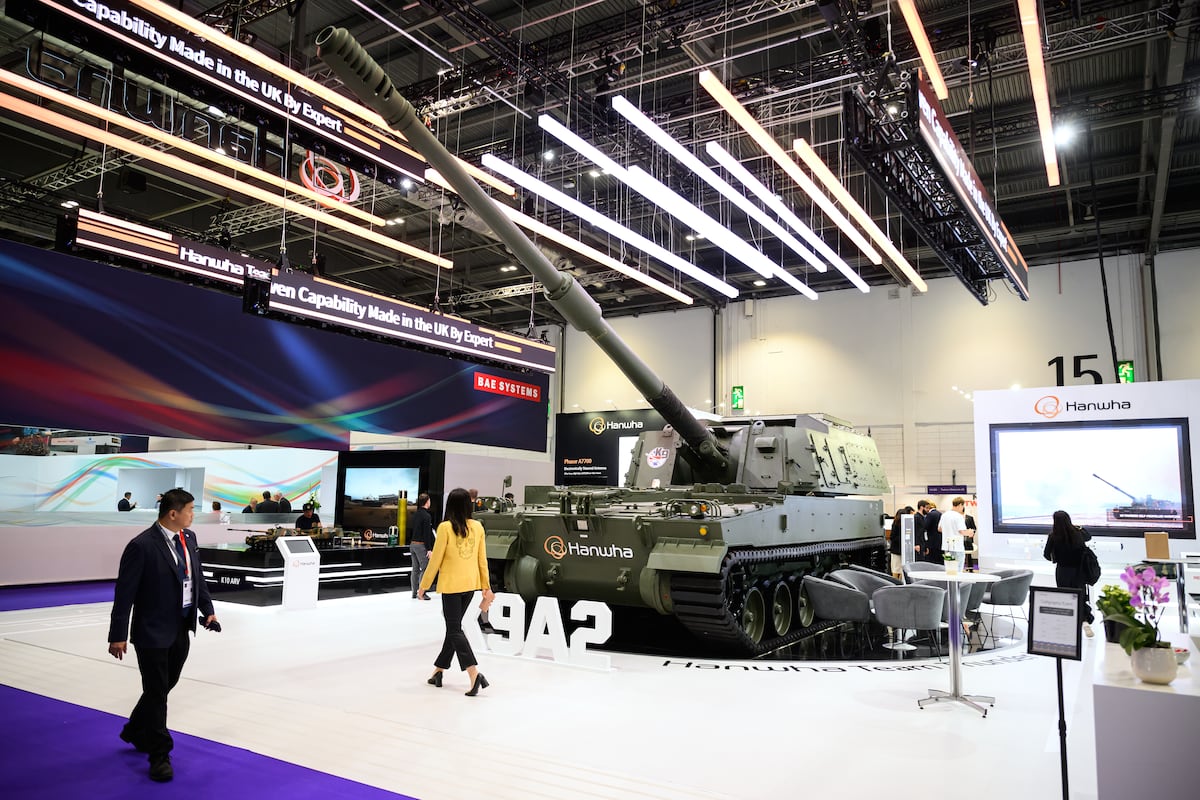
The findings by a London-based think tank come ahead of one of Europe’s largest defense exhibitions, DSEI, hosted in the British capital Sept. 9–12. The trade show is expected to see an uptick in European participation this year, with more countries and companies represented —specifically from nations such as Lithuania and the Czech Republic.
Still, the U.S. government and arms industry are set to have a significant footprint, with only five of the 11 international pavilions listed on the DSEI website coming from European states.
In 2024, Europe raised its defense spending by nearly 50% in comparison to 2014 levels. Yet pervasive readiness gaps remain, according to the latest dossier published last week by the International Institute for Strategic Studies (IISS).
The document, which assessed current progress and shortfalls in European defense, listed capability deficiencies across several critical domains.
The first involves a lack of sufficient intelligence, surveillance and reconnaissance aircraft as well as geospatial capabilities among NATO European countries. IISS estimates that it may cost Europeans up to $4.8 billion to replace the eight signals- and electronic-intelligence platforms that Washington currently allocates for NATO contingencies.
While some European countries are starting to buy ISR aircraft and slowly develop national satellite constellations, American-made systems remain the core of NATO’s capability in this area. For instance, according to IISS data, the U.S. operates at least 80 crewed ISR aircraft and 34 signals-intelligence planes, compared to 36 and 11 in Europe, respectively.
A similar gap also exists in medium-altitude, long-endurance UAVs used for intelligence operations.
The report identifies space capabilities as another key shortfall, noting Europe’s limited launch capacity and reliance on France’s Ariane and Vega systems, despite efforts by countries like Germany, Italy and the Netherlands to expand their space architectures.
“Currently, it largely depends on the U.S. for access to space – SpaceX’s Falcon 9 [launcher rocket] has conducted more launches in the first half of 2025 than the combined European Arianne and Vega launcher families since 2015,” it says.
Another important vulnerability concerns long-range strike capability. With few exceptions —primarily France and the UK — European forces lack sufficient land- and sea-based missiles that can reach targets at ranges over 1,000 kilometers, limiting their ability to sustain high-intensity warfare.
The report also points to a growing trend regarding ground-based air- and missile-defense, for which the European defense market has been found to increasingly lean on non-NATO suppliers – notably Brazil, Israel, and South Korea.
Driven largely by the need to meet Europe’s urgent military modernization, defense export contracts from these three countries were found to have increased by almost 1,000% from 2018-2021 ($2.48 billion) to 2022-2025 ($27.11 billion).
IISS analysts further highlight that Europe’s integrated air and missile defense is still underdeveloped. The continent urgently lacks sufficient layered air defense across short, medium, and long ranges, where even operational systems are not accessible in the required quantities.
“European terminal-phase missile defense capabilities rely mainly on the U.S., either through U.S.-made systems operated by national militaries or American deployments to Europe — principally the Patriot,” the report said.
Elisabeth Gosselin-Malo was a Europe correspondent for Defense News. She covers a wide range of topics related to military procurement and international security, and specializes in reporting on the aviation sector. She is based in Milan, Italy.
米兰——最近的一份报告显示,尽管欧洲各国加大了对本土武器和系统的投资,但在情报收集、太空准入、远程打击和导弹防御方面仍然面临重大差距,导致欧洲各国政府严重依赖美国。
伦敦一家智库的研究结果发布之际,正值欧洲最大的防务展之一——DSEI——即将于9月9日至12日在英国首都伦敦举行。预计今年的展会将吸引更多欧洲国家的参与,参展国家和公司将会增加,特别是来自立陶宛和捷克等国的代表。
不过,美国政府和军火工业仍将占据相当大的份额,DSEI 网站列出的 11 个国际展馆中只有 5 个来自欧洲国家。
根据国际战略研究所(IISS)上周发布的最新报告,2024年欧洲的国防开支比2014年增长了近50%。然而,普遍存在的战备差距依然存在。
该文件评估了欧洲国防领域目前的进展和不足,列出了几个关键领域的技能缺陷。
第一个问题是北约欧洲国家缺乏足够的情报、监视和侦察飞机以及地理空间能力。国际战略研究所估计,替换华盛顿目前为北约应急行动分配的八个信号和电子情报平台,可能需要欧洲人花费高达48亿美元。
尽管一些欧洲国家已开始采购情报、监视与侦察(ISR)飞机并逐步发展国家卫星星座,但美国制造的系统仍然是北约在该领域能力的核心。例如,根据国际战略研究所(IISS)的数据,美国至少拥有80架有人驾驶的ISR飞机和34架信号情报飞机,而欧洲的相应数量分别为36架和11架。
用于情报行动的中空长航时无人机也存在类似的差距。
该报告指出,太空能力是另一个关键的不足之处,并指出欧洲的发射能力有限,依赖法国的阿丽亚娜和维加系统,尽管德国、意大利和荷兰等国都在努力扩展其太空架构。
“目前,人类进入太空主要依赖美国——SpaceX 的猎鹰 9 号[运载火箭]在 2025 年上半年进行的发射次数比欧洲阿里安娜和织女星运载火箭自 2015 年以来的总发射次数还要多,”报告称。
另一个重要的弱点在于远程打击能力。除少数例外——主要是法国和英国——欧洲军队缺乏足够的陆基和海基导弹,无法打击1000公里以上的目标,这限制了它们持续进行高强度战争的能力。
该报告还指出,在地面防空和导弹防御方面,欧洲国防市场越来越依赖非北约供应商,尤其是巴西、以色列和韩国,这已成为一种日益增长的趋势。
受欧洲迫切的军事现代化需求的推动,这三个国家的国防出口合同从 2018-2021 年(24.8 亿美元)到 2022-2025 年(271.1 亿美元)增长了近 1000%。
国际战略研究所(IISS)的分析师进一步指出,欧洲的综合防空和导弹防御体系仍然不完善。欧洲大陆迫切缺乏覆盖短程、中程和远程的多层防空体系,甚至连现有作战系统都无法以所需的数量获得。
报告称:“欧洲的末段导弹防御能力主要依赖美国,要么是通过各国军队操作的美国制造的系统,要么是通过美国向欧洲部署的系统——主要是爱国者导弹系统。”
伊丽莎白·戈斯林-马洛曾任《防务新闻》欧洲通讯员。她的报道涵盖军事采购和国际安全等广泛领域,尤其擅长航空领域的报道。她常驻意大利米兰。