A Dozen Of The Most Unusual Variants Of The Ubiquitous KC-135 Family Of Aircraft十二种最不寻常的KC-135系列飞机变型
The KC-135A Stratotanker has been reworked into many different configurations, some of which are bizarre, to accomplish a dizzying array of missions.
Updated Nov 27, 2020 6:13 PM EST
Since its first flight on August 31st, 1956, there have been more than 80 variants of the KC-135A. For some of these, the differences were minor and often reflected only internal changes. For others, modifications significantly altered the appearance of the jet. In tribute to these many versions, The War Zone presents—as Rod Serling would say—for your consideration a dozen versions of the weird and wonderful. Selecting just 12 was insanely difficult, especially as the many testbed variants could easily account for twice that many.
12. It’s Just Paint.
Originally delivered in natural metal, the KC-135 has had relatively few color schemes. Coroguard was eventually applied to limit corrosion, later followed by a light grey. In the 1980s, Strategic Air Command (SAC) was concerned about tankers over Europe being shot down while in support of NATO, which prompted the hideously ineffective “Shamu” scheme of dark grey-green. This might have helped hide the KC-135 when viewed from above over cloudless terrain, but it made the jet more visible in the air and played havoc with the interior heat.
Today the jets wear a more effective grey. Still, there are a few KC-135s—too few, IMHO—that have sported unique paint schemes worthy of mention here.
In 1976, the American Bicentennial craze resulted in special paint schemes for just about every airplane in the inventory, but the then-Commander in Chief of Strategic Air Command (SAC) General Russell Dougherty was not convinced that his bombers and tankers should take part. Nonetheless, as this airshow image reveals, KC-135A 63-8012 did manage to sneak in a colorful scheme. At least one other jet had red, white, and blue striping on the engine cowls and around the nose radome.
Photo: author’s collection
Never let it be said that the French don’t know how to celebrate an anniversary, as C-135FR 63-8471 attests. There’s plenty of time to start planning the 80th anniversary of USAF KC-135s in 2037, which will probably be about the time the KC-46 is declared fully mission capable and retired to the Boneyard.
Photo: Pierre-Clément Got
11. Civilian KC-135s?
Both the KC-135 and the Boeing 707 were derived from the company’s earlier 367-80— famously barrel-rolled by the late, great “Tex” Johnston—but each was designed for separate markets: military and civilian. Nonetheless, two civil users—well, U.S. government agencies, to be precise—did acquire KC-135As. One of these helped put men on the moon, while the other helped make global commercial jet travel safer.
The original “Weightless Wonder” zero-gravity simulator was a Convair C-131, but the availability of spare KC-135s allowed for longer-duration training flights. Three different C/NKC/KC-135As were used at Wright-Patterson Air Force Base, Ohio, but by 1974 the Air Force wanted to divest the zero-g mission to NASA. KC-135A 59-1481 had a terrible maintenance record, which is why the Air Force offered it to NASA. That agency, not surprisingly, declined. After much bureaucratic wrangling and extensive repairs, however, it went on to fly 57,667 parabolas over its 22-year career. It would also support Space Shuttle transport flights alongside NASA’s 747 s.
Photo: Bob Burns via Stephen Miller
The Air Force was happy to shunt its hangar queens to civilian agencies, and, like NASA’s KC-135, 59-1518 was in pretty sorry shape when the FAA asked for a jet. Not that the FAA did much better. As N96, it suffered maintenance issues throughout its career with the agency. The airplane flew intercontinental and domestic routes at high altitudes and jet speeds to evaluate existing air traffic control (ATC) procedures and instrument approaches.
Jim Morrow via Stephen Miller
Along with KC-135A N98 (59-1481 which went to NASA), what it found while executing its research mission was appalling, as the procedures and how the airways operated were designed for the previous generation of piston-powered airliners. As such, today’s air travel owes its safety to the two FAA KC-135As. N96 eventually returned to the Air Force in 1979 for conversion into an EC-135K Head Dancer airborne command post.
Much to the surprise of many SAC alumni, two NKC-135As served with the U.S. Navy.
As part of its electronic warfare training to the fleet, the Navy operated three ex-SAC B-47 bombers carrying electronic countermeasure (ECM) pods and jammers. These soon proved too old and too small for the expansion needed as electronic warfare technology evolved, so the Navy requested replacements.
In December 1977, 55-3134 and 56-3596 joined the Fleet Electronic Warfare Support Group (FEWSG) operated by Douglas Aircraft in Tulsa, Oklahoma, bristling with antennae and the Tree Horn and Tree Shark jammer pods capable of simulating a variety of foreign (read Soviet) aircraft that might attack a carrier task force.
A Tree Shark jammer pod., Photo: Stephen Miller
A Tree Horn jammer pod., Photo: Stephen Miller
9. Don’t Point Those at Anyone
Although SAC wanted to put ejection seats in the KC-135—Boeing said “no” because it might undermine public perception of the 707 airliner’s safety—there were never any plans to arm the tanker as it would not operate in a threatened environment. That didn’t mean the type wasn’t involved in aerial weapons tests, notably the Airborne Laser Lab (ALL), preserved today at the National Museum of the Air Force at Wright-Patterson Air Force Base, and precursor of the YAL-1A 747 .
Interestingly, JKC-135A 55-3128 was involved with tests of wingtip-mounted rocket pods. Official records have yet to be uncovered that reveal exactly what these were, but they may well have been associated with test of the forward-firing AN/ALE-25 chaff rocket pods for the B-52.
Photo: PM-8634 Seattle Museum of Flight
8. Everyone Else Has Them, Why Not Me?
Look around at any airport and you’ll see them on just about every airplane designed and built since the 1990s. From hang gliders to 747s and A380s, winglets improve fuel efficiency and aerodynamic performance. First tested jointly with NASA in 1979 on NKC-135A 55-3129—previously a Weightless Wonder, with a bulkhead autographed by the Mercury Seven astronauts—they were never adopted for the KC-135 fleet.
Results were impressive though: 6.5% fuel savings per annum—45 million gallons of fuel at $0.86 per gallon = $38,700,000 saved—not to mention improved safety due to dissipation of wingtip vortices. SAC, however, opted for a computerized fuel/flight management system that offered a mere 2% savings if the jet was flown in an atypical airline flight profile and, for the first five years, never worked.
Mick Roth via Stephen Miller
7. Nuke ‘Em ‘Til They Glow
Beginning with the October 31st, 1961 Tsar Bomba detonation monitored by JKC-135A 55-3127—it was not 20 miles away, but that’s another story—KC-135 variants have been used to assess dozens of atmospheric atomic tests from the United States, Soviet Union, and even France.
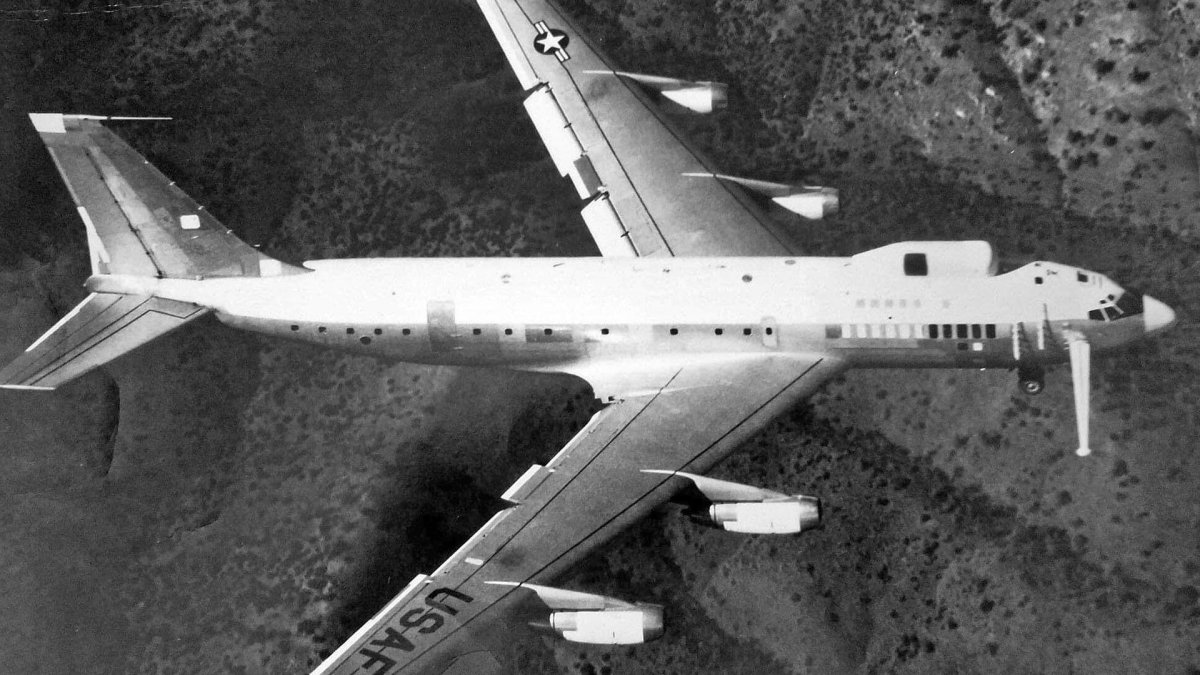
In an effort to ensure DoD support for the 1963 Partial Test Ban Treaty, Congress approved the purchase of three Early Day/Rivet Digger NC-135As as part of the National Nuclear Test Readiness Program (NNTRP). Each one was configured by the three U.S. atomic labs: Los Alamos Diagnostic Lab, Sandia National Lab, and the Lawrence Livermore National Lab. Each carried a variety of nuclear sensors, high-speed cameras, and technical equipment. Two—60-0369 and 60-0370—lacked all markings on the right side, while 60-0371 was unmarked on the left side to avoid flash burns to the paint from any the fireball. This proved unnecessary, but the paint scheme was retained anyway.
During one program, 60-0369 carried what is believed to be an ionization sensor mounted on a long strut off the right side of the forward fuselage.
As long as there’s been aerial gunnery, there have been aerial target towing aircraft, as well as target drones. Two KC-135 variants have served as “targets” for airborne laser experiments, beginning in 1977 with NC-135A 60-0371.
For tests with the YAL-1 747 laser platform, big crow NKC-135E 55-3132 acted as the target, simulating an incoming ballistic missile. To make sure the YAL-1’s sensors could see the “missile” clearly, a white ICBM was painted on the black forward fuselage to simulate re-entry against an exoatmospheric background. In addition, light and heat source emitters were placed at the exhaust of the “missile.” It worked, but the YAL-1 was canceled anyway.
Paul Minert via Stephen Miller
5. Rockets, Missiles, and Capsules, Oh My!
During the early years of the US space program, scientists and engineers sought to understand the survivability of spacecraft as they exited and then re-entered the atmosphere. Several programs, such as the two JKC-135As that took part in Operation Skyscraper, tracked unmanned spacecraft immediately after launch and during re-entry. Beyond the pure research and “space race” benefits of these flights, there was a significant, but unmentioned, military component.
Efforts such as the Radiation Monitoring Program (RAMP) and Terminal Radiation Program (TRAP) built a database of American— never Soviet—missile and re-entry vehicle (warhead) infrared signatures. This would allow targeting of Soviet ICBMs during the boost phase, including by Kelly Johnson’s proposed Low Card laser-equipped U-2s hovering around the USSR, and incoming warheads.
Filled with cameras and infrared sensors mounted in a large dorsal fairing, JKC-135A 55-3134 operated from Patrick AFB, FL, unseen by the multitudes who watched rocket launches from the adjacent Cape Canaveral.
Bill Sides via Stephen Miller
Long before any new electronic equipment is installed on an operational platform, it undergoes extensive testing and evaluation. As part of the 1963 Reconnaissance Strike Program, JKC-135A 56-3596 tested the performance of the side-looking radar (SLAR) for the planned RB-58 Hustler. Eventually, this was replaced by NKC-135A 55-3132 in Recce Strike II associated with the Quill satellite-based bomb damage assessment (BDA) project, designed to provide SAC with real-time re-targeting data for use in its nuclear war plan.
Both aircraft had a huge fairing scabbed onto the right side of the fuselage plus a huge air intake on top for systems cooling, although this intake was later removed.
Photo: Richard Sullivan via Stephen Miller
3. Does That Affect Your Gas Mileage?
Although NASA had ground communications and data stations around the world to link to satellites and its manned spacecraft, there were still gaps over the southern Atlantic and Pacific Oceans. For the Apollo moon missions, this was complicated by the rotation of the Earth.
In 1966, Douglas received the contract to install a 7ft diameter, 700 lb steerable antenna inside a 10 ft diameter nose on eight surplus C-135A transports. These were known as Apollo Range Instrumented Aircraft (ARIA). After Apollo 17 the name was changed to Advanced Range Instrumented Aircraft. As if these were not sufficiently ungainly, four were configured to carry the Airborne Lightweight Optical Tracking System (ALOTS) pod. This allowed an operator, sitting inside a plexiglass bubble atop the fuselage, to track and film rockets, missiles, and spacecraft during launch and re-entry. One ARIA was lost in a tragic accident over Maryland during a spouse orientation flight.
2. You’re Joking, Right?
When originally delivered, the KC-135 was equipped with Pratt & Whitney J57 engines. These used water injection to increase available thrust on initial takeoff, but were nonetheless woefully inadequate in terms of overall performance and fuel consumption. Indeed, there were some emergency situations where the KC-135 could neither climb nor accelerate after takeoff, all but guaranteeing the loss of a jet and its crew.
Consequently, SAC sought to re-engine its KC-135 fleet as a cost-saving alternative to procuring hundreds of new airplanes. In one example, two additional jets were mounted in a single pod on each wingtip and used only for takeoff.
Perhaps the most unusual proposal was Boeing’s KC-135ME—which stood for Mixed Engine—that, fortunately, never got off the drawing board. The outboard engines were still J57s, but the inboard engines were of the same caliber as today’s CFM-56 (F108) engines, figuring that it would halve the cost of the re-engining program.
Some ideas are best left untested…
1. You’ll Need a Lot More Than Four Engines
On the 4th of October, 1957, Americans were shocked by the Soviet Sputnik satellite. US defense planners, however, were far more concerned about the R-7 Semyorka rocket that launched it, as they quickly understood that its next payload could well be an atom bomb aimed at Washington, DC. This prompted a dedicated program to assess Soviet ICBM development, leading to specialist variants of the B-47 and RC-135 .
One of these was the unique RC-135E Lisa Ann, later known as Rivet Amber. It carried a version of the massive Hughes radar installed on the island of the USS Enterprise to track incoming Soviet warheads to the Klyuchi Test Range on the Kamchatka Peninsula, and steered a Ballistic Streak Camera that filmed the event. The radar and associated equipment were far too big to fit in the jet, so the Big Safari conversion team extended the fuselage by 18 inches. No, this wasn’t the advent of the longer “hog” nose on the RC-135, but a stretch of the actual fuselage—prompting Boeing to disavow all responsibility for the airframe.
Moreover, the four TF33 engines could not produce enough electricity to power the radar, so a Lycoming T55 engine was mounted in a pod beneath the left wing, and a heat exchange pod was installed under the right wing to dissipate the 1 million BTUs of additional heat generated by the radar. This gave rise to spurious claims of a “six-engine RC-135.” A fiberglass radome covered half of the fuselage over the radar, but it was not wrap-around, as some have claimed.
Rivet Amber was quite successful, and during May 1969 it collected evidence that proved the Soviet SS-9 Scarp’s three warheads were not multiple independently targetable re-entry vehicles (MIRVs).
Tragically, the RC-135E and 19 souls disappeared over the Bering Sea on 5th June 1969, likely the result of the failure of the vertical stabilizer following damage from severe turbulence during an operational mission the previous day.
So, that’s our list. Which ones do you think should be on it? Let us know in the comments below!
Robert S Hopkins, III, is an independent scholar and aviation historian. Previously he was a US Air Force pilot and flew 17 different variants of EC-, KC-, and RC-135s. He has appeared on a variety of aviation programs on the BBC, Smithsonian, Discovery, NRK (Norway), and the History Channel. Hopkins earned a PhD in History from the University of Virginia and has published multiple books on the history of strategic airpower and aerial reconnaissance.
Contact the editor: Tyler@thedrive.com
Comments couldn’t be loaded. Please refresh the page.
更新于美国东部时间2020年11月27日下午6:13。
自1956年8月31日首飞以来,KC-135A已衍生出80多个型号。其中一些型号之间的差异微乎其微,通常仅体现在内部结构上。而另一些型号则进行了显著的改进,彻底改变了飞机的外观。为了向这些众多版本致敬,《战区》杂志——正如罗德·瑟林所说——特地为您呈现十二款奇特而精彩的KC-135A。从中挑选出十二款实属不易,尤其是考虑到众多的测试原型机,其数量很可能是现在的两倍。
12. 这只是油漆而已。
KC-135最初交付时采用金属原色,涂装方案相对较少。后来为了防止腐蚀,机身涂装了Coroguard防锈涂层,之后又涂装了浅灰色。20世纪80年代,战略空军司令部(SAC)担心在欧洲上空支援北约的加油机被击落,因此采用了效果极差的“沙姆”涂装——深灰绿色。这种涂装或许有助于在晴朗的地面上空从空中隐藏KC-135,但却使飞机在空中更加显眼,并且严重影响了机舱内部的散热。
如今,这些喷气式飞机大多采用更具现代感的灰色涂装。不过,在我看来,仍有一些KC-135——数量太少了——采用了值得一提的独特涂装。
1976年,美国建国两百周年庆典的热潮席卷而来,几乎所有现役飞机都采用了特殊的涂装方案。然而,时任战略空军司令部(SAC)总司令拉塞尔·多尔蒂将军却认为他的轰炸机和加油机不应该参与其中。尽管如此,正如这张航展照片所示,KC-135A 63-8012 还是设法偷偷地涂上了鲜艳的图案。至少还有一架喷气式飞机在发动机罩和机头雷达罩周围涂上了红、白、蓝三色条纹。
照片:作者收藏
千万别说法国人不懂如何庆祝周年纪念,C-135FR 63-8471 就是最好的证明。现在开始筹划美国空军 KC-135 加油机服役 80 周年纪念活动还为时不晚,2037 年正是 KC-46 宣布完全具备作战能力并退役进入飞机坟场的时候。
照片:皮埃尔-克莱门特·戈特
11. 民用KC-135?
KC-135 和波音 707 都源自波音公司早期的 367-80——已故的飞行传奇人物“德克萨斯”约翰斯顿曾驾驶 367-80 进行过著名的桶滚特技——但它们各自的设计目标市场不同:军用和民用。尽管如此,还是有两家民用用户——更准确地说,是美国政府机构——采购了 KC-135A。其中一家助力人类登月,另一家则提升了全球商业喷气式飞机的安全性。
最初的“失重奇迹”(Weightless Wonder)零重力模拟器是一架康维尔C-131,但备用KC-135的出现使得更长时间的训练飞行成为可能。俄亥俄州赖特-帕特森空军基地曾使用过三架不同的C/NKC/KC-135A,但到了1974年,空军希望将零重力任务移交给NASA。KC-135A 59-1481的维护记录糟糕透顶,这也是空军将其提供给NASA的原因。不出所料,NASA拒绝了。然而,经过一番官僚主义的周旋和大量的维修后,这架飞机在其22年的服役生涯中完成了57,667次抛物线飞行。它还曾与NASA的747飞机一起为航天飞机运输飞行提供支持。
照片:鲍勃·伯恩斯(Bob Burns)供图,斯蒂芬·米勒(Stephen Miller)提供
空军乐于将那些闲置在机库里的飞机转交给民用机构,就像NASA的KC-135一样,59-1518号飞机在联邦航空管理局(FAA)需要一架喷气式飞机时状况相当糟糕。不过,FAA的情况也好不到哪里去。这架飞机注册号为N96,在FAA服役期间一直饱受维护问题的困扰。它曾以高空和喷气式飞机的速度飞行洲际和国内航线,以评估现有的空中交通管制(ATC)程序和仪表进近程序。
吉姆·莫罗(Jim Morrow)通过斯蒂芬·米勒(Stephen Miller)
与KC-135A N98(编号59-1481,后移交给NASA)一样,它在执行研究任务时发现的情况令人震惊,因为当时的航路运行程序和操作方式都是为上一代活塞式客机设计的。因此,如今的航空安全要归功于这两架FAA的KC-135A。N96最终于1979年归还空军,改装成EC-135K“领舞者”空中指挥所。
令许多战略空军司令部校友感到惊讶的是,有两架 NKC-135A 曾在美国海军服役。
作为舰队电子战训练的一部分,海军曾使用三架前战略空军司令部(SAC)的B-47轰炸机,这些轰炸机搭载电子对抗(ECM)吊舱和干扰器。但随着电子战技术的不断发展,这些飞机很快就显得老旧且容量不足,无法满足扩展需求,因此海军要求更换飞机。
1977 年 12 月,55-3134 和 56-3596 加入了由道格拉斯飞机公司在俄克拉荷马州塔尔萨运营的舰队电子战支援大队 (FEWSG),这两架飞机上布满了天线,并装有“树角”和“树鲨”干扰吊舱,能够模拟各种可能攻击航母特遣舰队的外国(即苏联)飞机。
树鲨干扰器舱。照片:斯蒂芬·米勒
树角干扰器舱。照片:斯蒂芬·米勒
9. 不要用那些东西指着任何人
尽管战略空军司令部(SAC)希望在KC-135上安装弹射座椅——波音公司拒绝了,因为这可能会损害公众对707客机安全性的认知——但由于该加油机不会在受威胁的环境中运行,因此从未计划为其配备武器。但这并不意味着该机型没有参与过空中武器测试,尤其是机载激光实验室(ALL)的测试。ALL如今保存在赖特-帕特森空军基地的国家空军博物馆,是YAL-1A 747的前身。
有趣的是,JKC-135A 55-3128曾参与翼尖火箭发射器的测试。官方记录尚未公开这些火箭发射器的具体型号,但它们很可能与B-52轰炸机前射式AN/ALE-25箔条火箭发射器的测试有关。
照片:PM-8634 西雅图飞行博物馆
8. 别人都有,为什么我没有?
环顾任何机场,你都会发现自上世纪90年代以来设计和制造的几乎所有飞机都装有翼梢小翼。从滑翔机到波音747和空客A380,翼梢小翼都能提高燃油效率和空气动力性能。翼梢小翼最早于1979年与NASA联合在NKC-135A 55-3129号机上进行测试——这架飞机之前被称为“失重奇迹”,其隔板上有“水星七号”宇航员的签名——但最终并未被KC-135机队采用。
尽管结果令人印象深刻:每年可节省 6.5% 的燃油——按每加仑 0.86 美元计算,4500 万加仑燃油可节省 3870 万美元——更不用说由于翼尖涡流的消散而带来的安全性提升。然而,SAC 选择了一套计算机化的燃油/飞行管理系统,该系统在飞机以非典型航空公司飞行模式飞行时仅能节省 2% 的燃油,而且在前五年从未正常工作过。
米克·罗斯(Mick Roth)通过斯蒂芬·米勒(Stephen Miller)
7. 用核弹把它们炸到发光
从 1961 年 10 月 31 日由 JKC-135A 55-3127 监测的沙皇炸弹爆炸开始——虽然爆炸地点并非在 20 英里之外,但那是另一个故事了——KC-135 的各种型号已经被用来评估来自美国、苏联甚至法国的数十次大气层原子弹试验。
为了确保国防部对1963年《部分禁止核试验条约》的支持,国会批准购买三架早期/铆钉挖掘机NC-135A型飞机,作为国家核试验准备计划(NNTRP)的一部分。每架飞机都由美国三个原子能实验室——洛斯阿拉莫斯诊断实验室、桑迪亚国家实验室和劳伦斯利弗莫尔国家实验室——进行配置。每架飞机都搭载了各种核传感器、高速摄像机和技术设备。其中两架——60-0369和60-0370——右侧没有任何标记,而60-0371的左侧则没有标记,以避免火球灼伤油漆。事实证明这种做法没有必要,但涂装方案仍然保留了下来。
在一次试验中,60-0369 携带了一个据信是电离传感器的装置,该装置安装在机身前部右侧的一根长支柱上。
只要有空中射击,就会有空中靶机拖曳飞机和靶机。两架KC-135衍生机型曾被用作机载激光实验的“靶机”,最早的一次是1977年的NC-135A 60-0371。
在YAL-1 747激光平台的测试中,NKC-135E 55-3132“大乌鸦”运输机被用作目标,模拟来袭的弹道导弹。为了确保YAL-1的传感器能够清晰地探测到“导弹”,在黑色的前机身涂上了白色的洲际弹道导弹图案,以模拟其在大气层外背景下的再入过程。此外,还在“导弹”的排气口处安装了光源和热源发射器。测试成功,但YAL-1项目最终还是被取消了。
保罗·米纳特(Paul Minert)通过斯蒂芬·米勒(Stephen Miller)
5. 火箭、导弹和太空舱,我的天哪!
在美国太空计划的早期,科学家和工程师致力于了解航天器在出入大气层时的生存能力。一些项目,例如参与“摩天大楼行动”的两架JKC-135A无人机,对无人航天器在发射后和重返大气层过程中进行了跟踪。除了这些飞行带来的纯粹科研和“太空竞赛”效益之外,还存在着一个重要的、但鲜为人知的军事用途。
诸如辐射监测计划(RAMP)和末端辐射计划(TRAP)等项目建立了一个数据库,其中包含美国(而非苏联)导弹和再入飞行器(弹头)的红外特征。这使得在助推阶段对苏联洲际弹道导弹进行目标定位成为可能,包括利用凯利·约翰逊提出的配备激光雷达的U-2侦察机在苏联上空盘旋进行探测。
JKC-135A 55-3134 飞机背部装有大型整流罩,里面装满了摄像头和红外传感器,从佛罗里达州帕特里克空军基地起飞,因此在邻近的卡纳维拉尔角观看火箭发射的众多观众看不到它。
比尔·赛德斯(Bill Sides)通过斯蒂芬·米勒(Stephen Miller)
在任何新型电子设备安装到作战平台上之前,都需要经过广泛的测试和评估。作为1963年侦察打击计划的一部分,JKC-135A 56-3596测试了计划中的RB-58“盗贼”(Hustler)侦察机侧视雷达(SLAR)的性能。最终,在与“羽毛笔”(Quill)卫星炸弹损害评估(BDA)项目相关的“侦察打击II”计划中,该雷达被NKC-135A 55-3132取代。该项目旨在为战略空军司令部(SAC)提供实时重新瞄准数据,用于其核战争计划。
两架飞机的机身右侧都加装了一个巨大的整流罩,顶部还有一个巨大的进气口用于系统冷却,不过这个进气口后来被拆除了。
照片:理查德·沙利文(Richard Sullivan)经斯蒂芬·米勒(Stephen Miller)授权使用
3. 这会影响你的油耗吗?
尽管美国宇航局在全球各地设有地面通信和数据站,用于连接卫星和载人航天器,但在南大西洋和太平洋上空仍然存在通信盲区。对于阿波罗登月任务而言,地球自转使这一问题更加复杂。
1966年,道格拉斯公司获得一份合同,在八架剩余的C-135A运输机上,于直径10英尺的机头内安装一个直径7英尺、重700磅的可转向天线。这些飞机被称为阿波罗测距仪飞机(ARIA)。阿波罗17号任务之后,其名称改为先进测距仪飞机。这些飞机原本就笨重,其中四架还被改装用于搭载机载轻型光学跟踪系统(ALOTS)吊舱。该系统允许操作员坐在机身顶部的有机玻璃罩内,跟踪并拍摄火箭、导弹和航天器在发射和再入大气层过程中的运行轨迹。其中一架ARIA飞机在一次配偶体验飞行中,于马里兰州上空发生不幸事故而坠毁。
2. 你在开玩笑吧?
KC-135最初交付时配备的是普惠J57发动机。这些发动机采用水喷射技术来增加起飞时的推力,但就整体性能和燃油消耗而言,仍然远远不够。事实上,在某些紧急情况下,KC-135起飞后既无法爬升也无法加速,几乎必然导致飞机及其机组人员的损失。
因此,战略空军公司寻求对其KC-135机队进行发动机更换,以此作为采购数百架新飞机的节约成本的替代方案。例如,在一种方案中,每架飞机的翼尖都安装了一个吊舱,其中装有两台额外的喷气式发动机,仅用于起飞。
或许最不寻常的方案是波音公司的KC-135ME——即混合发动机——所幸最终未能付诸实施。该机外侧发动机仍采用J57,但内侧发动机则与如今的CFM-56(F108)发动机性能相当,波音公司认为这样可以将发动机更换项目的成本减半。
有些想法最好不要去尝试……
1. 你需要的远不止四个引擎
1957年10月4日,苏联发射人造卫星“斯普特尼克”震惊了美国民众。然而,美国国防规划人员更关注的是发射这颗卫星的R-7“谢米约尔卡”火箭,因为他们很快意识到,这枚火箭的下一个有效载荷很可能是一枚瞄准华盛顿特区的原子弹。这促使美国启动了一项专门评估苏联洲际弹道导弹发展情况的项目,并最终研发出了B-47和RC-135的专用改进型。
其中一架是独一无二的RC-135E“丽莎·安”(Lisa Ann),后来更名为“铆钉琥珀”(Rivet Amber)。它搭载了休斯公司生产的巨型雷达,该雷达曾安装在“企业号”航空母舰的舰岛上,用于追踪来袭的苏联核弹头,目标地点是堪察加半岛的克柳奇试验场。这架飞机还配备了一台弹道轨迹摄像机,用于拍摄整个过程。由于雷达及其相关设备体积庞大,无法装入RC-135喷气式飞机,因此“大探险”(Big Safari)改装团队将机身加长了18英寸。不,这并非RC-135加长了标志性的“猪鼻子”,而是对机身本身的加长——这也导致波音公司否认对该机身负有任何责任。
此外,四台TF33发动机产生的电力不足以驱动雷达,因此在左翼下方吊舱内安装了一台莱康明T55发动机,并在右翼下方安装了一个热交换吊舱,用于散发雷达产生的额外100万BTU热量。这导致了关于“六引擎RC-135”的虚假说法。机身一半的雷达罩由玻璃纤维制成,但并非像某些人声称的那样是环绕式的。
“铆钉琥珀”行动非常成功,在 1969 年 5 月,它收集到了证据,证明苏联 SS-9“斯卡普”导弹的三个弹头不是多弹头独立重返大气层飞行器(MIRV)。
令人痛心的是,1969 年 6 月 5 日,RC-135E 和机上 19 人在白令海上空失踪,很可能是由于前一天执行作战任务时遭遇严重湍流导致垂直尾翼受损而发生故障所致。
以上就是我们的名单。你觉得还有哪些应该上榜呢?请在下方评论区留言!
罗伯特·S·霍普金斯三世是一位独立学者和航空史学家。他曾是美国空军飞行员,驾驶过17种不同型号的EC-135、KC-135和RC-135飞机。他曾多次出现在BBC、史密森尼频道、探索频道、挪威广播公司(NRK)和历史频道等多个航空节目中。霍普金斯拥有弗吉尼亚大学历史学博士学位,并出版过多部关于战略空军力量和空中侦察史的著作。
联系编辑:Tyler@thedrive.com
评论加载失败,请刷新页面。