More Primary 1 places for Phase 2C; 12 schools to reserve spots for children living farther away第二阶段C期将增加一年级学位;12所学校将为居住在较远地区的儿童预留学位。
Singapore will reserve more Primary 1 places in Phase 2C to widen access, including spots for children living farther away in 12 selected schools. Read more at straitstimes.com.
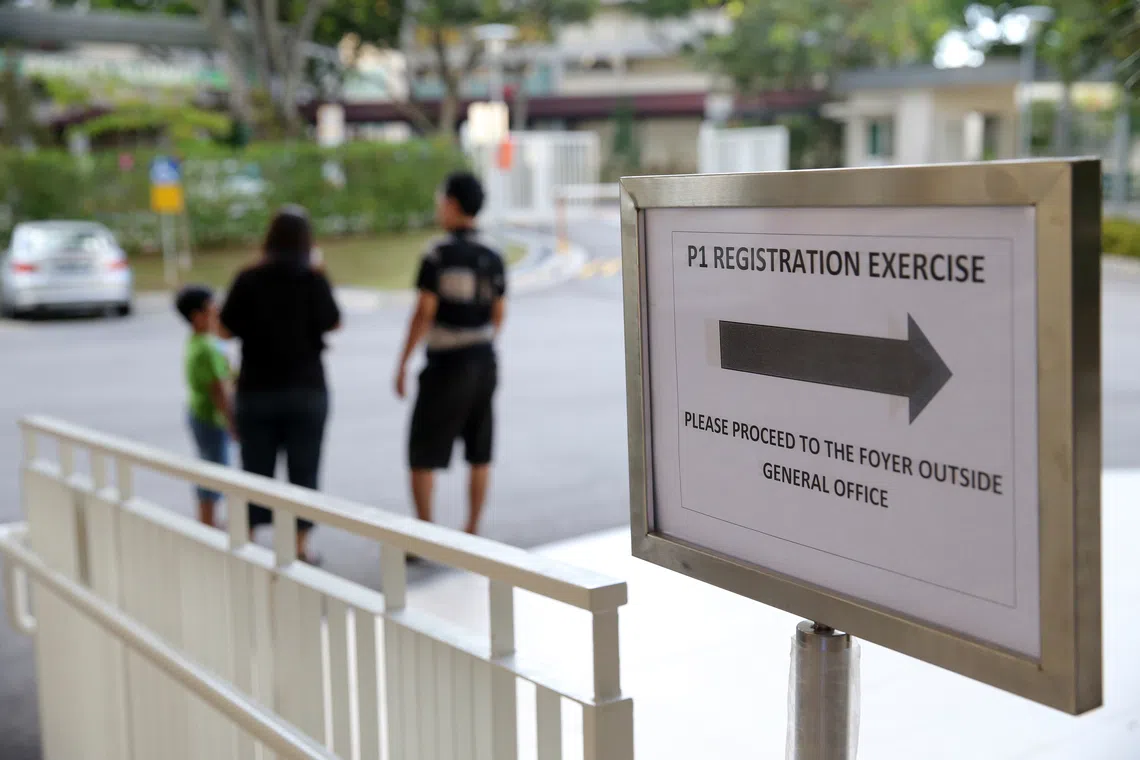
Twelve schools will split the 60 reserved places in Phase 2C into two tracks.
ST PHOTO: ONG WEE JIN
Published Sep 10, 2026, 06:30 PM
Updated Sep 10, 2026, 06:30 PM
More Primary 1 places in Singapore will be reserved for children without prior connections, increasing Phase 2C spots from 40 to 60, starting in the 2027 registration exercise.
Twelve schools in areas with less public housing will reserve half their Phase 2C spots for children living more than 2km away, promoting access and diversity.
Education Minister Desmond Lee emphasised these changes aim to broaden school access, encourage social mixing, and balance factors like sibling priority and proximity.
SINGAPORE - More Primary 1 places will be reserved for children without prior connections, as part of efforts to widen access to schools.
From the next registration exercise in 2027, 60 spots will be set aside for this group of children in Phase 2C, up from the current 40. This change will not be applied to 27 schools with smaller intakes of fewer than 180 Primary 1 spots. There are 182 primary schools in Singapore.
Twelve schools in areas like Bukit Timah, Newton and Marine Parade with a lower proportion of public housing will also set aside spots in Phase 2C for children who live further than 2km away, to ensure access to a more diverse mix of applicants.
This is the stage for those who do not qualify for the earlier stages of admission, which give priority to children of alumni and other connections.
Announcing these changes on Sept 10, the Education Ministry (MOE) said it had identified 12 schools in neighbourhoods where public housing makes up less than 40 per cent of homes within a 2km radius.
Applying home-school distance priority to these schools may not substantially broaden access for children from different socioeconomic backgrounds, it said.
As such, these 12 schools will split the 60 reserved places in Phase 2C into two tracks. This means 30 spots will be reserved for those who live within 2km of the school, and the remaining 30 will be for those who live even further away. Within each of the two tracks, how far a child lives from the school will not be considered.
The 12 schools are Anglo-Chinese School (ACS) (Junior), ACS Primary, CHIJ (Katong) Primary, Methodist Girls’ School (Primary), Nanyang Primary School, Ngee Ann Primary School, Pei Hwa Presbyterian Primary School, Raffles Girls’ Primary School, Singapore Chinese Girls’ Primary School, St. Margaret’s School (Primary), Tanjong Katong Primary School and Tao Nan School.
This move is meant to keep access to a share of pupils living nearby while opening the schools up to those living further away.
Education Minister Desmond Lee said the changes - a result of MOE’s review of the Primary 1 registration framework - aim to broaden access to primary schools, and enable greater mixing among pupils from different backgrounds as they learn together.
Anglo-Chinese School (Junior) is one of the 12 schools. PHOTO: ST FILE
Anglo-Chinese School (Junior) is one of the 12 schools.
“Our schools are shared spaces. They are where our children form their friendships, where they understand different perspectives, and they find common ground,” he said.
With the upcoming changes, he said that about one in four places in a typical primary school with about 240 vacancies will be open to children regardless of whether they have prior connections to the school.
He added that whether the 12 identified schools will see greater diversity depends on other factors too, such as parents’ preferences and school choices.
While most primary schools comprise pupils from diverse backgrounds, MOE said some schools have a narrower socioeconomic mix because of the demographics of their immediate neighbourhoods.
“This is partly due to the current home-school distance priority in the P1 Registration Framework, where priority is determined by citizenship, followed by home-school distance, when balloting is required,” it said in a statement.
While most primary schools comprise pupils from diverse backgrounds, MOE said some schools have a narrower socioeconomic mix because of the demographics of their immediate neighbourhoods. PHOTO: ST FILE
Lee said the conversations during the review showed broad agreement that primary schools should remain open and accessible to families from different backgrounds. But there were different views on how to achieve this, with a range of ideas put forward.
This included reducing the weight given to home-school distance, doing away with distance priority altogether, and even completely redesigning the admission system so that children are automatically allocated to schools.
Said Lee: “There are different considerations that we have to balance with every change that we make. For example, we know that parents value a school that’s near to home, particularly for young children, and it’s more convenient for siblings to attend the same school together.
“Alumni and community members contribute to their school and to the wider community. They preserve the school’s heritage and ethos, and they contribute to community. And we do appreciate their efforts and their contributions.”
MOE said that the past changes to the Primary 1 registration framework implemented in 2014 and 2022 have improved access across all schools for children without prior ties, especially those living nearby.
In 2014, 20 places were reserved for Phase 2C in every primary school. In 2022, this was doubled to 40.
Lee said the ministry will track the registration outcomes of the latest round of measures and make further changes where needed.
“In doing so, we will continue to seek to balance the different considerations involved, including sibling priority, proximity between home and school, alumni ties, as well as contributions to community,” he said.
Principal of Tao Nan School, Poh Qinyu, said the two-track scheme can give families living beyond the school’s immediate neighbourhood a more realistic opportunity to secure a place, should they feel the school is a good fit for their child.
Principal of Tao Nan School, Poh Qinyu, said the two-track scheme can give families living beyond the school’s immediate neighbourhood a more realistic opportunity to secure a place, should they feel the school is a good fit for their child. PHOTO: LIANHE ZAOBAO FILE
PHOTO: LIANHE ZAOBAO FILE
“A wider catchment may also bring together students from more diverse backgrounds, enriching their primary school experience through greater exposure to different perspectives and experiences,” she added.
While the new measures may not foster a greater mix of students overnight, Methodist Girls’ School principal Pamela Yoong , said the changes are meaningful steps towards ensuring that schools remain accessible and are reflective of the broader community.
Said Yoong: “Learning and growing alongside peers from different backgrounds during students’ primary school years can be one of the most formative experiences of their childhood, shaping how they see and engage with the world around them.”
Elisha Tushara is a correspondent at The Straits Times, specialising in Singapore’s education landscape.
Primary 1 registration
Ministry of Education
12 所学校将把 2C 阶段预留的 60 个名额分成两个班级。
《海峡时报》摄影:王伟进
发布于2026年9月10日下午6:30
更新于2026年9月10日下午6:30
新加坡将为没有先前关系的儿童保留更多小学一年级名额,从 2027 年的注册开始,第二阶段 C 的名额将从 40 个增加到 60 个。
在公共住房较少的地区,十二所学校将保留其 2C 期招生名额的一半,供居住在 2 公里以外的儿童使用,以促进教育机会和多样性。
教育部长李智陞强调,这些改革旨在扩大入学机会,鼓励社会融合,并平衡兄弟姐妹优先权和居住距离等因素。
新加坡——为扩大入学机会,政府将为没有家庭背景的儿童预留更多小学一年级名额。
从2027年的下一次入学登记开始,第二阶段C期将为这部分儿童预留60个名额,高于目前的40个。这项调整不适用于招生人数少于180人的27所小学一年级招生名额。新加坡共有182所小学。
在武吉知马、纽顿和马林百列等公共住房比例较低的地区,12 所学校也将在第二阶段 C 期预留名额,供居住在 2 公里以外的儿童入学,以确保招收更多不同背景的申请者。
这是为那些不符合早期录取阶段条件的人准备的阶段,早期录取阶段优先考虑校友子女和其他关系人子女。
教育部于 9 月 10 日宣布了这些变化,并表示已确定 12 所学校位于方圆 2 公里内公共住房占比低于 40% 的社区。
报告称,对这些学校实行家庭学校距离优先政策可能不会大幅扩大不同社会经济背景儿童的入学机会。
因此,这12所学校将把第二阶段C期预留的60个名额分成两组。这意味着30个名额将预留给居住在学校2公里范围内的学生,另外30个名额将预留给居住在更远地区的学生。在每组名额分配中,学生居住地与学校的距离将不予考虑。
这 12 所学校分别是:英华小学 (ACS)、英华小学部、圣婴女校(加东)小学部、卫理公会女校(小学部)、南洋小学、义安小学、培华长老会小学、莱佛士女校小学、新加坡华女小学、圣玛格丽特学校(小学部)、丹戎加东小学和道南学校。
此举旨在保留一部分居住在附近的学童的入学机会,同时向居住在较远地区的学童开放学校。
教育部长李智陞表示,这些改革是教育部检讨小学一年级入学登记框架的结果,旨在扩大小学入学机会,并让来自不同背景的学生在共同学习的过程中有更多交流。
英华中学(小学部)是12所学校之一。(图片来源:海峡时报档案)
英华中学(小学部)是12所学校之一。
他说:“我们的学校是共享空间。孩子们在那里建立友谊,了解不同的观点,并找到共同点。”
他表示,随着即将到来的变化,一所典型的拥有约 240 个空缺名额的小学,大约四分之一的名额将向儿童开放,无论他们之前是否与该校有任何联系。
他还补充说,这 12 所确定的学校是否会有更大的多样性,还取决于其他因素,例如家长的偏好和学校选择。
教育部表示,虽然大多数小学的学生来自不同的背景,但有些学校由于周边地区的人口结构原因,其社会经济构成较为单一。
声明中称:“这部分是由于目前小学一年级注册框架中以家庭与学校距离为优先原则,在需要抽签的情况下,优先考虑的是公民身份,其次是家庭与学校距离。”
教育部表示,虽然大多数小学都由来自不同背景的学生组成,但由于周边社区的人口结构限制,部分学校的社会经济构成较为单一。(图片:海峡时报档案)
李表示,审查期间的讨论表明,各方普遍认同小学应该保持开放,让来自不同背景的家庭都能入学。但对于如何实现这一目标,各方意见不一,提出了各种各样的想法。
这包括降低对家庭与学校距离的重视程度,完全取消距离优先权,甚至彻底重新设计入学系统,使儿童自动分配到学校。
李说:“我们每次做出改变都需要权衡各种因素。例如,我们知道家长们重视学校离家近,特别是对于年幼的孩子来说,而且兄弟姐妹一起上同一所学校也更方便。”
“校友和社区成员为母校和更广泛的社区做出了贡献。他们传承了学校的传统和精神,也为社区做出了贡献。我们非常感谢他们的努力和贡献。”
教育部表示,2014 年和 2022 年实施的小学一年级入学登记框架改革,改善了所有学校中没有先前关系的孩子,特别是住在附近的孩子入学的机会。
2014年,每所小学都预留了20个二期C阶段的名额。到2022年,这个数字翻了一番,达到40个。
李表示,该部门将跟踪最新一轮措施的登记结果,并在必要时做出进一步调整。
“在这样做的时候,我们将继续努力平衡各种相关因素,包括兄弟姐妹优先权、家校距离、校友关系以及对社区的贡献,”他说。
道南学校校长傅勤宇表示,双轨制计划可以为居住在学校附近以外的家庭提供更现实的机会,让他们有机会获得入学名额,如果他们认为这所学校适合自己的孩子的话。
道南学校校长傅勤宇表示,双轨制招生计划可以让居住在学校周边以外的家庭有更现实的机会获得入学名额,前提是他们认为这所学校适合自己的孩子。图片:联合早报资料图
照片:联合早报档案
她补充说:“扩大招生范围还可以让来自不同背景的学生聚集在一起,通过更多地接触不同的观点和经验来丰富他们的小学经历。”
虽然新措施可能不会在一夜之间促进学生群体的多元化,但卫理公会女子学校校长 Pamela Yoong 表示,这些改变是朝着确保学校保持开放性和反映更广泛的社区迈出的重要一步。
Yoong表示:“在小学阶段,与来自不同背景的同龄人一起学习和成长,可能是他们童年时期最具塑造性的经历之一,塑造了他们看待和参与周围世界的方式。”
Elisha Tushara 是《海峡时报》的记者,专门报道新加坡的教育领域。
小学一年级注册
教育部