ST Explains: How will the P1 registration changes affect children applying for primary school?《海峡时报》解释:小学一年级注册制度的改变将如何影响申请小学的儿童?
Singapore's 2027 Primary 1 registration will increase Phase 2C places and introduce a two-track system in 12 schools to widen access and diversity. Read more at straitstimes.com.
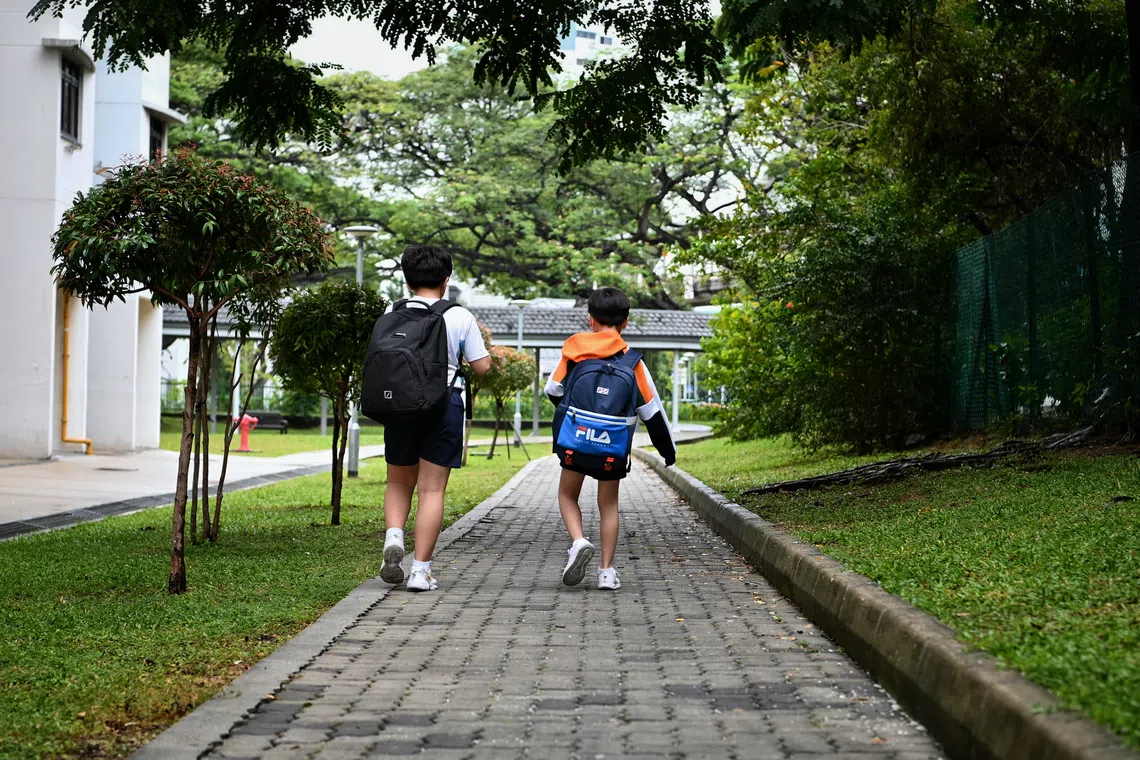
The Education Ministry said the moves are intended to widen access to the schools and encourage greater mixing among students from different backgrounds.
ST PHOTO: KUA CHEE SIONG
Vanessa Paige Chelvan
Published Sep 10, 2026, 06:31 PM
Updated Sep 10, 2026, 06:31 PM
SINGAPORE - Starting from the 2027 Primary 1 registration exercise, almost all schools in Singapore will open up more reserved spaces for children without prior connections .
For 12 schools in areas such as Bukit Timah and Marine Parade, places will also be reserved for children who live more than 2km away.
What are the latest changes announced on Sept 10, and how will they affect school applicants? The Straits Times explains.
Q: How will the 2027 P1 registration exercise change?
The changes will apply to Phase 2C, for children without prior ties to the school and where home-school distance plays a role in admission.
The number of places reserved for this phase will increase from 40 to 60 for almost all schools.
This change will not be applied to schools with smaller intakes of fewer than 180 pupils. In the 2026 P1 registration exercise, there were 27 such schools out of 179 schools that were open for registration in 2026.
For 12 schools in areas such as Bukit Timah and Marine Parade, where the proportion of public housing is significantly lower than the national average, the 60 reserved places in Phase 2C will be split into two tracks.
Thirty spots will be reserved for those who live within 2km of the school, and the remaining 30 will be for those who live further away. Within each of these two tracks, home-school distance priority will not apply.
“Some schools have a narrower socio economic mix of students, reflecting the profile of their immediate neighbourhoods,” said MOE on Sept 10. “This is partly due to the current home-school distance priority in the P1 registration framework, where priority is determined by citizenship, followed by home-school distance, when balloting is required.”
The other phases of registration - Phase 1, 2A and 2B - will remain unchanged.
Q: Which are the 12 schools which will have two tracks for Phase 2C?
Anglo-Chinese School (Junior)
Anglo-Chinese School (Primary)
CHIJ (Katong) Primary
Methodist Girls’ School (Primary)
Nanyang Primary School
Ngee Ann Primary School
Pei Hwa Presbyterian Primary School
Raffles Girls’ Primary School
Singapore Chinese Girls’ Primary School
St. Margaret’s School (Primary)
Tanjong Katong Primary School
Q: How were 12 schools selected?
The 12 schools are located in neighbourhoods where public housing makes up less than 40 per cent of homes within 2km of the school.
This is significantly lower than the national average, where about four in five of Singapore’s resident population live in public housing. So far, only these 12 schools are located in such neighbourhoods, MOE said.
When Anglo-Chinese School (Primary) moves from its current Barker Road campus in Newton to Tengah in 2030, it will be removed from the list.
MOE will periodically review the list of schools under the Phase 2C two-track scheme. But the ministry said it does not expect frequent changes to the list, as housing profiles do not change drastically over a short period.
Q: How will the 60 places in Phase 2C be allocated for the 12 affected schools?
The 60 Phase 2C places will be split equally between two tracks: children who live within 2km of the school and those who live more than 2km away.
There will be no home-school distance priority within either track. This means that a child who lives within 1km away from the school, for instance, will not be given priority over one who lives between 1km and 2km away.
There is also no upper limit to the home-school distance under Phase 2C.
Applications for all 60 places will open at the same time.
If there are more Singaporean applicants than places in either track, places will be allocated through balloting.
Excess places in one track will be offered to applicants on the other track within Phase 2C.
Q: Will there be fewer places in the earlier phases?
The increase in reserved Phase 2C places will come from the earlier registration phases, Phase 2A and Phase 2B.
Phase 2A is for children with a parent or sibling who is a former pupil; a parent who is a member of the school advisory or management committee; or a parent who is a school staff member. Children from MOE kindergartens that are under the purview of their chosen primary school also qualify for this phase.
Phase 2B is for children whose parent has volunteered at the school, whose parent is endorsed by a church or clan directly connected with the school, or whose parent is an active community leader.
Admission in Phase 2A is based on the places left after Phase 1 (no cap), and what has been set aside for Phase 2B (20) and 2C (60).
Phase 1 is for children who have an older sibling already enrolled in the school.
Even so, eligible families under earlier phases will continue to have priority over Phase 2C applicants.
The change seeks to balance MOE’s objectives of improving access for children without prior connections to the school, while continuing to recognise the contributions of alumni members and others who have supported the school and community.
Q: Will the two-track scheme reduce the admission chances of children living near the 12 schools?
The two-track scheme is intended to preserve access for children living near the school, while opening the 12 schools to a more diverse socio-economic mix of families.
Families living within 2km of the school will continue to have places set aside for them under the Phase 2C (≤2km) track. At the same time, the Phase 2C (>2km) track creates opportunities for these schools to enable their student profiles to better reflect Singapore’s diversity, said MOE.
MOE said it regularly reviews the provision of P1 places, taking into account factors including demographic trends and upcoming housing developments. While demand varies across schools depending on parents’ preferences, MOE said it plans sufficient P1 places for children in the different neighbourhoods, to enable children to be able to attend a school relatively near their homes.
Changes to the Primary 1 registration exercise over the years
April 2026: MOE said it would begin to gradually reduce P1 intake at many schools because of falling birth cohorts. For the 2026 registration exercise (for the 2027 P1 cohort), 61 of 179 primary schools reduced their intake, while 12 increased places. MOE said this was intended to maintain a good geographical spread of schools and avoid unnecessary mergers or relocations.
- Phases 2A1 and 2A2 were merged into a single Phase 2A. Alumni priority remained, but former students no longer had a separate earlier phase. Phase 2A also covered children whose parents or siblings had studied in the school, children of school staff, MOE Kindergarten children from the school and children of School Advisory/Management Committee members.
- Phase 2C reserved places doubled from 20 to 40 per school. Phase 2B retained its 20 reserved places, meaning 60 places in total were reserved at the start of the exercise - 20 for 2B and 40 for 2C.
- Remaining vacancies were redistributed between Phases 2B and 2C: one-third of vacancies remaining after Phase 2A were allocated to 2B and two-thirds to 2C.
- The way home-school distance was calculated changed. Instead of measuring from a single reference point based on the school’s original building layout, MOE began measuring from the school land boundary. This slightly expanded the number of homes falling within the 1km and 2km categories for most schools.
- The revised framework was implemented against a backdrop of increasing competition in Phase 2C: in 2021, about one in three schools balloted among Singapore Citizen applicants living within 1km, up from about one in four in 2014.
MOE announced a major review of the system, with changes taking effect from the 2022 P1 registration exercise (for children starting P1 in 2023). The changes were aimed partly at helping more children secure places in schools near their homes.
MOE Kindergarten children became eligible for Phase 2A2 if their MOE Kindergarten was under the purview of and co-located with the primary school. This gave them priority admission to support their transition to P1.
20 places were reserved for Phase 2C in every primary school. Phase 2C is for children with no prior connection to the school. The measure was intended to ensure that such children would have some places available even after earlier phases.
Phase 2A1 priority for alumni was introduced. Children whose parents were former students and had joined the school’s alumni association could register ahead of other groups. MOE said this was intended to strengthen alumni and community support for schools.
Vanessa Paige Chelvan is a correspondent at The Straits Times. She writes about all things transport and pens the occasional commentary.
Shermaine Ang is a journalist at The Straits Times, covering social issues in Singapore.
Primary 1 registration
Ministry of Education
教育部表示,这些举措旨在扩大入学机会,并鼓励不同背景的学生之间更多地交流。
《海峡时报》摄影:郭志雄
凡妮莎·佩奇·切尔万
发布于 2026 年 9 月 10 日下午 6:31
更新于2026年9月10日下午6:31
新加坡——从 2027 年小学一年级入学登记开始,新加坡几乎所有学校都将为没有关系的儿童开放更多预留名额。
在武吉知马和马林百列等地区的12所学校,还将为居住在2公里以外的儿童预留学位。
9月10日宣布的最新变化有哪些?这些变化将如何影响学校申请者?《海峡时报》对此进行了解释。
问:2027 年 P1 注册工作将有哪些变化?
这些变化将适用于 2C 阶段,即与学校没有先前联系的儿童,并且家庭与学校之间的距离在入学中起着一定作用。
这一阶段预留的学位名额将从40个增加到60个,几乎所有学校都将如此。
这项变更不适用于招生人数少于180人的学校。在2026年小学一年级(P1)入学登记中,在2026年开放登记的179所学校中,有27所属于此类学校。
对于武吉知马和马林百列等地区,公共住房比例远低于全国平均水平的12所学校,第二阶段C期的60个预留名额将分为两个方向分配。
学校将预留30个名额给居住在学校2公里范围内的学生,其余30个名额则留给居住在更远地区的学生。在这两类学生中,均不适用家庭住址与学校距离的优先原则。
教育部9月10日表示:“一些学校的学生社会经济构成较为单一,反映了其所在社区的概况。这部分是由于目前小学一年级注册框架中以家庭住址距离为优先考虑因素,在需要抽签的情况下,优先考虑的是公民身份,其次才是家庭住址距离。”
注册的其他阶段——第 1 阶段、第 2A 阶段和第 2B 阶段——将保持不变。
问:在第二阶段C中,哪12所学校将设置两条跑道?
英华中学(初级)
英华小学
圣婴女校(加东)小学
卫理公会女子小学
南洋小学
义安小学
培华长老会小学
莱佛士女子小学
新加坡女子小学
圣玛格丽特小学
丹戎加东小学
问:如何选出这12所学校?
这 12 所学校位于距离学校 2 公里范围内,公共住房占比不到 40% 的社区。
这远低于全国平均水平,新加坡约有五分之四的居民居住在公共组屋中。教育部表示,目前只有这12所学校位于此类社区。
当英华小学于 2030 年从位于牛顿的巴克路校区迁至登加校区时,它将从名单中移除。
教育部将定期检讨第二阶段C期双轨制计划下的学校名单。但教育部表示,预计名单不会频繁变动,因为住房结构在短期内不会发生剧烈变化。
问:第二阶段C的60个名额将如何分配给受影响的12所学校?
第二阶段C期的60个名额将平均分配给两个群体:居住在学校2公里以内的孩子和居住在2公里以外的孩子。
无论选择哪条入学路径,都不会考虑家校距离的远近。这意味着,例如,居住在离学校1公里以内的孩子,不会比居住在1公里到2公里之间的孩子享有优先权。
第二阶段C也对家庭与学校之间的距离没有上限。
所有60个名额的申请将同时开放。
如果新加坡申请人数超过两个方向的招生名额,则将通过抽签方式分配名额。
在第二阶段C中,一个方向的剩余名额将提供给另一个方向的申请人。
问:早期阶段的名额会比较少吗?
预留的第二阶段 C 名额的增加将来自之前的注册阶段,即第二阶段 A 和第二阶段 B。
第二阶段A适用于父母或兄弟姐妹曾就读于该校、父母是学校顾问委员会或管理委员会成员、或父母是学校教职员工的儿童。来自教育部幼儿园且该幼儿园隶属于其所选小学管辖范围的儿童也符合此阶段的资格。
第二阶段 B 适用于父母在学校担任志愿者、父母得到与学校直接相关的教会或家族的认可,或者父母是活跃的社区领袖的孩子。
第二阶段 A 的录取名额取决于第一阶段结束后剩余的名额(无上限),以及为第二阶段 B(20)和第二阶段 C(60)预留的名额。
第一阶段面向已有哥哥姐姐在该校就读的儿童。
即便如此,早期阶段符合条件的家庭仍将优先于 2C 阶段的申请人。
这项改革旨在平衡教育部改善与学校没有先前联系的儿童入学机会的目标,同时继续表彰校友和其他支持学校和社区的人士所做出的贡献。
问:双轨制方案是否会降低居住在12所学校附近的儿童的入学机会?
双轨制方案旨在保留居住在学校附近的儿童的入学机会,同时向更多不同社会经济背景的家庭开放这 12 所学校。
教育部表示,居住在学校2公里范围内的家庭将继续在第二阶段C类(≤2公里)招生计划下获得预留名额。同时,第二阶段C类(>2公里)招生计划也为这些学校创造了机会,使其学生构成更好地反映新加坡的多元化。
教育部表示,会定期检讨小学一年级学位供应情况,并考虑人口趋势和即将兴建的房屋等因素。虽然不同学校的需求会因家长的偏好而有所不同,但教育部表示,会为各个社区的儿童规划充足的小学一年级学位,使孩子们能够就近入学。
多年来小学一年级入学登记制度的变化
2026年4月:教育部表示,由于出生人口数量下降,将逐步减少许多小学一年级(P1)的招生名额。在2026年的入学登记中(针对2027届P1学生),179所小学中有61所减少了招生名额,而12所增加了招生名额。教育部表示,此举旨在保持学校良好的地域分布,避免不必要的合并或搬迁。
- 第二阶段A1和2A2合并为第二阶段A。校友优先权依然保留,但往届学生不再享有单独的早期阶段。第二阶段A还涵盖了父母或兄弟姐妹曾在该校就读的子女、学校教职工子女、教育部幼儿园就读于该校的儿童以及学校顾问/管理委员会成员的子女。
- 第二阶段C类预留名额从每所学校20个增加到40个。第二阶段B类保留了20个预留名额,这意味着在本次招生开始时总共预留了60个名额——第二阶段B类20个,第二阶段C类40个。
- 剩余空缺职位在第二阶段 B 和第二阶段 C 之间重新分配:第二阶段 A 结束后剩余空缺职位的三分之一分配给第二阶段 B,三分之二分配给第二阶段 C。
- 计算家校距离的方式发生了变化。教育部不再以学校原有建筑布局的单一参考点为基准进行测量,而是开始以学校用地边界为基准进行测量。这使得大多数学校1公里和2公里范围内的家庭数量略有增加。
- 修订后的框架是在第二阶段C竞争日益激烈的背景下实施的:2021年,约有三分之一的学校在居住在1公里范围内的新加坡公民申请者中进行抽签,而2014年这一比例约为四分之一。
教育部宣布对入学制度进行重大检讨,改革措施将于2022年小学一年级(P1)入学登记时生效(适用于2023年入读小学一年级的儿童)。改革的部分目的是为了帮助更多儿童在家附近的学校获得入学名额。
如果教育部幼儿园隶属于小学管辖且与小学位于同一校址,则该幼儿园的儿童有资格参加第二阶段A2计划。这使他们享有优先入学资格,以帮助他们顺利过渡到小学一年级。
每所小学都预留了20个名额给第二阶段C类入学儿童。第二阶段C类入学儿童与该校此前并无任何联系。此举旨在确保即使在之前的入学阶段结束后,这些儿童仍能有部分入学名额。
针对校友的第二阶段A1优先入学计划正式启动。父母是该校校友且已加入校友会的子女可以优先于其他群体进行注册。教育部表示,此举旨在加强校友和社区对学校的支持。
Vanessa Paige Chelvan是《海峡时报》的记者。她撰写有关交通运输方面的文章,偶尔也撰写评论文章。
Shermaine Ang是《海峡时报》的记者,负责报道新加坡的社会问题。
小学一年级注册
教育部