200 years of law: How Singapore’s legal system has helped shape the nation200年的法律历程:新加坡的法律体系如何塑造了这个国家
Explore how Singapore's legal system and the Rule of Law have shaped the nation's stability, prosperity and global reputation over 200 years. Read more at straitstimes.com.
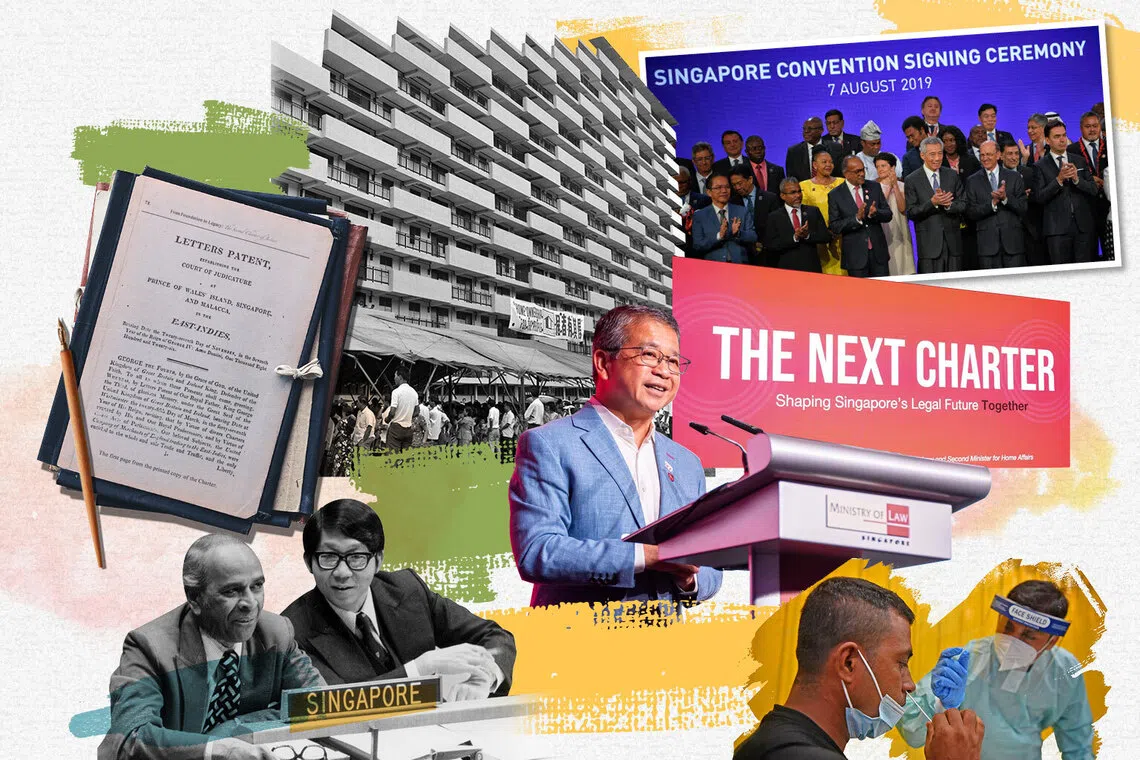
The Rule of Law is more than lawyers and legislation. It underpins the stability, fairness and predictability that enabled Singapore to grow from a colonial trading post into a global city
The Rule of Law has played a key role in Singapore’s development, from the early years of nation-building to the challenges of a changing world.
PHOTOS: SPH MEDIA, GETTY IMAGES, MINISTRY OF LAW, “FROM FOUNDATION TO LEGACY: THE SECOND CHARTER OF JUSTICE” BY JUSTICE ANDREW PHANG, UNITED NATIONS
Published Sep 11, 2026, 04:00 AM
What exactly is the Rule of Law?
Stripped of its legal jargon, the Rule of Law is a set of enduring principles. That no one – not even the government – is above the law.
That laws are clear, applied consistently and enforced by independent courts. And that, every person, whatever their status or means, is equal before the law and is entitled to a fair hearing.
The Rule of Law is not an abstract ideal. It is what gives every citizen confidence that he or she will be treated fairly in court. It is what gives every business the assurance that a contract will be honoured. And it is what gives every investor certainty that the rules will not change overnight.
For a small city-state with no natural resources, trust is everything.
The foundations of Singapore’s legal system
Singapore inherited its modern legal system from the British. In 1826, the Second Charter of Justice established Singapore’s modern legal and judicial system and, for the first time, a common body of law applied to everyone on the island – regardless of race, language or religion. It was a significant moment.
But for much of the colonial era, the law was wielded less for the benefit of ordinary inhabitants than to advance the interests of empire and trade.
The legal systems gave merchants the legal certainty they needed to do business, and it helped grow revenue for the British colonial power – including through the licensing of opium sale for profit.
The courts were largely the preserve of the wealthy. Social services were thin, and the police had limited ability to enforce laws and maintain stability for the population.
The focus of the legal system only began to change after independence.
Building trust, stability and prosperity
When Singapore became a sovereign nation in 1965, its founding leaders – including Mr Lee Kuan Yew, who was a lawyer – recognised the Rule of Law as one of the most valuable legacies the British had left behind, even as they saw how it had to be reshaped to serve a new purpose: the pillar for Singapore’s nation-building.
To deliver on that promise, the young nation invested in strong legal institutions – the Judiciary, the Attorney-General’s Chambers, and the Police – each tasked with applying the law firmly and fairly.
The powers of the Corrupt Practices Investigation Bureau were also enhanced through the Prevention of Corruption Act in 1960, to stamp out corruption.
Clear and predictable rules, reliably enforced, gave businesses and investors the confidence to put down roots in an untested country.
The results were dramatic. In 1965, the average income per person was around US$500 (S$633). By 2024, it had climbed to more than US$75,000.
Just as important was safety and security. The Singapore of the 1950s and 1960s was crime-ridden and uneasy – plagued by secret societies and gang violence, and scarred by the racial riots of 1964 and 1969. The Rule of Law became the instrument for restoring order and binding a divided society together.
To safeguard racial and religious harmony, equality was written into our Constitution, and the Presidential Council for Minority Rights was established in 1970.
The Maintenance of Religious Harmony Act later provided further safeguards against conduct that could fracture the peace between faiths.
To reduce crime, tough measures were introduced. The Criminal Law (Temporary Provisions) Act gave the authorities powers to clamp down on secret societies, while drug laws were tightened – including the introduction of the death penalty for serious drug trafficking in 1975.
The law also underpinned social policies that still shape the everyday life of ordinary Singaporeans.
Public housing was delivered through the Housing and Development Act; retirement savings through the Central Provident Fund; national defence through the Enlistment Act of 1970; and, in time, schooling for every child through a framework of compulsory education. Each policy was made real through law – and each remains woven into the fabric of our lives today.
In 1984, a resident holds an older view of Hong Lim area, since transformed by a hawker centre and high-rise public housing. PHOTO: SPH MEDIA
In 1984, a resident holds an older view of Hong Lim area, since transformed by a hawker centre and high-rise public housing.
The Rule of Law also shaped how the young nation took its place in the world. Joining the United Nations in 1965 brought Singapore into a rules-based international order in which disputes between states were to be settled by law rather than force – an existential matter for a small, open and trade-dependent country.
And Singapore did not merely play by those rules; we helped write them.
Singaporeans such as Professor S Jayakumar, Professor Tommy Koh and then-Attorney-General Chao Hick Tin played a leading role in negotiating the United Nations Convention on the Law of the Sea, adopted in 1982, which set the legal framework governing the world’s oceans and the vital shipping lanes on which Singapore’s prosperity depends.
From nation-building to global relevance
By the 1990s, Singapore’s nation-building years were largely complete. The challenge had grown from simply holding a young country together to ensuring that the Rule of Law remained effective in a rapidly changing world.
As the economy became more globalised and society more complex, new demands were placed on the legal system.
One response was to build institutions that could support the growing volume of cross-border trade and investment flowing through the region.
Singapore’s reputation for fair and impartial justice became an engine of growth in its own right. The Singapore International Arbitration Centre was established in 1991, offering the international business community an efficient and reliable venue for dispute resolution.
This was followed by the opening of Maxwell Chambers in 2010 – the world’s first integrated dispute resolution complex, the establishment of the Singapore International Mediation Centre in 2014, and the establishment of the Singapore International Commercial Court in 2015.
Together, these institutions further cemented Singapore’s reputation as a safe, stable and neutral venue for cross-border commercial disputes.
A broader shift in thinking about dispute resolution was also underway. While courts remained essential in determining rights and obligations, increasing emphasis was placed on helping parties resolve conflicts through dialogue, compromise and mutual agreement – in ways that preserved relationships and produced lasting outcomes.
Singapore’s leadership in this field was recognised internationally when the United Nations adopted the Singapore Convention on Mediation in 2018, the first international convention to bear Singapore’s name.
This thinking extended beyond commercial disputes. The Community Mediation Centre was established in 1998 to help neighbours, families and members of the public settle disagreements amicably, while the Community Disputes Resolution Tribunals were introduced in 2015.
A similar shift was underway in criminal and family justice.
In our criminal system, the focus increasingly extended beyond punishment towards rehabilitation and reintegration through initiatives like the Yellow Ribbon Project in 2004 and the introduction of community-based sentences in 2010.
In family justice, the establishment of the Family Justice Courts in 2014 and the recommendations by the Committee to Review and Enhance Reforms in the Family Justice System paved the way for the adoption of the Therapeutic Justice Model, a problem-solving and relationship-centred approach designed to help families resolve disputes while preserving family bonds.
If earlier generations built and globalised Singapore’s legal system, this generation faces a different task: keeping it relevant against challenges that move faster than ever before.
We entered the 2020s with an upheaval no one could have anticipated: the Covid-19 pandemic, which disrupted daily life, paralysed businesses and strained contractual relationships on a scale few had imagined.
Almost overnight, businesses could not honour their contracts and tenants could not pay their rent. The legal system had to respond quickly.
Singapore passed the Covid-19 (Temporary Measures) Act within nine days, temporarily shielding individuals, families and businesses from legal action over rents, loans and contracts they could no longer meet, and allowing court hearings to continue online.
It was a bold step – having the law reach into private contracts is not something any government does lightly.
As then-Minister for Law and Minister for Home Affairs K. Shanmugam SC explained, insisting on the strict letter of contract law in such an extraordinary moment would have undermined its very spirit: the trust on which all commerce depends.
Yet the relief was carefully bounded – available only where hardship was genuinely caused by the pandemic, and designed to lapse once the crisis passed.
A new, informal system of assessors was created so that thousands of ordinary people could resolve disputes quickly, without the cost and formality of court. The Rule of Law was used as a tool – firm, fair and focused on outcomes.
If the Covid-19 pandemic tested the legal system’s ability to respond to crises, the digital age posed a different challenge: How do you govern risks that are evolving as quickly as the technology behind them?
As digital technologies transformed everyday life, new legislations were enacted to provide clear protections and safeguard public trust in an increasingly online world – from the Protection from Harassment Act to newer measures tackling online falsehoods, scams and abuse.
In 2023, the Online Criminal Harms Act was passed, which enabled the Government to issue directions where there is a suspicion of online activity carried out in furtherance of an offence.
In 2025, the Online Safety (Relief and Accountability) Act 2025 was passed, establishing a dedicated Online Safety Commission with the power to issue directions to put a stop to specified online harms, giving victims timely and accessible relief.
Yet amid all these changes, one principle remained constant – that justice must be accessible to all, regardless of means.
The Legal Aid Bureau, now nearly seven decades old, has provided civil legal aid to thousands of people over the years.
The establishment of the Public Defender’s Office in 2022 further strengthened Singapore’s criminal justice system by providing criminal legal aid to eligible accused persons who cannot afford a lawyer.
Looking ahead, further headwinds are on the horizon. Geopolitical tensions, economic nationalism, climate change and the rise of AI, which has turbocharged online harms such as deepfakes and scams.
In the face of these emerging challenges, the Rule of Law must evolve to remain meaningful and effective.
Yet the core principles of the Rule of Law remain as relevant now as they were in Singapore’s early years. Their endurance lies in their ability to adapt to changing times, to remain effective and meaningful.
As Minister for Law, Edwin Tong SC, put it: “Today, we look ahead, and think about the next Charter… keeping our laws up to date, meeting demands of the market, making sure that we evolve to remain relevant is a key feature of the Singapore justice system.”
PHOTOS: SPH MEDIA, GETTY IMAGES, MINISTRY OF LAW, “FROM FOUNDATION TO LEGACY: THE SECOND CHARTER OF JUSTICE” BY JUSTICE ANDREW PHANG, LIM KHENG CHYE COLLECTION (COURTESY OF NATIONAL ARCHIVES OF SINGAPORE), UNITED NATIONS
法治不仅仅关乎律师和立法。它支撑着新加坡的稳定、公平和可预测性,使新加坡得以从一个殖民贸易站发展成为一座国际化大都市。
从建国初期到应对不断变化的世界带来的挑战,法治在新加坡的发展中发挥了关键作用。
图片来源:新加坡报业控股(SPH MEDIA)、盖蒂图片社(GETTY IMAGES)、新加坡法律部、安德鲁·方大法官所著《从奠基到传承:第二部正义宪章》、联合国
发布于 2026 年 9 月 11 日 上午 4:00
法治究竟是什么?
抛开法律术语,法治是一套永恒的原则,即任何人——即使是政府——都不能凌驾于法律之上。
法律必须清晰明确,执行始终如一,并由独立的法院强制执行。而且,每个人,无论其身份或经济状况如何,在法律面前一律平等,并享有公平审判的权利。
法治并非抽象的理想。它赋予每一位公民信心,相信自己在法庭上会受到公正对待;它赋予每家企业保障,相信合同会得到履行;它赋予每一位投资者确信,规则不会在一夜之间改变。
对于一个没有自然资源的小城邦来说,信任至关重要。
新加坡法律体系的基础
新加坡的现代法律体系继承自英国。1826年,《第二份正义宪章》确立了新加坡的现代法律和司法体系,并首次实现了岛上所有人——无论种族、语言或宗教——都适用同一法律。这是一个意义非凡的时刻。
但在殖民时代的大部分时间里,法律的运用与其说是为了造福普通居民,不如说是为了推进帝国和贸易的利益。
法律体系为商人提供了开展业务所需的法律确定性,并帮助英国殖民政权增加了收入——包括通过发放鸦片销售许可证牟利。
法院基本上是富人的专属领地。社会服务薄弱,警察执法和维护社会稳定的能力有限。
法律体系的重心直到独立后才开始转变。
建立信任、稳定和繁荣
1965年新加坡成为一个主权国家时,其开国领导人——包括身为律师的李光耀先生——认识到法治是英国留下的最宝贵的遗产之一,尽管他们也看到了法治必须被重新塑造以服务于新的目的:成为新加坡国家建设的支柱。
为了兑现这一承诺,这个年轻的国家投资建立了强大的法律机构——司法机构、总检察长办公室和警察——每个机构都肩负着坚定公正地执行法律的重任。
为了根除腐败,1960 年《防止腐败法》也加强了贪污调查局的权力。
清晰、可预测的规则,加上可靠的执行,让企业和投资者有信心在一个未经检验的国家扎根。
结果令人瞩目。1965年,人均收入约为500美元(633新元)。到2024年,这一数字已攀升至超过75000美元。
安全保障同样至关重要。20世纪五六十年代的新加坡犯罪猖獗,社会动荡不安——秘密社团和帮派暴力横行,1964年和1969年的种族骚乱更是给这片土地留下了难以磨灭的伤痕。法治成为恢复秩序、弥合社会分裂的工具。
为了维护种族和宗教和谐,平等被写入宪法,总统少数族裔权利委员会于 1970 年成立。
《维护宗教和谐法》后来提供了进一步的保障措施,防止可能破坏不同信仰间和平的行为。
为了减少犯罪,政府采取了严厉措施。《刑法(临时规定)法》赋予当局打击秘密社团的权力,同时加强了毒品法律的管制——包括1975年对严重贩毒行为引入死刑。
该法律也为至今仍在影响新加坡普通民众日常生活的社会政策奠定了基础。
公共住房是通过《住房和发展法》提供的;退休储蓄是通过中央公积金提供的;国防是通过1970年的《征兵法》提供的;最终,通过义务教育体系实现了每个孩子的受教育权。每一项政策都通过法律得以落实——而且每一项政策至今仍然深深融入我们的生活之中。
1984年,一位居民拍摄了一张昔日芳林地区的照片,如今这里已变成小贩中心和高层公屋区。照片:新加坡报业控股媒体
1984 年,一位居民对芳林地区抱有旧时的印象,而如今,芳林地区已被小贩中心和高层公共住房所改变。
法治也塑造了这个年轻国家在世界上的地位。1965年加入联合国,使新加坡融入了以规则为基础的国际秩序,在这个秩序中,国家间的争端应通过法律而非武力解决——这对一个面积小、开放且依赖贸易的国家来说,是关乎其存亡的大事。
新加坡不仅遵守这些规则,我们还参与了规则的制定。
新加坡人如 S Jayakumar 教授、Tommy Koh 教授和当时的司法部长赵锡廷在 1982 年通过的《联合国海洋法公约》的谈判中发挥了主导作用,该公约确立了世界海洋和新加坡繁荣所依赖的重要航道的法律框架。
从国家建设到全球影响力
到了20世纪90年代,新加坡的建国历程基本完成。挑战也从维系一个年轻国家的统一,转变为确保法治在快速变化的世界中保持有效。
随着经济全球化程度加深和社会日益复杂化,法律体系面临着新的要求。
其中一项应对措施是建立能够支持该地区日益增长的跨境贸易和投资的机构。
新加坡公正无私的司法声誉本身就成为了其经济增长的引擎。新加坡国际仲裁中心成立于1991年,为国际商界提供了一个高效可靠的争议解决场所。
随后,2010 年,世界首个综合性争议解决中心——麦士威商事中心开业;2014 年,新加坡国际调解中心成立;2015 年,新加坡国际商事法庭成立。
这些机构共同巩固了新加坡作为跨境商业纠纷安全、稳定和中立场所的声誉。
更广泛的争议解决理念也在发生转变。虽然法院在确定权利和义务方面仍然至关重要,但人们越来越重视通过对话、妥协和相互协商来解决冲突,以维护双方关系并取得持久成果。
新加坡在该领域的领导地位得到了国际社会的认可,联合国于 2018 年通过了《新加坡调解公约》,这是第一项以新加坡命名的国际公约。
这种理念不仅限于商业纠纷。社区调解中心成立于1998年,旨在帮助邻里、家庭和公众友好地解决分歧;而社区纠纷解决法庭则于2015年推出。
刑事司法和家庭司法领域也正在发生类似的转变。
在我们的刑事司法系统中,重点逐渐从惩罚转向改造和重新融入社会,例如 2004 年的“黄丝带计划”和 2010 年引入的社区矫正措施。
在家庭司法领域,2014 年家庭司法法院的成立以及审查和加强家庭司法系统改革委员会的建议,为采用治疗性司法模式铺平了道路。治疗性司法模式是一种以解决问题和关系为中心的模式,旨在帮助家庭解决纠纷,同时维护家庭纽带。
如果说前几代人建立并全球化了新加坡的法律体系,那么这一代人则面临着不同的任务:使其与时俱进,应对前所未有的快速变化带来的挑战。
2020 年代伊始,我们遭遇了一场无人预料的剧变:新冠肺炎疫情,它扰乱了日常生活,使企业瘫痪,并以前所未有的规模破坏了合同关系。
几乎一夜之间,企业无法履行合同,租户也无法支付租金。法律体系必须迅速做出反应。
新加坡在九天内通过了《新冠肺炎(临时措施)法》,暂时保护个人、家庭和企业免受因无法履行租金、贷款和合同而面临的法律诉讼,并允许法庭听证会继续在线进行。
这是一个大胆的举措——让法律介入私人合同并非任何政府会轻易做出的事情。
正如当时的律政部长兼内政部长尚穆根高级律师所解释的那样,在这种特殊时刻坚持严格遵守合同法的字面规定,将会破坏合同法的精神:所有商业活动所依赖的信任。
然而,救济措施受到严格限制——仅在疫情确实造成困难的情况下才可获得,并且一旦危机过去,救济措施就会终止。
一套全新的非正式评估员体系应运而生,使成千上万的普通民众能够快速解决纠纷,免去诉讼的费用和繁琐程序。法治被用作一种工具——坚定、公平且注重结果。
如果说新冠疫情考验了法律体系应对危机的能力,那么数字时代则带来了不同的挑战:如何管控那些随着技术发展而快速演变的风险?
随着数字技术改变了日常生活,新的法律法规相继出台,旨在为公众提供明确的保护,维护公众对日益网络化的世界的信任——从《防止骚扰法》到打击网络虚假信息、诈骗和滥用行为的新措施。
2023 年,《网络犯罪危害法》获得通过,该法授权政府在怀疑存在为实施犯罪而进行的网络活动时,可以发布指令。
2025 年,《2025 年网络安全(救济和问责)法案》获得通过,设立了专门的网络安全委员会,该委员会拥有发布指令制止特定网络危害的权力,并为受害者提供及时便捷的救济。
然而,在所有这些变化中,有一条原则始终不变——那就是无论手段如何,所有人都必须享有正义。
法律援助局成立至今已有近七十年,多年来为成千上万的人提供了民事法律援助。
2022 年公共辩护人办公室的成立进一步加强了新加坡的刑事司法系统,为符合条件但无力聘请律师的被告人提供刑事法律援助。
展望未来,更多不利因素即将到来。地缘政治紧张局势、经济民族主义、气候变化以及人工智能的兴起,都加剧了网络犯罪,例如深度伪造和诈骗。
面对这些新出现的挑战,法治必须不断发展才能保持其意义和有效性。
然而,法治的核心原则在今天仍然像新加坡建国初期一样具有现实意义。它们的持久性在于能够适应时代的变化,保持有效性和意义。
正如律政部长唐振辉高级律师所说:“今天,我们展望未来,思考下一部宪章……使我们的法律与时俱进,满足市场需求,确保我们不断发展以保持相关性,这是新加坡司法制度的一个关键特征。”
图片:新加坡报业控股媒体、盖蒂图片社、新加坡律政部、安德鲁·潘法官所著《从奠基到传承:第二部正义宪章》、林庆财收藏(由新加坡国家档案馆提供)、联合国