Surface-Launched Version Of The Tomcat’s AIM-54 Phoenix Missile Nearly Armed Cold War Carriers“雄猫”战斗机AIM-54“不死鸟”导弹的陆基发射版本,几乎武装到牙齿的冷战时期航母
The Sea Phoenix air defense system would have ported the weapons system from the F-14 Tomcat onto Navy flattops.
新闻视频
Published Aug 11, 2021 6:30 PM EDT
The U.S. Navy’s Cold War-era AIM-54 Phoenix long-range air-to-air missile , the primary fleet air defense armament of its F-14 Tomcat interceptors for four decades, was also adapted for surface launch from warships. The little-known Sea Phoenix project also involved installing the F-14’s fire-control radar on a ship and progressed as far as missile test launches.
The Sea Phoenix concept had emerged by the mid-1970s and was proposed as an alternative or a replacement for the early versions of the Sea Sparrow , which was another adaptation of an air-to-air missile for fleet defense. At that time, the air-launched AIM-54 was already in frontline use on the Navy’s F-14 fighters , coupled with the powerful AN/AWG-9 pulse-Doppler fire-control radar system as part of a sophisticated defense, primarily intended to defeat Soviet naval cruise missiles, and the long-range aircraft that carried them.
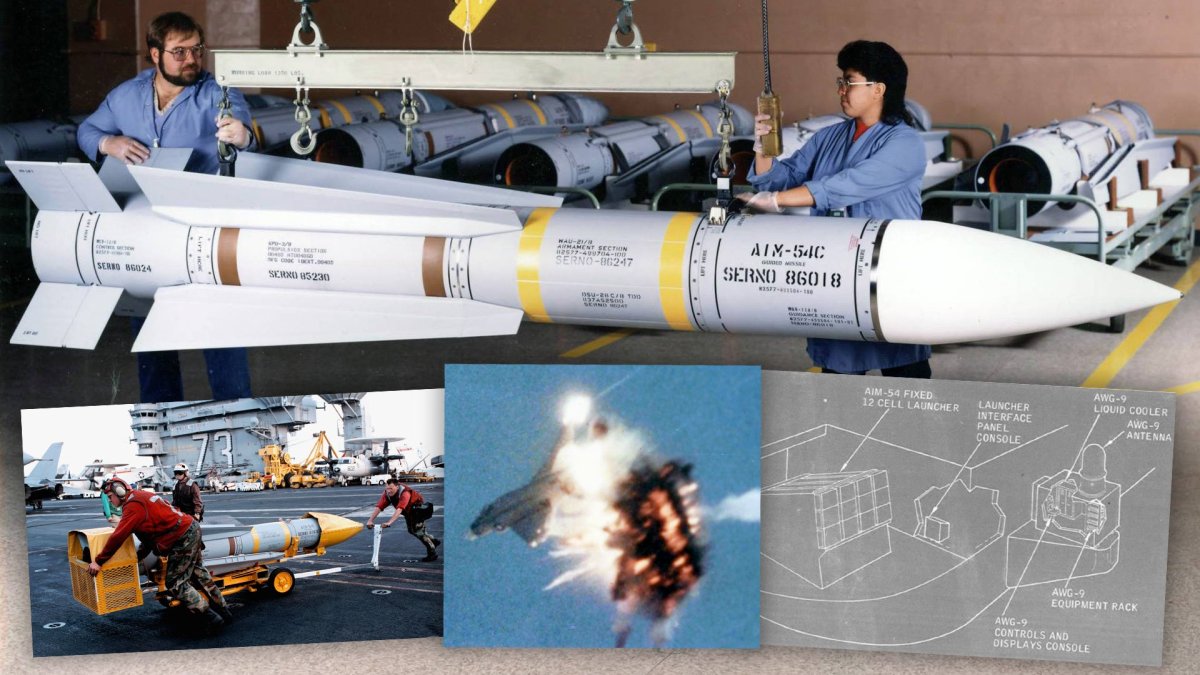
The massive AIM-54A Phoenix on a ground handling trolley., U.S. Navy
The origins of the Phoenix and the AWG-9 date back beyond the F-14 and can be found in the Navy’s Bendix AAM-N-10 Eagle and the Air Force’s Hughes GAR-9 , two similar, but ultimately abortive long-range air-to-air missile programs. Superseding these, Hughes Aircraft began development of the Phoenix in 1962, and a first full-scale test of the missile was achieved on September 8, 1966, from an NA-3A Skywarrior over the Navy Pacific Missile Range. The AIM-54A became operational with the Navy’s F-14As in 1974.
The first launch of an AIM-54A Phoenix air-to-air missile from an NA-3A Skywarrior testbed, on September 8, 1966., U.S. Navy
While Tomcats launched from the deck of aircraft carriers were intended to provide an outer layer of protection for Carrier Battle Groups, the Sea Phoenix would have been installed on the carriers themselves, providing a closer, but still long-range defensive ring against any aircraft or missiles that may have made it through.
The plan was to install three launchers on each carrier so equipped, to provide full 360-degree coverage for each ship. Each of those systems would have been a standalone item , combining a fixed 12-cell launcher for Phoenix missiles, an AWG-9 radar, plus the various controls and displays required to operate it.
The USN looked at the idea of a ship version of the AWG-9 /Phoenix combination.Test of the radar was done in the USNS Wheeling in 74 and a missile was fired in a ground test a China Lake. Three radars boxes each with 12 cell launchers was the setup for the big carriers. #aviation pic.twitter.com/kzeTMQQb1Y — The Shadow of the Eagle (@clemente3000) February 27, 2021
The USN looked at the idea of a ship version of the AWG-9 /Phoenix combination.Test of the radar was done in the USNS Wheeling in 74 and a missile was fired in a ground test a China Lake. Three radars boxes each with 12 cell launchers was the setup for the big carriers. #aviation pic.twitter.com/kzeTMQQb1Y
Installing the Sea Phoenix on a carrier, or on another warship, for that matter, was not expected to pose too many problems. According to Hughes Aircraft, responsible for building both the AIM-54 and the AWG-9, a full 27 of the 29 major components of the system could be added to a warship, with next to no modifications required.
The advantages of the Sea Phoenix would have included the ability to engage multiple targets simultaneously. After all, the AWG-9 was capable of tracking up to 24 targets simultaneously in track-while-scan mode and then engaging six of these with Phoenix missiles. That number was limited by the six AIM-54s that each F-14 could carry (reduced to four missiles for routine carrier-based operations), but potentially more targets could have been engaged using the Sea Phoenix system with its greater ‘magazine depth.’
An AIM-54 Phoenix destroys a QF-4 drone in 1983., U.S. Navy
The AIM-54 also offered very impressive performance for a missile at this time. In its original AIM-54A form, the weapon had an air-launched range of up to around 72.5 nautical miles and it could hit a top speed of Mach 4.3. However, this would have been reduced in surface-launched form, with the air-launched model gaining extra reach thanks to the speed and altitude of the launching aircraft.
In comparison, the air-launched AIM-7F Sparrow has a range of approximately 38 nautical miles, which is slashed to around 14 nautical for the Sea Sparrow’s RIM-7P missile. Nevertheless, despite the range penalty of the surface-launched AIM-54, which weighed a hefty 1,000 pounds, it’s clear that its performance would have far outstripped that of the Sea Sparrow in terms of range.
An RIM-7P Sea Sparrow missile launches from the Nimitz class aircraft carrier USS Abraham Lincoln (CVN-72)., U.S. NAVY
For shorter-range engagements, the air-launched AIM-54 employed active radar homing for the duration of its flight and this would likely have been the case for the shipborne version, too. The minimum engagement range for air-launch was around 2 nautical miles.
The original plans called for the Phoenix/AWG-9 combination to be installed on warships with little changes made to them but, “at a later stage, the system could be further enhanced by applying missile modifications to optimize it for the naval role,” according to the 1977 edition of Jane’s Weapon Systems . Unconfirmed accounts suggest there was a plan to install an additional booster stage, to address the reduction in range after surface launch, and this might have been the modifications referred to.
A Sea Sparrow shot from the USS Midway (CV-41) in the early 1980s. Note the manned missile director position, located on the lower corner of the flight deck, on the left of the photo., U.S. Navy
Tests of the surface-launched Phoenix missile included a firing from what was then known as Naval Weapons Center China Lake, in California, during which a standard version of the missile traveled a distance of 13.5 miles in 90 seconds. This test, however, was less concerned with evaluating end-to-end performance than it was the separation of the missile from its launcher, as well as safety aspects. If they did occur, no other such tests appear to have been documented.
Meanwhile, the 14th production example of the AWG-9 radar was installed aboard the missile-tracking ship USNS Wheeling , in 1974, where it “successfully detected and tracked multiple targets at both high and low altitude from the ship’s deck,” according to a report in the United States Army Combat Forces Journal . “In multiple target tests,” the report continued, “five aircraft were flown in the target area and successfully tracked.”
USNS Wheeling (T-AGM-8), in a 1973 photo provided by the Pacific Missile Range Headquarters, Point Mugu, California., U.S. Navy
Unconfirmed reports suggest the AWG-9 radar was also tested on land, in a container van setup, at Point Mugu, California. This was likely in relation to a possible land-based mobile version of the Phoenix, reportedly intended for the U.S. Marine Corps. Few, if any details about this program are readily available, although it could perhaps have provided a notably potent air defense capability for the service’s expeditionary operations.
While the Sea Phoenix would also have offered much more in the way of anti-aircraft and anti-missile defense capabilities than the Sea Sparrow, it seems that its development was abandoned due to the high costs involved.
In addition, while the Sea Sparrow provided an intermediate to close-range point-defense capability, the same was not the case for the Sea Phoenix, which was by no means a dogfight missile and would have been of limited value against close-in, maneuvering threats. The AWG-9 radars, mounted low on the carrier’s sides, would be severely limited at detecting low-flying threats over the horizon.
It could also be argued that, with escort warships and F-14s already providing a robust outer defensive layer, there was not a pressing need for this same capability to be replicated aboard the carrier itself.
An F-14A Tomcat of VF-201 fires an AIM-54 missile in 1987., U.S. Navy
Still, had the Navy pursued the Sea Phoenix, the service could well have ended up with a very capable air defense system, the self-contained nature of which could have meant it would have been able to be added to existing warships fairly easily. It could have also provided a useful intermediate capability between the Sea Sparrow and other point-defense systems and the long-range Aegis system with its Standard missiles .
Nevertheless, with Aegis around the corner, the value of the Sea Phoenix’s multi-target, long-range engagement capability was reduced accordingly. Meanwhile, the Sea Sparrow also gained a multi-target capability after the introduction of multiple illuminators and full integration with the ship’s combat system. Today, the RIM-162 Evolved Sea Sparrow Missile is far more capable than the RIM-7, but leverages its same infrastructure.
A manual Sea Sparrow missile director aboard the USS Dwight D. Eisenhower (CVN-69) in 1982., U.S. National Archives
In the event, the Navy’s aircraft carriers were left with the Sea Sparrow to protect them against close-to-medium-range threats, with outer-tier defense left to other assets. As for the Navy’s air-launched Phoenix, it was retired from service in 2004, long after the apparent demise of the Soviet cruise missile threat.
With all this in mind, the surface-launched sister missile to the AIM-54 remains little known but is certainly an intriguing case of “what might have been,” had the Navy chosen to pursue it.
Contact the author: thomas@thedrive.com
Comments couldn’t be loaded. Please refresh the page.
发布于美国东部时间2021年8月11日下午6:30
美国海军冷战时期研制的AIM-54“不死鸟”远程空空导弹,曾是其F-14“雄猫”战斗机四十年来的主要舰队防空武器,也被改装用于舰载发射。鲜为人知的“海上不死鸟”项目还包括将F-14的火控雷达安装到舰艇上,并已完成导弹试射。
“海凤凰”导弹的概念在20世纪70年代中期就已经出现,并被提议作为早期“海麻雀”导弹的替代方案或替代品。“海麻雀”导弹是另一种用于舰队防御的空空导弹。当时,空射型AIM-54导弹已经装备在海军的F-14战斗机上,并与强大的AN/AWG-9脉冲多普勒火控雷达系统配合使用,构成了一套复杂的防御系统,其主要目的是拦截苏联海军巡航导弹及其搭载的远程飞机。
巨大的AIM-54A“不死鸟”导弹被放置在地面搬运车上。(美国海军)
“不死鸟”导弹和AWG-9导弹的起源可以追溯到F-14战斗机之前,可以追溯到海军的本迪克斯AAM-N-10“鹰”导弹和空军的休斯GAR-9导弹——这两个类似的远程空空导弹项目最终都以失败告终。休斯飞机公司于1962年开始研发“不死鸟”导弹,并于1966年9月8日在海军太平洋导弹靶场上空,由一架NA-3A“空中勇士”飞机进行了首次全尺寸测试。AIM-54A导弹于1974年开始装备海军的F-14A战斗机。
1966年9月8日,美国海军从NA-3A“空中战士”试验机上首次发射AIM-54A“不死鸟”空空导弹。
虽然从航空母舰甲板上起飞的“雄猫”战斗机旨在为航母战斗群提供外层保护,但“海凤凰”导弹系统将安装在航母本身上,提供更近距离但仍然远程的防御圈,以抵御任何可能突破防线的飞机或导弹。
该计划是在每艘配备该系统的航母上安装三套发射装置,以实现每艘舰艇360度全方位覆盖。每套系统都是独立单元,包含一个用于发射“不死鸟”导弹的固定式12单元发射装置、一部AWG-9雷达以及操作所需的各种控制装置和显示器。
美国海军曾考虑过将AWG-9/Phoenix组合雷达舰载化。1974年,该雷达在“惠灵”号补给舰上进行了测试,并在中国湖进行了地面导弹试射。大型航母的配置方案是:三个雷达箱,每个雷达箱配备12个单元的发射装置。#航空 pic.twitter.com/kzeTMQQb1Y — The Shadow of the Eagle (@clemente3000) February 27, 2021
美国海军曾考虑过将AWG-9/Phoenix组合雷达部署到舰载。1974年,该雷达在“惠灵”号补给舰上进行了测试,并在中国湖进行了地面导弹试射。大型航母的配置方案是三个雷达箱,每个雷达箱配备12个单元的发射装置。#航空 pic.twitter.com/kzeTMQQb1Y
将“海凤凰”导弹系统安装到航母或其他军舰上,预计不会遇到太多问题。据负责制造AIM-54和AWG-9导弹系统的休斯飞机公司称,该系统29个主要部件中的27个几乎无需任何改装即可安装到军舰上。
海凤凰导弹系统的优势之一在于能够同时攻击多个目标。毕竟,AWG-9雷达系统能够在边扫描边跟踪模式下同时跟踪多达24个目标,并用其中的6个目标发射“不死鸟”导弹进行攻击。这一数字受限于每架F-14战斗机可携带的6枚AIM-54导弹(在例行航母作战中减少至4枚),但海凤凰导弹系统凭借其更大的弹匣容量,理论上可以同时攻击更多目标。
1983年,一枚AIM-54“不死鸟”导弹击落了一架QF-4无人机。(美国海军)
AIM-54导弹在当时也展现出了非常出色的性能。最初的AIM-54A型空射射程可达约72.5海里,最高速度可达4.3马赫。然而,如果采用地基发射,射程会有所缩短;而空射型则凭借发射飞机的速度和高度优势,射程得以进一步提升。
相比之下,空射型AIM-7F“麻雀”导弹的射程约为38海里,而“海麻雀”导弹的RIM-7P导弹的射程则缩短至约14海里。尽管地射型AIM-54导弹的射程较短(重量高达1000磅),但其射程性能显然远超“海麻雀”导弹。
一枚RIM-7P“海麻雀”导弹从尼米兹级航空母舰“亚伯拉罕·林肯”号(CVN-72)上发射。(美国海军)
对于近距离交战,空射型AIM-54导弹在整个飞行过程中都采用主动雷达制导,舰载型AIM-54导弹可能也是如此。空射型AIM-54的最小交战距离约为2海里。
最初的计划是将“不死鸟”/AWG-9组合导弹安装在军舰上,无需进行太多改动。但根据1977年版《简氏武器系统》的记载,“在后期阶段,可以通过对导弹进行改进来进一步增强该系统,使其更适合海军作战”。一些未经证实的说法表明,当时曾计划加装一个助推级,以解决水面发射后射程缩短的问题,这可能就是文中提到的改进方案。
这张“海麻雀”导弹照片拍摄于20世纪80年代初,由“中途岛”号航空母舰(CV-41)拍摄。请注意照片左侧飞行甲板下角的有人值守导弹指挥仪。(美国海军)
对水面发射的“不死鸟”导弹的测试包括一次从当时位于加利福尼亚州的中国湖海军武器中心进行的发射。在这次测试中,一枚标准型导弹在90秒内飞行了13.5英里。然而,这次测试与其说是评估导弹的整体性能,不如说是评估导弹与发射装置的分离以及安全性能。如果确实进行过类似的测试,目前似乎没有其他记录。
与此同时,第14台量产型AWG-9雷达于1974年安装在导弹跟踪舰“惠灵”号上。据《美国陆军作战部队杂志》报道,该雷达“成功地从舰甲板上探测并跟踪了多个高低空目标”。报道还指出,“在多目标测试中,五架飞机飞入目标区域并被成功跟踪。”
美国海军“惠灵”号补给舰(T-AGM-8),摄于1973年,由加利福尼亚州穆古角太平洋导弹靶场总部提供。
未经证实的消息称,AWG-9雷达也曾在加利福尼亚州穆古角进行过陆地测试,测试装置是一个集装箱式集装箱。这很可能与“不死鸟”防空系统的陆基移动版本有关,据称该系统是为美国海军陆战队研发的。目前关于该项目的细节信息很少,甚至几乎没有,但它或许能为海军陆战队的远征作战提供相当强大的防空能力。
虽然“海凤凰”级潜艇在防空和反导防御能力方面也比“海麻雀”级潜艇强得多,但由于成本过高,其研发似乎被放弃了。
此外,虽然“海麻雀”导弹具备中近程点防御能力,但“海凤凰”导弹却并非如此。它并非近距离空战导弹,对付近距离机动目标价值有限。安装在航母两侧较低位置的AWG-9雷达在探测地平线以外的低空目标时也存在严重局限性。
也可以认为,由于护航战舰和 F-14 战机已经提供了强大的外部防御层,因此没有必要在航母本身上复制这种能力。
1987年,美国海军VF-201中队的一架F-14A“雄猫”战斗机发射了一枚AIM-54导弹。
不过,如果海军当初选择研发“海凤凰”防空系统,很可能最终会得到一套性能卓越的防空系统。由于其独立运行的特性,该系统可以相对容易地加装到现有军舰上。此外,它还可以作为“海麻雀”等近程防御系统与配备“标准”导弹的远程“宙斯盾”系统之间的一种有效的过渡方案。
然而,随着宙斯盾系统的即将问世,海凤凰导弹的多目标远程打击能力价值也相应降低。与此同时,海麻雀导弹在引入多个照明器并与舰载作战系统完全整合后,也获得了多目标打击能力。如今,RIM-162改进型海麻雀导弹的性能远超RIM-7,但仍沿用了相同的配套设施。
1982年,美国海军“德怀特·D·艾森豪威尔”号航空母舰(CVN-69)上的“海麻雀”导弹手动指挥仪。(美国国家档案馆)
最终,海军的航空母舰只能依靠“海麻雀”导弹来抵御近中程威胁,而外围防御则交由其他武器装备负责。至于海军的空射型“不死鸟”导弹,早在2004年就已退役,那时苏联巡航导弹的威胁早已不复存在。
考虑到所有这些因素,AIM-54 的舰载姊妹导弹仍然鲜为人知,但如果海军选择继续研发,这无疑是一个引人入胜的“可能结果”的例子。
联系作者:thomas@thedrive.com
评论加载失败,请刷新页面。