Arguably The Most Earth-Shattering Text Message Of All Time Was Sent 77 Years Ago Today可以说,史上最具震撼力的短信是在77年前的今天发出的。
The first message alerting others of Japan's surprise attack on Pearl Harbor was short and devastatingly clear.
Updated Dec 1, 2019 7:05 AM EST
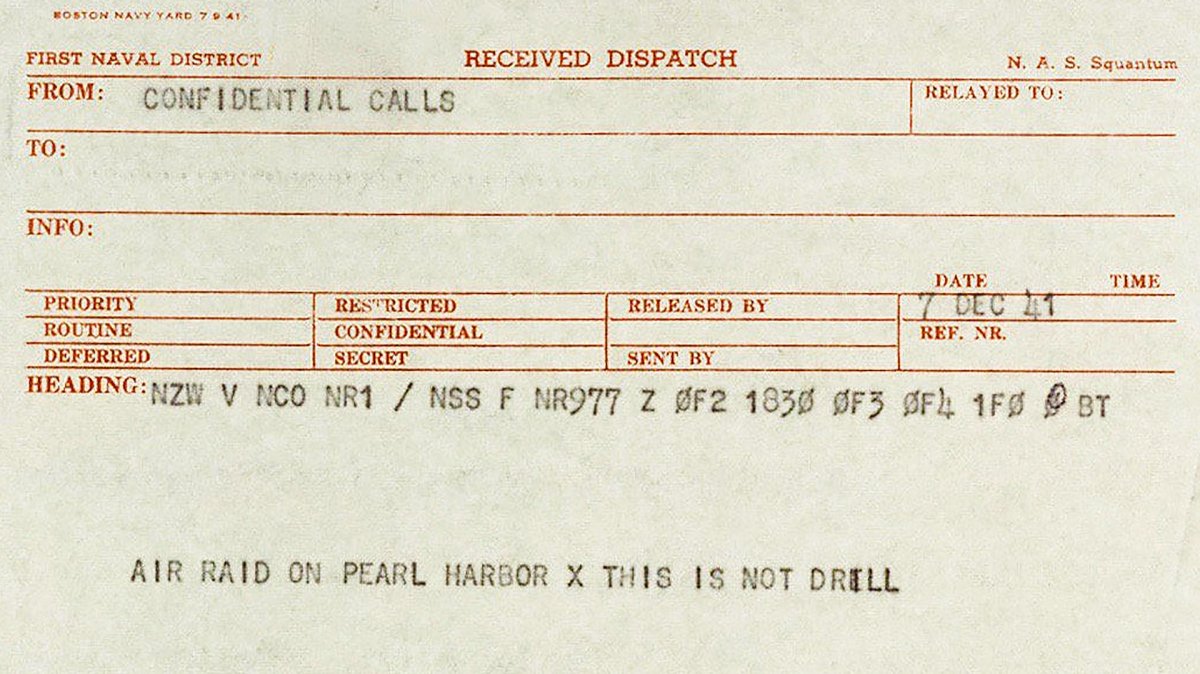
The message above was sent by the office of the Commander in Chief of the Pacific Fleet just minutes after the Japanese attack on Pearl Harbor began. It went out to ships and naval stations throughout the Pacific region and word of it quickly spread beyond. It was the first official correspondence acknowledging an event that would change the course of history in so many ways—one that still hangs over strategic decision making and national security policy to this very day.
The telegram was sent at 7:58am on December 7th, 1941 by Lieutenant Commander Logan Ramsey who had just witnessed first-hand low-flying airplanes with big red meatballs on their sides attacking Ford Island. The message informed Navy vessels of the attack, including the carriers that, by a stroke of sheer luck, were out at sea that fateful day and were spared from the onslaught of Yamamoto’s planned waves of aerial bombardment on the strategic American outpost in the Pacific.
For two hours and 20 minutes, beginning at 7:55am, Pearl Harbor was bombarded and strafed by Japanese aircraft. In all, 2,403 people on the American side were killed, 55 Japanese also perished in the operation, and 21 ships and 300 aircraft were damaged or entirely destroyed.
Visitpearlharbor.org
It was a horrendous blow military to the United States, but even more so psychologically. The U.S. could no longer avoid wading into the maelstrom that we now call World War II. The next day, President Roosevelt declared war on Japan and a formal congressional declaration of war against all the Axis Powers would follow three days later.
The House of Representatives historical webpage describes how these declarations occurred in the following passage:
On this date, the House approved declarations of war against Axis Powers Germany and Italy—just three days after Congress had declared war against Japan. On the morning of December 11, during a rambling speech at the German Reichstag, Adolph Hitler declared war on the United States in accord with the Tripartite Pact of September 27, 1940; Italy followed suit. President Roosevelt’s swift rejoinder requesting a declaration of war against both Axis nations was read to the House by reading clerk Irving Swanson. “The forces endeavoring to enslave the entire world now are moving toward this hemisphere,” Roosevelt wrote. “Rapid and united effort by all of the peoples of the world who are determined to remain free will ensure a world victory of the forces of justice and of righteousness over the forces of savagery and of barbarism.” The House first adopted the war resolution against Germany 393–0, followed moments later by a 399–0 vote to declare war on Italy. In both instances, Jeannette Rankin of Montana, who had voted against the declaration of war on Japan, answered “Present.” Shortly afterward, Frances Bolton of Ohio, who had earlier opposed U.S. intervention in the European conflict, summed up congressional resolve as isolationist sentiment melted away. Bolton told colleagues, “all that is passed. We are at war and there is no place in our lives for anything that will not build up our strength and power, and build it quickly.” After the conclusion of the session, Speaker of the House Sam Rayburn of Texas presented the gavel to reading clerk Swanson in appreciation for having read Roosevelt’s message and taken the roll calls. That gavel is now on display in the Capitol Visitor Center.
On this date, the House approved declarations of war against Axis Powers Germany and Italy—just three days after Congress had declared war against Japan. On the morning of December 11, during a rambling speech at the German Reichstag, Adolph Hitler declared war on the United States in accord with the Tripartite Pact of September 27, 1940; Italy followed suit.
President Roosevelt’s swift rejoinder requesting a declaration of war against both Axis nations was read to the House by reading clerk Irving Swanson. “The forces endeavoring to enslave the entire world now are moving toward this hemisphere,” Roosevelt wrote. “Rapid and united effort by all of the peoples of the world who are determined to remain free will ensure a world victory of the forces of justice and of righteousness over the forces of savagery and of barbarism.” The House first adopted the war resolution against Germany 393–0, followed moments later by a 399–0 vote to declare war on Italy.
In both instances, Jeannette Rankin of Montana, who had voted against the declaration of war on Japan, answered “Present.” Shortly afterward, Frances Bolton of Ohio, who had earlier opposed U.S. intervention in the European conflict, summed up congressional resolve as isolationist sentiment melted away. Bolton told colleagues, “all that is passed. We are at war and there is no place in our lives for anything that will not build up our strength and power, and build it quickly.” After the conclusion of the session, Speaker of the House Sam Rayburn of Texas presented the gavel to reading clerk Swanson in appreciation for having read Roosevelt’s message and taken the roll calls. That gavel is now on display in the Capitol Visitor Center.
Often times, there is confusion about the first communique from the attack on Pearl Harbor as it appears on multiple letterheads and in various formats, but that is because those documents are receipts of the message that was transmitted to many locales and ships. For instance, the carrier USS Lexington (CV-2) was on her way to Midway to deliver Marine fighter aircraft when the message came through. The ship’s Executive Officer Wallace “Gotch” Dillon was first to see it come through the teletype machine. This is that version of the message:
National Naval Aviation Museum
Nearly 12 hours later, the Lexington received an official message that she should be ready to intercept the Japanese fleet and avenge the attack. This would likely have been a suicide mission, but the order to execute that mission never came.
Other messages that emanated throughout the day from Oahu were many in number and highly inaccurate due to the fog of war and the very real sense that an invasion of the islands was imminent. In the days after the attack, with security now at its highest state on the smoldering paradise-like island, personnel trying just to get word home that they survived the raid became an exercise in extreme message control and brevity. This is an example of the postcards that servicemembers were allowed to send home to let loved ones know that they had survived the attack:
Today, 77 years after that horrible day, text messaging is once again a primary form of communication, although our variation of it is far more nimble than the kind our forebearers were using during World War II. But that doesn’t mean it can’t have just as large an impact, in fact, it can be even more impactful due to its widely distributed nature and near instantaneous delivery. This was demonstrated to a disastrous degree recently in the Hawaiian Islands of all places when the government sent out an alert to the population saying a ballistic missile strike was imminent. Chaos, confusion, fear, and eventually anger ensued. Now the President of The United States has their own direct emergency text service via FEMA at their disposal as well.
With all this in mind, it’s a bit bewildering to think that 77 years after “the date that will live in infamy,” God forbid there is another attack on the United States, or any other large-scale national emergency, we will probably hear about it first via text message as well.
Contact the author: Tyler@thedrive.com
Comments couldn’t be loaded. Please refresh the page.
更新于美国东部时间2019年12月1日上午7:05
上述信息由太平洋舰队总司令办公室在日军偷袭珍珠港后几分钟内发出。信息迅速传遍太平洋地区的舰艇和海军基地,消息很快传到更远的地方。这是官方首次正式承认这一事件,该事件在诸多方面改变了历史进程——时至今日,它仍然对战略决策和国家安全政策产生着深远的影响。
1941年12月7日上午7点58分,海军中校洛根·拉姆齐发出了这份电报。他刚刚亲眼目睹了侧面涂着醒目红色“肉丸”标志的低空飞机袭击福特岛。电报将此次袭击告知了海军舰艇,包括那些侥幸在事发当天出海的航母。这些航母侥幸躲过了山本五十六对太平洋战略要地福特岛发起的大规模空袭。
从早上7点55分开始,珍珠港遭到日军飞机长达2小时20分钟的炮击和扫射。美军方面共有2403人丧生,日军也有55人阵亡,21艘舰艇和300架飞机受损或被彻底摧毁。
访问pearlharbor.org
这对美国来说是一次沉重的军事打击,但心理上的打击更为严重。美国再也无法回避卷入我们今天称之为第二次世界大战的漩涡之中。第二天,罗斯福总统对日本宣战,三天后,国会正式对所有轴心国宣战。
美国众议院历史网页在以下段落中描述了这些声明的由来:
就在这一天,众议院批准了对轴心国德国和意大利的宣战决议——而就在三天前,国会刚刚对日本宣战。12月11日上午,阿道夫·希特勒在德国国会大厦发表了一篇冗长的演讲,根据1940年9月27日签署的《三国同盟条约》对美国宣战;意大利随后也宣布对美宣战。罗斯福总统迅速回应,要求对轴心国宣战,这份文件由宣读员欧文·斯旺森在众议院宣读。“企图奴役全世界的势力正向西半球推进,”罗斯福写道,“全世界所有决心保持自由的人民,只要迅速团结一致,必将确保正义和公义的力量战胜野蛮和残暴的力量。”众议院首先以393票赞成、0票反对通过了对德宣战决议,随后又以399票赞成、0票反对通过了对意大利宣战决议。在这两次表决中,此前曾投票反对对日宣战的蒙大拿州众议员珍妮特·兰金都回答“出席”。不久之后,此前曾反对美国介入欧洲冲突的俄亥俄州众议员弗朗西丝·博尔顿总结了国会的决心,表明孤立主义情绪正在消退。博尔顿对同事们说:“所有决议都已通过。我们正处于战争状态,任何不利于增强我们实力和力量的事物,尤其是在快速增强方面,都不应该出现在我们的生活中。” 会议结束后,众议院议长、德克萨斯州众议员萨姆·雷伯恩将议事槌赠予宣读员斯旺森,以感谢他宣读了罗斯福的咨文并进行了唱名表决。这把议事槌现陈列于国会大厦游客中心。
就在这一天,众议院批准了对轴心国德国和意大利的宣战决议——而就在三天前,国会刚刚对日本宣战。12月11日上午,阿道夫·希特勒在德国国会大厦发表了一篇冗长的演讲,根据1940年9月27日签署的《三国同盟条约》,向美国宣战;意大利随后也宣布对美宣战。
罗斯福总统迅速回应,要求对轴心国宣战,这份回应由宣读员欧文·斯旺森在众议院宣读。“企图奴役全世界的势力正向西半球推进,”罗斯福写道,“全世界所有决心保持自由的人民,只要迅速团结一致,必将确保正义和公义的力量战胜野蛮和野蛮的力量。”众议院首先以393票赞成、0票反对通过了对德宣战决议,随后又以399票赞成、0票反对通过了对意大利宣战的决议。
在这两起事件中,曾投票反对对日宣战的蒙大拿州众议员珍妮特·兰金都回答“出席”。不久之后,此前曾反对美国干预欧洲冲突的俄亥俄州众议员弗朗西丝·博尔顿总结了国会的决心,孤立主义情绪逐渐消散。博尔顿对同事们说:“一切都已通过。我们正处于战争状态,任何不利于增强我们实力和力量的事物,尤其是在快速增强方面,都不应存在于我们的生活中。” 会议结束后,众议院议长、德克萨斯州众议员萨姆·雷伯恩将议事槌赠予宣读员斯旺森,以感谢他宣读了罗斯福的咨文并进行了点名。这把议事槌现陈列于国会大厦游客中心。
人们常常对珍珠港事件后的第一份公报感到困惑,因为它出现在多个信笺抬头和各种格式的文件上,但这其实是因为这些文件是发送到多个地点和舰船的电报的收据。例如,当“列克星敦”号航空母舰(CV-2)正前往中途岛运送海军陆战队战斗机时,收到了这份公报。该舰的执行官华莱士·“戈奇”·狄龙是第一个通过电传打字机看到这份公报的人。以下是当时的版本:
国家海军航空博物馆
将近12小时后,“列克星敦”号收到正式电报,要求其做好拦截日本舰队并为此次袭击复仇的准备。这很可能是一次自杀式任务,但执行该任务的命令始终没有下达。
当天从瓦胡岛传出的其他消息数量众多,但由于战争迷雾以及岛屿即将遭受入侵的真实感受,这些消息大多不准确。袭击发生后的几天里,在这座仍在冒着烟的天堂般岛屿上,安保级别达到了最高,人员想要将自己在袭击中幸存的消息传回家,就必须严格控制信息,力求简洁。以下是军人被允许寄回家告知亲人自己幸存的明信片示例:
今天,距离那场可怕的灾难已经过去了77年,短信再次成为主要的沟通方式,尽管我们现在使用的短信比我们的前辈在二战期间使用的要灵活得多。但这并不意味着它的影响力会减弱,事实上,由于其广泛的传播和近乎即时的送达,它的影响力甚至可能更大。最近在夏威夷群岛发生的一起灾难性事件就充分证明了这一点:政府向民众发出警报,称弹道导弹袭击即将到来。随之而来的是混乱、困惑、恐惧,最终是愤怒。现在,美国总统也可以通过联邦紧急事务管理署(FEMA)使用自己的紧急短信服务。
考虑到这一切,想到在“那个遗臭万年的日子”77年后,如果美国再次遭受袭击,或者发生任何其他大规模国家紧急事件,我们很可能也会首先通过短信得知消息,这多少令人感到困惑。
联系作者:Tyler@thedrive.com
评论加载失败,请刷新页面。