Norway’s coastal rangers eye fresh drones to find threats at sea挪威海岸巡护员正考虑使用新型无人机来搜寻海上威胁。
With sabotage risks on NATO’s mind, formations like this are rising to new prominence in national force structures.
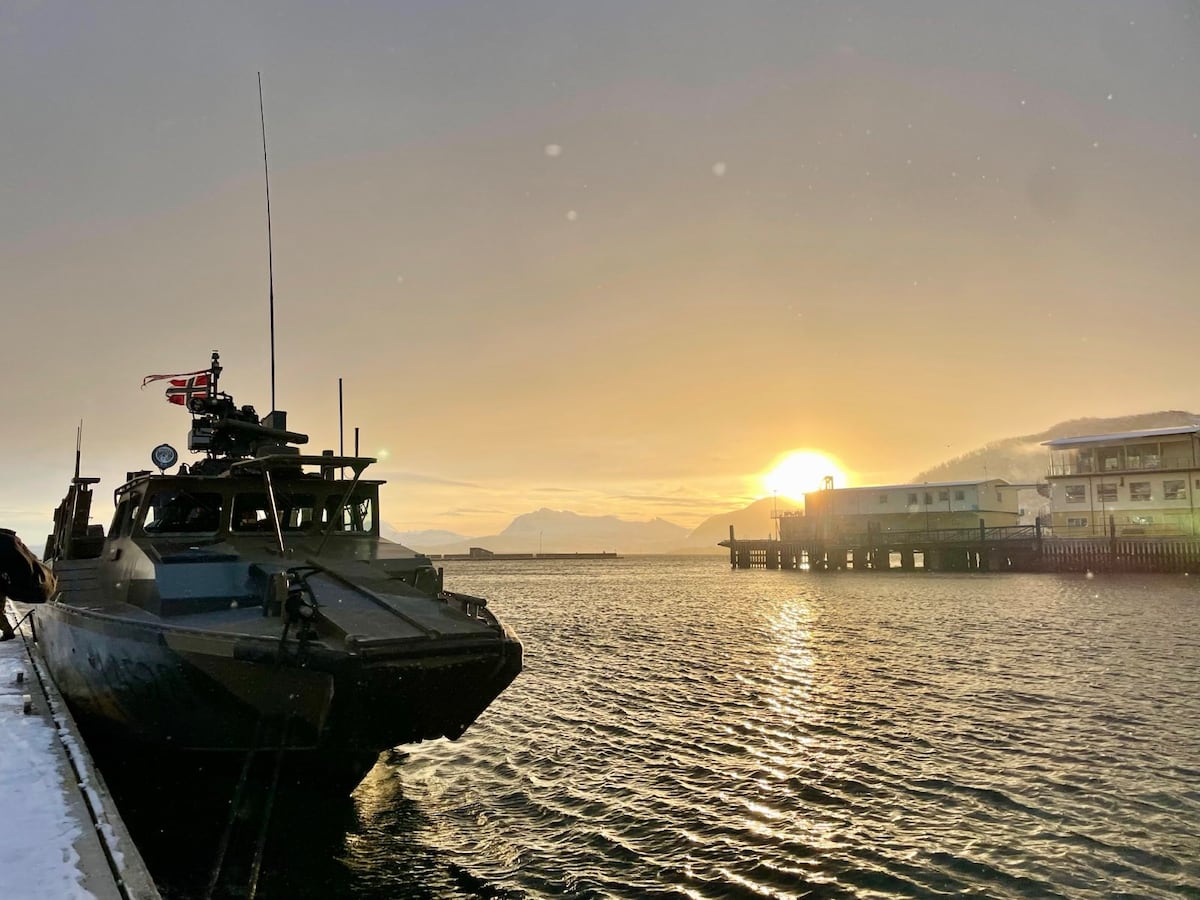
HARSTAD, Norway — Some hundreds of kilometers from a Russian naval base in Murmansk Oblast, a formation of military boats dash across the frigid Norwegian Sea.
A team of officers bearing the Norwegian flag on their uniform climb from one moving vessel onto another, a larger Norwegian Coast Guard offshore patrol ship, using a single pole with a hook and flimsy ladder to haul themselves up.
They are part of the Norwegian Coastal Rangers, a marine commando unit trained to operate in littoral combat environments. In the context of the NATO exercise Joint Viking 2025, organized earlier this month, they trained for the task of boarding a suspicious vessel.
The ship-boarding scenario has turned front and center in the alliance’s recent defense planning. Western officials fear that NATO adversaries employ ships under the guise of research missions or civilian cargo runs to damage undersea cables and energy infrastructure in the waters around Europe.
The small Norwegian unit, composed of roughly 150 individuals, is highly versatile, tasked with missions spanning from coastal raids and maritime patrol to intelligence-gathering. With sabotage risks on NATO’s mind , formations like this are rising to new prominence in national force structures.
In its annual national threat assessment report, the Norwegian Police Security Services noted that in the last year, Russia has shown “its resolve and ability to carry out sabotage operations on European soil” and that it is “likely” that it may affect Norway in 2025.
The NATO member shares a 198-kilometer (123-mile) land border with Russia in the Arctic and a maritime frontier in the Barents Sea.
While the Coastal Rangers have not noticed an uptick in the number of illegal or sanctioned vessels sailing along the Norwegian coast, officers did note that there has been an increase in the level of electromagnetic jamming over the last few years.
Norwegian defense authorities recently approved a series of upgrades to modernize and expand the capabilities of the ranger unit. Among these is the acquisition of new unmanned technologies, including long-range maritime surveillance drones, according to Frode Nakken, commanding officer of the Coastal Rangers.
“We’ve been operating with drones for a few years, primarily fixed-wing models, but they have proven vulnerable to the Arctic climate – the larger and longer-range drones we will get will have more endurance and power to resist these conditions,” he told Defense News during the Joint Viking exercise.
Winter temperatures in Northern Norway can easily drop to -10 degrees Celsius, where the cold quickly drains the drones’ battery life and the abundant precipitation makes it tricky for operators to fly them.
The 2025-2036 Norwegian Defense Pledge stated that the ambition is to have the unmanned aerial systems stationed at Andøya Air Station, some 300 kilometers north of the Arctic Circle.
The Norwegian Ministry of Defense has contacted U.S. manufacturers, including Northrop Grumman and General Atomics regarding this request for information, as reported by Janes.
A General Atomics spokesman told Defense News that the company has already responded to the solicitation, pitching its MQ-9B SeaGuardian.
“It will provide Norway with 360-degree maritime radar coverage and full SIGINT capabilities – the MQ-9B is the only remotely piloted aircraft able to perform anti-submarine warfare missions, allowing it to enhance the country’s existing fleet of P-8 patrol aircraft,” said spokesman C. Mark Brinkley.
Elisabeth Gosselin-Malo was a Europe correspondent for Defense News. She covers a wide range of topics related to military procurement and international security, and specializes in reporting on the aviation sector. She is based in Milan, Italy.
挪威哈尔斯塔德——距离摩尔曼斯克州的一个俄罗斯海军基地数百公里处,一队军舰疾驰在冰冷的挪威海上。
一队身着挪威国旗制服的军官从一艘行驶中的船只爬到另一艘更大的挪威海岸警卫队近海巡逻舰上,他们用一根带钩子的杆子和简易梯子把自己拉了上去。
他们是挪威海岸游骑兵部队的一员,这是一支训练有素的海军陆战队突击队,擅长在近岸作战环境中行动。在本月初举行的北约“联合维京2025”演习中,他们接受了登船检查可疑船只的训练。
在北约近期的国防规划中,登船作战已成为重中之重。西方官员担心,北约的对手会以科研任务或民用货物运输为幌子,利用船只破坏欧洲周边海域的海底电缆和能源基础设施。
这支由约150人组成的小型挪威部队用途广泛,任务涵盖海岸突袭、海上巡逻和情报搜集等。鉴于北约对破坏风险的担忧,像这样的部队在各国军队结构中的重要性日益凸显。
挪威警察安全部门在其年度国家威胁评估报告中指出,在过去一年中,俄罗斯已经展现出“在欧洲领土上进行破坏行动的决心和能力”,并且“很可能”会在 2025 年对挪威造成影响。
这个北约成员国与俄罗斯在北极地区共享 198 公里(123 英里)的陆地边界,并在巴伦支海拥有海上边界。
虽然海岸巡逻队没有注意到在挪威海岸航行的非法或合法船只数量有所增加,但官员们确实注意到,过去几年里电磁干扰的程度有所增加。
挪威国防部最近批准了一系列升级计划,旨在提升海岸巡逻队的能力并实现现代化。据海岸巡逻队指挥官弗罗德·纳肯称,其中包括采购新型无人技术,例如远程海上监视无人机。
“我们使用无人机已经好几年了,主要是固定翼机型,但它们已被证明很容易受到北极气候的影响——我们将获得的更大、航程更远的无人机将具有更强的续航能力和动力来抵抗这些条件,”他在联合维京演习期间告诉《防务新闻》。
挪威北部的冬季气温很容易降至零下 10 摄氏度,严寒会迅速耗尽无人机的电池电量,而充沛的降水也会使操作员难以操控无人机飞行。
2025-2036 年挪威国防承诺指出,其目标是在北极圈以北约 300 公里的安德亚空军基地部署无人机系统。
据简氏防务周刊报道,挪威国防部已就此信息请求与包括诺斯罗普·格鲁曼公司和通用原子公司在内的美国制造商进行了联系。
通用原子公司的一位发言人告诉《防务新闻》,该公司已经对此次招标做出了回应,推介了其MQ-9B“海卫士”无人机。
发言人 C·马克·布林克利表示:“这将为挪威提供 360 度海上雷达覆盖和完整的信号情报能力——MQ-9B 是唯一能够执行反潜作战任务的遥控驾驶飞机,使其能够增强该国现有的 P-8 巡逻机机队。”
伊丽莎白·戈斯林-马洛曾任《防务新闻》欧洲通讯员。她的报道涵盖军事采购和国际安全等广泛领域,尤其擅长航空领域的报道。她常驻意大利米兰。