AI company Helsing unveils swarming underwater surveillance drones人工智能公司Helsing推出集群式水下监视无人机
The company’s artificial-intelligence tool Lura is at the heart of the setup, processing data from SG-1 Fathom drones.
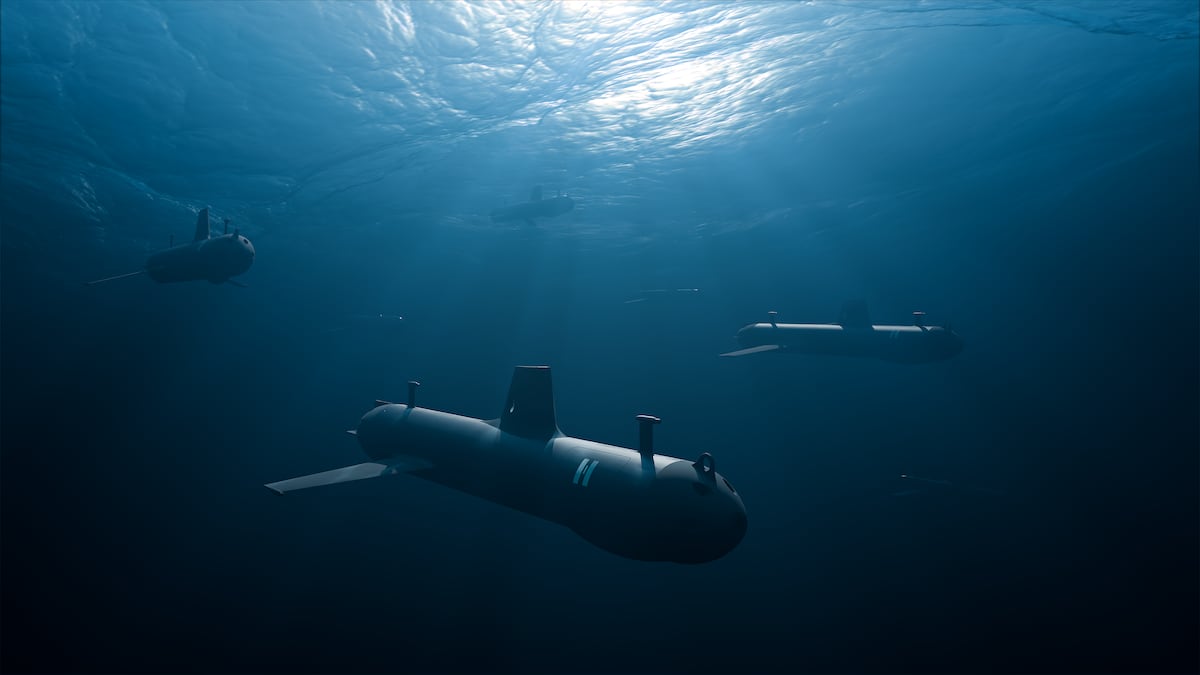
MILAN — Germany-based Helsing has launched an underwater drone surveillance network powered by artificial intelligence for the detection of enemy submarines and ships out at sea for months at a time.
The company’s artificial-intelligence tool Lura is at the heart of the setup, processing data from SG-1 Fathom drones, Helsing said in a statement.
By relying on a large-scale acoustic model, Lura is able to detect and categorize a variety of undersea threats based on the signature they emit, including submarines and different types of ships, at a high accuracy, according to the company.
“Lura’s use of this model enables it to detect acoustic signatures 10 times quieter than other AI models, even differentiating between specific vessels from within the same class, at a speed up to 40 times faster than humans,” reads the Helsing statement.
Many nations with advanced militaries collect intelligence about adversary ships, from the acoustic noise emitted by their propulsion systems to the characteristics of the wake form and water bubble generated by them. Analysts can then cross-check that data to identify threats at sea.
According to Helsing, the Fathom drone is swarming-capable, which means hundreds can be deployed at a time patrolling an area’s underwater environment for up to three months.
The company demonstrated the setup last week Portsmouth Naval Base, England, as the company expects to deploy the capability within the year.
Potential regions for deployment included the North and Baltic seas, where NATO is currently carrying out its Baltic Sentry mission focused on securing critical infrastructure at sea.
The military alliance has also trialled an AI software tool, dubbed Mainsail, developed by the NATO Centre for Maritime Research and Experimentation in Italy, which flags suspicious vessels. It allows sifting through and analyzing enormous amounts of data such as maritime traffic to enable authorities to collect underwater intelligence or detect boats diverting off-course.
“Deploying AI to the edge of underwater constellations will illuminate the oceans and deter our adversaries for a strong Europe,” the co-founder and co-CEO of Helsing, Gundbert Scherf, said.
Elisabeth Gosselin-Malo was a Europe correspondent for Defense News. She covers a wide range of topics related to military procurement and international security, and specializes in reporting on the aviation sector. She is based in Milan, Italy.
米兰——总部位于德国的赫尔辛公司推出了一项由人工智能驱动的水下无人机监视网络,用于探测海上敌方潜艇和舰船,一次监视时间可达数月之久。
赫尔辛在一份声明中表示,该公司的人工智能工具 Lura 是该装置的核心,用于处理来自 SG-1 Fathom 无人机的数据。
据该公司称,Lura 利用大规模声学模型,能够根据水下威胁发出的特征,高精度地探测和分类各种水下威胁,包括潜艇和不同类型的船只。
“Lura 使用该模型,能够检测到比其他 AI 模型安静 10 倍的声学特征,甚至可以区分同一类别中的特定船只,速度比人类快 40 倍,”赫尔辛声明中写道。
许多拥有先进军事力量的国家都会收集敌方舰艇的情报,包括其推进系统发出的声学噪声、尾流形状特征以及产生的水泡等。分析人员随后可以交叉比对这些数据,以识别海上威胁。
据赫尔辛称,Fathom 无人机具备集群作战能力,这意味着可以同时部署数百架无人机,在一个区域的水下环境中巡逻长达三个月。
该公司上周在英国朴茨茅斯海军基地展示了该装置,并预计将在年内部署该功能。
潜在的部署区域包括北海和波罗的海,北约目前正在这些海域执行“波罗的海哨兵”任务,重点是保护海上关键基础设施。
该军事联盟还试用了一款名为“Mainsail”的人工智能软件工具,该工具由位于意大利的北约海上研究与实验中心开发,能够识别可疑船只。它能够筛选和分析海量数据,例如海上交通信息,从而使当局能够收集水下情报或探测偏离航线的船只。
“将人工智能部署到水下星座的边缘,将照亮海洋,并威慑我们的对手,从而建立一个强大的欧洲,”Helsing 的联合创始人兼联合首席执行官 Gundbert Scherf 表示。
伊丽莎白·戈斯林-马洛曾任《防务新闻》欧洲通讯员。她的报道涵盖军事采购和国际安全等广泛领域,尤其擅长航空领域的报道。她常驻意大利米兰。