Origins Of Stealth Black Hawks Date Back Over Three Decades Before The Bin Laden Raid隐形黑鹰直升机的起源可以追溯到击毙本·拉登行动三十多年前。
At the dawn of the stealth revolution, the Army was already working to turn its new Black Hawk helicopter into a stealth special operations platform.
新闻视频
Updated Dec 1, 2019 6:39 AM EST
There are few defense or aviation stories as enigmatic as the mystery surrounding the highly modified H-60 Black Hawks that were used during the operation to capture or kill Osama Bin Laden. Most remain perplexed that the helicopters not only emerged out of virtually nowhere, but that they also disappeared back into the deeply classified world even after becoming a very publicly known component of the historic raid. Although there are various claims as to their origins and the timeline of their development, in this War Zone feature, we have official documentation that clearly shows the development of a stealthy Black Hawk began way farther back than anyone has claimed.
The stealth Black Hawk and Bin Laden raid story helped launch my career to a certain extent. To this day, as far as I can tell, I was the first person who went on the record stating that the chopped-off tail left over from the helicopter that crashed inside Bin Laden’s compound in the wee hours of May 2nd, 2011 was not that of any known American helicopter, or one of any other national origin for that matter. Over the years that followed, I continued to report on any new details about the ‘Stealth Hawks’ and their shadowy past.
This included everything from originally proving the carcass left behind was, in fact, an H-60 derivative, to how creative ground lighting was used to mask the helicopters’ uniqueness while staging out of Jalalabad Airfield in Afghanistan, to how communications jamming equipment wasn’t installed on the helicopters due to weight issues, and pretty much everything in-between. My last installment dates back to October of 2015 when I related some of the claims in Sean Naylor’s book on special operations Relentless Strike , a read I highly recommend incidentally. We will get to some of the information in that book in a bit.
Since then, there has been no new credible information or sightings of the Stealth Hawks or even of their possible successors. Literally, the trail had gone cold. That is until I came upon a 1978 report worked up by Sikorsky for the U.S. Army Research and Technology Laboratory at Fort Eustis in Virginia— the same place where the Army cooks up its dream flying machines and capabilities to this very day. The report is titled Structural Concepts And Aerodynamic Analysis For Low Radar Cross Section (LRCS) Fuselage Configurations . Sounds boring and general enough, right? Well, it is anything but.
The 139-page report outlines in great detail how Sikorsky could turn one of its new UH-60 Black Hawks into a stealth flying machine. Three separate configurations were proposed for the study, each with varying degrees of modification to the baseline UH-60. The designs would be evaluated on weight, performance, radar cross section, cost, safety, risk, and maintainability. Two variants of each configuration were studied. One using conventional building materials and the other using advanced composite materials. The stealthy designs themselves came straight from the Army’s Applied Technology Laboratory. For the limited purposes of the study, the tail rotor would be left in stock configuration.
Three low radar cross section fuselage configurations for this study were developed by the Applied Technology Laboratory. The first configuration slightly modified the nose section from the baseline configuration; the second configuration changed the fuselage shape along the lines of a truncated triangular prism; the third extended canted flat side shaping throughout the fuselage. The tail surfaces and main rotor pylon fairing were the same as those of the baseline UH-60A.
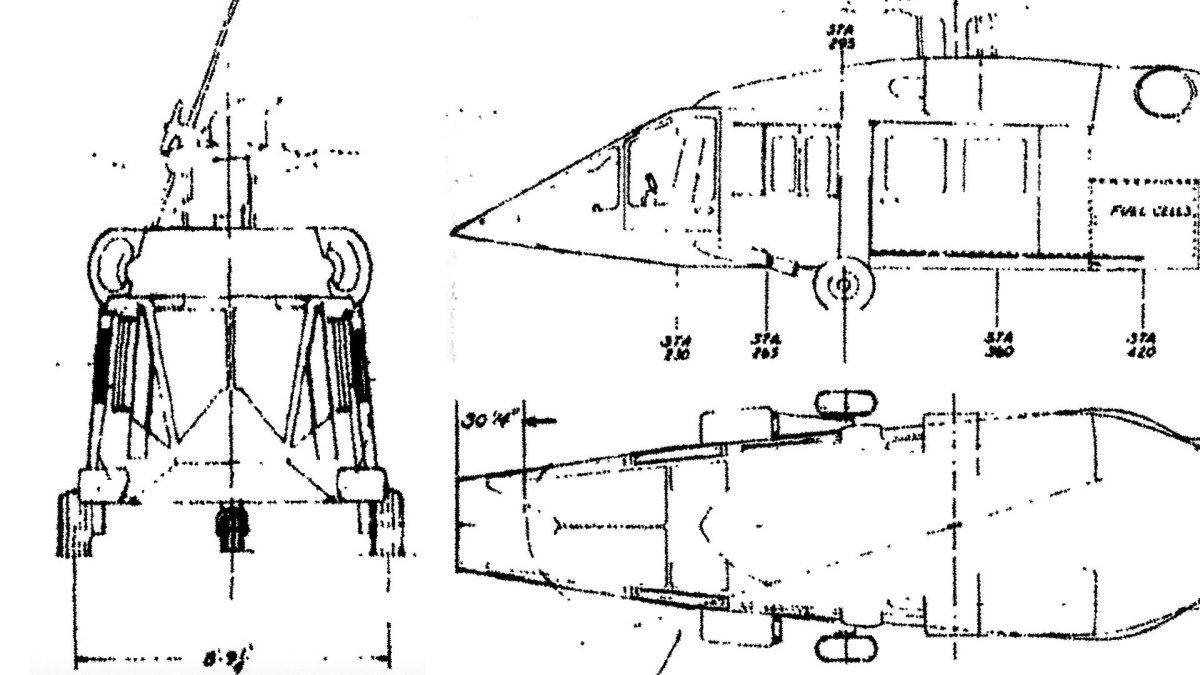
It continues to describe each configuration in greater detail and provides drawings of each fairly wicked looking designs:
CONFIGURATION 1 The general arrangement of Configuration 1, shown in Figure 3, was developed from mold line drawing No. 20074180. This configuration alters the baseline fuselage forward of the mid-cabin section (the cockpit). Although this configuration is different from the baseline, the internal structure must be compatible with the forward cabin to avoid a heavy joining structure… The overall length is slightly increased due to this configuration.
The general arrangement of Configuration 1, shown in Figure 3, was developed from mold line drawing No. 20074180. This configuration alters the baseline fuselage forward of the mid-cabin section (the cockpit). Although this configuration is different from the baseline, the internal structure must be compatible with the forward cabin to avoid a heavy joining structure… The overall length is slightly increased due to this configuration.
CONFIGURATION 2 The general arrangement of Configuration 2, shown in Figure 4, was developed from mold line drawing No. 20074135. This configuration is basically a trapezoidal cross-section airframe having sides canted inward 30 degrees and made up of flat exterior structural panels. This configuration is wider at the bottom of the fuselage and narrower at the top of the fuselage than the baseline. This configuration is slightly longer than the baseline UH-60A, and its overall height is slightly larger than the baseline. The increased length, width, and height of Configuration 2 does not allow an aircraft of this size to meet the air transportability requirements of the baseline. The narrow upper fuselage causes the pilot and copilot seats to be spaced closer to each other, and shoulder room in the main cabin is decreased. The main cabin floor is approximately 6 inches higher than the baseline from the ground. The increased floor-to-ground height causes difficulties for combat troops to enter or leave the aircraft quickly. Minor modifications of the mold lines for the transition and tail-cone sections were made to properly house the tail rotor shaft of the baseline UH-60A.
The general arrangement of Configuration 2, shown in Figure 4, was developed from mold line drawing No. 20074135. This configuration is basically a trapezoidal cross-section airframe having sides canted inward 30 degrees and made up of flat exterior structural panels. This configuration is wider at the bottom of the fuselage and narrower at the top of the fuselage than the baseline. This configuration is slightly longer than the baseline UH-60A, and its overall height is slightly larger than the baseline.
The increased length, width, and height of Configuration 2 does not allow an aircraft of this size to meet the air transportability requirements of the baseline. The narrow upper fuselage causes the pilot and copilot seats to be spaced closer to each other, and shoulder room in the main cabin is decreased. The main cabin floor is approximately 6 inches higher than the baseline from the ground. The increased floor-to-ground height causes difficulties for combat troops to enter or leave the aircraft quickly. Minor modifications of the mold lines for the transition and tail-cone sections were made to properly house the tail rotor shaft of the baseline UH-60A.
CONFIGURATION 3 The general arrangement of Configuration 3, shown in Figure 5, was developed from mold line drawing No. 20074136. This configuration is basically a flat side cross-section airframe having sides canted inward 50 degrees and is tapered in width from a narrow cockpit section to a transition section as wide as the baseline UH-60A. The tail-cone is a rectangular section which is narrower than the baseline. The narrow cockpit causes the pilot and copilot seats to be spaced closer to each other; space for four-across seating in the main cabin is decreased. The cockpit and main cabin floors are at the same height from the ground as the baseline. The slope of the windshields may cause problems of visibility for the flight crew. Minor modifications of the mold lines for the transition and tail-cone sections were made to properly house the tail rotor shaft of the baseline UH-60A.
The general arrangement of Configuration 3, shown in Figure 5, was developed from mold line drawing No. 20074136. This configuration is basically a flat side cross-section airframe having sides canted inward 50 degrees and is tapered in width from a narrow cockpit section to a transition section as wide as the baseline UH-60A.
The tail-cone is a rectangular section which is narrower than the baseline. The narrow cockpit causes the pilot and copilot seats to be spaced closer to each other; space for four-across seating in the main cabin is decreased. The cockpit and main cabin floors are at the same height from the ground as the baseline. The slope of the windshields may cause problems of visibility for the flight crew. Minor modifications of the mold lines for the transition and tail-cone sections were made to properly house the tail rotor shaft of the baseline UH-60A.
Three wireframe mold line models were also included in the report, one for each of the concepts:
The document continues to go into evaluating production concepts of the configurations using traditional aircraft building materials as one option and advanced composites as another. It describes how cost and risk would be impacted by either construction concept, as well as performance and what developmental pitfalls could potentially impact either choice. It’s interesting that while there were concerns over some safety and durability aspects of the composite materials construction concept, the authors noted that using graphite panels and other non-traditional materials would probably be needed to meet low-observable (stealth) goals.
An even more telling section is the one on how each design would impact performance compared to a stock UH-60A. In fact, there seems to be a bit of foreshadowing of the crash that occurred 33 years later inside Bin Laden’s compound in Abbottabad, Pakistan:
CONCLUSIONS Comparison of the UH-60A attributes with the calculated results for the three proposed low radar cross section configurations indicate that: 1. A change in the UH-60A configuration to reflect the LRCS1 configuration caused a decrease in the drag of the UH-60A at α=00′. This decrease was reflected through a range of angles of attack (+8′ < α < -8′) with the exception of angles of attack of +8 and -8 respectively, where no change in drag was exhibited. Configuration changes reflecting the LRCS2 and LRCS3 configuration showed increases of 11% and 17% respectively, of the UH-60A drag at α=00′ and as high as 21% and 29%, respectively, at angles of attack of +8′ and -8′. These changes do not reflect the required increase in stabilator size which would result in an additional drag penalty. 2. The LRCS1 configuration produces an insignificant change in lift compared to the UH-60A while the LRCS2 and LRCS3 configurations reflect an additional download of 40% of the UH-60A download at α=40. 3. Compared to the UH-60A, the LRCS2 and LRCS3 configurations demonstrate a substantial reduction in static stability which will require a redesign of the horizontal stabilator. This is primarily due to a reduction in tail effectiveness and an increase in fuselage instability. The reduction in tail effectiveness was estimated at 21% for the LRCS2 concept and 28% for the LRCS3 configuration. Minor changes in the pitching moment of the LRCS1 and LRCS3 configurations, compared to the UH-60A were calculated, however, the LRCS2 trend demonstrated an increase in slope resulting in an 83% increase in basic fuselage instability. 4. The three proposed LRCS configurations demonstrated an increase in vertical drag of 27% for the LRCS1, 106% for the LRCS2, and 70% for the LRCS3, of the basic UH-60A vertical drag. This increase in vertical drag is a direct result of the additional cross-sectional area and sharp edges presented to the downwash of the main rotor by the LRCS2 configuration. In the case of the LRCS3 configuration, the wedge type of cross-sectional area of the cockpit, the additional area of the main landing gear support structure and the presence of sharp edges presented to the main rotor downwash resulted in an increase in vertical drag as indicated. Finally, the increase in vertical drag for the LFCS1 configuration is a direct result of the wedge type cross-sectional area of the cockpit. 5. In comparison to the UH-60A, no change in the maximum cruise speed and endurance of the LRCSl configuration was observed, however, a loss of 217 feet in hover ceiling and 12 feet in OEI service ceiling was exhibited. The performance of the LCS2 and LRCS3 configurations did not meet the performance requirements of the basic UH-60A. Decreases of 7 and 11 knots in maximum cruise speed, 805 and 520 feet in hover ceiling, 248 and 740 feet in OEI service ceiling, and 0.14 and 0.19 hour in endurance were calculated for the LRCS2 aid LRCS3 configurations respectively.
Comparison of the UH-60A attributes with the calculated results for the three proposed low radar cross section configurations indicate that:
1. A change in the UH-60A configuration to reflect the LRCS1 configuration caused a decrease in the drag of the UH-60A at α=00′. This decrease was reflected through a range of angles of attack (+8′ < α < -8′) with the exception of angles of attack of +8 and -8 respectively, where no change in drag was exhibited.
Configuration changes reflecting the LRCS2 and LRCS3 configuration showed increases of 11% and 17% respectively, of the UH-60A drag at α=00′ and as high as 21% and 29%, respectively, at angles of attack of +8′ and -8′. These changes do not reflect the required increase in stabilator size which would result in an additional drag penalty.
2. The LRCS1 configuration produces an insignificant change in lift compared to the UH-60A while the LRCS2 and LRCS3 configurations reflect an additional download of 40% of the UH-60A download at α=40.
3. Compared to the UH-60A, the LRCS2 and LRCS3 configurations demonstrate a substantial reduction in static stability which will require a redesign of the horizontal stabilator. This is primarily due to a reduction in tail effectiveness and an increase in fuselage instability. The reduction in tail effectiveness was estimated at 21% for the LRCS2 concept and 28% for the LRCS3 configuration. Minor changes in the pitching moment of the LRCS1 and LRCS3 configurations, compared to the UH-60A were calculated, however, the LRCS2 trend demonstrated an increase in slope resulting in an 83% increase in basic fuselage instability.
4. The three proposed LRCS configurations demonstrated an increase in vertical drag of 27% for the LRCS1, 106% for the LRCS2, and 70% for the LRCS3, of the basic UH-60A vertical drag. This increase in vertical drag is a direct result of the additional cross-sectional area and sharp edges presented to the downwash of the main rotor by the LRCS2 configuration. In the case of the LRCS3 configuration, the wedge type of cross-sectional area of the cockpit, the additional area of the main landing gear support structure and the presence of sharp edges presented to the main rotor downwash resulted in an increase in vertical drag as indicated. Finally, the increase in vertical drag for the LFCS1 configuration is a direct result of the wedge type cross-sectional area of the cockpit.
5. In comparison to the UH-60A, no change in the maximum cruise speed and endurance of the LRCSl configuration was observed, however, a loss of 217 feet in hover ceiling and 12 feet in OEI service ceiling was exhibited. The performance of the LCS2 and LRCS3 configurations did not meet the performance requirements of the basic UH-60A. Decreases of 7 and 11 knots in maximum cruise speed, 805 and 520 feet in hover ceiling, 248 and 740 feet in OEI service ceiling, and 0.14 and 0.19 hour in endurance were calculated for the LRCS2 aid LRCS3 configurations respectively.
Clearly, the more elaborate the stealthy modifications to the baseline H-60 design, the more penalty was paid in drag, overall performance, and especially general instability. This largely vibes with many of the claims about the two helicopters used in the Bin Laden raid over three decades later. These included major performance deficiencies, handling quirks, and were considered by some as downright unstable. Relentless Strike talks about this in detail, stating:
“The additional material that made the helicopters invisible to radar also added weight and made them difficult to fly. This gave Team 6’s most experienced men pause. Rehearsals had revealed that the “helicopter was very unstable when they tried to hover,” said a Team 6 operator. “Those things had been mothballed. The [pilots] hadn’t flown them in a while, but they got back out there. … “The helicopters were really forced on us,” a Team 6 source said. “These newfangled helicopters that had never been used before.” During initial planning meetings, McRaven had told Red Squadron to “look at all options” as they considered how to conduct the mission… In Team 6, there were different opinions about whom to blame for the insistence on using the helicopters. Some operators thought the CIA was driving the decision. Others attributed it to McRaven. “He wanted to use these newfangled helicopters,” said an operator. “He sold it to the president that way: These things are invisible to radar, they’ll get in, the [Pakistanis] will never know we were there.” When the helicopters proved unstable during training, the JSOC commander refused to revisit the decision, the operator said.”
“The additional material that made the helicopters invisible to radar also added weight and made them difficult to fly. This gave Team 6’s most experienced men pause. Rehearsals had revealed that the “helicopter was very unstable when they tried to hover,” said a Team 6 operator. “Those things had been mothballed. The [pilots] hadn’t flown them in a while, but they got back out there.
“The helicopters were really forced on us,” a Team 6 source said. “These newfangled helicopters that had never been used before.” During initial planning meetings, McRaven had told Red Squadron to “look at all options” as they considered how to conduct the mission… In Team 6, there were different opinions about whom to blame for the insistence on using the helicopters. Some operators thought the CIA was driving the decision. Others attributed it to McRaven. “He wanted to use these newfangled helicopters,” said an operator. “He sold it to the president that way: These things are invisible to radar, they’ll get in, the [Pakistanis] will never know we were there.” When the helicopters proved unstable during training, the JSOC commander refused to revisit the decision, the operator said.”
It remains unclear if a non-stealthy MH-47G or MH-60M special operations helicopter would have experienced the same unrecoverable issue that the Stealth Hawk did that night over Abbottabad, but other factors beyond the helicopter’s known deficiencies came into play in that crash. Namely a far warmer than expected night in the already lofty targeting area and the fact that Stealth Hawks had trained on a model of Bin Laden’s compound in the Nellis Test and Training Range that used wire fencing for the compound’s solid walls.
MH-47s belonging to the 160th SOAR take off from an LZ during a demonstration of their capabilities. , US Army
Air circulated freely through the wire fencing, but stagnated inside the real McCoy, resulting in the Stealth Hawk experiencing a condition called vortex ring state (some have attributed it to settling with power, and really, it could have been a combination of both), which led to its crash.
It’s also worth noting that the 1978 study’s conclusions are based on a modified Black Hawk that still retains its stock four-bladed, unshrouded, tail assembly configuration. We know that the Stealth Hawk that went down Abbottabad had a very elaborate tail modification featuring a cover over its hub and five composite blades. This would have significantly reduced the helicopter’s radar and audible signature, but could have also further impacted its performance in a negative manner.
The Stealth Hawks also had a larger, rounded horizontal tailplane that is thicker in chord than the one found on its more traditional brethren. It also appeared to be forward-swept for radar signature reduction. The 1978 study mentions that a larger tailplane would have been necessary in order to keep the more elaborate configurations stable in flight, so seeing this unique feature of the Stealth Hawks used in the Bin Laden raid is yet another indication that the study was incredibly accurate for its age.
The report also doesn’t take into account other major acoustic reductions that we know would have been a major factor in a stealth Black Hawk design intended for the special operations mission set. Before there were major initiatives to examine reducing the radar signature on helicopters, there were ones to drastically muffle their sound output that made it into an operational form . Naylor details the importance of reduced acoustic signature for a stealthy assault helicopter in Relentless Strike :
“The 160th Special Operations Aviation Regiment and the combat development organizations that support it had been experimenting with stealth technologies for many years, beginning with a program to create a stealthy Little Bird . The program progressed to include the Black Hawk, the 160th’s principal assault aircraft. The work had two overall aims: to reduce a helicopter’s radar signature by giving it a different shape and coating it in special materials, and making the aircraft quieter, which usually involved development of a Fenestron, or shrouded tail rotor. (Much of a helicopter’s noise signature comes from its tail rotor.) The 160th took the issue of reducing aircraft noise very seriously. In training exercises the unit would time how far from the target—in time of flight—the rotor sounds could be heard. As a rule, the larger the airframe, the farther out the target could hear the helicopter. The 160th wanted to reduce the time between an enemy hearing a helicopter approaching and it arriving overhead by as much as possible. “Even [cutting] fifteen seconds is huge,” said a 160th veteran. “And thirty seconds is amazing, because then you can be on top of the target and fast-roping people down.”
Sound suppression measures would also have added weight and potentially aerodynamic inefficiency to the Stealth Hawks and thus reduced performance, further exacerbating their negative stability and general performance issues. The Stealth Hawks retained the four-bladed rotor hub system found on all Black Hawks, so it’s clear that the sound suppression was approached in a balanced manner against complexity and cost.
Beyond similarities between the projected deficiencies of a stealthy Black Hawk detailed in the 41-year old report and those of the real ones, the existence of this study gives us new context as to the timeline of the still highly classified program. Once again, Relentless Strike describes the Steal Hawk’s supposed genesis in a very similar fashion as to what I had heard and posited for years. Naylor states:
“The stealth Black Hawk gained almost mythical status, like a unicorn. “I remember first hearing about it … in 2000 to 2001,” said a Delta source. The program quickly gained traction. “I remember in 2004 hearing that it was a line item in the budget,” he said. Knowledge of the special access program was on a strictly need-to-know basis, and hardly anyone needed to know. Shortly thereafter the 160th regimental leadership came looking to 1st Battalion—the core unit of Task Force Brown—for two crews to go down to Nellis Air Force Base, Nevada, and start training on the new helicopters. In the end, one crew went after a couple of pilots volunteered. “I never saw them again,” said a 160th source. “They’d be permanently assigned out there.” The program became more formalized. The aircraft were based at Nellis [actually Area 51], but 160th crews trained on them at some of the military’s other vast landholdings in the Southwest: Area 51; China Lake Naval Air Weapons Station in California; and Yuma Proving Ground, Arizona. U.S. Special Operations Command planned to create a fleet of four and make them the centerpiece of a new covered aviation unit in Nevada. By 2011 Special Operations Command had canceled that plan, but the first two stealth helicopters still existed and certain 1st Battalion crews would rotate down to Nellis to train on them.”
As I had stated in the past, the events of 9/11 and the larger defense budgets that followed, which included large increases in spending on special operations, combined with the rising threat from rogue states with nuclear programs, accelerated the Stealth Hawk program, or at the very least, breathed new life into it if it had been underway in the 1990s. The RAH-66 Comanche stealth armed-scout helicopter program, an enterprise that sucked down billions in development dollars and was canceled in 2004, also provided Sikorsky with a very deep bag of already-paid-for tricks and solutions to directly incorporate onto a stealthy Black Hawk derivative. Taking the easiest to adapt tech from the RAH-66 and integrating it around the UH-60 would have resulted in a far lower-risk, faster, and more affordable program than starting having never built a stealthy helicopter before.
Regardless of the operational requirements, it’s also clear why the Army would have seen such a program as a decent consolation prize for the defunct RAH-66. In the darkness of the classified world, it would keep the stealth helicopter ingenuity and brain trust alive, while also allowing the Army to benefit from billions ‘wasted’ on Comanche without it being a political pawn for those on Capitol Hill or the bean counters in the Pentagon.
RAH-66 prototype., Sikorsky
I had long posited that the Stealth Hawks were not the result of a ‘snap-on kit’ as it was widely described, but a full buildout around the UH-60’s core drivetrain and subsystems, an idea further backed up again by the 1978 stealth Black Hawk study. Such a design would have also benefitted from Sikorsky’s S-75 technology demonstrator that long predated Comanche.
The S-75 first flew in the mid-1980s and acted as a proof of concept for composite helicopter airframe construction utilizing many of the techniques described in the 1978 stealth Black Hawk study. With lessons learned from the S-75, Sikorsky was ready to work at building an operational stealth helicopter, whether it be a RAH-66 or a stealthy Black Hawk derivative. Clearly, only one option survived into the mid-2000s.
S-75 technology demonstrator, Sikorsky
Being able to better access defended territories for special operations missions wasn’t just about the Global War On Terror, it was also about having the ability to neuter or at least drastically decrease the possibility that a less-than-stable state would get its nuclear arms pilfered by a non-state actor hostile to the United States. Pakistan’s growing nuclear arsenal, in particular, proved to be a unique problem, but by 2009, it was one that defense officials said they could deal with directly in an emergency. This was largely thought to include sending special operations teams in to secure nuclear warheads and material during a crisis, and even removing them. Many found cryptic statements by Pentagon leaders alluding to the U.S. having the ability to do this as indicative of a secret penetrating platform, or platforms , that would be survivable enough to make such a round trip feasible.
Just like the stealthy RQ-170 Sentinel drone that was devised to clandestinely spy on nuclear activities of friendly and enemy nations alike, a very low signature assault helicopter would allow special operations to quickly access targets in similar operating environments. And like the RQ-170 that was also developed in the mid-2000s and had a mission that sprung from a secretive stealth program decades earlier, we now know that the Stealth Hawks’ lineage can be traced back to the dawn of stealth technology.
Back in 1978, stealth was still in its infancy, although elaborate studies on advanced low-signature aircraft date back many years earlier . Just a year before the stealthy Black Hawk study was delivered, the Skunk Works’ Have Blue demonstrator , a plane that would give birth to the F-117 Nighthawk , first flew. Just four years before that, the idea of a stealth attack aircraft was just taking shape under the highly-classified XST program . So it really is amazing to think that the level of research into a stealth Black Hawk derivative was being done 41 years ago, and a year before the UH-60A Black Hawk even entered into operational service.
In the three decades between this 1978 study and the latter half of the 2000s—the latest that the prototype Stealth Hawks would have been delivered—beyond the S-75 and the RAH-66, there is something of a research and development gap. It is possible that the Stealth Hawk concept was born into a prototype state long before 9/11 and the aircraft were remodeled or a second set of prototypes were introduced in the mid to late 2000s as a result of the new geopolitical realities of the decade. Regardless, these aircraft were still experimental and for whatever reason, never made it into production, by the time they were brought out of storage for Operation Neptune Spear. The aircraft’s instability and restricted performance could have been a driving factor in keeping the program in a technology demonstrating and testing stage.
Yet according to multiple accounts, the Stealth Hawk concept was totally reborn again in the months and years after the successful mission into Pakistan. Naylor writes:
“In the early hours of July 3, 2014, two Black Hawks full of Delta operators crossed the border from Jordan into Syria, flying fast across the desert. Their destination was a compound outside the town of Raqqa, on the north bank of the Euphrates in north-central Syria. It was there, U.S. intelligence analysts believed, that a group calling itself the Islamic State—one of the two Islamist factions waging war in Syria—was holding several Western hostages, including at least two Americans: journalists James Foley and Steven Sotloff. The intelligence came from several sources: FBI interviews with two European men that the Islamic State had held as hostages before releasing them, probably as a result of ransoms paid; satellite imagery of a building near Raqqa that matched the descriptions given by the Europeans; and information supplied by Israel. This was not JSOC’s first raid into Syria. But unlike the October 2008 mission to kill Abu Ghadiya, which involved a few minutes’ flight across the Iraqi border, this operation involved penetrating 200 miles into Syrian airspace. For that reason, JSOC had chosen to use the latest version of the stealth Black Hawks that flew the Bin Laden raid. That mission famously left one of the two such aircraft then in existence burned to a crisp in bin Laden’s backyard. But since May 2011 more of the airframes had been constructed, and the program had expanded so that the 160th now kept a unit of about forty personnel under a lieutenant colonel at Nellis Air Force Base in Nevada, where the stealth helicopters were housed. As the use of the specialized airframes suggested, JSOC had spared little expense to prepare for the operation. The task force had been training for weeks on a replica of the compound they were going to assault. There had been “eyes on the target” for at least a week prior to D-day, reporting what they saw in short, encrypted messages. When the helicopters neared the compound, they were filmed by at least one armed drone overhead.”
“In the early hours of July 3, 2014, two Black Hawks full of Delta operators crossed the border from Jordan into Syria, flying fast across the desert. Their destination was a compound outside the town of Raqqa, on the north bank of the Euphrates in north-central Syria. It was there, U.S. intelligence analysts believed, that a group calling itself the Islamic State—one of the two Islamist factions waging war in Syria—was holding several Western hostages, including at least two Americans: journalists James Foley and Steven Sotloff. The intelligence came from several sources: FBI interviews with two European men that the Islamic State had held as hostages before releasing them, probably as a result of ransoms paid; satellite imagery of a building near Raqqa that matched the descriptions given by the Europeans; and information supplied by Israel.
This was not JSOC’s first raid into Syria. But unlike the October 2008 mission to kill Abu Ghadiya, which involved a few minutes’ flight across the Iraqi border, this operation involved penetrating 200 miles into Syrian airspace. For that reason, JSOC had chosen to use the latest version of the stealth Black Hawks that flew the Bin Laden raid. That mission famously left one of the two such aircraft then in existence burned to a crisp in bin Laden’s backyard. But since May 2011 more of the airframes had been constructed, and the program had expanded so that the 160th now kept a unit of about forty personnel under a lieutenant colonel at Nellis Air Force Base in Nevada, where the stealth helicopters were housed. As the use of the specialized airframes suggested, JSOC had spared little expense to prepare for the operation. The task force had been training for weeks on a replica of the compound they were going to assault. There had been “eyes on the target” for at least a week prior to D-day, reporting what they saw in short, encrypted messages. When the helicopters neared the compound, they were filmed by at least one armed drone overhead.”
An MH-60M prepares for a night mission. They don’t call them the Night Stalkers for nothing!, DoD
There have also been claims that the stealth Black Hawk was in its second generation when the Bin Laden raid took place, with the older generation being used for the raid out of fear that losing one would compromise far too many technological secrets. The more advanced models are supposedly called Ghost Hawks or ‘Jedi Rides’ and they possess many improvements over their predecessors and are extremely low-observable by design. There is probably some truth to these claims, but it is more likely that the new generation became available after the Bin Laden raid and not before.
We have received multiple tips over the years indicating that a new Stealth Hawk program is indeed alive and well and has been used on real-world operations as Naylor describes. With Lockheed having purchased Sikorsky in 2015 , one can only imagine the boost in low-observable knowledge base and technology Sikorsky now has at its fingertips. For all we know we could be on a third or fourth generation Stealth Hawk by now. In fact, I would put money on it. Their likely home? Tonopah Test Range Airport.
The prop helicopters used in the film Zero Dark Thiry caused a lot of online buzz and look similar to the concepts outlined in the 1978 report:
Such an aircraft would be an ideal complement to a stealthy fixed-wing special operations transport , especially in this day and age of the proliferation of ever more capable integrated air defense systems and anti-access/area-denial strategies. There is also the combat search and rescue issue to consider. As the U.S. moves to a tactical aircraft fleet dominated by stealth technology, how can traditional combat search and rescue assets go to rescue downed aircrews in places where the best stealth fighters couldn’t even survive? This alone seems to be justification for a small but potent low observable special operations helicopter fleet.
Regardless of what’s to come for America’s shadowy stealth helicopter capability, it’s amazing to think that it all began 41 years ago with this study. Clearly, they were on to something then, so we can only imagine what the Pentagon has its most elite special operations helicopter crews flying now.
As for when we might actually see the remaining Stealth Hawk from the historic raid? It’s anyone’s guess, but I think your best bet would be once the Obama Presidential Library in Chicago opens its doors or the CIA makes another big addition to their museum that you aren’t allowed to visit.
Contact the author: Tyler@thedrive.com
Comments couldn’t be loaded. Please refresh the page.
更新于美国东部时间2019年12月1日上午6:39
在国防或航空领域,鲜有故事能像在抓捕或击毙奥萨马·本·拉登的行动中使用的经过高度改装的H-60黑鹰直升机那样扑朔迷离。大多数人至今仍感到困惑:这些直升机不仅凭空出现,而且即便在成为这场历史性突袭行动中广为人知的组成部分之后,它们又重新消失在高度机密的领域。尽管关于它们的起源和研发时间线众说纷纭,但在本期“战区”专题报道中,我们提供了官方文件,清晰地表明隐形黑鹰直升机的研发开始时间远比任何人声称的都要早。
黑鹰隐形直升机和击毙本·拉登的行动在某种程度上开启了我的职业生涯。时至今日,据我所知,我是第一个公开声明2011年5月2日凌晨坠毁在本·拉登住所的直升机残骸并非任何已知美国直升机,也并非任何其他国家直升机的残骸的人。在随后的几年里,我持续报道有关“隐形鹰”及其神秘过往的任何新细节。
这包括从最初证实遗留的残骸确实是H-60的衍生机型,到如何巧妙地利用地面照明来掩盖直升机在阿富汗贾拉拉巴德机场集结时的独特性,再到由于重量问题而未在直升机上安装通信干扰设备,以及几乎所有其他细节。我上一篇相关文章发表于2015年10月,当时我提到了肖恩·内勒(Sean Naylor)关于特种作战的著作《无情打击》(Relentless Strike)中的一些说法,顺便一提,我强烈推荐这本书。我们稍后会谈到书中的一些信息。
自那以后,再也没有关于隐形鹰战机或其可能继任者的可靠新消息或目击报告。可以说,线索彻底中断了。直到我偶然发现了一份西科斯基公司于1978年为美国陆军位于弗吉尼亚州尤斯蒂斯堡的研究与技术实验室撰写的报告——直到今天,美国陆军仍然在那里研发其梦寐以求的飞行器和作战能力。这份报告的标题是《低雷达截面(LRCS)机身构型的结构概念和空气动力学分析》。听起来枯燥乏味,对吧?然而,事实并非如此。
这份长达139页的报告详细阐述了西科斯基公司如何将其新型UH-60“黑鹰”直升机改装成隐形飞行器。研究提出了三种不同的改装方案,每种方案都对UH-60进行了不同程度的改进。这些设计方案将从重量、性能、雷达反射截面、成本、安全性、风险和可维护性等方面进行评估。每种方案都研究了两种变体:一种采用传统制造材料,另一种采用先进复合材料。这些隐形设计方案直接来自美国陆军应用技术实验室。出于研究目的,尾桨将保持原厂配置。
应用技术实验室为本研究开发了三种低雷达反射截面机身构型。第一种构型在基准构型的基础上略微修改了机头部分;第二种构型将机身形状改为截角三角棱柱;第三种构型则在整个机身范围内采用了倾斜的扁平侧面造型。尾翼和主旋翼吊舱整流罩与基准型UH-60A相同。
它继续更详细地描述每种配置,并提供了每种看起来相当酷炫的设计图:
配置1 配置1的总体布局如图3所示,是根据20074180号模线图设计的。该配置改变了中座舱段(驾驶舱)前方的基本机身结构。尽管该配置与基本配置不同,但其内部结构必须与前座舱兼容,以避免使用笨重的连接结构……由于该配置,总长度略有增加。
图 3 所示的配置 1 的总体布局是根据模线图 20074180 设计的。该配置改变了中座舱段(驾驶舱)前方的基本机身结构。尽管该配置与基本配置不同,但其内部结构必须与前座舱兼容,以避免使用笨重的连接结构……由于该配置,总长度略有增加。
配置2 的总体布局如图4所示,是根据模线图20074135设计的。该配置基本采用梯形截面机身,侧面向内倾斜30度,由扁平的外部结构板构成。与基准型相比,该配置的机身底部更宽,顶部更窄。该配置的长度略长于基准型UH-60A,总高度也略高于基准型。配置2的长度、宽度和高度的增加使其无法满足基准型的空运要求。较窄的上部机身导致正副驾驶座椅间距更小,主舱的肩部空间也随之减少。主舱地板离地高度比基准型高出约6英寸。地板离地高度的增加使得作战人员难以快速上下飞机。对过渡段和尾锥段的模线进行了细微修改,以便更好地容纳基础型 UH-60A 的尾旋翼轴。
图 4 所示的构型 2 的总体布局是根据模线图 20074135 设计的。该构型基本采用梯形截面机身,两侧向内倾斜 30 度,由扁平的外部结构板构成。与基准型相比,该构型机身底部更宽,顶部更窄。该构型的长度略长于基准型 UH-60A,总高度也略高于基准型。
配置2的长度、宽度和高度增加,使得这种尺寸的飞机无法满足基准机型的空运要求。狭窄的上机身导致正副驾驶座椅间距缩小,主舱肩部空间也随之减少。主舱地板离地高度比基准机型高出约6英寸。地板离地高度的增加使得作战人员难以快速上下飞机。为了更好地容纳基准UH-60A的尾桨轴,过渡段和尾锥段的模线进行了细微修改。
配置3 的总体布局如图5所示,是根据编号为20074136的模线图设计的。该配置的基本结构为扁平侧截面机身,侧面向内倾斜50度,宽度从狭窄的驾驶舱段逐渐过渡到与基准型UH-60A相同的过渡段。尾锥为矩形截面,宽度小于基准型。狭窄的驾驶舱导致正副驾驶座椅间距较小,主舱四座并排的座位空间减少。驾驶舱和主舱地板与基准型的离地高度相同。挡风玻璃的倾斜角度可能会影响机组人员的视野。为了更好地容纳基准型UH-60A的尾桨轴,对过渡段和尾锥段的模线进行了细微修改。
图 5 所示的配置 3 的总体布局是根据 20074136 号模线图开发的。该配置基本上是一个扁平侧面横截面的机身,侧面向内倾斜 50 度,宽度从狭窄的驾驶舱部分逐渐变细到与基准 UH-60A 一样宽的过渡部分。
尾锥部分呈矩形,比基线部分窄。狭窄的驾驶舱导致正副驾驶座椅间距更小,主舱四座并排的座位空间也相应减少。驾驶舱和主舱地板与基线部分的高度相同。挡风玻璃的倾斜角度可能会影响机组人员的视野。为了更好地容纳基线型UH-60A的尾桨轴,对过渡段和尾锥部分的模线进行了细微的修改。
报告中还包括三个线框模线模型,每个概念对应一个模型:
该文件继续评估了两种配置的生产方案:一种方案采用传统飞机制造材料,另一种方案采用先进复合材料。文件描述了两种结构方案对成本和风险的影响,以及性能和可能影响两种方案的研发缺陷。值得注意的是,尽管人们对复合材料结构方案的安全性和耐久性方面存在一些担忧,但作者指出,为了实现低可探测性(隐身)目标,可能需要使用石墨面板和其他非传统材料。
更具启发性的章节是关于每种设计方案与标准型UH-60A相比,性能将受到怎样的影响。事实上,这似乎预示了33年后发生在巴基斯坦阿伯塔巴德本·拉登住所内的坠机事件:
结论:将UH-60A的性能与三种提出的低雷达散射截面构型的计算结果进行比较,结果表明:1. 将UH-60A的构型更改为LRCS1构型后,在迎角α=00′时,UH-60A的阻力有所降低。这种阻力降低体现在一系列迎角(+8′ < α < -8′)上,但迎角为+8′和-8′时阻力没有变化。而更改为LRCS2和LRCS3构型后,UH-60A在迎角α=00′时的阻力分别增加了11%和17%,在迎角为+8′和-8′时,阻力分别增加了高达21%和29%。这些变化并未反映出所需的水平尾翼尺寸增加,而增加水平尾翼尺寸会导致额外的阻力增加。 2. 与UH-60A相比,LRCS1构型产生的升力变化微乎其微,而LRCS2和LRCS3构型在α=40时,其下沉量比UH-60A增加了40%。3. 与UH-60A相比,LRCS2和LRCS3构型的静态稳定性显著降低,需要重新设计水平尾翼。这主要是由于尾翼效能降低和机身不稳定性增加所致。LRCS2构型的尾翼效能降低估计为21%,LRCS3构型的尾翼效能降低估计为28%。与UH-60A相比,LRCS1和LRCS3构型的俯仰力矩变化较小,但LRCS2构型的俯仰力矩斜率增大,导致基本机身不稳定性增加83%。 4. 三种提出的远程驾驶舱配置方案(LRCS1、LRCS2 和 LRCS3)的垂直阻力分别比基本型 UH-60A 增加了 27%、106% 和 70%。LRCS2 配置方案垂直阻力的增加是由于其额外的横截面积和尖锐边缘对主旋翼下洗气流的影响所致。LRCS3 配置方案中,驾驶舱的楔形横截面积、主起落架支撑结构的额外面积以及对主旋翼下洗气流的尖锐边缘均导致了垂直阻力的增加。最后,LRCS1 配置方案垂直阻力的增加是由于其驾驶舱的楔形横截面积所致。 5. 与UH-60A相比,LRCS1构型的最大巡航速度和续航时间没有变化,但悬停升限降低了217英尺,单发失效(OEI)使用升限降低了12英尺。LCS2和LRCS3构型的性能均未达到UH-60A基本型的性能要求。计算得出,LRCS2和LRCS3构型的最大巡航速度分别降低了7节和11节,悬停升限分别降低了805英尺和520英尺,单发失效(OEI)使用升限分别降低了248英尺和740英尺,续航时间分别缩短了0.14小时和0.19小时。
将 UH-60A 的各项属性与三种提出的低雷达反射截面配置的计算结果进行比较,结果表明:
1. 将 UH-60A 的构型改为 LRCS1 构型后,UH-60A 在 α=00′ 时的阻力有所降低。这种降低反映在一系列攻角(+8′ < α < -8′)上,但攻角分别为 +8 和 -8 时,阻力没有变化。
反映LRCS2和LRCS3构型的构型变化分别导致UH-60A在迎角α=00′时的阻力增加11%和17%,在迎角+8′和-8′时阻力分别增加高达21%和29%。这些变化并未反映出所需的水平尾翼尺寸增加,而增加水平尾翼尺寸会导致额外的阻力增加。
2. 与 UH-60A 相比,LRCS1 配置产生的升力变化微乎其微,而 LRCS2 和 LRCS3 配置在 α=40 时反映了 UH-60A 下载量的 40% 的额外下载量。
3. 与UH-60A相比,LRCS2和LRCS3构型的静态稳定性显著降低,需要重新设计水平尾翼。这主要是由于尾翼效能降低和机身不稳定性增加所致。LRCS2构型的尾翼效能降低估计为21%,LRCS3构型的尾翼效能降低估计为28%。与UH-60A相比,LRCS1和LRCS3构型的俯仰力矩变化较小,但LRCS2构型的俯仰力矩斜率增大,导致机身基本不稳定性增加83%。
4. 三种提出的远程驾驶舱配置方案(LRCS1、LRCS2 和 LRCS3)的垂直阻力分别比基本型 UH-60A 增加了 27%、106% 和 70%。LRCS2 配置方案垂直阻力的增加是由于其额外的横截面积和尖锐边缘对主旋翼下洗气流的影响所致。LRCS3 配置方案中,驾驶舱的楔形横截面积、主起落架支撑结构的额外面积以及对主旋翼下洗气流的尖锐边缘均导致了垂直阻力的增加。最后,LRCS1 配置方案垂直阻力的增加是由于其驾驶舱的楔形横截面积所致。
5. 与UH-60A相比,LRCS1构型的最大巡航速度和续航时间没有变化,但悬停升限降低了217英尺,单发失效(OEI)使用升限降低了12英尺。LCS2和LRCS3构型的性能均未达到UH-60A基本型的性能要求。计算得出,LRCS2和LRCS3构型的最大巡航速度分别降低了7节和11节,悬停升限分别降低了805英尺和520英尺,单发失效(OEI)使用升限分别降低了248英尺和740英尺,续航时间分别缩短了0.14小时和0.19小时。
显然,对H-60基本设计进行越复杂的隐蔽改装,其在阻力、整体性能,尤其是稳定性方面所付出的代价就越大。这与三十多年后对参与本·拉登行动的两架直升机的诸多评价基本吻合。这些评价包括严重的性能缺陷、操控上的怪异之处,甚至被一些人认为极不稳定。《无情打击》一书对此进行了详细论述,指出:
“使直升机雷达隐形的额外材料也增加了重量,使飞行变得困难。这让第六小队经验最丰富的队员都犹豫了。一名第六小队队员说,演练表明,‘直升机悬停时非常不稳定’。这些直升机之前一直封存着。飞行员们已经很久没飞过了,但他们又重新投入使用……“这些直升机是被迫使用的,”一名第六小队消息人士说,“这些以前从未用过的新型直升机。”在最初的计划会议上,麦克雷文曾告诉红色中队,在考虑如何执行任务时要“考虑所有方案”……在第六小队内部,对于坚持使用直升机的责任归属众说纷纭。一些队员认为这是中央情报局的决定。另一些人则认为是麦克雷文的责任。“他想用这些新型直升机,”一名队员说。 “他就是这样向总统推销的:这些东西雷达探测不到,它们能潜入,巴基斯坦人永远不会知道我们来过。”这位操作员说,当这些直升机在训练中被证明不稳定时,联合特种作战司令部指挥官拒绝重新考虑这个决定。
“使直升机雷达隐形的额外材料也增加了重量,使飞行变得困难。这让第六小队经验最丰富的队员们都犹豫了。一位第六小队的队员说,演练表明,‘直升机在悬停时非常不稳定’。‘这些直升机之前一直封存着。飞行员们已经很久没飞过了,但他们又重新投入使用。’”
“这些直升机完全是强加给我们的,”第六特遣队的一名消息人士说,“这些新式直升机以前从未用过。”在最初的计划会议上,麦克雷文曾告诉“红队”在考虑如何执行任务时要“考虑所有方案”……第六特遣队内部对于坚持使用直升机的责任归属众说纷纭。一些队员认为这是中央情报局在幕后操纵。另一些人则认为是麦克雷文的责任。“他想用这些新式直升机,”一名队员说,“他就是这么跟总统说的:这些直升机雷达不可见,它们能潜入目标,(巴基斯坦人)永远不会知道我们在那里。”这名队员还说,当这些直升机在训练中被证明不稳定时,联合特种作战司令部指挥官拒绝重新考虑这个决定。
目前尚不清楚,如果换成非隐形的MH-47G或MH-60M特种作战直升机,是否也会像“隐形鹰”直升机当晚在阿伯塔巴德上空那样遭遇无法挽回的事故。但除了直升机已知的缺陷之外,还有其他因素导致了那次坠机。具体而言,当晚在原本就地势高耸的目标区域,气温远高于预期;此外,“隐形鹰”直升机曾在内利斯试验训练场的本·拉登住所模型上进行训练,该模型使用铁丝网模拟了住所的实体围墙。
隶属于美国陆军第160特种作战航空团的MH-47直升机在一次能力演示中从着陆区起飞。
空气在铁丝网中自由流通,但在真正的隐形鹰战机内部却停滞不前,导致隐形鹰战机出现一种称为涡环状态的状况(有人将其归因于动力下降,实际上,也可能是两者的结合),最终导致其坠毁。
值得注意的是,1978 年的研究结论是基于一架经过改装的黑鹰直升机,该直升机仍然保留了其标准的四叶无罩尾翼组件配置。我们知道,在阿伯塔巴德坠毁的那架隐形鹰直升机进行了非常复杂的尾翼改装,包括加装尾翼轮毂罩和五片复合材料桨叶。这会显著降低直升机的雷达和声呐特征,但也可能对其性能产生负面影响。
隐形鹰战机还配备了更大、更圆润的水平尾翼,其弦长比传统战机更厚。此外,它似乎还采用了前掠式设计,以降低雷达反射截面积。1978 年的研究指出,为了保持更复杂的飞行结构在飞行中的稳定性,更大的尾翼是必不可少的。因此,在击落本·拉登行动中看到隐形鹰战机的这一独特特征,再次印证了该研究在当时的准确度。
该报告也没有考虑到其他一些重要的声学降噪措施,而我们知道这些措施对于专为特种作战任务设计的隐形黑鹰直升机来说至关重要。在大规模开展降低直升机雷达反射截面的研究之前,就已经有一些旨在大幅降低其噪音输出的措施被付诸实践。内勒在《无情打击》一书中详细阐述了降低声学特征对于隐形突击直升机的重要性:
第160特种作战航空团及其支援的作战发展机构多年来一直在试验隐形技术,最初的项目是研发隐形版的“小鸟”(Little Bird)。该项目后来扩展到“黑鹰”(Black Hawk)——第160团的主力攻击机。这项工作有两个总体目标:一是通过改变直升机的外形并涂覆特殊材料来降低其雷达反射截面积;二是降低飞机噪音,这通常需要研发涵道式尾桨(Fenestron)。(直升机的大部分噪音都来自尾桨。)第160团非常重视降低飞机噪音的问题。在训练演习中,该部队会记录旋翼的声音在飞行时间内能被目标听到的距离。一般来说,机身越大,目标听到直升机声音的距离就越远。第160团希望尽可能缩短敌方听到直升机接近到直升机到达其头顶的时间。“即使只缩短15秒也是巨大的,”一位专家说道。第160团老兵。“30秒简直太棒了,因为在那之前你就能到达目标上方,然后快速绳降人员。”
降噪措施也会增加隐形鹰直升机的重量,并可能降低其空气动力效率,从而降低性能,进一步加剧其稳定性差和整体性能问题。隐形鹰直升机保留了所有黑鹰直升机都采用的四叶旋翼轮毂系统,因此很明显,降噪方案是在复杂性和成本之间取得平衡的。
除了这份41年前的报告中详细描述的隐形黑鹰直升机的预期缺陷与实际存在的缺陷之间的相似之处之外,这项研究的存在还为我们了解这个至今仍高度机密的项目的进展提供了新的背景。再一次,《无情打击》一书对隐形黑鹰直升机的起源描述与我多年来所听到和推测的非常相似。内勒写道:
“隐形黑鹰直升机几乎成了神话,就像独角兽一样。”一位三角洲部队的消息人士说,“我记得第一次听说它是在2000年到2001年之间。”该项目迅速发展。“我记得2004年听说它被列入了预算,”他说。这个特殊项目的知情权严格限制在“需要知道”的范围内,而且几乎没人需要知道。不久之后,第160团的领导层找到第1营——布朗特遣队的核心单位——希望派出两个机组前往内华达州的内利斯空军基地,开始接受这种新型直升机的训练。最终,在两名飞行员自愿报名后,一个机组前往了那里。“我再也没见过他们,”一位第160团的消息人士说,“他们将被永久派驻在那里。”该项目逐渐走向正规化。这些飞机驻扎在内利斯空军基地(实际上是51区),但第160特种作战司令部的机组人员会在美国西南部其他一些广袤的军事基地进行训练,包括:51区;加利福尼亚州的中国湖海军航空武器站;以及亚利桑那州的尤马试验场。美国特种作战司令部曾计划组建一支由四架飞机组成的机队,并将其作为内华达州一支新的隐蔽航空部队的核心力量。到2011年,特种作战司令部取消了该计划,但最初的两架隐形直升机仍然存在,第1营的部分机组人员会轮换到内利斯空军基地进行训练。
正如我之前所说,9/11事件以及随后国防预算的大幅增长(包括特种作战经费的大幅增加),再加上拥有核武器计划的流氓国家日益增长的威胁,加速了“隐形鹰”直升机项目的推进,或者至少,如果该项目在20世纪90年代就已经启动,那么这些因素无疑为其注入了新的活力。RAH-66“科曼奇”隐形武装侦察直升机项目耗资数十亿美元,最终于2004年被取消。该项目也为西科斯基公司提供了大量已付费的技术和解决方案,可以直接应用于“黑鹰”隐形直升机的衍生机型。如果从RAH-66项目中选取最容易改造的技术并将其整合到UH-60直升机上,那么该项目的风险将大大降低,速度将更快,成本也将更低,远胜于从零开始研发隐形直升机。
撇开作战需求不谈,陆军将这个项目视为已终止的RAH-66项目的合理补偿,这一点也显而易见。在保密的环境下,它既能延续隐形直升机领域的创新精神和精英团队,又能让陆军从“浪费”在科曼奇项目上的数十亿美元中获益,而无需沦为国会山或五角大楼财务人员的政治棋子。
RAH-66原型机,西科斯基
我一直认为,隐形鹰直升机并非如人们普遍描述的那样是“即插即用”的套件,而是在UH-60的核心动力系统和子系统基础上进行全面改造的产物。1978年的隐形黑鹰研究进一步证实了这一观点。此外,西科斯基公司早在科曼奇直升机问世之前就已研发出S-75技术验证机,这也有助于隐形鹰直升机的设计。
S-75于20世纪80年代中期首飞,作为复合材料直升机机身结构概念验证机,其采用了1978年“黑鹰”隐形直升机研究中描述的诸多技术。凭借从S-75项目中汲取的经验,西科斯基公司准备着手研发一款可投入使用的隐形直升机,无论是RAH-66还是“黑鹰”的隐形衍生机型。显然,只有一种方案延续到了21世纪初。
S-75技术验证机,西科斯基
能够更好地进入防御严密的领土执行特种作战任务,不仅仅关乎全球反恐战争,也关乎能否削弱或至少大幅降低局势不稳定的国家被敌对于美国的非国家行为体窃取核武器的可能性。巴基斯坦不断增长的核武库尤其构成了一个独特的问题,但到2009年,国防官员表示,他们能够在紧急情况下直接应对这一问题。这主要包括在危机期间派遣特种作战小组进入目标区域,确保核弹头和相关材料的安全,甚至将其移除。许多人认为,五角大楼领导人暗示美国具备这种能力的隐晦表述,表明美国拥有某种或多种秘密渗透平台,这些平台具备足够的生存能力,能够完成这样的往返行动。
就像隐形无人机RQ-170“哨兵”一样,这种无人机最初是为秘密侦察友国和敌国的核活动而设计的,而低特征攻击直升机可以让特种部队在类似的作战环境中快速抵达目标。RQ-170同样是在2000年代中期研发的,其任务源于几十年前一项秘密的隐形计划。如今我们知道,“隐形鹰”的血统可以追溯到隐形技术的萌芽时期。
早在1978年,隐形技术还处于起步阶段,尽管对先进低特征飞机的深入研究可以追溯到很多年前。就在隐形黑鹰直升机交付的前一年,臭鼬工厂的“Have Blue”验证机——F-117“夜鹰”战斗机的雏形——进行了首飞。而在此之前的四年,隐形攻击机的概念才刚刚在高度机密的XST计划下成形。因此,令人惊叹的是,早在41年前,也就是UH-60A“黑鹰”直升机正式服役前一年,就已经开展了对隐形黑鹰衍生机型的研究。
从1978年的这项研究到2000年代后半期——也就是隐形鹰原型机最晚交付的时间——这三十年间,除了S-75和RAH-66之外,隐形鹰的研发存在一段空白期。隐形鹰的概念可能早在9/11事件之前就已经诞生,并进入原型机阶段,而这些飞机可能在2000年代中后期由于新的地缘政治形势而被重新设计,或者推出了第二批原型机。无论如何,这些飞机在“海王星之矛行动”中被启用时,仍然处于实验阶段,并且由于某种原因,始终未能投入生产。飞机的不稳定性以及性能限制可能是导致该项目一直停留在技术验证和测试阶段的主要原因。
然而,据多方报道,在成功执行巴基斯坦任务后的几个月和几年里,“隐形鹰”的概念得到了彻底的复兴。内勒写道:
2014年7月3日凌晨,两架满载三角洲特种部队队员的黑鹰直升机从约旦越过边境进入叙利亚,高速飞越沙漠。他们的目的地是位于叙利亚中北部幼发拉底河北岸拉卡镇郊外的一处院落。美国情报分析人员认为,一个自称“伊斯兰国”(在叙利亚交战的两大伊斯兰极端组织之一)的组织在那里劫持了几名西方人质,其中包括至少两名美国人:记者詹姆斯·福利和史蒂文·索特洛夫。情报来源多样:联邦调查局对两名曾被“伊斯兰国”扣押后获释的欧洲男子的采访(很可能是因为支付了赎金);拉卡附近一栋建筑的卫星图像,与欧洲人质的描述相符;以及以色列提供的信息。这并非联合特种作战司令部(JSOC)首次对叙利亚进行突袭。但与2008年10月击毙阿布·加迪亚的行动(仅需几分钟飞越伊拉克边境)不同,此次行动涉及更广阔的区域。深入叙利亚领空200英里。正因如此,联合特种作战司令部(JSOC)选择了执行击毙本·拉登行动的最新版本隐形黑鹰直升机。众所周知,那次行动导致当时仅有的两架黑鹰直升机之一在本·拉登的“后院”被烧成灰烬。但自2011年5月以来,该型直升机的产量有所增加,项目规模也随之扩大,以至于第160特种作战司令部在内华达州内利斯空军基地(隐形直升机的驻地)设立了一个由一名中校指挥的约40人小队。正如使用这些专用机型所表明的那样,JSOC为此次行动不惜一切代价。特遣部队在他们即将攻击的院落模型上进行了数周的训练。在行动开始前至少一周,就有人员“监视”目标,并通过简短的加密信息汇报所见情况。当直升机接近院落时,至少有一架武装无人机从上方拍摄了他们的飞行画面。
2014年7月3日凌晨,两架满载三角洲特种部队队员的黑鹰直升机从约旦越过边境进入叙利亚,高速飞越沙漠。他们的目的地是位于叙利亚中北部幼发拉底河北岸拉卡镇郊外的一处院落。美国情报分析人员认为,一个自称“伊斯兰国”(在叙利亚交战的两大伊斯兰极端组织之一)的组织在那里扣押了几名西方人质,其中包括至少两名美国人:记者詹姆斯·福利和史蒂文·索特洛夫。情报来源多样:联邦调查局对两名曾被“伊斯兰国”扣押后获释的欧洲男子的采访(很可能是因为支付了赎金);拉卡附近一栋建筑的卫星图像,与欧洲人的描述相符;以及以色列提供的信息。
这并非联合特种作战司令部(JSOC)首次对叙利亚发动突袭。但与2008年10月击毙阿布加迪亚的行动(仅需几分钟飞越伊拉克边境)不同,此次行动需要深入叙利亚领空200英里。因此,JSOC选择了执行击毙本·拉登行动的最新版本隐形黑鹰直升机。众所周知,那次行动导致当时仅有的两架黑鹰直升机之一在本·拉登的“后院”被烧毁。但自2011年5月以来,该机型的产量有所增加,项目规模也随之扩大,以至于第160特种作战司令部在内华达州内利斯空军基地(隐形直升机的驻地)设立了一个由一名中校指挥的约40人小队。正如使用这些专用机型所表明的那样,JSOC为此次行动的准备工作可谓不惜重金。特遣部队已在他们即将攻击的建筑物的模拟场地进行了数周的训练。在行动日之前至少一周,就有人“监视”目标,并将所见情况以简短的加密信息汇报。当直升机接近目标建筑群时,至少有一架武装无人机从上方拍摄了它们。
一架MH-60M直升机正在准备执行夜间任务。它们被称为“夜行者”可不是浪得虚名!——美国国防部
也有人声称,在击毙本·拉登行动发生时,隐形黑鹰直升机已经是第二代了,之所以使用老一代机型,是因为担心损失一架会泄露太多技术机密。据说更先进的型号被称为“幽灵鹰”或“绝地战机”,它们在前代机型的基础上进行了诸多改进,并且从设计上就极难被探测到。这些说法或许有一定道理,但更有可能的是,新一代黑鹰直升机是在本·拉登行动之后才投入使用的,而不是在此之前。
多年来,我们收到多条线索,表明新一代隐形鹰无人机项目确实正在进行中,并且正如奈勒所描述的那样,已经在实战中使用过。洛克希德·马丁公司在2015年收购了西科斯基公司,可以想象西科斯基如今在低可探测性知识库和技术方面拥有多么巨大的提升。说不定我们现在已经在使用第三代甚至第四代隐形鹰无人机了。事实上,我对此深信不疑。它们最有可能的部署地点?托诺帕试验场机场。
电影《猎杀本·拉登》中使用的道具直升机在网上引起了广泛关注,看起来与 1978 年报告中概述的概念相似:
这种飞机将是隐形固定翼特种作战运输机的理想补充,尤其是在当今一体化防空系统和反介入/区域拒止战略日益普及的时代。此外,还需考虑战斗搜救问题。随着美国战术飞机机队向隐形技术主导的方向发展,传统的战斗搜救力量如何才能抵达连最先进的隐形战斗机都无法生存的地区,营救被击落的机组人员?仅此一点就足以证明组建一支规模虽小但威力强大的低可探测性特种作战直升机队的必要性。
无论美国神秘的隐形直升机能力未来会如何发展,令人惊叹的是,这一切都始于41年前的这项研究。显然,他们当时就发现了某些关键所在,因此我们只能想象五角大楼如今为其最精锐的特种作战直升机机组人员配备的究竟是什么。
至于我们何时才能真正见到那次历史性突袭中幸存的隐形鹰战机?这谁也说不准,但我认为最好的机会是等到芝加哥的奥巴马总统图书馆开放,或者中央情报局在其博物馆中新增一个你无法参观的大型展品之后。
联系作者:Tyler@thedrive.com
评论加载失败,请刷新页面。