Canada’s CF-105 Arrow Interceptor Is The Cold War Legend That Refuses To Die加拿大CF-105“箭”式截击机是冷战时期不朽的传奇
Sixty years later, we compile and unpack the rumors, myths, and conspiracy theories surrounding the fate of the intriguing Avro Arrow.
新闻视频
Published Mar 25, 2021 3:57 PM EDT
The CF-105 Arrow was a uniquely Canadian response to the Cold War threat of nuclear-armed Soviet bombers . The Arrow’s promised and demonstrated performance — as well as resplendent aesthetics — commanded attention around the world and garnered major excitement at home in Canada. This big interceptor, which was developed in the 1950s, never entered service but Canada’s emotional attachment to the plane still runs very deep. This combined with the program’s abrupt cancellation the better part of a century ago has created a bizarre breeding ground for wild rumors and conspiracy theories about a sort of secret second life for the jet after its official demise. As such, the Arrow has become something of the ghost of aerospace past that just won’t die.
In the early 1950s, rapid advances in the Soviet Union’s bomber fleet were being observed with concern around the world. Canadian studies aimed at producing a jet to defend against Soviet bombers initially focused on dramatically improving the existing Avro Canada CF-100 Canuck , which was an indigenous, two-seat, twin-engine subsonic jet. The Canuck was a capable machine that gave Canada many years of service but was not designed for high-altitude, high-speed interception. Efforts to increase the top speed and performance of the CF-100 design led to diminishing returns and a reevaluation of the entire program. Canada instead decided to start from the ground up and indigenously develop an all-new advanced interceptor.
The first prototype CF-105 Arrow on a test flight., PUBLIC DOMAIN — CANADIAN FORCES
Royal Canadian Air Force (RCAF) Specification AIR 7-3 was published in 1953. It outlined Canada’s true need, calling for a potent, cutting-edge machine capable of reaching a Mach 1.5 cruise at 50,000 feet five minutes after takeoff. Additional requirements were a paltry range of 300 nautical miles for a mission at normal speeds and a range of 200 nautical miles for a high-speed intercept. Operations from a 6,000-foot runway and a 10-minute turnaround time on the ground were mandated, as well. The RCAF surveyed British, French, and U.S. manufacturers, ultimately determining that no existing design could fulfill its requirements. Avro Canada went to the drawing board and the Arrow was born.
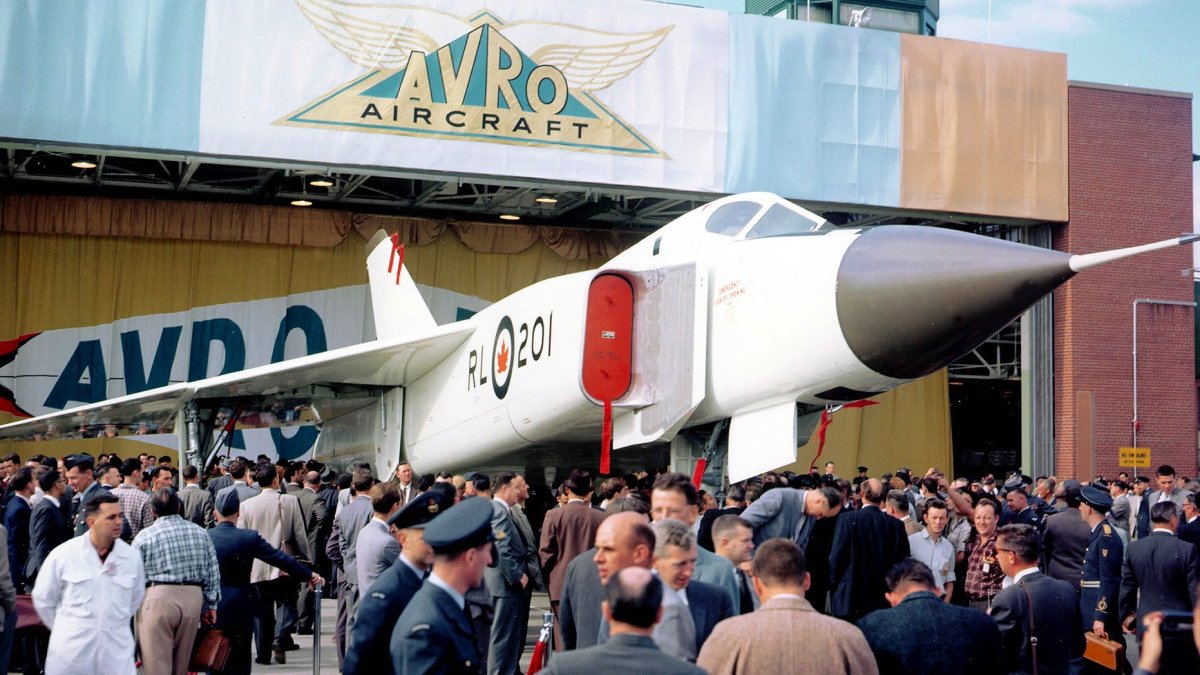
The new plan was realized in 1957 with a rollout, and the two-seat Arrow’s first flight took place shortly after in 1958. The first Arrow, RL-201, achieved Mach 1.9 on its maiden flight. The promise had been kept.
Rollout ceremony for the first Arrow, RL-201, on October 4, 1957. , PUBLIC DOMAIN — CANADIAN FORCES
First flight of the Avro Canada Arrow, on March 25, 1958:
Four aircraft, RL-201, RL-202, RL-203, and RL-204, were built and designated Arrow Mk 1. All the Mk 1 aircraft utilized Pratt & Whitney J75 engines and interim avionics. Ultimately, the design was intended to use the in-development Orenda Iroquois engine, an advanced turbojet of lighter weight and greater thrust than the J75. The Arrow Mk 1s flew a total of 66 times.
RL-204 was the last of the four CF-105 Arrow Mk 1 prototypes, here with a CF-100 Canuck in the background., Dong Rogers/Wikimedia Commons
Two Arrow Mk 2s were built, as well, RL-205 and RL-206. Both these were considered production examples and were fitted with the more advanced Iroquois engines. RL-205 only flew once and was grounded due to engine problems. RL-206 never flew.
For many reasons, including the Arrow program’s prodigious price tag and the proliferation of Soviet intercontinental ballistic missiles (ICBMs) no jet could stop, the program was canceled on February 20, 1959, by newly elected Canadian Prime Minister John Diefenbaker.
A memorandum for Prime Minister John Diefenbaker, outlining the main points behind the “105 problem”., CANADIAN GOVERNMENT MEMO
The news was not entirely unexpected, but it was heartbreaking to many Canadians. To thousands of Avro employees, the bad news came via company president Crawford Gordon Jr. He took to the factory’s loudspeaker and reportedly referred to Diefenbaker as “That fucking prick in Ottawa.”
RL-204 landing. The first four aircraft were all powered by a pair of Pratt & Whitney J75 engines., PUBLIC DOMAIN — CANADIAN FORCES
The cancelation left 14,000 Avro Canada employees almost immediately unemployed. The fallout extended to another estimated 15,000 aerospace contractors who lost their jobs as a knock-on effect. Since then, the day has been referred to as “Black Friday” in aerospace circles.
If the cancelation wasn’t harsh and abrasive enough, the order came two months later to destroy every part of the Arrow program, including the aircraft themselves. Nothing was supposed to escape the scrapper’s torch or shredder. The entire idea of the Arrow was to be liquidated, but that wasn’t quite how things turned out. A number of pieces of the aircraft and relics related to it did survive.
Arrow Mk 2 RL-206 on the production line., PUBLIC DOMAIN
Regardless, sixty years later, the decision remains highly controversial. Industry engineers and defense experts still claim it almost single-handedly eviscerated Canada’s ability to natively develop and produce advanced aerospace products.
Officially, the story ends there. However, the Arrow morphed into a specter that lives on to haunt Canada. There’s an old Canadian joke that says the best thing that ever happened to America was the cancellation of the Arrow. America did benefit. A group of 32 engineers known as the “ Avro group ” took their knowledge and skills to NASA and ultimately served critical roles in the Apollo space program .
Jim Chamberlin, chief of technical design for the CF-105, during his time at NASA., NASA
The Arrow wouldn’t go away quietly. Far-reaching rumors began immediately. Canadian writer June Callwood lived near the Avro plant in Malton, near Toronto, as a child. She claims that the day after cancellation, she and thousands of others heard the unmistakable crackling roar of an Arrow departing the area. Hardly conclusive evidence, but, to explain how that could have happened, conspiracy theorists point to photographs of the Arrows’ destruction, illicitly obtained from the air. The early pictures, before the cutting work began, confirm all the Arrows present, but the pictures from later in the process don’t appear to depict RL-202 at all.
RL-202 was an Arrow Mk 1 and so would not have been the obvious candidate for preservation. RL-205 and RL-206, with their Iroquois engines and fully equipped avionics suite, would have been more representative of the program’s final design goals. Avro Canada knew the program was in jeopardy and a plan to relocate an aircraft would have required immense planning. If a scheme to make off with an Arrow had existed, it stands to reason that a Mk 2 would have been chosen. Photographic evidence proves both Arrow Mk 2s were destroyed.
Control column from a CF-105 at the Bagotville Air Defense Museum in Quebec., Imer/Wikimedia Commons
These circumstances leave a sliver of space for the conspiracy about RL-202. RL-202 had just been repaired from a landing gear malfunction and had been readied for flying when the program was canceled. With all the employees laid off and expeditiously seeking gainful employment elsewhere, no one would have been around to modify RL-202 up to Arrow Mk 2 production standards, let alone continue to fly and service it for a meaningful period of time.
Avro worked with Crown Assets and Disposal Corporation, which hired Lax Iron and Steel to handle all the scrap and residue. The owner, Samuel Lax, recalled strict controls in an undated interview. All scrapped parts were supposedly weighed and compared to the expected weights at Hamilton Scrap Yard. He also claimed RL-202, the specific jet conspiracies are predicated upon, was the first Arrow to be completely dismantled, which had occurred by June 24, 1959. The following August the RCAF was informed that the final melting down of component parts and remnant wreckage was complete, but some pieces still survived.
The nose section of the unflown RL-206 on display at the Canada Aviation and Space Museum in Ottawa, Ontario. , Ahunt/Wikimedia Commons
Not quite 10 years later, Air Marshal Wilfred Curtis, a World War II hero and head of the Arrow program, refused to answer in a 1968 interview if an entire Arrow had been spirited away. He suggested it was too soon to reveal the surviving Arrow’s location, and he needed to wait for a more favorable political climate. Curtis never spoke about the subject on the record again, and he died in 1977.
Further rumors of a surviving Arrow came from the United Kingdom. In 2008, and again in 2011, Martin-Baker Mk 5 ejection seats built for the Arrow appeared for sale on eBay in England. In 2011, the head of Martin-Baker business development, Andrew Martin, generated a letter of authenticity for the seats, confirming they were indeed from an Arrow. Further, there is reasonable evidence that the seats were installed and flown in the jet.
Chris Wilson, the managing director of Jet Art Aviation, which sells aviation collectibles, said in 2011 the two seats were a matched pair and likely came from an Arrow which escaped destruction and found a home in the United Kingdom. Wilson further claimed that a customer of his saw an Arrow at RAF Manston, in Kent. That claim is clearly problematic.
Orenda PS.13 Iroquois turbojet, the intended powerplant of the Arrow Mk 2 on display at the Canada Aviation and Space Museum in Ottawa., Bzuk/Wikimedia Commons
In the early 1960s, many aircraft were white, and many were shaped similarly. One prime example is the British Aircraft Corporation (BAC) TSR-2 , which was both similar in planform and white. The TSR-2 first flew in 1964 and was canceled in 1965. If the sighting wasn’t completely fabricated, there’s a chance that’s what was seen. By any logic, the sightings aren’t attributed to defined, credible sources within the aerospace or defense industries and can’t be relied upon.
Viewing the claim from an even bigger picture, the United Kingdom declassifies information at 30, 50, and 100-year intervals. The 30 and 50-year intervals have now passed. Not only was the Avro Arrow program public knowledge, both in development and defeat, but the United Kingdom had its own similar projects at the time, such as the aforementioned TSR-2. It’s unlikely an Arrow would have been of use to the United Kingdom. It seems highly unlikely that possessing an unclassified Canadian Mach 2 fighter would qualify as a national secret to be kept for 100 years; information that would have a grave effect on national security if compromised. Under the U.K. Official Secrets Act 1989, a confidential program such as one supporting an Arrow more likely than not would’ve been disclosed after 30 years.
As for the ejection seats in the United Kingdom, seats of this kind contain explosive charges necessary for the pilot to clear and egress the aircraft being abandoned. As with many conspiracies, the simplest explanation is perhaps most likely. Ejection seats are among the first parts procedurally removed before an aircraft can be safely cut up and destroyed. Museum-bound aircraft receive inert ejection seats that have been permanently “safed.”
A contemporary artist’s impression of the CF-105 in RCAF service., National Film Board of Canada
In keeping with the orders to destroy everything, no complete Arrows were allotted to museums. Martin-Baker confirms that fewer than 20 seats were built for the Arrow program. The specific installed seats were removed before the aircraft began to be scrapped. There’s no verified chain of custody for these seats. We only know for sure that they came from an Arrow. Nothing beyond blind hope sprinkled with fantasy suggests they could’ve been removed in England from an airworthy aircraft.
In 1998, 40 years after the Arrow’s cancellation, an organization that called itself Arrow Recovery Canada, led by Andrew Hibbert, started scouring Lake Ontario for one of nine 1/8th scale test models of the Arrow that were strapped to rockets and launched from Point Petre, Ontario, at supersonic speeds. They spent between 1999 and 2006 surveying the area. For three years from 2006 to 2009, they dived to investigate targets that had been detected by sonar but didn’t find what they were looking for.
The wings of the third prototype Arrow survive at the Canada Aviation and Space Museum., Emdx/Wikimedia Commons
They had zealous competition. Ed Burtt, a shipwreck diver, was looking for the models as well. In 2018, a third project looking for the same models — called Raise the Arrow — funded by the OEX Recovery Group, found, and recovered a delta-wing test model from the Arrow program. It wasn’t the 1/8th scale model they were looking for, but it was a celebrated find. That model was restored and put on display at the Canada Aviation and Space Museum in Ottawa. The search for the models continued into 2020. On October 8 last year, Raise the Arrow announced they found the 1/8th scale model they had been looking for and needed to determine how to raise it.
2020 was a big year all around for the ghost of the Arrow. Blueprints surfaced in January, of the type believed to have all been destroyed. A senior draftsman for Avro Canada, Ken Barnes, defied the 1959 order, snuck them out, and kept them in his basement. He never spoke of them in his lifetime and forbade his kids from going into the corner in which his workbench sat. After his death, they were discovered by his son. The blueprints are currently on loan to the Diefenbaker Canada Centre (the same Diefenbaker responsible for canceling the Arrow) and can be seen by visitors. Also smuggled out were RL-206’s nose cone and some panels. Those are on display at the Canada Aviation and Space Museum, alongside the delta test model recovered from Lake Ontario. In the meantime, a full-scale replica was even built and placed on display at the Canadian Air & Space Museum in Toronto.
A full-size replica of an Arrow Mk 1 at the Canadian Air & Space Museum in Toronto., EyeNo/Wikimedia Commons
In 2010 Bourdeau Industries submitted a bizarre proposal to Stephen Harper’s Conservative government to replace Canada’s aging CF-18 Hornet fighter jets with updated Avro Arrows, instead of the officially favored F-35 Joint Strike Fighters . Canada’s retired Major General Lewis Mackenzie championed the proposal and said that the Arrow’s basic design still exceeded that of any current fighter jet. Major General Mackenzie is a highly respected officer who was at one time the Chief of Staff of the United Nations peacekeeping force in former Yugoslavia, but his claim about the Arrow’s capabilities as compared to fourth and fifth-generation fighter jets as of 2010 is easily disputable. Canada’s Associate Minister of National Defense at the time, Julian Fantino, agreed, stating that the Arrow was not a viable option 50 years after its demise.
As an impactful part of Canada’s history, the Avro Arrow is beyond reproach in its afterlife. It seems every last corner of its legacy has been explored and every known surviving part has been given the full artifact treatment. Even the depths of a great lake were laboriously scoured for 20 years to locate relics from the program. The reappearance of pieces, models, and plans and their placement in museums speaks to the fact that even though the program came and went almost a lifetime ago, it has been duly shown respect through commemoration. While fragments and mementos probably still exist in basements and warehouses throughout Canada, it doesn’t mean a jet is out there or ever was.
Why has its legacy persisted? The myths that have carried the Arrow beyond its resting place are a common vein with aircraft that become the source of national pride. For the sake of comparison, the SR-71 program was one of the United States’ greatest technological achievements. Its fans and proponents never wanted to admit that time had passed the SR-71 by, they didn’t want it to retire , and when it did, they assumed it was still out there somewhere, flying in secret. The Arrow is similar in its own way. The dream of what could have been is a tough thing to let go of.
Over six decades later, it may finally be time to lay the conspiracies and rumors surrounding the CF-105 Arrow to rest, but that doesn’t mean we can’t admire just how much of a technological marvel and a source of collective pride the aircraft could have been for Canada.
Contact the editor: Tyler@thedrive.com
Comments couldn’t be loaded. Please refresh the page.
发布于美国东部时间2021年3月25日下午3:57
CF-105“箭”式战斗机是加拿大为应对冷战时期苏联核轰炸机的威胁而独创的战机。凭借其卓越的性能和惊艳的外观,“箭”式战斗机吸引了全世界的目光,并在加拿大国内引发了巨大的轰动。这款大型截击机于20世纪50年代研发,但从未正式服役,加拿大人对它的情感却始终深厚。加之该项目在近一个世纪前突然终止,各种关于“箭”式战斗机在官方宣布终止后以某种秘密“第二春”形式出现的传闻和阴谋论层出不穷。因此,“箭”式战斗机仿佛成了航空史上一个挥之不去的幽灵。
20世纪50年代初,苏联轰炸机机队的快速发展引起了全世界的关注。加拿大最初致力于研发一种能够防御苏联轰炸机的喷气式战斗机,其重点在于大幅改进现有的加拿大阿弗罗CF-100“卡努克”(Canuck)战斗机。CF-100是一款加拿大自主研发的双座双引擎亚音速喷气式战斗机。“卡努克”性能优异,为加拿大服役多年,但其设计并非用于高空高速拦截。提升CF-100最高速度和性能的努力收效甚微,最终导致整个项目需要重新评估。加拿大决定从零开始,自主研发一种全新的先进拦截机。
首架CF-105“箭”式原型机正在进行试飞。(公共领域)——加拿大军队
加拿大皇家空军(RCAF)于1953年发布了AIR 7-3型技术规范。该规范明确了加拿大的真正需求,要求研制一种性能强劲、技术先进的战机,能够在起飞五分钟后达到50,000英尺(约15,800米)高度1.5马赫的巡航速度。此外,规范还要求战机在正常速度下执行任务的航程仅为300海里(约480公里),高速拦截航程为200海里(约620公里)。规范还规定战机必须在6,000英尺(约1800米)长的跑道上起降,且地面周转时间不超过10分钟。加拿大皇家空军考察了英国、法国和美国的制造商,最终认定没有一款现有设计能够满足其要求。于是,加拿大Avro公司重新设计,Arrow战机由此诞生。
新计划于1957年得以实现,双座箭式战斗机的首飞紧随其后,于1958年进行。首架箭式战斗机RL-201在首飞中达到了1.9马赫的速度。承诺兑现了。
1957年10月4日,首架箭式导弹RL-201下线仪式举行。(公共领域——加拿大军队)
加拿大Avro Arrow飞机于1958年3月25日首飞:
共制造了四架飞机,分别为RL-201、RL-202、RL-203和RL-204,并被命名为Arrow Mk 1。所有Mk 1型飞机均采用普惠J75发动机和过渡型航电系统。最终设计方案是使用当时正在研发的奥伦达Iroquois发动机,这是一款比J75更轻、推力更大的先进涡轮喷气发动机。Arrow Mk 1型飞机共飞行了66次。
RL-204是四架CF-105“箭”式Mk 1原型机中的最后一架,图中背景是一架CF-100“加拿大人”战斗机。(图片来源:Dong Rogers/Wikimedia Commons)
此外,还制造了两架Arrow Mk 2型飞机,编号分别为RL-205和RL-206。这两架飞机都被视为量产型,并配备了更先进的Iroquois发动机。RL-205仅飞行过一次,便因发动机故障而停飞。RL-206则从未飞行过。
由于诸多原因,包括箭式战斗机计划的巨额预算以及苏联洲际弹道导弹(ICBM)的扩散(任何喷气式飞机都无法阻止),该计划于 1959 年 2 月 20 日被新当选的加拿大总理约翰·迪芬贝克取消。
一份提交给总理约翰·迪芬贝克的备忘录,概述了“105问题”背后的要点。(加拿大政府备忘录)
这个消息虽然并非完全出乎意料,但对许多加拿大人来说仍然令人心碎。对数千名Avro员工而言,这个坏消息是通过公司总裁克劳福德·戈登二世宣布的。据报道,他通过工厂的广播系统,称迪芬贝克为“渥太华那个混蛋”。
RL-204 着陆。前四架飞机均由两台普惠 J75 发动机提供动力。(公共领域 — 加拿大军队)
此次取消导致Avro Canada公司14000名员工几乎立即失业。连锁反应还波及到另外约15000名航空航天承包商,他们也因此失去了工作。自此以后,航空航天界将这一天称为“黑色星期五”。
如果说取消项目还不够残酷无情,那么两个月后下达的命令更是雪上加霜:销毁“箭”式战斗机项目的所有部件,包括飞机本身。一切都注定要被拆解殆尽。整个“箭”式战斗机项目似乎要彻底消失,但事情的发展却并非如此。一些飞机部件和相关遗物幸存了下来。
生产线上的 Arrow Mk 2 RL-206 型火箭筒。(公共领域)
然而,六十年过去了,这项决定仍然极具争议。行业工程师和国防专家仍然认为,这项决定几乎彻底摧毁了加拿大自主研发和生产先进航空航天产品的能力。
官方说法是,故事到此结束。然而,“箭”式飞机却像幽灵一样,一直萦绕在加拿大。加拿大有个老笑话说,美国历史上最棒的事就是“箭”式飞机项目被取消。美国确实从中受益。一个由32名工程师组成的团队,被称为“阿弗罗小组”,将他们的知识和技能带到了美国国家航空航天局(NASA),最终在阿波罗登月计划中发挥了关键作用。
吉姆·张伯伦,在NASA任职期间担任CF-105的技术设计主管。
“箭式”飞机的消失并未就此平息。各种谣言迅速传播开来。加拿大作家琼·卡尔伍德(June Callwood)童年时期住在多伦多附近的马尔顿,靠近阿弗罗飞机制造厂。她声称,在项目取消的第二天,她和成千上万的人都听到了“箭式”飞机离开该地区时发出的标志性噼啪声和轰鸣声。这虽然算不上确凿的证据,但为了解释这一切是如何发生的,阴谋论者指出了一些从空中非法获取的“箭式”飞机销毁照片。早期照片拍摄于切割工作开始之前,证实了所有“箭式”飞机都在现场,但后期拍摄的照片似乎完全没有出现RL-202的身影。
RL-202是一架Arrow Mk 1型飞机,因此并非最显而易见的保存对象。RL-205和RL-206配备了Iroquois发动机和全套航电系统,更能代表该项目的最终设计目标。Avro Canada公司深知该项目岌岌可危,转移飞机需要周密的计划。如果真有计划盗走Arrow飞机,那么选择Mk 2型飞机也在情理之中。照片证据显示,两架Arrow Mk 2型飞机均已被销毁。
魁北克省巴戈特维尔防空博物馆中一架CF-105战斗机的操纵杆。图片来源:Imer/Wikimedia Commons
这些情况为关于RL-202的阴谋论留下了一线生机。RL-202刚刚修复了起落架故障,正准备试飞,项目却被取消了。所有员工都被解雇,并迅速另谋高就,根本没人会留下来对RL-202进行改装,使其达到Arrow Mk 2的生产标准,更遑论继续飞行和维护一段时间了。
Avro公司与皇家资产处置公司合作,后者聘请了Lax钢铁公司处理所有废料和残骸。公司老板Samuel Lax在一次未注明日期的采访中回忆起严格的管控措施。据说所有报废部件都要称重,并与汉密尔顿废料场的预期重量进行比较。他还声称,RL-202——所有关于喷气式飞机阴谋论的依据——是第一架被完全拆解的Arrow飞机,拆解工作于1959年6月24日完成。同年8月,加拿大皇家空军被告知,零部件和残骸的最终熔化工作已经完成,但仍有一些部件幸存下来。
加拿大航空航天博物馆(位于安大略省渥太华)展出的未飞行过的RL-206飞机的机头部分。(图片来源:Ahunt/Wikimedia Commons)
不到十年后,二战英雄、箭式导弹计划负责人威尔弗雷德·柯蒂斯空军元帅在1968年的一次采访中拒绝回答是否有一架完整的箭式导弹被秘密转移。他认为现在透露幸存的箭式导弹的下落还为时过早,需要等待更有利的政治环境。柯蒂斯此后再未公开谈论过此事,并于1977年去世。
关于一架幸存的“箭”式战斗机的更多传闻来自英国。2008年和2011年,专为“箭”式战斗机制造的马丁-贝克Mk 5型弹射座椅出现在英国eBay网站上出售。2011年,马丁-贝克公司业务发展主管安德鲁·马丁出具了一份座椅鉴定函,证实这些座椅确实来自“箭”式战斗机。此外,还有合理的证据表明,这些座椅曾安装在该架飞机上并进行过飞行测试。
销售航空收藏品的Jet Art Aviation公司总经理克里斯·威尔逊在2011年表示,这两张座椅是一对,很可能来自一架幸免于难、最终落户英国的Arrow飞机。威尔逊还声称,他的一位客户曾在肯特郡的曼斯顿皇家空军基地见过一架Arrow飞机。显然,这种说法存在问题。
奥伦达PS.13“易洛魁”涡轮喷气发动机,是加拿大航空航天博物馆(位于渥太华)展出的箭式Mk 2战斗机的预定动力装置。(图片来源:Bzuk/Wikimedia Commons)
20世纪60年代初期,许多飞机都是白色的,而且外形也十分相似。英国飞机公司(BAC)的TSR-2就是一个典型的例子,它的平面形状和外观都与上述飞机相似。TSR-2于1964年首飞,1965年停产。如果目击事件并非完全捏造,那么人们看到的很可能就是TSR-2。但无论如何,这些目击事件并没有来自航空航天或国防工业领域内明确可靠的消息来源,因此不可信。
从更宏观的角度来看,英国每30年、50年和100年才会解密一次信息。如今,30年和50年的期限都已过去。Avro Arrow项目,无论是在研发阶段还是最终失败,都早已是公开信息。而且,英国当时也有类似的计划,例如前文提到的TSR-2。Arrow对英国来说不太可能有什么实际用途。拥有一架未保密的加拿大2马赫战斗机,不太可能被列为需要保密100年的国家机密;毕竟,一旦泄露,会对国家安全造成严重影响。根据1989年英国《官方保密法》,像Arrow这样的机密项目,很可能在30年后就会被公开。
至于英国的弹射座椅,这类座椅内装有爆炸装置,用于飞行员在弃机时弹射逃生。如同许多阴谋论一样,最简单的解释或许才是最有可能的。弹射座椅是飞机拆解销毁前最先按程序移除的部件之一。送往博物馆的飞机则会安装已被永久“封存”的惰性弹射座椅。
加拿大国家电影局出品的当代艺术家笔下的加拿大皇家空军CF-105战斗机。
为了执行销毁一切的命令,没有一架完整的“箭”式飞机被分配给博物馆。马丁-贝克证实,“箭”式飞机项目只生产了不到20个座椅。这些座椅在飞机开始拆解之前就被拆除了。这些座椅的来源没有可查证的记录。我们唯一确定的是它们来自一架“箭”式飞机。除了盲目的希望和一些臆想之外,没有任何证据表明它们有可能在英国从一架适航的飞机上拆卸下来。
1998年,在“箭”式火箭项目取消40年后,一个名为“加拿大箭式火箭回收组织”(Arrow Recovery Canada)的机构,在安德鲁·希伯特(Andrew Hibbert)的领导下,开始在安大略湖中搜寻“箭”式火箭的九个1/8比例测试模型之一。这些模型曾被绑在火箭上,从安大略省的佩特雷角(Point Petre)以超音速发射升空。他们在1999年至2006年间对该区域进行了勘测。从2006年至2009年的三年间,他们潜入水中,调查声纳探测到的目标,但最终未能找到他们要寻找的东西。
第三架箭式战斗机原型机的机翼现存于加拿大航空航天博物馆。(图片来源:Emdx/Wikimedia Commons)
他们面临着激烈的竞争。沉船潜水员埃德·伯特也在寻找这些模型。2018年,由OEX回收小组资助的第三个寻找相同模型的项目——名为“打捞箭矢”(Raise the Arrow)——发现并打捞了一架“箭矢”计划的三角翼测试模型。虽然它并非他们一直在寻找的1/8比例模型,但仍然是一项令人瞩目的发现。该模型被修复后,在渥太华的加拿大航空航天博物馆展出。对这些模型的搜寻一直持续到2020年。去年10月8日,“打捞箭矢”项目宣布他们找到了一直在寻找的1/8比例模型,并正在研究如何将其打捞出水。
2020年对于“箭式”战斗机的幽灵来说可谓意义非凡。今年1月,一些此前被认为早已销毁的蓝图重见天日。加拿大Avro公司的高级绘图员肯·巴恩斯(Ken Barnes)违抗了1959年的命令,偷偷将这些蓝图带出,并藏在自家地下室。他生前从未提及此事,甚至禁止孩子们靠近他工作台所在的角落。他去世后,这些蓝图被他的儿子发现。目前,这些蓝图借展于迪芬贝克加拿大中心(正是迪芬贝克公司取消了“箭式”战斗机项目),供游客参观。此外,RL-206的鼻锥和一些面板也被偷偷带出。这些部件与从安大略湖打捞上来的三角翼测试模型一同在加拿大航空航天博物馆展出。与此同时,一架全尺寸复制品也被建造出来,并在多伦多的加拿大航空航天博物馆展出。
多伦多加拿大航空航天博物馆展出的一架箭式Mk 1战斗机的全尺寸复制品。(图片来源:EyeNo/Wikimedia Commons)
2010年,博尔德奥工业公司向斯蒂芬·哈珀领导的保守党政府提交了一份令人匪夷所思的提案,建议用升级后的阿弗罗箭式战斗机取代加拿大老旧的CF-18“大黄蜂”战斗机,而不是官方更倾向的F-35联合攻击战斗机。加拿大退役少将刘易斯·麦肯齐力挺这项提案,并声称箭式战斗机的基本设计仍然优于任何现役战斗机。麦肯齐少将是一位备受尊敬的军官,曾任联合国驻前南斯拉夫维和部队参谋长,但他关于箭式战斗机在2010年与第四代和第五代战斗机相比性能的说法很容易受到质疑。时任加拿大国防部副部长朱利安·范蒂诺也同意这一观点,他表示,箭式战斗机在退役50年后已不再是一个可行的选择。
作为加拿大历史上影响深远的一部分,Avro Arrow战斗机在后世的保存状况无可挑剔。似乎它留下的每一个角落都已被探索殆尽,每一个已知的幸存部件都得到了全面的文物保护。甚至连一座大湖的深处,人们也曾耗费20年时间,不辞辛劳地搜寻该项目的遗迹。这些部件、模型和设计图纸的重现,以及它们在博物馆中的展出,都表明尽管该项目已近乎消逝,但它仍然通过纪念活动得到了应有的尊重。虽然碎片和纪念品可能仍然散落在加拿大各地的地下室和仓库中,但这并不意味着一架真正的Avro Arrow战斗机仍然存在,或者曾经存在过。
为什么它的传奇经久不衰?那些让“箭”式战斗机超越其最终归宿的神话,与那些成为国家骄傲的飞机有着共通之处。举例来说,SR-71项目是美国最伟大的技术成就之一。它的拥趸和支持者们始终不愿承认SR-71已经过时,他们不希望它退役,即便它真的退役了,他们也仍然相信它还在某个地方秘密飞行。“箭”式战斗机在某种程度上也是如此。对它本可以拥有的辉煌的憧憬,总是难以割舍。
六十多年过去了,或许是时候终结围绕 CF-105 箭式战斗机的阴谋论和谣言了,但这并不意味着我们不能赞叹这架飞机原本可以成为加拿大的一项技术奇迹和集体自豪感的来源。
联系编辑:Tyler@thedrive.com
评论加载失败,请刷新页面。