The Mysterious Cold War Case Of Unidentified Aircraft Descending On Loring Air Force Base冷战时期不明飞行物降落洛林空军基地的神秘事件
When it comes to cases involving unidentified flying objects, few are as well documented or involve as many people as what occurred at Loring in 1975.
新闻视频
Updated Nov 27, 2020 6:27 PM EST
Despite the newfound attention the topic of unexplained incursions into airspace over sensitive locales across the United States is receiving, these types of bizarre incidents are not necessarily new. One of the most puzzling accounts of such an event, or series of events, occurred during the depths of the Cold War.
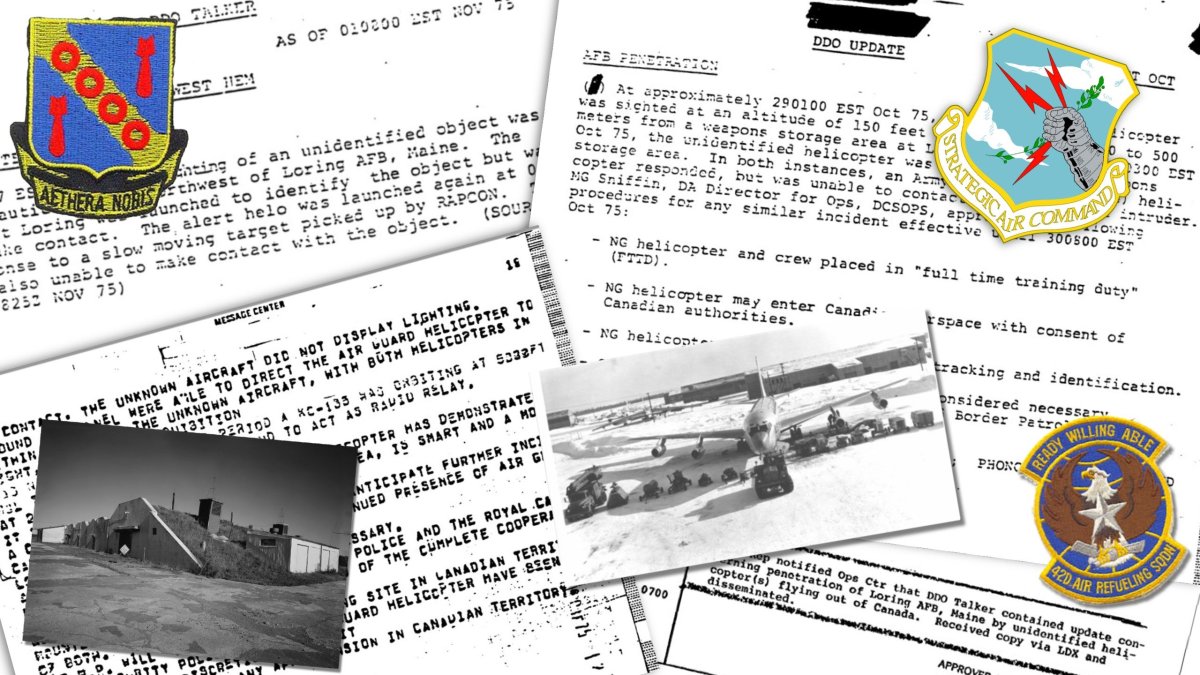
Over a series of nights in 1975, Loring Air Force Base in Maine was invaded by mysterious craft originating from Canadian airspace. At the time, the base was home to B-52 bombers and KC-135 tankers and was tasked with the nuclear alert mission. The Loring AFB incidents are extremely well documented, both in terms of personal testimonials and declassified CIA and National Military Command Center (NMCC) documents. What also made the events so interesting was just how many people were involved or knew about the potential threat and the reaction to it. It was truly a community-scale ordeal that even made its way into the national press. Considering we are talking about a base that housed nuclear weapons and a delivery system for those weapons, the bombers and tankers they rely on, the concern regarding the strange incursions was extreme, to say the least.
What is also interesting about the bizarre events at Loring Air Force Base in the fall of 1975 was what was going on elsewhere, as well. Based on additional official documentation and reports, similar occurrences were remarkably widespread during this time period, albeit few, if any, were as widely experienced or as public in nature.
Unidentified ‘Helicopters’ Appear Over Loring Air Force Base
It was October of 1975. At the time, Loring Air Force Base was a Strategic Air Command (SAC) base that housed two KC-135 tanker squadrons and a B-52 bomber squadron, which had the alert nuclear weapons delivery mission. It was SAC’s easternmost base in the continental United States, putting it in a unique position to quickly respond to a crisis.
The strange affair began on the evening on October 27 when security personnel at the base observed what was described officially as “an unidentified helicopter” that appeared near the northern perimeter of the installation. The aircraft was said to be flying at a low altitude, estimated to be around 150 feet, and appeared to feature a red navigational light and a white strobe. The helicopter seemed to be particularly interested in the highly-secure nuclear weapons storage area at Loring. Army National Guard helicopters were dispatched in an attempt to contact and identify the aircraft, but those attempts proved unsuccessful. The base was immediately put on high alert.
Loring AFB in 1970., Wikimedia Commons
Shortly after the craft appeared, radar operators in the control tower at Loring observed another unknown aircraft circling between 10 and 13 miles northeast of the base. Once again, that aircraft could not be identified despite numerous attempts to make contact by radio on both civilian and military channels. The first unknown aircraft eventually turned north and flew into Canada near Grand Falls, New Brunswick, and the second unknown craft vanished from radar, possibly landing or descending below radar coverage.
Loring’s nuclear weapons storage area, also known as Caribou Air Force Station. , Library of Congress
The next night, on October 28, another unknown aircraft appeared over Loring, this time without lights. Once again, National Guard helicopters were sent to investigate, but were unable to establish visual confirmation of the aircraft. In an Operation Report (OPREP) issued after the incident, officials wrote that “It is our opinion that the unknown helicopter has demonstrated a clear intent in the weapons storage area, is smart and a most capable aviator.” The incidents continued through at least October 30th.
In response to the incursion, Loring increased its local security presence and coordinated with Canadian authorities to allow U.S. aircraft to pursue the offending aircraft into Canadian airspace should the unknown aircraft return.
reported on the incursions in the 1979 article “U.F.O. Files: The Untold Story,” adding that despite the fact the Joint Chiefs of Staff received multiple briefings on the incursions, “Subsequent investigations by the Air Force into the sightings at Loring Air Force Base, Maine, where the remarkable series of events began, did not reveal a cause for the sightings.”
Eyewitness Accounts Complicate The Helicopter Narrative
One account of the aerial intrusions at Loring comes from Arthur Beers, who served at the base from 1970 to 1976. In an account posted to LoringRemembers.com , a site dedicated to chronicling the experiences of the many men and women who served at Loring, Beers described his “ most memorable experience ” at Loring:
Probably my favorite story was when I was in the Rated Supplement as a Security Police Shift Commander. I was on duty one evening when the Nuclear Weapons Storage Area was buzzed by a unknown helicopter. Obviously we reported this up channel and I raced out to the storage area. When I arrived, I was told that the National Emergency Command Post was on the line for me. When I talked to the Colonel at the National Command Post and explained what had been reported by my team at the storage area, he gave me orders to shoot down the helicopter if it tried to buzz the area again. I immediately went out to the brief my SAT Teams on these orders but before I could complete that briefing I was called back to the entry point where I talked with a General Officer who said that the President had been briefed and that my new orders were to shoot only if the helicopter tried to land (ah, heck!). I went out and rebriefed my teams in just the nick of time as the unknown pilot in an unlighted Huey type helicopter came back again and then two more times during my shift. He came back three other nights and then just disappeared. To my knowledge the identity was never discovered. A interesting side note to this, once the information got up to NORAD that we had this unauthorized flying over the storage area, NORAD launched the F-106 that was on alert at Loring. Not exactly sure how that jet jockey was going to see or shoot at a helicopter, 50 feet off the ground in the Northern Maine woods at night running with no lights, but I guess NORAD had to do something. Never saw the F-106, did see the helicopter.
Probably my favorite story was when I was in the Rated Supplement as a Security Police Shift Commander. I was on duty one evening when the Nuclear Weapons Storage Area was buzzed by a unknown helicopter. Obviously we reported this up channel and I raced out to the storage area. When I arrived, I was told that the National Emergency Command Post was on the line for me. When I talked to the Colonel at the National Command Post and explained what had been reported by my team at the storage area, he gave me orders to shoot down the helicopter if it tried to buzz the area again.
I immediately went out to the brief my SAT Teams on these orders but before I could complete that briefing I was called back to the entry point where I talked with a General Officer who said that the President had been briefed and that my new orders were to shoot only if the helicopter tried to land (ah, heck!). I went out and rebriefed my teams in just the nick of time as the unknown pilot in an unlighted Huey type helicopter came back again and then two more times during my shift. He came back three other nights and then just disappeared. To my knowledge the identity was never discovered.
A interesting side note to this, once the information got up to NORAD that we had this unauthorized flying over the storage area, NORAD launched the F-106 that was on alert at Loring. Not exactly sure how that jet jockey was going to see or shoot at a helicopter, 50 feet off the ground in the Northern Maine woods at night running with no lights, but I guess NORAD had to do something. Never saw the F-106, did see the helicopter.
Other personal testimony complicates the claims that the intruder was actually helicopter. Michael Wallace, a former KC-135 tanker pilot who was stationed at Loring in 1975, shared his own bizarre Loring incursion experience on YouTube:
Wallace states that he was briefed on an incursion over the nuclear-armed B-52s and weapons storage facilities at Loring. Wallace and a few hundred other personnel were informed of a silent, luminous object hovering over the base which could move “very quickly” and “unconventionally” in “rapid, straight-line movements, with straight vertical movements, can turn without any apparent radius in the turn. It’s pretty incredible technology.” The object was openly referred to as a UFO by base personnel.
Wallace goes on to claim that Loring personnel were briefed only to speak to SAC officers about the incursion, not to speak to the press, and that they were “going to tell the press that there was a Canadian helicopter crossing the border and harassing us.” He also notes that interceptors were going to be brought in to assist in the efforts to protect the base and investigate what was going on.
Wallace was eventually sent on a refueling mission in his KC-135 to support F-4 Phantoms for unrelated training when his flight was notified by the base’s command post to switch radio frequencies. The lead KC-135 in the flight was instructed to depart the formation, turn off its lights, go radio silent, and proceed to Loring under its own discretion, something Wallace describes as a highly unusual order.
Wallace remembers hearing “stressed voices” over the radio as the pilots and tower personnel attempted to track the object as it seemed to fly back and forth over the base at incredible speeds. As quickly as the transmissions began, they ended as tower personnel stated simply “We’ve lost it.” When Wallace later saw the pilot of the lead aircraft who was sent to intercept the object, he told Wallace “I can’t talk about it, and you wouldn’t believe me if I could talk about it.”
A NORAD document states “Information indicates that the A/C [aircraft] is a helicopter. However, the A/C remains unidentified. Descriptions of the observed A/C lighting have varied somewhat but not in such a way that there is any indication there is more than one A/C involved.”, Nick Redfern via FOIA
LoringRemembers.com contains numerous other references to the 1975 incursions, with many former Loring personnel calling the incident their most memorable experience . One former Field Maintenance Squadron member remembers “the activity on the flight-line was a frenzy ” the night of the incursion.
John E. Morkavich, who served at Loring from 1972 to 1975, recounted the following to LoringRemembers.com:
I was a Hospital Corpsman OR Tech 72-75 and one night in the fall of 73 (I will stand corrected if someone else recalls and has better time line [sic]) the base sirens went off and they said thats [sic] the big one thats [sic] gonna scramble the jets and bombers. About 6 of us got on the roof of the medical barracks and waited for whatever. The base went nuts, claxons, sirens, security police vehicles speeding around lots of flashing lights. Lots of flight line roaring of engines. Well about 3 weeeks [sic] later I was in the Officers Club with Dr John P Sheppard and a couple of pilots were sitting with us. We talked sports and politics then Doc Sheppard asked what the hell happened the other night. They replied with the ubiquitous “Do You Have a Need To Know?” Sheppard said hell yes, so I heard this explanation and both pilots were dead serious. There was a UFO that came up on radar out of nowhere and was hovering over East Loring near the weapons storage facility. Aircraft was scrambled to intercept, it was seen visually and tracked on radar. Then the Lt Colonel said. “This damn thing was there one second and gone the next, vanished….then radar analysis showed this bogey was so far away and at such a high altitude…..let me tell you this -“… there is NOTHING on THIS PLANET that can do the things this aircraft or damn UFO did….” Then they got up and walked away from the table. Sheppard and I were stunned and we did not talk about it again. This is no BS and I welcome those who were there and remember.
I was a Hospital Corpsman OR Tech 72-75 and one night in the fall of 73 (I will stand corrected if someone else recalls and has better time line [sic]) the base sirens went off and they said thats [sic] the big one thats [sic] gonna scramble the jets and bombers. About 6 of us got on the roof of the medical barracks and waited for whatever. The base went nuts, claxons, sirens, security police vehicles speeding around lots of flashing lights. Lots of flight line roaring of engines. Well about 3 weeeks [sic] later I was in the Officers Club with Dr John P Sheppard and a couple of pilots were sitting with us. We talked sports and politics then Doc Sheppard asked what the hell happened the other night. They replied with the ubiquitous “Do You Have a Need To Know?” Sheppard said hell yes, so I heard this explanation and both pilots were dead serious.
There was a UFO that came up on radar out of nowhere and was hovering over East Loring near the weapons storage facility. Aircraft was scrambled to intercept, it was seen visually and tracked on radar. Then the Lt Colonel said. “This damn thing was there one second and gone the next, vanished….then radar analysis showed this bogey was so far away and at such a high altitude…..let me tell you this -“… there is NOTHING on THIS PLANET that can do the things this aircraft or damn UFO did….” Then they got up and walked away from the table. Sheppard and I were stunned and we did not talk about it again. This is no BS and I welcome those who were there and remember.
LoringRemembers.com even contains a section called “ the official UFO story ” which states simply “In 1975, a ‘UFO’ buzzed the WSA over a few nights. Internet lore has stamped this as a true UFO conspiracy involving numerous other bases. The DOD released a declassified report on the incident.”
A 1975 CIA memo noting the Loring AFB incursion., CIA via FOIA
One of the most thorough investigations of the Loring incidents was conducted by Barry Greenwood and Lawrence Fawcett and included in their 1984 book
Clear Intent: The Government Coverup of the UFO Experience . An excerpt from that book containing sections on Loring can be found online here . It goes into great detail as to what the narrative of events was, at least according to their research. We will pick it up on the second night, but we encourage you to read the whole excerpt.
On October 28, 1975, at 7:45 P.M., Sgt. Clifton W. Blakeslee and Staff Sgt. William J. Long, both assigned to the 42nd Security Police Squadron, were on duty at the munitions storage area. Along with Sgt. Danny Lewis, both Sgts. Blakeslee and Long spotted what appeared to be the running lights of an aircraft approaching Loring Air Force Base from the north at 3,000 feet. The aircraft did not come closer to Loring than about three miles at this time, and it was observed intermittently for the next hour. On first spotting the craft, Sgt. Lewis called the Command Post and advised it that the unknown craft had returned to Loring. Lewis reported that he could see a white flashing light and an amber or orange light. Once again, the Commander, 42nd Bomb Wing responded. Rushing to the area of the storage dump, he observed the unknown craft. He reported seeing a flashing white light and an amber-colored light on the object also. The speed and movement in the air suggested that the craft was a helicopter. From 7:45 P.M. to 8:20 P.M., it was under constant observation, both visually by the personnel in the storage area and electronically by the control tower radar, which showed the craft at a position three miles north of the Loring perimeter. The unknown craft would appear and disappear from view, and, at one point, appeared over the end of the runway at an altitude of 150 feet. The object subsequently shut off its lights and reappeared over the weapons storage area, maintaining an altitude of 150 feet. At this time, Sgt. Steven Eichner, a crew chief on a B-52 bomber, was working out of a launch truck along with Sgt. R. Jones and other members of the crew. Jones spotted a red and orange object over the flight line. It seemed to be on the other side of the flight line from where the weapons storage area was located. To Eichner and Jones, the object looked like a stretched-out football. It hovered in midair as everyone in the crew stared in awe. As they watched, the object put out its lights and disappeared, but it soon reappeared again over the north end of the runway, moving in jerky motions. It stopped and hovered. Eichner and the rest of the crew jumped into the truck and started to drive toward the object. Proceeding down Oklahoma Avenue (which borders the runway), they turned left onto the road that led to the weapons storage area. As they made the turn, they spotted the object about 300 feet in front of them. It seemed to be about five feet in the air and hovered without movement or noise. Exhibiting a reddish-orange color, the object was about four car lengths long. Eichner described what he saw next: “The object looked like all the colors were blending together, as if you were looking at a desert scene. You see waves of heat rising off the desert floor. This is what I saw. There were these waves in front of the object and all the colors were blending together. The object was solid and we could not hear any noise coming from it.” They could not see any doors or windows on the object nor any propellers or engines which would keep the object in the air. Suddenly, the base came alive. Sirens began screaming. Eichner could see numerous blue lights on police vehicles coming down the flight line and runway toward the weapons storage area at high speed. Jones turned and said to the crew, “We better get out of here!” They immediately did. The Security Police did not try to stop them. Their interest was in the object over the storage dump, not in the truck which was in a restricted area. The crew drove the truck back to its original location and watched from there. The scene at the weapons storage area was chaotic, with blue lights rotating around, and the vehicles’ searchlight beams shining in all directions. The men in the crew decided not to report what they had seen, because they had entered a restricted area and could have been arrested for the violation. The object shut off its lights and disappeared, not to be seen again that night. The 42nd Police conducted a security sweep of the weapons storage area inside and out, with no results. Radar had once again briefly tracked the object heading for Grand Falls, New Brunswick, finally losing the unknown at Grand Falls itself. Priority messages were sent to the National Military Command Center in Washington, the Chief of Staff of the Air Force, the Air Force Forward Operations Division at Fort Ritchie, Maryland, SAC Headquarters, and the 9th Air Force, 45th Division, advising them that an unknown object had penetrated the base and had been in the nuclear storage area.
On October 28, 1975, at 7:45 P.M., Sgt. Clifton W. Blakeslee and Staff Sgt. William J. Long, both assigned to the 42nd Security Police Squadron, were on duty at the munitions storage area. Along with Sgt. Danny Lewis, both Sgts. Blakeslee and Long spotted what appeared to be the running lights of an aircraft approaching Loring Air Force Base from the north at 3,000 feet. The aircraft did not come closer to Loring than about three miles at this time, and it was observed intermittently for the next hour.
On first spotting the craft, Sgt. Lewis called the Command Post and advised it that the unknown craft had returned to Loring. Lewis reported that he could see a white flashing light and an amber or orange light. Once again, the Commander, 42nd Bomb Wing responded. Rushing to the area of the storage dump, he observed the unknown craft. He reported seeing a flashing white light and an amber-colored light on the object also. The speed and movement in the air suggested that the craft was a helicopter. From 7:45 P.M. to 8:20 P.M., it was under constant observation, both visually by the personnel in the storage area and electronically by the control tower radar, which showed the craft at a position three miles north of the Loring perimeter.
The unknown craft would appear and disappear from view, and, at one point, appeared over the end of the runway at an altitude of 150 feet. The object subsequently shut off its lights and reappeared over the weapons storage area, maintaining an altitude of 150 feet.
At this time, Sgt. Steven Eichner, a crew chief on a B-52 bomber, was working out of a launch truck along with Sgt. R. Jones and other members of the crew. Jones spotted a red and orange object over the flight line. It seemed to be on the other side of the flight line from where the weapons storage area was located. To Eichner and Jones, the object looked like a stretched-out football. It hovered in midair as everyone in the crew stared in awe. As they watched, the object put out its lights and disappeared, but it soon reappeared again over the north end of the runway, moving in jerky motions. It stopped and hovered. Eichner and the rest of the crew jumped into the truck and started to drive toward the object.
Proceeding down Oklahoma Avenue (which borders the runway), they turned left onto the road that led to the weapons storage area. As they made the turn, they spotted the object about 300 feet in front of them. It seemed to be about five feet in the air and hovered without movement or noise. Exhibiting a reddish-orange color, the object was about four car lengths long. Eichner described what he saw next:
“The object looked like all the colors were blending together, as if you were looking at a desert scene. You see waves of heat rising off the desert floor. This is what I saw. There were these waves in front of the object and all the colors were blending together. The object was solid and we could not hear any noise coming from it.”
They could not see any doors or windows on the object nor any propellers or engines which would keep the object in the air. Suddenly, the base came alive. Sirens began screaming. Eichner could see numerous blue lights on police vehicles coming down the flight line and runway toward the weapons storage area at high speed. Jones turned and said to the crew, “We better get out of here!” They immediately did. The Security Police did not try to stop them. Their interest was in the object over the storage dump, not in the truck which was in a restricted area. The crew drove the truck back to its original location and watched from there. The scene at the weapons storage area was chaotic, with blue lights rotating around, and the vehicles’ searchlight beams shining in all directions.
The men in the crew decided not to report what they had seen, because they had entered a restricted area and could have been arrested for the violation.
The object shut off its lights and disappeared, not to be seen again that night. The 42nd Police conducted a security sweep of the weapons storage area inside and out, with no results. Radar had once again briefly tracked the object heading for Grand Falls, New Brunswick, finally losing the unknown at Grand Falls itself.
Priority messages were sent to the National Military Command Center in Washington, the Chief of Staff of the Air Force, the Air Force Forward Operations Division at Fort Ritchie, Maryland, SAC Headquarters, and the 9th Air Force, 45th Division, advising them that an unknown object had penetrated the base and had been in the nuclear storage area.
The writers interviewed Chief Warrant Officer Bernard Poulin of the Maine Army National Guard’s 112th Medical Company (Air Ambulance), who was tasked with tracking down and identifying the unknown aircraft in a UH-1 as the nightly occurrences wore on in late October. Poulin told Fawcett that despite numerous witnesses seeing and hearing the intruder, his helicopter crew could not get visual confirmation on the aircraft, but gives additional details of his experiencing of walking into the SAC base on high alert for a mysterious intruder:
“Well, we were launched on the first search mission after ground personnel started to see or hear the, quote, if you will, “UFO” go by. So, we would launch, and I believe that we were in the air for around 40 minutes looking for this thing, with the idea that it was a rotary-type craft we were searching for. We were vectored in by ground personnel to different spots on the base where the ground personnel were seeing or hearing it. All this time we were being tracked by base radar [traffic control radar which is designed to pick up aircraft], and radar was not painting the object that was being reported. Ground personnel would call and say the object is at this location, but radar would not pick it up. Well, anyway, we hunted around, and we didn’t see anything. Again they would call and say they could hear it at a location, and we would go there, but could not see it. We would then shut down and wait for the next call. And that went on for a couple of nights. This, again, was early evening or early in the morning. I can recall on the second night of the mission radar picked up a return, but it turned out to be a KC-135 tanker returning from overseas.” Poulin was asked: “According to some of the documents, personnel on the ground were reporting that at times you would bring your craft within 100 feet of the intruder, yet you could not see it?” He answered: “Yes, well, we could go real low to where they said it was and would turn on our search light and sweep the area with the light, but we never saw the craft. After it was over, we discussed our mission. The powers to be were quite concerned about what was going on and if we were able to see anything. They maintained all along up there, you know, those are pretty sensitive places and they have to know what the hell was going on.” When they arrived at the base, the security lid was on so tightly that both pilots were permitted to call their wives only once to say that they were on a mission. In a meeting with Chapman, Poulin recalled the Commander saying, “We’ve got to keep the lid on the fact that someone has been able to penetrate in and around the bomb dump, and we don’t know what’s going on. We’ve got to find out what is going on and prevent it from happening again.”
“Well, we were launched on the first search mission after ground personnel started to see or hear the, quote, if you will, “UFO” go by. So, we would launch, and I believe that we were in the air for around 40 minutes looking for this thing, with the idea that it was a rotary-type craft we were searching for. We were vectored in by ground personnel to different spots on the base where the ground personnel were seeing or hearing it. All this time we were being tracked by base radar [traffic control radar which is designed to pick up aircraft], and radar was not painting the object that was being reported. Ground personnel would call and say the object is at this location, but radar would not pick it up.
Well, anyway, we hunted around, and we didn’t see anything. Again they would call and say they could hear it at a location, and we would go there, but could not see it. We would then shut down and wait for the next call. And that went on for a couple of nights. This, again, was early evening or early in the morning. I can recall on the second night of the mission radar picked up a return, but it turned out to be a KC-135 tanker returning from overseas.”
Poulin was asked: “According to some of the documents, personnel on the ground were reporting that at times you would bring your craft within 100 feet of the intruder, yet you could not see it?” He answered:
“Yes, well, we could go real low to where they said it was and would turn on our search light and sweep the area with the light, but we never saw the craft. After it was over, we discussed our mission. The powers to be were quite concerned about what was going on and if we were able to see anything. They maintained all along up there, you know, those are pretty sensitive places and they have to know what the hell was going on.”
When they arrived at the base, the security lid was on so tightly that both pilots were permitted to call their wives only once to say that they were on a mission. In a meeting with Chapman, Poulin recalled the Commander saying, “We’ve got to keep the lid on the fact that someone has been able to penetrate in and around the bomb dump, and we don’t know what’s going on. We’ve got to find out what is going on and prevent it from happening again.”
Greenwood and Fawcett continue:
At Loring, additional manpower was armed and ready for deployment. The Security Police Battle Staff was to be manned at Central Security Control. An additional two-man mobile patrol was assigned to the weapons storage area during the hours of darkness, while a ten-man reserve force was standing by, ready for deployment. A two-man patrol would be positioned at key vantage points about one mile north of the base for added surveillance. An SAC/SP message informed northern tier bases of the situation and recommended a “Security Option Three” alert all along the U.S.-Canadian border. The message went to Pease AFB in New Hampshire, Plattsburgh AFB in New York, Wurtsmith AFB in Michigan, Kinchloe AFB in Michigan, Sawyer AFB in Michigan, Grand Forks AFB in North Dakota, Minot AFB in North Dakota, Malmstrom AFB in Montana, Fairchild AFB in Washington, and Barksdale AFB in Iowa. The subject-identifying line of the message was “Defense Against Helicopter Assault,” and it read: The past two evenings at one of our northern tier bases, an unidentified helicopter has been observed hovering over and in the near vicinity of the weapons storage area. Attempts to identify this aircraft have so far met with negative results. In the interest of nuclear weapons security, the action addresses will assume Security Option 3 during hours of darkness until further notice. Actions also should be taken to re-establish liaison with local law enforcement agencies that could assist your base in the event of a similar incident. Bases should thoroughly review and insure [sic] all personnel are familiar with actions to take in association with the helicopter denial portion of your 207-xx plan. On October 30, the Maine National Guard helicopter was replaced by a USAF helicopter and crew from Plattsburgh Air Force Base. The following evening there were several reports of unknown objects suspected to be helicopters, at distances varying from directly over the base to 10 nautical miles northeast of the base. Some reports were confirmed on RAPCON radar with altitudes between 300 and 5,000 feet. Additional, sporadic reports of helicopters continued well into December, though many of these were subsequently identified as normal helicopter traffic. In these reports, however, a distinction was drawn between the October sightings and later reports: Robert Fauk, Deputy Chief Patrol Agent with the U.S. Border Patrol, said he felt that an alleged helicopter report of November 18 was not the “Midnight Skulker of Loring.” He added, “This craft was too slow and too small to be the craft they had problems with at Loring.”
At Loring, additional manpower was armed and ready for deployment. The Security Police Battle Staff was to be manned at Central Security Control. An additional two-man mobile patrol was assigned to the weapons storage area during the hours of darkness, while a ten-man reserve force was standing by, ready for deployment. A two-man patrol would be positioned at key vantage points about one mile north of the base for added surveillance. An SAC/SP message informed northern tier bases of the situation and recommended a “Security Option Three” alert all along the U.S.-Canadian border.
The message went to Pease AFB in New Hampshire, Plattsburgh AFB in New York, Wurtsmith AFB in Michigan, Kinchloe AFB in Michigan, Sawyer AFB in Michigan, Grand Forks AFB in North Dakota, Minot AFB in North Dakota, Malmstrom AFB in Montana, Fairchild AFB in Washington, and Barksdale AFB in Iowa. The subject-identifying line of the message was “Defense Against Helicopter Assault,” and it read:
The past two evenings at one of our northern tier bases, an unidentified helicopter has been observed hovering over and in the near vicinity of the weapons storage area. Attempts to identify this aircraft have so far met with negative results. In the interest of nuclear weapons security, the action addresses will assume Security Option 3 during hours of darkness until further notice. Actions also should be taken to re-establish liaison with local law enforcement agencies that could assist your base in the event of a similar incident. Bases should thoroughly review and insure [sic] all personnel are familiar with actions to take in association with the helicopter denial portion of your 207-xx plan.
On October 30, the Maine National Guard helicopter was replaced by a USAF helicopter and crew from Plattsburgh Air Force Base. The following evening there were several reports of unknown objects suspected to be helicopters, at distances varying from directly over the base to 10 nautical miles northeast of the base. Some reports were confirmed on RAPCON radar with altitudes between 300 and 5,000 feet.
Additional, sporadic reports of helicopters continued well into December, though many of these were subsequently identified as normal helicopter traffic. In these reports, however, a distinction was drawn between the October sightings and later reports: Robert Fauk, Deputy Chief Patrol Agent with the U.S. Border Patrol, said he felt that an alleged helicopter report of November 18 was not the “Midnight Skulker of Loring.”
He added, “This craft was too slow and too small to be the craft they had problems with at Loring.”
Strangely enough, the Lewiston Daily Sun newspaper in Maine reported two eyewitnesses encountering a curiously lit aircraft on the morning of October 27, 1975 near the town of Poland. Poland is in the southwest corner of Maine, while Loring was in the northeast, so the two events may be unrelated. Still, it’s curious that two eyewitnesses far from the Air Force Base would describe seeing such a similar aircraft on the same night that the Loring encounters began. Greenwood and Fawcett’s book also claims a rash of civilian sighting occurred around the same time throughout the area.
Similar Incursions Continued At Other Military Installations
Eerily similar events occurred at other U.S. Air Force Bases in the months following the incident at Loring AFB, although there is no definitive evidence that any of them were linked. On October 30, just days after the Loring incursion, the now-decommissioned Wurtsmith AFB in eastern Michigan had its own encounter detailed in the missive below.
In November 1975, personnel at Malmstrom AFB in Montana, another Strategic Air Command site, encountered bright lights that seemed to be accompanied by jet engine noises. NORAD scrambled two interceptors in an attempt to locate and identify the aircraft, but was unsuccessful in their attempts to do so.
In January of 1976, Cannon AFB in eastern New Mexico reported two unidentified flying objects described as “25 yards in diameter, gold or silver in color with blue light on top, hole in the middle and red light on bottom.”
On January 31, 1976, security personnel at Eglin AFB in Florida spotted lights near one of their radar sites, and later issued a press release announcing the incident.
Later that year, on July 30, 1976, security patrols at Fort Richie in Maryland spotted “3 oblong objects with a reddish tint” near ammunition storage areas, although a National Military Command Center memo issued after the incident cites temperature inversions in the area as a possible cause for the unexplained sightings.
Reporters Ward Sinclair and Art Harris referenced several of these events in a 1979 article in The Washington Post , and wrote that “a Nov. 11, 1975, directive from the office of the secretary of the Air Force instructed public information staffers to avoid linking the scattered sightings unless specifically asked.”
Numerous documents have been declassified via the Freedom of Information Act which shed light on the Department of Defense’s response to the mysterious incidents at Loring and at other bases, some of which are mentioned above. You can read these documents for yourself at the PDF link below.
Loring And Other Base Incursion Incident Files From The Mid 1970s.
The 1975 incident at Loring Air Force Base shows that even nearly 50 years ago, some of America’s most strategically sensitive sites were vulnerable to intrusion from mysterious craft. While some reports cite the objects as “helicopters,” multiple eyewitness accounts complicate this characterization by describing jet engine noises, incredible feats of speed and maneuverability, bizarre descriptions of physical craft, and a seeming inability for pilots to get visual confirmation of them.
Whether the multi-day string of aerial intrusion incidents over Loring AFB was perpetrated by a wily helicopter pilot with still unknown motivations, some type of bizarre Cold War strategic gamesmanship, or something even more exotic, remains unclear. The reality is that any of those possibilities are fascinating in their own right.
What is clear is that something extremely strange did happen over the span of at least four nights at Loring in the fall of 1975, incidents that had hundreds of witnesses, some of which have provided direct testimonial as to their experiences. Although personal observations can vary in accuracy greatly, the core aspects of these events are backed up by numerous official documents that reach up to the highest levels of the U.S. military’s command structure. According to other documents from the time period, Loring wasn’t alone in enduring bizarre visits by unidentified aircraft, although in terms of the scope and detail of such incidents, the Loring AFB case seems to have few parallels.
For more information and documentation about the Loring incident and other incursions throughout the 1970s, check out researcher Paul Dean’s extensive nine-part series , at his site, Documenting the Evidence.
If you served at Loring AFB between 1975 and 1976 and witnessed these unexplained incursions, The War Zone wants to hear your story.
Contact the author: Brett@TheDrive.com
Comments couldn’t be loaded. Please refresh the page.
更新于美国东部时间2020年11月27日下午6:27。
尽管近期美国敏感地区上空发生的不明原因入侵事件引起了广泛关注,但这类离奇事件并非新鲜事。其中最令人费解的事件之一,或一系列事件,就发生在冷战最激烈的时期。
1975年的几个夜晚,缅因州洛林空军基地遭到来自加拿大领空的神秘飞行器入侵。当时,该基地驻扎着B-52轰炸机和KC-135加油机,并承担着核警报任务。洛林空军基地的事件有详尽的记录,包括个人证词以及解密的中央情报局和国家军事指挥中心(NMCC)文件。事件之所以如此引人注目,还在于有多少人卷入其中,或者了解潜在的威胁以及他们对此的反应。这真是一场波及整个社区的磨难,甚至引起了全国媒体的关注。考虑到我们谈论的是一个部署核武器及其运载系统的基地,以及支撑这些武器的轰炸机和加油机,人们对这些奇怪的入侵事件的担忧可谓是极其严重的。
1975年秋季洛林空军基地发生的离奇事件,其有趣之处还在于,当时其他地方也发生了类似的事情。根据其他官方文件和报告,类似的事件在这一时期相当普遍,尽管很少有像洛林空军基地事件这样广为人知或如此公开的。
不明“直升机”出现在洛林空军基地上空
那是1975年10月。当时,洛林空军基地是战略空军司令部(SAC)的一个基地,驻扎着两个KC-135加油机中队和一个B-52轰炸机中队,后者负责随时准备投放核武器。它是战略空军司令部在美国本土最东端的基地,使其在应对危机方面拥有得天独厚的优势。
这起离奇事件始于10月27日晚,当时基地安保人员发现一架官方称之为“身份不明的直升机”出现在基地北部边界附近。据称,这架直升机飞行高度很低,估计约为150英尺(约45米),机身似乎装有红色导航灯和白色频闪灯。这架直升机似乎对洛林基地高度戒备的核武器储存区特别感兴趣。国民警卫队派出直升机试图联系并识别这架直升机,但未能成功。基地随即进入高度戒备状态。
1970年的洛林空军基地。(图片来自维基共享资源)
飞行器出现后不久,洛林空军基地控制塔的雷达操作员发现另一架不明飞行器在基地东北方向10至13英里处盘旋。尽管多次尝试通过民用和军用无线电频道联系,但仍然无法识别这架飞行器。第一架不明飞行器最终转向北方,飞入加拿大新不伦瑞克省大瀑布附近,而第二架不明飞行器则从雷达上消失,可能降落或下降到雷达覆盖范围之外。
洛林核武器储存区,又称驯鹿空军基地。(美国国会图书馆)
10月28日晚,另一架不明飞行物出现在洛林空军基地上空,这次没有开启灯光。国民警卫队再次派出直升机进行调查,但未能目视确认该飞行物。事件发生后,官员们在一份行动报告(OPREP)中写道:“我们认为,这架不明直升机已明确表明其意图袭击武器库区域,且飞行员技术高超,驾驶技术精湛。”此类事件至少持续到10月30日。
为应对此次入侵,洛林空军基地加强了当地的安保力量,并与加拿大当局协调,以便在不明飞机返回时,允许美国飞机追击入侵飞机进入加拿大领空。
1979 年的文章《UFO 档案:不为人知的故事》报道了这些入侵事件,并补充说,尽管参谋长联席会议多次收到有关这些入侵事件的简报,“但空军随后对缅因州洛林空军基地(这一系列非凡事件的开端)的目击事件进行的调查,并未揭示目击事件的原因。”
目击者的证词使直升机事件的叙述变得复杂
关于洛林空军基地发生的空中入侵事件,亚瑟·比尔斯(Arthur Beers)的记述颇丰。他于1970年至1976年在该基地服役。在LoringRemembers.com网站上,比尔斯发表了一篇记述。该网站致力于记录众多曾在洛林基地服役的男女军人的经历。在记述中,比尔斯描述了他在洛林基地“最难忘的经历”:
我最喜欢的故事大概要数我在担任安全警察值班指挥官时的经历了。一天晚上我值班,一架不明直升机突然低空掠过核武器储存区。我们当然向上级汇报了情况,我立刻赶往储存区。到达后,有人告诉我国家紧急指挥中心正在和我通话。我与国家指挥中心的上校通话,解释了我的小组在储存区报告的情况,他命令我如果直升机再次试图低空掠过该区域就将其击落。我立即出去向我的安全小组(SAT)传达这些命令,但还没来得及完成汇报,就被叫回入口处。在那里,我与一位将军交谈,他告诉我总统已经听取了汇报,我的新命令是只有当直升机试图降落时才能开火(哎呀!)。我赶紧出去重新向我的小组汇报情况,真是千钧一发,因为那架没有灯光的休伊式直升机的飞行员再次飞来,而且在我值班期间又飞来了两次。他又连续三个晚上回来,然后就彻底消失了。据我所知,他的身份始终没有查明。这件事还有个有趣的插曲:一旦北美防空司令部(NORAD)得知有未经授权的飞行器飞越我们的仓库区域,NORAD就立即派出了在洛林空军基地待命的F-106战斗机。我不太明白那架F-106要怎么才能看到并击落一架在缅因州北部树林里,夜间飞行且没有灯光,离地仅50英尺的直升机,但我想NORAD总得有所行动。我没看到F-106,但确实看到了那架直升机。
我最喜欢的故事大概要数我在军官训练队担任安全警察值班指挥官那会儿了。一天晚上我值班时,一架不明直升机突然飞过核武器储存区。我们当然向上级汇报了情况,我立刻赶往储存区。到达后,有人告诉我国家紧急指挥中心正在和我通话。我跟国家指挥中心的上校通了电话,解释了我们小组在储存区报告的情况,他命令我如果那架直升机再次试图飞越该区域,就将其击落。
我立即出去向我的特警队简要说明这些命令,但还没来得及完成,就被叫回入口处。在那里,我和一位将军交谈,他告诉我总统已经听取了简报,我的新命令是只有当直升机试图降落时才能开火(哎呀!)。我赶在千钧一发之际再次出去向我的队员们进行了简要说明,因为那架没有灯光的休伊型直升机的飞行员身份不明,他又回来了,而且在我值班期间又来了两次。他又连续三个晚上回来,然后就消失了。据我所知,他的身份始终没有查明。
这件事还有个有趣的插曲:北美防空司令部(NORAD)得知有未经授权的飞行器飞越仓库区域后,立即派出了在洛林空军基地待命的F-106战斗机。我不太明白这架F-106要怎么才能看到并击落一架在缅因州北部树林里夜间飞行、离地仅50英尺、且没有灯光的直升机,但我想北美防空司令部总得有所行动。我没看到F-106,但看到了那架直升机。
其他一些个人证词使入侵者实际上是直升机的说法变得复杂。迈克尔·华莱士曾是KC-135加油机飞行员,1975年驻扎在洛林空军基地,他在YouTube上分享了自己在洛林基地遭遇的离奇入侵经历:
华莱士称,他曾听取过关于洛林基地核武装B-52轰炸机和武器储存设施遭到入侵的简报。华莱士和其他几百名人员被告知,基地上空盘旋着一个无声发光的物体,该物体能够“非常快速”且“以非常规的方式”移动,“快速直线运动,垂直直线运动,转弯时几乎没有任何半径。这真是不可思议的技术。”基地人员公开称该物体为不明飞行物(UFO)。
华莱士接着声称,洛林空军基地的人员只被告知要向战略空军司令部军官汇报入侵事件,而不是接受媒体采访,而且他们“打算告诉媒体有一架加拿大直升机越境骚扰我们”。他还指出,拦截机将被调来协助保护基地并调查事件真相。
华莱士最终驾驶他的KC-135加油机执行一项与训练无关的F-4“鬼怪”战斗机的空中加油任务。任务期间,基地指挥所通知他的飞行队切换无线电频率。领头的KC-135被指示脱离编队,关闭机灯,保持无线电静默,并自行决定是否飞往洛林空军基地。华莱士称这是一项极其不寻常的命令。
华莱士回忆说,他听到无线电里传来“紧张的声音”,飞行员和塔台人员正试图追踪那个物体,它似乎以惊人的速度在基地上空来回飞行。通讯开始得快,结束得也快,塔台人员简单地说:“我们跟丢了。”后来,华莱士见到奉命拦截该物体的领航机飞行员时,飞行员告诉他:“我不能说这件事,就算我说了你也不会相信。”
一份北美防空司令部(NORAD)的文件指出:“信息显示,该飞机是一架直升机。然而,该飞机的具体型号仍未确定。对观测到的飞机灯光的描述略有不同,但没有任何迹象表明涉及多架飞机。” (尼克·雷德芬通过《信息自由法》获取)
LoringRemembers.com网站上还有许多其他关于1975年入侵事件的记载,许多洛林空军基地的前工作人员称该事件是他们最难忘的经历。一位前野战维护中队成员回忆说,入侵当晚“飞行线上一片混乱”。
1972年至1975年在洛林空军基地服役的约翰·E·莫卡维奇向LoringRemembers.com网站讲述了以下情况:
1972年至1975年间,我是一名医院医务兵兼手术室技师。1973年秋天的一个晚上(如果有人记得更清楚,我会纠正他们),基地警报响了,他们说“大事不妙,要紧急出动喷气式飞机和轰炸机了”。我们六个人爬上医务兵营的屋顶,等待着什么。基地彻底乱了套,警报声、警笛声此起彼伏,警车呼啸而过,闪着警灯。跑道上到处都是飞机引擎的轰鸣声。大约三周后,我在军官俱乐部里,和约翰·P·谢泼德医生以及几位飞行员坐在一起。我们聊了体育和政治,然后谢泼德医生问那天晚上到底发生了什么事。他们用那句老套的“你需要知道吗?”回答道。谢泼德说“当然需要”,于是我听了他们的解释,两位飞行员都非常严肃。雷达上突然出现了一个不明飞行物,它盘旋在东洛林武器库附近。飞机紧急升空拦截,目视和雷达都追踪到了它。然后,中校说:“这该死的东西前一秒还在,下一秒就消失了……雷达分析显示,这个不明飞行物距离我们非常远,而且高度很高……我告诉你——这星球上没有任何东西能做到这架飞机或这个该死的UFO所做的事……”说完,他们起身离开了桌子。谢泼德和我当时都惊呆了,之后我们再也没提起过这件事。这不是胡说八道,我欢迎所有在场并记得这件事的人。
1972年至1975年间,我是一名医院医务兵兼手术室技师。1973年秋天的一个晚上(如果有人记得更清楚,我会纠正他们),基地警报响了,他们说“大事不妙,要紧急出动喷气式飞机和轰炸机了”。我们六个人爬上医务兵营的屋顶,等待着什么。基地彻底乱了套,警报声、警笛声此起彼伏,警车呼啸而过,闪着警灯。跑道上到处都是飞机引擎的轰鸣声。大约三周后,我在军官俱乐部里,和约翰·P·谢泼德医生以及几位飞行员坐在一起。我们聊了体育和政治,然后谢泼德医生问那天晚上到底发生了什么事。他们用那句老套的“你需要知道吗?”回答道。谢泼德说“当然需要”,于是我听了他们的解释,两位飞行员都非常严肃。
雷达上突然出现了一个不明飞行物,它盘旋在东洛林武器库附近。飞机紧急升空拦截,目视和雷达都追踪到了它。然后,中校说:“这该死的东西前一秒还在,下一秒就消失了……雷达分析显示,这个不明飞行物距离我们非常远,而且高度很高……我告诉你——这星球上没有任何东西能做到这架飞机或这个该死的UFO所做的事……”说完,他们起身离开了桌子。谢泼德和我当时都惊呆了,之后我们再也没提起过这件事。这不是胡说八道,我欢迎所有在场并记得这件事的人。
LoringRemembers.com 甚至有一个名为“官方UFO故事”的版块,其中简单地写道:“1975年,一个‘UFO’连续几个晚上在WSA上空盘旋。互联网上的说法将其视为一场真正的UFO阴谋,涉及许多其他基地。美国国防部发布了一份关于此事件的解密报告。”
一份1975年的中央情报局备忘录,记录了洛林空军基地入侵事件。(中央情报局通过《信息自由法》提供)
巴里·格林伍德和劳伦斯·福西特对洛林事件进行了最彻底的调查之一,调查结果收录在他们1984年出版的书中。
《清晰的意图:政府对不明飞行物事件的掩盖》。本书节选(包含关于洛林的部分)可在此处在线阅读。节选详细阐述了事件的叙述,至少根据他们的研究是如此。我们将在第二天晚上继续讨论,但我们鼓励您阅读完整的节选。
1975年10月28日晚上7点45分,隶属于第42安全警察中队的克利夫顿·W·布莱克斯利中士和威廉·J·朗上士正在弹药库值班。布莱克斯利中士和朗上士与丹尼·刘易斯中士一起,发现一架疑似飞机的航行灯从北方3000英尺高空接近洛林空军基地。当时,这架飞机距离洛林基地至少还有三英里,并在接下来的一个小时里断断续续地被观察到。刘易斯中士第一次发现这架飞机后,立即呼叫指挥所,报告说这架不明飞行物已返回洛林基地。刘易斯报告说,他看到一盏白色闪光灯和一盏琥珀色或橙色的灯。第42轰炸机联队指挥官再次做出反应。他迅速赶到弹药库附近,观察了这架不明飞行物。他报告说看到该物体闪烁着白光和琥珀色灯光。其飞行速度和空中移动表明该飞行器是一架直升机。从晚上7点45分到8点20分,该飞行器一直处于持续监视之下,包括储存区人员的目视监视和塔台雷达的电子监视。雷达显示该飞行器位于洛林基地以北三英里处。这架不明飞行器时隐时现,一度出现在跑道尽头上方150英尺的高度。随后,该飞行器关闭了灯光,再次出现在武器储存区上空,并保持150英尺的高度。此时,B-52轰炸机的机组长史蒂文·艾希纳中士正与R·琼斯中士和其他机组成员在发射车内工作。琼斯发现飞行跑道上空有一个红橙色的物体。它似乎位于飞行跑道的另一侧,与武器储存区隔路相望。在艾希纳和琼斯看来,那物体就像一个拉长的橄榄球。它悬停在半空中,机组人员都目瞪口呆地盯着它。他们注视着,那物体熄灭了灯光,消失了,但很快又出现在跑道北端上空,开始不规则地移动。它停了下来,悬停在空中。艾希纳和其他机组人员跳上卡车,朝着那物体驶去。他们沿着俄克拉荷马大道(与跑道相邻)行驶,然后左转进入通往武器库的道路。转弯时,他们发现那物体在前方约300英尺处。它似乎离地约5英尺,悬停在那里,一动不动,也没有发出任何声音。那物体呈红橙色,大约有四辆汽车的长度。艾希纳描述了他接下来看到的景象:“那个物体看起来就像所有颜色都混杂在一起,就像在看沙漠景象一样。你会看到热浪从沙漠地面升腾而起。这就是我看到的。物体前方有这些波浪,所有颜色都混杂在一起。那个物体是实心的,我们听不到它发出任何声音。”他们没有看到物体上有任何门窗,也没有任何能让它保持飞行的螺旋桨或发动机。突然,基地一片寂静。警笛声响起。艾希纳看到无数辆警车闪着蓝灯,沿着飞行线和跑道高速驶向武器库。琼斯转身对机组人员说:“我们最好离开这里!”他们立即撤离。安全警察没有试图阻止他们。他们的注意力集中在武器库上空的那个物体上,而不是停在禁区的卡车上。机组人员把卡车开回了原来的位置,并在那里观察情况。武器库区域一片混乱,蓝灯四处旋转,车辆的探照灯光束四处照射。由于他们已进入禁区,可能会因违规而被捕,因此车组人员决定不报告所见情况。该物体关闭了灯光并消失,当晚再未出现。第42宪兵队对武器库区域内外进行了安全检查,但一无所获。雷达再次短暂追踪到该物体正朝新不伦瑞克省的大瀑布城方向移动,最终在大瀑布城失去了该不明物体的踪迹。紧急信息已发送至位于华盛顿的国家军事指挥中心、空军参谋长、位于马里兰州里奇堡的空军前沿作战司令部、战略空军司令部以及第九航空队第45师,告知他们有不明物体已潜入基地并进入核武器库区。
1975年10月28日晚上7点45分,隶属于第42安全警察中队的克利夫顿·W·布莱克斯利中士和威廉·J·朗上士正在弹药库值班。布莱克斯利中士和朗上士与丹尼·刘易斯中士一起,发现一架疑似飞机的航行灯从北方3000英尺高空接近洛林空军基地。当时这架飞机距离洛林基地最近时大约还有三英里,并在接下来的一个小时里断断续续地被观察到。
刘易斯中士首次发现该飞行器后,立即呼叫指挥所,报告称该不明飞行器已返回洛林空军基地。刘易斯报告说,他看到一盏白色闪光灯和一盏琥珀色或橙色的灯。第42轰炸机联队指挥官再次做出反应。他迅速赶到弹药库区域,观察了该不明飞行器。他报告说,他也看到该物体上有一盏白色闪光灯和一盏琥珀色的灯。该飞行器在空中的速度和运动轨迹表明它是一架直升机。从晚上7点45分到8点20分,该飞行器一直处于持续监视之下,既有弹药库人员的目视观察,也有塔台雷达的电子监测。雷达显示该飞行器位于洛林空军基地以北三英里处。
这架不明飞行物时隐时现,一度出现在跑道尽头上方150英尺的高度。随后,该物体关闭了灯光,再次出现在武器库上方,并保持150英尺的高度。
当时,B-52轰炸机的机组长史蒂文·艾希纳中士正和R·琼斯中士以及其他机组成员在发射车里工作。琼斯发现跑道上空有一个红橙色的物体。它似乎位于跑道另一侧,与武器库所在位置相对。在艾希纳和琼斯看来,这个物体像一个拉长的橄榄球。它悬停在半空中,机组人员都目瞪口呆地盯着它。他们注视着,物体熄灭了灯光,消失了,但很快又出现在跑道北端上空,开始不规则地移动。它停了下来,悬停在空中。艾希纳和其他机组人员跳上卡车,朝着那个物体驶去。
他们沿着俄克拉荷马大道(毗邻跑道)继续前行,然后左转驶入通往武器库的道路。转弯时,他们发现前方约300英尺处有一个物体。该物体似乎离地约5英尺,悬停在空中,没有移动也没有发出任何声音。该物体呈红橙色,长度约为四辆汽车的长度。艾希纳描述了他接下来看到的景象:
“那个物体看起来就像所有颜色都混在一起了,就像在看沙漠景象一样。你会看到热浪从沙漠地面升腾而起。这就是我看到的。物体前面有这些波浪,所有颜色都混杂在一起。那个物体是实心的,我们听不到它发出任何声音。”
他们看不到那个物体上有任何门窗,也看不到任何能让它飞行的螺旋桨或发动机。突然,基地一片混乱,警笛声刺耳地响起。艾希纳看到无数辆警车闪着蓝光,沿着飞行线和跑道高速驶向武器库。琼斯转身对机组人员说:“我们最好离开这里!”他们立刻动身。安全警察没有试图阻止他们。他们的注意力集中在武器库上空的那个物体上,而不是停在禁区内的卡车。机组人员把卡车开回了原来的位置,然后从那里观察情况。武器库那边一片混乱,警灯四处闪烁,探照灯的光束四处照射。
船员们决定不报告他们所看到的情况,因为他们进入了禁区,可能会因违规行为而被捕。
该物体熄灭了灯光,消失不见,当晚再也没有出现过。第42警察部队对武器库内外进行了安全搜查,但一无所获。雷达再次短暂追踪到该物体正朝着新不伦瑞克省的大瀑布城方向移动,最终在大瀑布城附近失去了它的踪迹。
优先信息已发送至华盛顿国家军事指挥中心、空军参谋长、马里兰州里奇堡空军前沿作战部、战略空军司令部总部以及第9航空队第45师,告知他们有不明物体已渗透到基地并进入了核储存区。
作者采访了缅因州陆军国民警卫队第112医疗连(空中救护队)的首席准尉伯纳德·普兰。10月下旬,夜间发生的事件持续不断,普兰的任务是驾驶UH-1直升机追踪并识别这架不明飞行物。普兰告诉福塞特,尽管有许多目击者看到并听到了入侵者,但他的直升机机组人员却无法目视确认该飞行物。他还详细描述了自己当时进入高度戒备的战略空军司令部基地,应对神秘入侵者的经历:
“嗯,地面人员开始看到或听到所谓的‘不明飞行物’飞过时,我们就执行了第一次搜索任务。我们起飞后,大概在空中飞行了40分钟左右,寻找这个东西,当时我们认为它是一种旋翼飞行器。地面人员引导我们飞往基地内不同的地点,因为他们在那里看到或听到了它。与此同时,基地雷达(一种用于探测飞机的交通管制雷达)一直在跟踪我们,但雷达并没有探测到报告的那个物体。地面人员会打电话说那个物体在某个位置,但雷达就是探测不到。总之,我们四处搜寻,但什么也没看到。他们又会打电话说在某个位置听到了它的声音,我们就飞过去,但还是看不到。然后我们就停止飞行,等待下一个电话。这种情况持续了几个晚上。这都是在傍晚或清晨。我记得在第二个晚上……”任务雷达探测到了一个回波,但结果发现是一架从海外返回的KC-135加油机。”有人问普兰:“根据一些文件,地面人员报告说,你们有时把飞机飞到距离入侵者100英尺(约30米)的地方,却看不到它?”他回答说:“是的,我们可以飞得很低,飞到他们所说的位置,打开探照灯扫视那片区域,但我们始终没看到那架飞机。任务结束后,我们讨论了这次任务。上级非常关注事态发展,以及我们是否发现了什么。他们一直强调,你知道,那里是非常敏感的地方,他们必须知道到底发生了什么。”当他们到达基地时,安保措施非常严格,两位飞行员只被允许给妻子打一次电话,告诉她们他们正在执行任务。普兰回忆说,在与查普曼的一次会面中,指挥官说道:“我们必须掩盖有人已经渗透到炸弹库及其周围的事实,而我们却不知道发生了什么。我们必须查明真相,并防止此类事件再次发生。”
“嗯,地面人员开始看到或听到所谓的‘不明飞行物’飞过时,我们就执行了第一次搜索任务。我们起飞后,大概在空中飞行了40分钟,寻找这个东西,当时我们认为它是一种旋翼飞行器。地面人员引导我们飞往基地内他们看到或听到它的不同地点。在此期间,基地雷达(一种用于探测飞机的交通管制雷达)一直在跟踪我们,但雷达没有探测到报告的那个物体。地面人员会打电话说那个物体在某个位置,但雷达就是探测不到。”
总之,我们四处搜寻,但什么也没发现。他们又会打电话来说在某个地方听到了动静,我们就赶过去,但还是看不到。然后我们就停止行动,等待下一个电话。这种情况持续了几个晚上。同样,这都是在傍晚或清晨。我记得在任务的第二个晚上,雷达探测到了一个回波,但后来发现那是一架从海外返回的KC-135加油机。
有人问普兰:“根据一些文件,地面人员报告说,有时你们的飞行器会飞到距离入侵者100英尺以内,但你们却看不到它?”他回答说:
“是的,我们可以飞到他们所说的位置,打开探照灯扫视那片区域,但我们始终没看到那架飞行器。任务结束后,我们讨论了这次飞行。上级非常关注事态发展,以及我们是否发现了什么。他们一直强调,你知道,那些地方非常敏感,他们必须知道到底发生了什么。”
他们抵达基地时,安全措施严密到极致,两名飞行员只被允许给妻子打一次电话,告知他们正在执行任务。普兰回忆说,在与查普曼的一次会面中,指挥官说道:“我们必须严守秘密,不能让任何人知道有人已经渗透到炸弹库附近,而我们却一无所知。我们必须查明真相,并防止此类事件再次发生。”
格林伍德和福西特继续说道:
在洛林空军基地,增援人员已武装完毕,随时准备部署。安全警察作战参谋部将在中央安全控制中心驻守。一支由两人组成的机动巡逻队在夜间被派往武器库区巡逻,同时一支十人预备队也已待命,随时准备部署。一支由两人组成的巡逻队将在基地以北约一英里处的关键制高点部署,以加强监视。战略空军司令部/安全警察司令部(SAC/SP)向北部各基地通报了情况,并建议沿美加边境启动“安全选项三”警报。通报对象包括新罕布什尔州的皮斯空军基地、纽约州的普拉茨堡空军基地、密歇根州的沃茨史密斯空军基地、密歇根州的金奇洛空军基地、密歇根州的索耶空军基地、北达科他州的大福克斯空军基地、北达科他州的迈诺特空军基地、蒙大拿州的马尔姆斯特罗姆空军基地、华盛顿州的费尔柴尔德空军基地以及爱荷华州的巴克斯代尔空军基地。该邮件的主题为“防御直升机袭击”,内容如下:过去两个晚上,在我们北部的一个基地,一架身份不明的直升机被发现盘旋在武器库上方及其附近。迄今为止,试图识别该飞机的努力均未成功。为了核武器安全,行动单位将在夜间启动第三安全选项,直至另行通知。此外,还应采取措施与当地执法机构重新建立联系,以便在发生类似事件时能够协助基地。各基地应彻底审查并确保所有人员都熟悉与207-xx计划中直升机拒止部分相关的行动。10月30日,缅因州国民警卫队的直升机已由来自普拉茨堡空军基地的美国空军直升机和机组人员替换。第二天晚上,有多份报告称在基地正上方至基地东北方向10海里处发现了疑似直升机的不明物体。部分报告在RAPCON雷达上得到证实,高度在300至5000英尺之间。此后,零星的直升机目击报告一直持续到12月,但其中许多后来被确认为正常的直升机飞行。然而,在这些报告中,有人对10月份的目击事件和后来的报告进行了区分:美国边境巡逻队副队长罗伯特·福克表示,他认为11月18日的所谓直升机报告并非“洛林午夜潜伏者”。他补充说:“这架飞行器速度太慢,体积也太小,不可能是他们在洛林遇到的那架有问题的飞行器。”
在洛林空军基地,增援人员已配备武器并做好部署准备。安全警察作战参谋部将驻守中央安全控制中心。一支由两人组成的机动巡逻队将在夜间巡逻武器库区,同时一支十人预备队随时待命。一支由两人组成的巡逻队将部署在基地以北约一英里处的关键制高点,以加强监视。战略空军司令部/安全警察司令部已向北部各基地通报了情况,并建议沿美加边境启动“安全选项三”警报。
这条信息发送到了新罕布什尔州的皮斯空军基地、纽约州的普拉茨堡空军基地、密歇根州的沃茨史密斯空军基地、密歇根州的金奇洛空军基地、密歇根州的索耶空军基地、北达科他州的大福克斯空军基地、北达科他州的迈诺特空军基地、蒙大拿州的马尔姆斯特罗姆空军基地、华盛顿州的费尔柴尔德空军基地以及爱荷华州的巴克斯代尔空军基地。信息的主题是“防御直升机袭击”,内容如下:
过去两个晚上,在我们北部某基地,一架身份不明的直升机在武器库上方及其附近盘旋。目前为止,试图识别该飞机的努力均未成功。为了核武器安全,在另行通知之前,夜间行动方案将启用安全选项3。此外,还应采取措施与当地执法机构重新建立联系,以便在发生类似事件时能够协助基地。各基地应彻底审查并确保所有人员都熟悉与207-xx计划中直升机拦截部分相关的行动方案。
10月30日,缅因州国民警卫队的直升机被来自普拉茨堡空军基地的美国空军直升机及机组人员替换。次日晚间,有多份报告称在基地正上方至东北方向10海里处发现疑似直升机的不明物体。部分报告经雷达确认,高度在300至5000英尺之间。
12月期间,仍有零星的直升机目击报告,但其中许多后来被证实是正常的直升机飞行。然而,在这些报告中,10月份的目击事件与后来的报告有所区别:美国边境巡逻队副队长罗伯特·福克表示,他认为11月18日的所谓直升机目击报告并非“洛林午夜潜伏者”。
他补充说:“这艘飞行器速度太慢、体积太小,不可能是洛林航天中心遇到问题的那艘飞行器。”
奇怪的是,缅因州刘易斯顿的《每日太阳报》报道,1975年10月27日清晨,两名目击者在波兰镇附近遇到了一架灯光奇特的飞机。波兰镇位于缅因州西南角,而洛林空军基地位于东北部,因此这两起事件可能并无关联。然而,令人费解的是,两名远离空军基地的目击者竟然在洛林遭遇事件发生的同一晚,都描述了看到如此相似的飞机。格林伍德和福西特的书中也提到,大约在同一时期,该地区出现了一系列平民目击事件。
类似入侵事件在其他军事设施中持续发生
在洛林空军基地事件发生后的几个月里,其他美国空军基地也发生了类似但令人毛骨悚然的事件,尽管没有确凿证据表明这些事件之间存在关联。10月30日,就在洛林入侵事件发生几天后,位于密歇根州东部、现已退役的沃茨史密斯空军基地也发生了一起类似事件,详情如下。
1975年11月,位于蒙大拿州马尔姆斯特罗姆空军基地(另一个隶属于战略空军司令部的基地)的人员遭遇了强光,似乎还伴有喷气式发动机的轰鸣声。北美防空司令部紧急出动了两架拦截机试图定位并识别飞机,但未能成功。
1976 年 1 月,新墨西哥州东部的坎农空军基地报告称,有两个不明飞行物,描述为“直径 25 码,金色或银色,顶部有蓝光,中间有孔,底部有红光”。
1976 年 1 月 31 日,佛罗里达州埃格林空军基地的安全人员发现其一个雷达站附近有灯光,随后发布新闻稿宣布了这一事件。
同年晚些时候,1976 年 7 月 30 日,马里兰州里奇堡的安全巡逻队在弹药库附近发现了“3 个带有红色色调的长方形物体”,尽管事件发生后国家军事指挥中心发布的一份备忘录指出,该地区的温度逆增可能是造成这些无法解释的目击事件的原因。
记者沃德·辛克莱和阿特·哈里斯在 1979 年《华盛顿邮报》的一篇文章中提到了其中几起事件,并写道:“1975 年 11 月 11 日,空军部长办公室下达指令,指示公共信息工作人员除非被明确询问,否则不要将零星的目击事件联系起来。”
根据《信息自由法》,大量文件已被解密,揭示了国防部对洛林空军基地和其他基地(其中一些已在上文提及)发生的神秘事件的回应。您可以通过下方PDF链接阅读这些文件。
20 世纪 70 年代中期洛林及其他基地入侵事件档案。
1975年发生在洛林空军基地的事件表明,即使在近50年前,美国一些最具战略意义的敏感地点也容易受到神秘飞行器的入侵。虽然一些报告将这些物体称为“直升机”,但多位目击者的描述却使这种说法变得复杂,他们描述了喷气式发动机的轰鸣声、令人难以置信的速度和机动性、对飞行器外观的怪异描述,以及飞行员似乎无法目视确认这些飞行器的存在。
洛林空军基地上空连续数日发生的空中入侵事件,究竟是动机不明的狡猾直升机飞行员所为,还是某种冷战时期离奇的战略博弈,抑或是其他更为离奇的阴谋,目前尚不得而知。但事实上,无论哪种可能性,都引人入胜。
显而易见的是,1975年秋季,洛林空军基地至少连续四个晚上发生了一系列极其怪异的事件,数百名目击者提供了证词,其中一些人还提供了亲身经历的直接证词。尽管个人观察的准确性可能存在很大差异,但这些事件的核心内容得到了众多官方文件的佐证,这些文件甚至上升到了美国军方指挥系统的最高层。根据当时的其他文件,洛林并非唯一遭受不明飞行物造访的基地,但就此类事件的规模和细节而言,洛林空军基地的案例似乎鲜有相似之处。
有关洛林事件和 20 世纪 70 年代其他入侵事件的更多信息和文件,请查看研究员保罗·迪恩 (Paul Dean) 在其网站“记录证据”上发表的详尽的九部分系列文章。
如果您在 1975 年至 1976 年间在洛林空军基地服役,并目睹了这些无法解释的入侵事件,《战区》栏目想听听您的故事。
联系作者:Brett@TheDrive.com
评论加载失败,请刷新页面。