This Giant B-2 Replica Is How Airmen Train To Load Weapons Onto A Stealth Bomber这个巨型B-2模型展示了空军人员如何训练将武器装载到隐形轰炸机上。
It's the largest contraption of its kind and is key in teaching ground crews how to load the B-2 up with some of the deadliest weapons on earth.
新闻视频
Updated Feb 19, 2018 12:56 PM EST
The B-2 Spirit can pack one hell of a punch . In addition to B-61 and B-83 nuclear bombs, it can carry as many as 80 independently targetable 500lb Joint Direct Attack Munitions or a pair of 33,000lb GBU-57 Massive Ordnance Penetrators , and a ton of other weapon types as well. When the B-2 goes on an actual mission, it usually carries a big load, and often times it lugs that load halfway around the world. Suffice it to say, loading up the jet safely and accurately with all those explosives is a serious task that requires constant training, especially considering that a nick to the stealth bomber’s delicate radar absorbent skin can end a critical mission before it even starts.
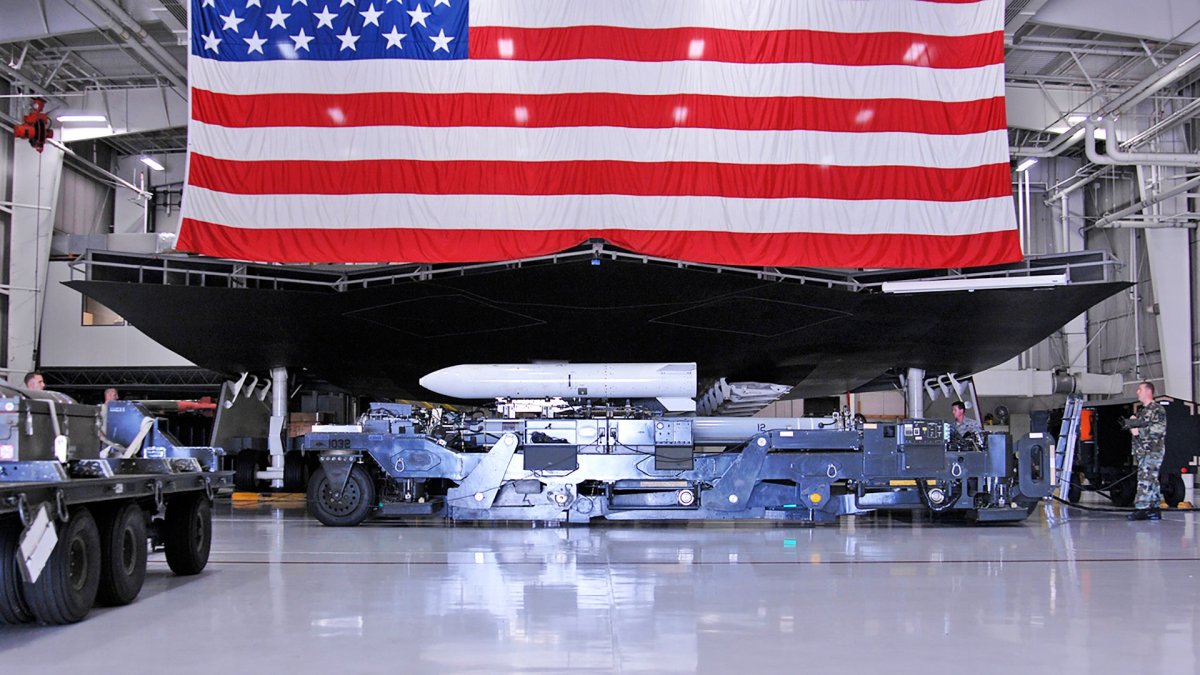
This is where Whiteman Air Force Base’s one-of-a-kind B-2 Weapons Load Trainer comes into play. The 67 foot long, 48 foot wide, 18 foot high replica of a B-2’s center fuselage weighs in at 80,000 pounds. It was built by Lockheed and Hughes back in 1993 to support the B-2 program that was still nearly a half decade away from becoming operational at the time.
The contraption is used to train and certify Aircraft Armament Systems Specialists, also known as “Ordies,” to load various weapons into the B-2’s two cavernous weapons bays. Those bays work with the B-2’s actual smart bomb racks and rotary launchers, as well as the weapons lift trailer that conveys them.
The 509th Maintenance Group trains airmen three shifts each day of the work week using the system, and it is especially handy for familiarizing novice airmen with the ins and outs of loading weapons onto America’s most prized air combat asset. The tolerances can be very tight, with just two inches of clearance in some circumstances, and the checklists to follow and attention to detail required to make sure the weapons will drop as promised can be exhaustive.
There are also some unique issues for Ordies to contend with when it comes to servicing the B-2, like the jet’s sharp sawtooth edges on its weapons bay doors and access ports—something you don’t want to ram your forehead into. And it can be very dark under its umbrella-like charcoal gray fuselage. The munitions themselves aren’t cheap either. A JDAM costs around $20,000. A stealthy Joint Air to Surface Standoff Missile (JASSM) can run upwards of three quarters of a million bucks.
Although publicly there isn’t any mention of using the trainer for practicing nuclear weapons loading and to certify ground crews to do so, we can assume this is a major mission of the huge training aid as well. Nuclear weapons have their own set of requirements when it comes to conveying them to an aircraft and mounting them, including a bunch of security protocols such as manipulating the Permissive Action Links (PAL) that arm the weapon for use and select its desired yield. It’s worth noting that in the top picture, a B-83 nuclear bomb’s form factor is shown in front of the B-2 Weapons Load Trainer.
Having a full size device like this also allows the tiny fleet of B-2s—just 20 in the inventory, a fraction of which are mission ready at any given time—to operate without being hampered by weapons load training needs.
Other aircraft communities use derelict airframes and other setups for similar purposes, but the B-2’s system is the most elaborate purpose-built device of its kind in the USAF’s inventory. Other systems like it are catching on though, especially as expensive stealth fighters continue to fill-out the USAF’s inventory. Eglin AFB has a similar system for the F-35 , although it isn’t nearly as imposing.
With the B-2 slated to be in the inventory for another 15 years , the big device will continue to get a lot of use, and it’s very likely that a similar system will take its place in the shape and configuration of the upcoming B-21 Raider. Still, by almost every indication the B-21 won’t be able to carry as much weapons tonnage as its forbearer B-2.
So there you have it, the B-2 Weapons Load Trainer. It takes its place alongside the Navy’s USS CALASSES carrier mockup as one of the military’s largest and most exotic training aids.
Contact the author: Tyler@thedrive.com
Comments couldn’t be loaded. Please refresh the page.
更新于美国东部时间2018年2月19日下午12:56。
B-2“幽灵”隐形轰炸机火力极其强大。除了B-61和B-83核弹外,它还能携带多达80枚可独立瞄准的500磅联合直接攻击弹药(JDMA)或两枚33000磅GBU-57巨型穿甲弹,以及其他多种武器。B-2执行实际任务时,通常携带大量弹药,而且往往需要背负这些弹药飞越半个地球。毋庸置疑,安全、精准地为这架飞机装载如此多的炸药是一项极其艰巨的任务,需要持续不断的训练,尤其考虑到隐形轰炸机脆弱的雷达吸波蒙皮一旦被划破,就可能在任务开始前就将其终结。
怀特曼空军基地独一无二的B-2武器装载训练器正是在这里发挥作用。这台长67英尺、宽48英尺、高18英尺的B-2中央机身复制品重达8万磅。它由洛克希德公司和休斯公司于1993年建造,旨在支持当时距离投入使用还有近五年时间的B-2项目。
这套装置用于训练和认证飞机武器系统专家(也称“Ordies”),让他们能够将各种武器装入B-2轰炸机的两个巨大的武器舱。这些武器舱与B-2轰炸机的智能炸弹挂架、旋转发射器以及运输它们的武器升降拖车配合使用。
第509维护大队使用这套系统,每周工作日每天三班轮流训练空军人员。这套系统对于让新飞行员熟悉如何将武器装载到美国最重要的空中作战资产上尤其方便。装载的公差非常小,在某些情况下间隙只有两英寸,而且为了确保武器按时投放,需要遵循的检查清单和对细节的关注也相当繁琐。
奥迪斯在维护B-2轰炸机时也面临着一些独特的挑战,例如该机武器舱门和检修口锋利的锯齿状边缘——谁也不想一头撞上去。而且,它那伞状的炭灰色机身下非常昏暗。弹药本身也不便宜。一枚联合直接攻击弹药(JDAM)的价格约为2万美元。一枚隐形的联合空对地防区外导弹(JASSM)的价格则可能高达75万美元以上。
虽然公开场合并未提及使用该训练器进行核武器装载训练和地勤人员资格认证,但我们可以推断,这同样是这台巨型训练设备的主要任务之一。核武器在运输到飞机上并进行安装时,有着一套独特的要求,包括一系列安全协议,例如操作授权操作链(PAL),该操作链用于启动武器并选择所需的当量。值得注意的是,在上图中,B-83型核弹的外形尺寸就展示在B-2武器装载训练器前方。
拥有这样一台全尺寸设备,也使得规模很小的 B-2 机队(库存只有 20 架,任何时候都只有一小部分处于随时可执行任务的状态)能够不受武器装载训练需求的阻碍而进行操作。
其他飞机部队也利用废弃的机身和其他装置来实现类似目的,但B-2的这套系统是美国空军现役同类设备中最精密复杂的专用装置。不过,其他类似的系统也正在普及,尤其是在昂贵的隐形战斗机不断加入美国空军的装备行列之后。埃格林空军基地也为F-35战斗机配备了类似的系统,尽管它远没有B-2的那么庞大。
由于B-2轰炸机预计还将服役15年,这款大型飞机仍将频繁使用,而且很可能即将推出的B-21“突袭者”轰炸机将采用类似的系统和配置来取代它。不过,几乎所有迹象都表明,B-21的武器载量将不及它的前辈B-2。
这就是B-2武器装载训练器。它与海军的“卡拉塞斯”号航母模型一起,成为军方规模最大、最奇特的训练辅助设备之一。
联系作者:Tyler@thedrive.com
评论加载失败,请刷新页面。