Get To Know America’s Long Serving B61 Family Of Nuclear Bombs了解美国服役多年的B61系列核弹
The first variant entered service 50 years ago and with a new version in development the B61 will continue to serve for decades to come.
新闻视频
By Joseph Trevithick
Updated Jun 30, 2019 3:07 PM EDT
When the U.S. military released its latest Nuclear Posture Review , the most significant weapon-related details were plans to install lower yield warheads in submarine-launched ballistic missiles and develop a new nuclear-armed sea-launched cruise missile . Less eye-catching were discussions about maintaining stockpiles of B61 gravity bombs , a family of weapons with a long and colorful lineage that has already been in service for nearly 50 years in various forms, for the foreseeable future.
According to the new Nuclear Posture Review, or NPR, which the Pentagon unveiled in February 2018, the latest version of the B61, known as the B61 Mod 12 or B61-12 , will begin entering service in 2020. At that point, it will begin replacing all of the remaining variants of the weapon, which have kiloton-class yields, still in service – the B61-3, -4, -7, and -11 – as well as separate stocks of B83 Mod 1 bombs , which have a much larger megaton-class yield. B83-1 is an improved version of that bomb, which first entered service in 1983. President Barack Obama’s Administration in the previous NPR had said that the U.S. military could safely retire the B83-1s before the B61-12s arrived, a position President Donald Trump’s Administration apparently does not share.
The B61-12 has been in development since at least 2011 and will be the first in the series to feature a precision guidance capability. They will have a GPS and inertial navigation system (INS)-directed tail kit and strakes along the weapon’s main body similar in form and function to those on conventional Joint Direct Attack Munitions (JDAM) bombs.
The weapon’s thermonuclear warhead will reportedly have a maximum yield of approximately 50 kilotons, but personnel on the ground will almost certainly be able to further reduce that using a so-called “dial-a-yield” feature that effectively limits the extent of the nuclear reaction in the “physics package” at the warhead’s core when the weapon detonates. Some older B61s have settings as low as 0.3 kilotons – 50 times less powerful than Little Boy , the bomb the United States dropped on Hiroshima, Japan in 1945.
A prototype B61-12 body with the GPS-guided tail kit., USAF
The primary delivery systems for these weapons will be the existing B-2 Spirit and future B-21 Raider stealth bombers . These aircraft have the necessary low-observable and other protective features to successfully penetrate into high risk areas , potentially full of advanced fighter aircraft and networked air defenses, to drop the relatively short-range bombs onto their targets. The B-52, which will serve for decades to come, lost its nuclear gravity bomb capability due to its vulnerability to air defenses.
In addition, the U.S. military will continue to forward deploy a smaller number of the weapons at various sites in Europe as a potential weapon for American and allied “dual-capable” combat aircraft, such as the U.S. Air Force’s F-15E Strike Eagles, F-16 Vipers and eventually its F-35A Joint Strike Fighters , as well as other tactical jets belonging to NATO . There have also been discussions about re-establishing stockpiles of these weapons in East Asia in light of growing threats from North Korea.
The U.S. military expects to finish production of the B61-12s – which experts believe will total between 400 and 500 bombs – and replacing the existing types by the end of 2024, at which point, this series of bombs will have been in service for more than 55 years.
The United States first started work on the weapons in 1961 as a result of the need for a new, more aerodynamic nuclear bomb that was better suited for use on then new high-performance jet aircraft, some of which were capable of reaching supersonic speeds.
Los Alamos National Laboratory in New Mexico, which the Department of Energy’s National Nuclear Security Administration (NNSA) oversees today, built the first prototypes, initially known as TX-61s, in 1963. Difficulties during the engineering design phase meant the first B61-0s did not enter full-scale production until five years later.
Over the next decade, U.S. nuclear engineers steadily improved the capability, reliability, and safety of the design. All of the B61s came in two basic flavors, “strategic” versions for larger city-size targets and “tactical” variants for smaller site and even potentially for battlefield use against enemy troop concentrations, with the only real differences being in the available, selectable yields. Since most of the exact information is classified, open sources often disagree, but what follows is based on our best accounting of the information available.
An infographic showing historic and active nuclear weapons the US military has had in service since the 1940s, including the B61 family., NNSA
The original B61-0 and -1 weapons had “strategic” yields ranging from 10 to 300 kilotons. The B61-1 reportedly differed from the first version mainly in that it lacked any sort of Permissive Action Link , or PAL.
PALs are, broadly, safety devices to prevent unauthorized use of a nuclear weapon, the exact specifics of which are classified. However, the U.S. government has developed broad and publicly available categories for the devices.
The 500 B61-0s had a “Category B” device, which consisted of electromechanical switches that would function and arm the weapon only if an individual put in the appropriate four-digit code. On aircraft, the crew could do this in flight using a wired connection to the bomb, allowing units to launch aircraft with live weapons in a contingency, but with the added safeguard of not arming them until receiving an actual order to proceed with a strike.
A seperate control panel, seen in the video below, controlled other functions, including height of burst and delay in detonation. The latter feature, coupled with a parachute or ballute retarding systems, could allow a low- and fast-flying combat aircraft to “lay down” the bomb and still safely escape the blast area.
It’s not entirely clear why the B61-1 lacked the PAL safety feature, but it may have had to do with the fact that some of the 700 of these weapons went into stockpiles set aside for NATO allies to use in a crisis. U.S. and allied leaders may have determined the need for American personnel to get the codes and then pass them along to third party crews would have been too time consuming a process to make for a credible deterrent capability.
Whatever the case, every subsequently bomb had some type of PAL, as well as a manual “command disable” system that crews on the ground could use to disarm the weapon completely in an emergency. Afterwards, the bomb would be largely useless until specialized personnel reactivated it at a depot. Although it’s still debated if this feature could stop a well resourced state or entity from putting the nuke to use if they had considerable time.
The 235 B61-2s, tactical variants with yields ranging from 10 to 150 kilotons, featured a Category D PAL. This device required a six-digit code, which an operator only had one chance to enter correctly before the system locked up, and could accept multiple code sequences that would either set the weapon to a “safe” training mode or deliberately disable it if necessary.
The B61-3 and -4 had Category F PALs, the most advanced type, which do allow for multiple attempts, but use a 12-digit code sequence. These devices also link those codes to the desired yield, allowing crews to set that in flight.
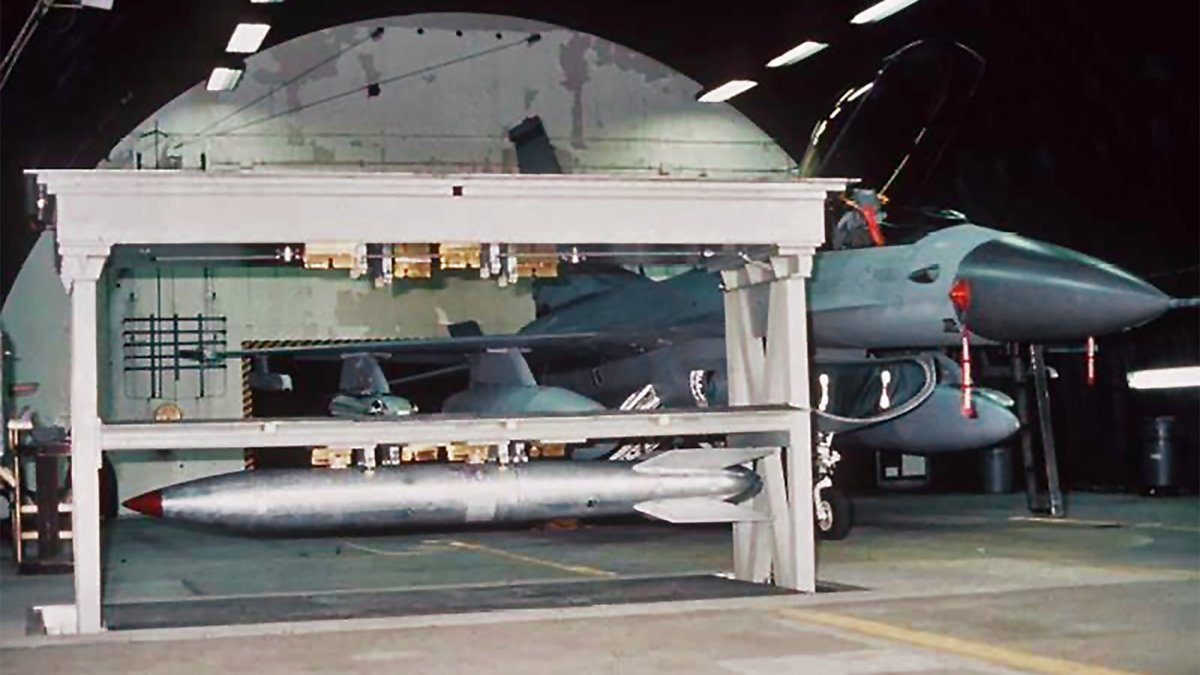
An B61 bomb “shape” with no warhead or other critical components now in a museum., Dave Bezaire via Flickr
The two weapons were also the first to use an insensitive explosive in the warhead, necessary to kickstart the nuclear reaction. This made the charges less likely to explode and potentially cause the weapon to function inadvertently in the event of an accident.
Though both bombs were tactical variants, the B61-3 featured eight separate yield settings – 0.3, 1.5, 5, 10, 45, 60, 80, or 170 kilotons. The B61-4 had few options, ranging from 0.3 to 50 kilotons. The United States built nearly 550 and 700 B61-3 and -4 bombs, respectively.
The B61-5 had the same yield as the B61-1, but added a Category D PAL. These 265 bombs were also the first to incorporate Enhanced Nuclear Detonation Safety (ENDS) features that better protected the bombs from physical shocks, extreme temperatures, electromagnetic interference, and any other “abnormal conditions.” At its most basic, an ENDS set up isolates the portions of the warhead that are essential for its functioning inside a shell that keeps out any unwanted “energy.”
It’s not clear, but it appears that the United States refitted many older weapons with those features afterwards, as well. Whatever the case, the B61-5 represented one of the last “new” versions of the bomb.
With the exception of the B61-10, all of the subsequent versions were upgrades of existing bombs. The B61-0 was to serve as the basis for first the B61-6 and then the B61-9, which would have Category D and F PALs respectively, but the U.S. government canceled those projects. Plans to rebuild the older Mod 2s and 5s as the B61-8 using warheads with insensitive explosives similarly did not come to pass.
A B61 family tree with red crosses indicating variants that were either out of service or otherwise never existed to begin with as of 2014., Hans Kristensen/FAS
In the 1980s, the remaining 600 B61-1s did get Category D PALs and warheads with ENDS and insensitive explosives, becoming B61-7s. These strategic weapons also had slightly increased maximum yields of approximately 340-360 kilotons.
The B61-10 is something of an oddball. When the U.S. military was developing the Pershing II tactical short-range ballistic missile, it determined that this weapon would be more useful on a European battlefield against the Soviet Union and its allies if it had a lower yield than the older Pershing I . American weapons designers decided to modify the warhead from the B61-4, resulting in the W85 , which had selectable yields from 5 to 50 kilotons.
But in 1987, the United States and the Soviets signed the Intermediate-Range Nuclear Forces Treaty, or INF , which banned the Pershing II. Not wanting to waste the perfectly good warheads for those missiles and since they were already based on the one inside the B61, the U.S. government rebuilt them into 215 B61-10s, with yields ranging from 0.3 to 80 kilotons and a Category F PAL.
US Army Pershing II missiles., DOD
The most recent operational variant, the B61-11 , entered service in 1997 and is the first to dramatically differ in form, as well as function. The U.S. military treats this version as a combination tactical and strategic bomb even though it’s based on the B61-7 and reportedly has a single, maximum yield of approximately 340-400 kilotons.
The bigger difference, though, is that it has a significantly reinforced shell, possibly with a depleted uranium penetrating nose section, a delay fuzing system, and a booster rocket motor in the rear, all so it can break into deeply buried, hardened facilities. There are less than 100 of these bombs in existence, according to publicly available data, and the United States more or less built them with one specific target in mind.
In 1996, Russia finished work on its Kosvinsky Kamen bunker, part its so-called “ continuity of government ” plans to protect senior leadership in the event of a nuclear strike or other major emergency. Similar in concept and reportedly similarly—if not better—protected than the U.S. military’s Cheyenne Mountain Complex or Site R, also known Raven Rock , the Kremlin built it specifically to be hardened against nuclear weapons going off up above. The B61-11’s job was to put even those defenses beyond reach in what would likely already be an apocalyptic scenario.
Before the B61-11, the United States planned to use a much less elegant approach when it came to nuclear bunker busting, relying on aging B53 bombs , a design dating back to 1958 for this purpose. These 12-foot long, 4-foot wide, nearly 9,000 pound weapons would have used the sheer explosive power of their 9 megaton yield to create massive craters and crush underground targets. The U.S. government also explored using a modified B83-1, with its 1.2 megaton yield, for the role before deciding on the modified B61.
Workers at the Pantex Plant maneuver a B53 bomb slated for dismantlement in 2011., NNSA
Now, the U.S. military says the future B61-12’s precision guidance coupled with this low-yield warhead, which will also produces less radioactive fallout, will make these weapons more flexible and suitable for a wider range of contingencies than any of the existing types. It will still be just a modified B61-4 at its core, possibly even using the same basic physics package, though the design may also end up cannibalizing parts from the B61-3s, -7s, and -11s as they head off to the specialized Pantex Plant in Texas for dismantlement.
The new bombs will apparently even allow it to replace existing bunker-buster B61-11s, though its not entirely clear how and the U.S. military has been especially tight-lipped on this particular point. Test footage has shown the weapon is able to at least embed its entire length into the ground, but if it does use the B61-4 shell, it won’t have any of the -11’s added penetrating features.
In 2014, former U.S. Air Force Chief of Staff General Norton Schwartz, speaking at event at the Stimson Center think tank in Washington, D.C., described the weapon’s precision guidance as being key to the weapon’s bunker-busting capabilities, since the bomb would be able to focus its blast more acutely onto a target. The B61-11’s penetrating features and particularly high-yield were, at least in part, to help offset its inherent inaccuracy as an unguided weapon, but would still be significant more capable in breaking through to underground facilities that a bomb without any sort of deliberately hardened casing .
“The B83-1 and B61-11 gravity bombs can hold at risk a variety of protected targets,” the NPR makes clear, though. “As a result, both will be retained in the stockpile, at least until there is sufficient confidence in the B61-12 gravity bomb that will be available in 2020.”
Whatever its bunker-busting capabilities actually are, critics have warned that the various improvements and expanded capabilities the B61-12 offers may also make the U.S. government feel the weapons are more “ usable ” and increase the likelihood of a nuclear exchange. The United States notably does not have a “no first use” policy with regards to nuclear weapons and reserves the right to use them in response to non-nuclear strikes in certain circumstances, which you can read more about in detail here and here .
The B61-12 has also been controversial because of its cost. Just in 2012, the official cost estimates for the surged from $4 billion to $10 billion. This figure did not include the funds necessary to develop the tail kit – another $1.2 billion at the time – or other components. If it takes at least 400 of the weapons to adequately replace the four existing types, this means each individual 700-pound bomb will be literally worth more than its weight in gold .
Part of that seems to be a product of the decision to use the old B61-4s as the basis for the new bombs. Though the United States built nearly 700 of them, it only has around 200 in active stockpiles. To make up the difference, the U.S. government will have to dig out another 200 to 300 of the weapons and make sure they’re in safe, working order before it even begins to upgrade them into the new B61-12 configuration.
An infographic describing what components the B61-12 may take from older bombs. The left circles in the bomb are the main portion of the warhead, with the right circles and space in between indicating other components., Hans Kristensen/FAS
All of this has prompted experts to question the actual necessity of the weapon, especially in context of the U.S. military’s other nuclear modernization efforts and conventional weapons plans and with so few aircraft expected to serve as delivery systems and in such limited context. On top of the B61-12, the U.S. Air Force is in the process of developing a new nuclear-capable, air-launched cruise missile and is buying more massive, conventional, precision-guided bunker buster bombs that only the B-2 and potentially the B-21 will be able to carry. Those weapons will be capable of holding hardened targets, such as enemy’s buried command and control facilities, strategic weapons sites, and bunkers for their senior military and civilian leadership, at risk, too, but they aren’t as capable of a penetrating nuclear warhead.
Of course, it’s equally worth pointing out that a B-2 or B-21 bomber could be able to carry many more B61-12s than nuclear-tipped Long Range Stand Off cruise missiles or conventional GBU-57/B Massive Ordnance Penetrator bombs. As such, an individual aircraft with the nuclear bombs could potentially strike more targets in a single sortie.
B61-12 mounted on an F-15E., DoD
In addition, American commanders can still decide recall bombers carrying gravity bombs even late in their mission, giving them more time to respond to changing circumstances or new information, making this combination perhaps the most flexible nuclear weapon system the United States has at its disposal. Whether or not this justifies the B61-12 costs remains open for debate.
The issue of whether or not it remains useful to forward deploy B61s of any type at bases in Europe is a separate and complicated question that is much more related to the political proclivities of America’s NATO allies than the actual capabilities of the weapons. We at The War Zone have previously discussed those matters in detail, which you can find here and here .
But at least at present, the United States remains committed to maintain a stockpile of B61 gravity bombs for decades to come. And if it continues with the plan laid out in the latest NPR, by the end of the 2020s, they could easily be among the oldest nuclear weapons, as least when it comes to their physics package, that the U.S. military still has in active service.
Contact the author: joe@thedrive.com
Comments couldn’t be loaded. Please refresh the page.
作者:约瑟夫·特雷维西克
更新于美国东部时间2019年6月30日下午3:07
美国军方发布最新《核态势评估报告》时,其中最引人注目的武器相关细节是计划在潜射弹道导弹上安装低当量核弹头,并研发新型核武装海基巡航导弹。相比之下,关于在可预见的未来继续维持B61重力炸弹库存的讨论则显得不那么引人注目。B61重力炸弹是一系列历史悠久、用途广泛的武器,其各种型号已经服役近50年。
根据五角大楼于2018年2月公布的最新版《核态势评估报告》(NPR),最新版本的B61核弹,即B61 Mod 12或B61-12,将于2020年开始服役。届时,它将取代所有仍在服役的、当量为千吨级的B61核弹——B61-3、-4、-7和-11——以及一部分当量更大的B83 Mod 1型核弹。B83-1是B83的改进型,于1983年首次服役。奥巴马政府在上一版《核态势评估报告》中曾表示,美军可以在B61-12服役前安全地退役B83-1,但特朗普政府显然并不认同这一观点。
B61-12型炸弹至少从2011年就开始研发,它将是该系列中首款具备精确制导能力的炸弹。其尾翼组件和沿弹体分布的导流片由GPS和惯性导航系统(INS)共同控制,其外形和功能与传统的联合直接攻击弹药(JDAM)炸弹类似。
据报道,该武器的热核弹头最大当量约为50千吨,但地面人员几乎肯定能够利用所谓的“可调当量”功能进一步降低当量。该功能可以有效地限制弹头核心“物理组件”中核反应的程度。一些较老的B61型核弹头的当量设定低至0.3千吨——比美国1945年投掷在日本广岛的原子弹“小男孩”的威力小50倍。
美国空军B61-12原型机身,配备GPS制导尾翼套件。
这些武器的主要运载系统将是现有的B-2“幽灵”隐形轰炸机和未来的B-21“突袭者”隐形轰炸机。这些飞机具备必要的低可探测性和其他防护能力,能够成功突破高风险区域——这些区域可能遍布先进战斗机和联网防空系统——并将相对较短射程的炸弹投掷到目标上。B-52轰炸机由于易受防空系统攻击,已失去了核重力炸弹的投掷能力,但它仍将服役数十年。
此外,美军将继续在欧洲各地前沿部署少量此类武器,作为美国及其盟国“双用途”战斗机(例如美国空军的F-15E“攻击鹰”、F-16“蝰蛇”以及最终的F-35A“联合攻击战斗机”)以及北约其他战术喷气式飞机的潜在武器。鉴于朝鲜日益增长的威胁,各方也曾讨论过在东亚重新建立此类武器的储备。
美国军方预计将在 2024 年底前完成 B61-12 型炸弹的生产(专家认为总产量将在 400 至 500 枚之间),并取代现有型号的炸弹。届时,该系列炸弹的服役时间将超过 55 年。
美国于 1961 年开始研制这种武器,原因是需要一种新型的、空气动力学性能更好的核弹,以便更好地用于当时的新型高性能喷气式飞机,其中一些飞机能够达到超音速。
位于新墨西哥州的洛斯阿拉莫斯国家实验室(现由美国能源部国家核安全管理局 (NNSA) 监管)于 1963 年建造了第一批原型机,最初被称为 TX-61。由于工程设计阶段的困难,第一批 B61-0 直到五年后才投入全面生产。
在接下来的十年里,美国核工程师不断改进B61核弹的性能、可靠性和安全性。所有B61核弹都分为两种基本类型:“战略型”用于打击大型城市目标,“战术型”用于打击较小目标,甚至可能用于战场上打击敌军集结地,两者之间唯一的真正区别在于可选的当量。由于大部分具体信息属于机密,公开来源的信息往往存在分歧,但以下内容基于我们对现有信息的最佳解读。
一张信息图展示了美国军方自20世纪40年代以来服役的历史性和现役核武器,包括B61系列核武器。(美国国家核安全管理局)
最初的B61-0和-1型武器的“战略”当量范围为10至300千吨。据报道,B61-1型与第一版的主要区别在于它缺少任何类型的许可行动链接(PAL)。
防爆装置(PAL)总体而言是防止未经授权使用核武器的安全装置,其具体细节属于机密。不过,美国政府已制定了广泛且公开的防爆装置分类标准。
这500枚B61-0炸弹配备了“B类”装置,该装置由机电开关组成,只有输入正确的四位密码才能启动并激活武器。在飞机上,机组人员可以通过与炸弹的有线连接在飞行中完成此操作,这使得部队能够在紧急情况下派出携带实弹的飞机,同时又能确保在接到正式的打击命令之前不会激活炸弹,从而增加了一层安全保障。
下方视频中可以看到一个独立的控制面板,它控制着其他功能,包括爆炸高度和引爆延迟。引爆延迟功能与降落伞或气囊减速系统配合使用,可以让低空高速飞行的战斗机“投放”炸弹后仍能安全脱离爆炸区域。
目前尚不完全清楚B61-1为何缺少PAL安全装置,但这可能与部分此类武器被储备起来供北约盟国在危机中使用有关。美国及其盟国领导人可能认为,需要美国人员获取密码并将其传递给第三方操作人员,这个过程过于耗时,难以形成有效的威慑能力。
无论如何,之后制造的每一枚核弹都配备了某种形式的PAL装置,以及一套手动“指令解除”系统,地面人员可以在紧急情况下使用该系统彻底解除武器的武装。之后,这枚核弹基本上就无法使用了,直到专业人员在仓库重新激活它为止。不过,如果某个资源充足的国家或实体有足够的时间,这种装置是否能够阻止他们使用核弹,目前仍存在争议。
这235枚B61-2型战术型核弹,当量从10千吨到150千吨不等,均配备D类PAL装置。该装置需要输入六位数密码,操作员只有一次机会正确输入,否则系统将锁定。该装置可以接受多个密码序列,这些序列可以将武器设置为“安全”训练模式,或在必要时将其彻底禁用。
B61-3 和 -4 型轰炸机配备了 F 类 PAL(脉冲诱饵装置),这是最先进的类型,允许多次尝试引爆,但使用 12 位数的代码序列。这些装置还将这些代码与所需的爆炸当量关联起来,使机组人员能够在飞行中设置爆炸当量。
一枚B61炸弹的“外形模型”,没有弹头或其他关键部件,目前收藏于博物馆。(图片来自Flickr用户Dave Bezaire)
这两款核武器也是首批在弹头中使用钝感炸药的核武器,这种炸药是启动核反应所必需的。这使得装药爆炸的可能性降低,从而避免了在发生意外时导致武器意外启动。
虽然两款炸弹均为战术型,但B61-3型炸弹有八种不同的当量设置——0.3、1.5、5、10、45、60、80或170千吨。B61-4型炸弹的选择较少,当量范围在0.3至50千吨之间。美国分别生产了近550枚B61-3型炸弹和700枚B61-4型炸弹。
B61-5型核弹的当量与B61-1型相同,但增加了D类PAL(脉冲辅助装置)。这265枚核弹也是首批采用增强型核爆炸安全系统(ENDS)的核弹,该系统能更好地保护核弹免受物理冲击、极端温度、电磁干扰以及其他任何“异常情况”的影响。ENDS系统的基本原理是将弹头中对其运作至关重要的部分隔离在一个能阻挡任何有害“能量”的外壳内。
目前尚不清楚,但美国似乎后来也对许多老式武器进行了类似的改装。无论如何,B61-5 是该型原子弹最后几个“新”版本之一。
除了B61-10之外,所有后续型号都是对现有炸弹的升级。B61-0原本计划作为B61-6和B61-9的基础,分别配备D类和F类防护等级(PAL),但美国政府取消了这些项目。同样,将老款Mod 2和Mod 5型炸弹改造为B61-8型,并采用钝感炸药弹头的计划也未能实现。
一张B61家族谱系图,红色十字标记表示截至2014年已停用或从未存在过的变体。(图片来源:Hans Kristensen/FAS)
20世纪80年代,剩余的600枚B61-1型核弹头加装了D类脉冲加速器(PAL)和带有电子扩散炸药(ENDS)及钝感炸药的弹头,升级为B61-7型核弹头。这些战略武器的最大当量也略有增加,约为340-360千吨。
B61-10 导弹有点特殊。美国军方在研发潘兴 II 战术短程弹道导弹时,认为如果其当量低于老式的潘兴 I 导弹,那么在欧洲战场上对抗苏联及其盟国时,该导弹会更加有效。美国武器设计师决定对 B61-4 导弹的弹头进行改进,最终研制出 W85 弹头,其当量可在 5 至 50 千吨之间选择。
但在 1987 年,美国和苏联签署了《中导条约》(INF),该条约禁止了潘兴 II 型导弹。由于不想浪费这些导弹上完好的弹头,而且这些弹头已经基于 B61 导弹内部的弹头,美国政府将它们改造成了 215 枚 B61-10 型导弹,当量从 0.3 千吨到 80 千吨不等,属于 F 类 PAL(防护等级)。
美国陆军潘兴II型导弹,国防部
最新服役型号B61-11于1997年投入使用,是首款在外形和功能上都与前代产品有显著差异的型号。尽管B61-11是在B61-7的基础上改进而来,且据报道其单枚最大当量约为340-400千吨,但美军仍将其视为战术和战略炸弹的混合型产品。
不过,更大的区别在于它拥有经过显著加固的外壳,可能还配备了贫铀穿甲弹头、延时引信系统以及尾部的助推火箭发动机,所有这些都是为了使其能够突破深埋地下的加固设施。根据公开数据,这种炸弹的存世量不足100枚,而且美国制造它们时几乎是针对一个特定目标。
1996年,俄罗斯完成了科斯温斯基卡门地下掩体的建设,这是其所谓的“政府连续性”计划的一部分,旨在核打击或其他重大紧急情况下保护高级领导人的安全。该掩体的概念与美国军方的夏延山综合设施或R基地(又称“渡鸦岩”)类似,据报道其防护能力甚至更强。克里姆林宫建造该掩体的目的就是为了抵御来自地面的核武器爆炸。B61-11型掩体的任务是,在可能已经是世界末日般的场景下,进一步强化这些防御措施,使其无法触及。
在B61-11型核弹问世之前,美国曾计划采用一种远不如B61-11型核弹优雅的方法来摧毁地下掩体,即依靠老旧的B53型核弹。这种核弹的设计可以追溯到1958年。B53型核弹长12英尺(约3.7米),宽4英尺(约1.2米),重近9000磅(约4088公斤),其900万吨当量的爆炸威力足以摧毁巨大的弹坑并摧毁地下目标。在最终选择改进型B61-11型核弹之前,美国政府也曾考虑过使用改进型的B83-1型核弹,其当量为120万吨。
潘泰克斯工厂的工人们正在搬运一枚计划于2011年拆除的B53炸弹。(图片来源:美国国家核安全管理局)
美国军方表示,未来的B61-12型核弹头将采用精确制导技术,并配备低当量弹头,同时减少放射性尘埃的产生,这将使该型武器比现有任何型号都更加灵活,适用于更广泛的突发事件。其核心仍将是改进型的B61-4型核弹头,甚至可能沿用相同的基本物理原理。不过,由于B61-3、-7和-11型核弹头将被送往位于德克萨斯州的潘泰克斯工厂进行拆解,因此该型武器的设计最终可能会使用它们的零部件。
新型炸弹显然甚至可以取代现有的B61-11型钻地弹,但具体如何取代尚不完全清楚,美军对此一直守口如瓶。测试视频显示,该武器至少能够将其整个长度嵌入地下,但如果它使用B61-4型弹壳,则不会具备B61-11型的任何附加穿透性能。
2014年,美国前空军参谋长诺顿·施瓦茨将军在华盛顿特区史汀生中心智库的一次活动上发表讲话时指出,该武器的精确制导是其破盾能力的关键,因为炸弹能够更精准地将爆炸集中在目标上。B61-11的穿透性能和极高的当量,至少部分是为了弥补其作为非制导武器固有的精度不足,但即便如此,它在突破地下设施方面仍然比没有任何加固外壳的炸弹强大得多。
“B83-1 和 B61-11 重力炸弹可以对多种受保护目标构成威胁,”《核态势感知报告》明确指出。“因此,这两种炸弹都将继续保留在库存中,至少在人们对 2020 年即将投入使用的 B61-12 重力炸弹有足够的信心之前是如此。”
无论其钻地能力究竟如何,批评人士警告说,B61-12导弹的各项改进和扩展功能也可能使美国政府认为这些武器更“可用”,从而增加核战争的可能性。值得注意的是,美国在核武器方面并没有“不首先使用”政策,并保留在特定情况下对非核打击进行反击的权利,您可以在这里和这里阅读更多详细信息。
B61-12炸弹也因其高昂的成本而备受争议。仅在2012年,其官方成本估算就从40亿美元飙升至100亿美元。这一数字还不包括研发尾翼组件所需的资金(当时约为12亿美元)以及其他部件的费用。如果至少需要400枚这种炸弹才能有效替代现有的四种炸弹,这意味着每一枚700磅重的炸弹都将价值连城。
部分原因似乎在于决定以老旧的B61-4型炸弹为基础来研制新型炸弹。尽管美国制造了近700枚B61-4型炸弹,但目前仅有约200枚处于现役库存。为了弥补这一缺口,美国政府必须再找出200至300枚B61-4型炸弹,并确保它们处于安全且可正常使用的状态,才能开始将其升级为新型B61-12型炸弹。
这张信息图描述了B61-12炸弹可能沿用旧式炸弹的哪些部件。炸弹左侧的圆圈代表弹头的主体部分,右侧的圆圈及其之间的空白区域则表示其他部件。(图片来源:Hans Kristensen/FAS)
所有这些都促使专家质疑这种武器的实际必要性,尤其是在美国军方其他核现代化项目和常规武器计划的背景下,以及预计用作运载系统的飞机数量如此之少、应用范围如此有限的情况下。除了B61-12之外,美国空军正在研发一种新型的空射核巡航导弹,并采购更多威力巨大的常规精确制导掩体炸弹,这些炸弹只有B-2轰炸机,或许还有B-21轰炸机才能携带。这些武器也能对敌方的加固目标构成威胁,例如敌方的地下指挥控制设施、战略武器库以及高级军事和文职领导人的掩体,但它们并不具备核弹头的穿透能力。
当然,同样值得指出的是,B-2 或 B-21 轰炸机携带的 B61-12 核弹数量可能远多于携带核弹头的远程防区外巡航导弹或常规的 GBU-57/B 大型穿透炸弹。因此,携带核弹的单架飞机在一次飞行任务中可能打击更多目标。
B61-12 安装在 F-15E 上,美国国防部
此外,即使在任务后期,美国指挥官仍然可以决定召回携带重力炸弹的轰炸机,从而有更多时间应对不断变化的情况或新信息,这使得这种组合或许成为美国所能使用的最灵活的核武器系统。至于这是否足以抵消B61-12的成本,仍有待商榷。
在欧洲基地前沿部署任何类型的B61轰炸机是否仍然有用,这是一个独立且复杂的问题,它更多地与美国北约盟国的政治倾向有关,而非武器本身的性能。我们“战区”栏目此前已详细讨论过这些问题,您可以在这里和这里找到相关文章。
但至少目前,美国仍致力于在未来几十年内维持B61重力炸弹的库存。如果按照最新《核态势评估报告》(NPR)中提出的计划执行,到2020年代末,这些炸弹很可能成为美军现役核武器中最老旧的武器之一,至少就其物理特性而言是如此。
联系作者:joe@thedrive.com
评论加载失败,请刷新页面。