The “Toxic Death” Paint Scheme Was The F-117 Nighthawk’s Most Outrageous“毒死”涂装方案是F-117夜鹰战斗机最惊世骇俗的涂装。
It may not have been official, or long lived, but it sure looked evil.
Updated Jul 2, 2020 5:24 PM EDT
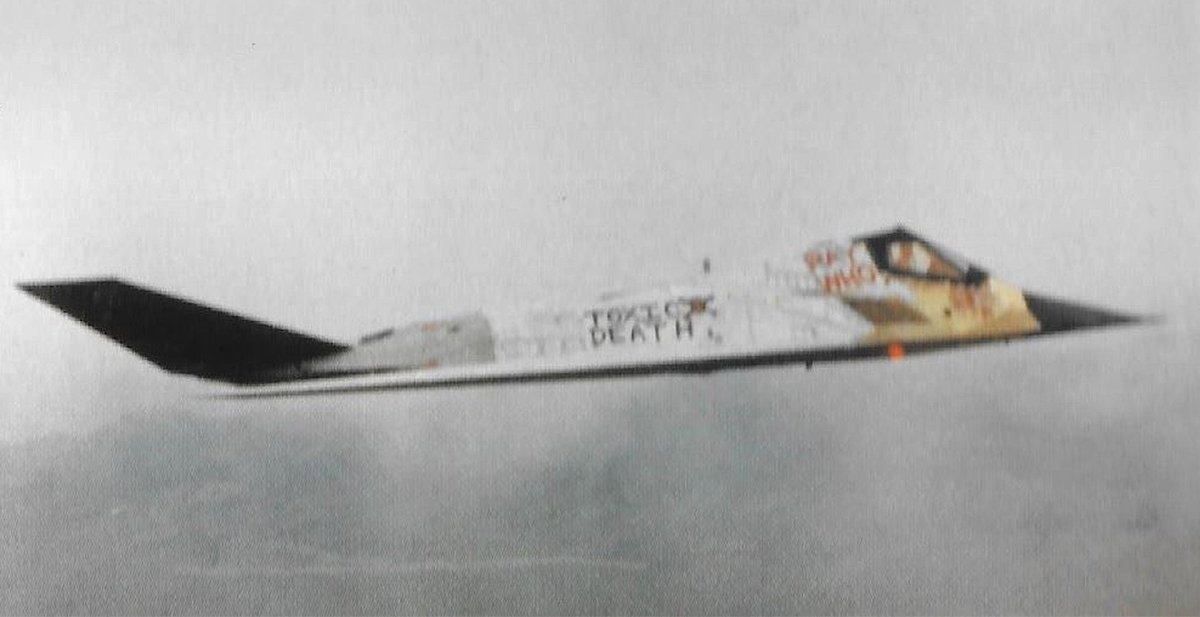
If a band of pirates were to have stolen an F-117 Nighthawk in an alternate dystopian reality, it probably would have looked exactly like YF-117A #781 does above. It’s not every day you see one of America’s most sensitive and exotic combat aircraft stripped of its paint and stealth coatings and rattle-canned with graffiti, but that’s exactly what happen on June 27th, 1991.
Just a couple of years after the F-117 was declassified , and just months after its incredible performance during Operation Desert Storm , YF-117 #781 “Scorpion 2” was selected to be retired to the National Museum of the United States Air Force , located at Wright Patterson AFB. At the time, #781 was just ten years old, and had racked up just 437 test flights, but it was a pre-production test aircraft—the second of its kind—and could not be reintroduced into the operational F-117 fleet.
Transferring #781 to a museum was a pretty big deal, as no F-117 had ever been put on public display—not to mention the fact that the aircraft was packed with classified systems and coated with some of America’s most sensitive material. Simply flying it to the museum and pulling out some avionics was not in the cards; the “Black Jet” had to be totally stripped and modified inside and out before being rolled out to the public.
To remove any trace of the highly classified radar-absorbent material that coated the F-117’s faceted surfaces, the aircraft was “media-blasted.” This is a process similar to sand-blasting, but utilizes sodium bicarbonate crystals instead of sand so that the jet’s bare skin, which is an amalgam of composite and metallic materials, would not be harmed in the process.
While media blasting was safe for the jet, it was abhorrent for the crews that had to do it. Everyone involved had to be covered head to toe in protective gear and masks, any open seam sealed with tape. Apparently, the fine particulates got everywhere and into everything—no crevice was too small. It was a nasty, arduous process—and precisely where the “Toxic Death” moniker and skull and crossbones emblazoned on both sides of #781 came from. Since the aircraft was going to be repainted before being put on display anyway, the crews had some fun with their blank canvas.
The “Ray Who?” inscription seen painted in red behind the cockpit apparently refers to the name of gregarious flight test engineer that worked with the Baja Scorpions, the Lockheed-USAF integrated test unit that conducted F-117 developmental flight testing during the jet’s infancy at Area 51 .
The Baja Scorpion’s insignia and a photo of the first YF-117, which actually flew in a pastel camouflage scheme., …
The freshly stripped #781 made its way to Wright Patterson AFB, and once it arrived was gutted of a ton of other sensitive materials, systems, and reusable parts. Many of the jet’s classified avionics, like its air-data computer, the radar-diffusing grids over its intakes, and low-observable (stealthy) screens over its FLIR and DLIR, had to be dealt with.
Once picked clean, #781 had to be built back up to look like any operational F-117. Certain frequency selective panels, the jet’s exhaust tiles, tail fins, and other sensitive body parts had to be pulled and replaced with lookalikes. Finally, the project was capped off with the application of the Nighthawk’s signature flat-black paint.
It was all a very time-intensive and expensive undertaking.
A somewhat “censored” #781 sitting on display at the National Museum of the United States Air Force., National Museum of the USAF
So that’s the wild tale of the “Toxic Death” F-117, just another facet of the Nighthawk’s wonderfully bizarre history, one that even included a Klingon Cloaking Device and that continues to intrigue to this very day.
Huge thanks to our good friend Chris Webb and the F-117 Nighthawk FB group.
Contact the author: Tyler@thedrive.com
Comments couldn’t be loaded. Please refresh the page.
更新于美国东部时间2020年7月2日下午5:24
如果在一个架空的反乌托邦世界里,一群海盗偷走了一架F-117“夜鹰”战斗机,它很可能看起来就像上面这架YF-117A #781一样。你并非每天都能看到美国最精密、最独特的战斗机之一被剥去油漆和隐形涂层,再被喷上涂鸦,但1991年6月27日,这正是发生的事情。
F-117战斗机解密仅几年后,在“沙漠风暴”行动中表现出色数月后,编号为781的YF-117“蝎子2号”被选中退役,送往位于赖特-帕特森空军基地的美国空军国家博物馆。当时,781号机机龄仅十年,累计试飞次数仅为437次,但它是一架预生产测试机——也是同系列的第二架——无法重新加入现役F-117机队。
将781号F-117移交给博物馆是一件大事,因为此前从未有任何一架F-117公开展出过——更何况这架飞机内部装满了机密系统,并且涂有美国最敏感的材料。简单地把它飞到博物馆,然后拆下一些航电设备是行不通的;这架“黑战机”必须从里到外彻底拆解改装,才能向公众展出。
为了彻底清除F-117多面体表面上涂覆的高度机密的雷达吸波材料,这架飞机接受了“介质喷砂”处理。该工艺类似于喷砂,但使用碳酸氢钠晶体代替沙子,这样就不会损伤飞机裸露的蒙皮(蒙皮由复合材料和金属材料混合而成)。
虽然喷砂处理对飞机本身是安全的,但对执行这项工作的机组人员来说却极其痛苦。所有参与人员都必须从头到脚穿戴防护服和口罩,任何开口都要用胶带密封。显然,细小的颗粒物无孔不入,钻进了所有缝隙——没有哪个缝隙小到不能钻进去。这是一个令人作呕、极其艰辛的过程——也正是“毒死神”这个绰号以及781号飞机两侧骷髅头和交叉骨图案的由来。由于这架飞机在展出前无论如何都要重新喷漆,机组人员便在这块空白的画布上尽情发挥创意。
驾驶舱后方用红色油漆写着的“Ray Who?”字样,显然是指一位性格外向的飞行测试工程师的名字,他曾与巴哈蝎子飞行队(洛克希德-美国空军联合测试部队)合作,该部队在F-117战斗机早期阶段于51区进行研发飞行测试。
“巴哈蝎子”的标志和第一架YF-117的照片,这架飞机实际上采用的是柔和的迷彩涂装。
刚刚被拆解的781号飞机被运往赖特-帕特森空军基地,抵达后,机上大量的敏感材料、系统和可重复使用的部件被拆除。这架喷气式飞机的许多机密航空电子设备,例如空速计算机、进气口上的雷达散射栅格以及前视红外和后视红外上的低可探测性(隐身)屏幕,都必须进行处理。
781号飞机被彻底清理干净后,必须重新组装,使其外观与任何一架可正常使用的F-117战斗机无异。某些频率选择面板、喷气发动机的排气瓦、尾翼和其他敏感部件都必须拆卸下来,并用仿制品替换。最后,整个项目以喷涂“夜鹰”标志性的哑光黑漆而告终。
这完全是一项耗时耗力且成本高昂的工程。
一架经过一定程度“审查”的781号飞机正在美国国家空军博物馆展出。
这就是“毒死神”F-117的离奇故事,这只是夜鹰战机奇妙而离奇的历史中的又一个侧面,这段历史甚至还包括克林贡隐形装置,直到今天仍然令人着迷。
非常感谢我们的好朋友克里斯·韦伯和F-117夜鹰FB群组。
联系作者:Tyler@thedrive.com
评论加载失败,请刷新页面。