The YF-23’s Weapons Bay Layout Was One Of Its Best Features And One Of Its WorstYF-23的武器舱布局既是其最佳特性之一,也是其最差特性之一。
Northrop's entry into the ATF tender had a big, ambiguous weapons bay that likely hurt its chances of being selected but would be prized today.
Published Oct 3, 2018 6:17 PM EDT
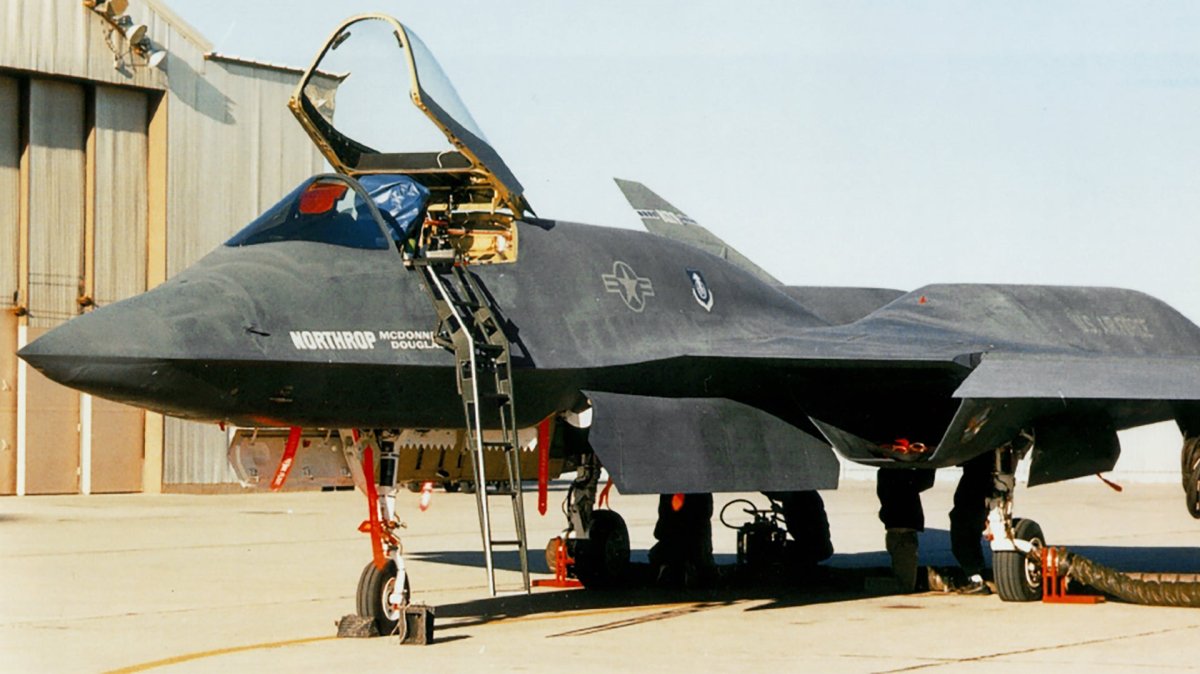
As we continue our series on one of the most enigmatic, misunderstood and ahead of its time aircraft in military history—Northrop’s YF-23 Black Widow that lost the Advanced Tactical Fighter (ATF) competition to Lockheed’s YF-22 Lightning—we turn our gaze toward its unique weapons bay configuration. Like so many things YF-23, this feature had big potential benefits, but it also represented a heightened developmental risk for the USAF. In the end, it very likely damaged Northrop’s prospects of supplying America’s air superiority fighter of the 21st Century, and maybe for good reason at the time, but today, the YF-23’s unique weapons bay configuration would almost certainly be highly prized.
The YF-22 and YF-23 went about carrying their weapons in drastically different manners. The YF-22 featured a fairly straightforward affair, with a shallow weapons bay that spanned its lower fuselage configured to carry four AIM-120 AMRAAMS nestled alongside one another and two small bays that flanked the aircraft’s waist—like a wild west gunfighter’s belt—carrying a pair of shorter ranged AIM-9 Sidewinders.
ATF competitors side-by-side over the Mojave Desert., USAF
The seeker heads on the Sidewinders would deploy into the slipstream at an angle once the side bay doors are open and before locking on and firing off their mounting rail at the enemy. The AIM-120s would be punched out of the ventral bay using a pneumatic trapeze-like vertical launcher. Each missile had its own one of these and could be launched freely regardless of the status of the other missiles in the bay.
F-22A showing its weapons bays. Note the three ejector-launchers situated in the main weapons bay. Each on carries a single AIM-120., USN
The final production configuration of the F-22 Raptor would hold six AIM-120C AMRAAMs internally—the clipped fins of this new model AMRAAM that was secretly in development during the ATF competition provided extra clearance for the two additional missiles—as well as the two sidewinders as originally envisioned. The F-22 can also carry a single GBU-32 1,000lb JDAM or four GBU-39 Small Diameter Bombs and an AIM-120 per bay or six Small Diameter Bombs per bay and no AIM-120s, giving the Raptor a limited standoff strike capability against medium sized and medium fortified structures, as well as smaller targets.
Four SDBs and a single AIM-120 can fit into each of the F-22’s main weapons bays. , USAF
Northrop’s YF-23, on the other hand, went with a far less straight-forward weapons bay configuration. Instead of shallow, largely conformal bays, the YF-23 had a single, coffin-like, cavernous weapons carrying cavity that ran from behind the cockpit, back into the area between the aircraft’s widely spaced and very unique air intakes . The bay was covered by two very large outwardly swinging doors and the interior of the bay was far deeper than the one found on the YF-22, but also a bit narrower overall.
The technology demonstrator aircraft were designed to notionally carry three AIM-120s and two AIM-9s in this bay—three AIM-120s mounted in a staggered fashion on trapeze launchers and two AIM-9s attached to the bay doors. I say notionally because a useable launch system was never installed on either of the prototype airframes, although some reports state that a single instrumented AIM-120 was mounted in the aircraft’s bay for fit checks and possibly to measure vibrations during a test flight. Lockheed’s YF-22, on the other hand, actually test fired an AIM-120 during its demonstration phase, which was not even part of the ATF requirements, but was impressive none the less. It also further painted a picture that the YF-22 was a far more mature design than Northrop’s offering.
Lockheed’s YF-22 executing an AIM-120 test launch. , USAF
A big, deep weapons bay is great for air-to-ground applications, but it does invite potentially unwanted complexity for air-to-air applications. By stacking missiles above other missiles, it means that if one jammed, the ones behind it would not be usable—or worse. It also meant that an elaborate missile handling and launching mechanism would be required. This could add substantial weight and complexity to the design, and thus increase risk and possibly cost associated with it. At the same time, a big, deep, trough-like weapons compartment meant that the YF-23 could potentially carry substantial air-to-ground stores, including 2,000lb class weapons, and possibly even larger. Such a bay could also be subdivided for different types of off smaller weapons to be carried at one time.
The YF-22 had far less air-to-ground potential but it also had none of the YF-23 weapons bay complexities and unknowns, and for what was supposed to be a thoroughbred air-to-air fighter the likes of which the world had never seen, putting a premium on air-to-ground capabilities that may pan out one day was not on the ATF program’s to-do list.
Note the weapons bay seams are visible., USAF
The final F-23 configuration would have been markedly different than its YF-23 progenitor. It would feature two weapons bays instead of one. A similar large bay roughly in the same place as the original, but also another smaller, shallower bay under the cockpit that would hold a pair of AIM-9 Sidewinders. By most accounts, this configuration would have allowed for four or maybe five AIM-120s and a pair of sidewinders to be carried, but some claim that elaborate and complex AIM-120 carriage contraptions could have drastically increased this to as many as eight or even 10 AIM-120s. Once again, this would rely on stacking missiles in magazines or using a form of a rotary launcher, among other concepts, some of which Northrop did receive patents for in the late 1980s when the ATF competition was underway.
A Northrop patent for a vertical fighter missile magazine from the ATF era. , USPTO
But any of these magazine designs could have left an F-23 pilot without a large portion of their arsenal if a missile jammed. And complex weapons carriage and deployment systems are not ideal for a fighter that constantly turns under the crushing force of 9Gs and is buffeted and vibrated like a jackhammer during hard maneuvering.
Like so many things YF-23, in retrospect, an ATF that could carry a diverse air-to-ground weapons load, including munitions capable of taking out large and well fortified targets—and especially a fighter that had better kinematic, range, and low observable (stealth) performance than even the YF-22—would be a near ideal combat aircraft today. In fact, designs eerily similar to the YF-23 continue to get pushed around as representing the next leap in manned fighter capability nearly three decades after the YF-23 took to the skies for the first time.
Lockheed has put forward renderings of an aircraft that looks awfully similar to the YF-23 as an example of 6th generation fighter almost 30 years after the YF-23 lost to its own YF-22 ATF competitor. Read more about this here. , Screencap via Youtube
Even though the YF-23 may have represented a larger evolutionary leap in fighter design and had even more potential to evolve than its counterpart, the YF-22 was a safer bet based on the information available when the ATF decision was made. In other words, the YF-22 was a more mature, lower risk, and fully realized example of what Lockheed wanted to bring to life in the form of the F-22A than what the YF-23 represented. It was also a more traditional option, all of which were huge factors in the USAF’s final decision. Their choice of the Pratt & Whitney F119 over the General Electric F120 was also thought to have been made on similar grounds.
I couldn’t write this piece without discussing the long-standing rumors surrounding the existence of a YF-23 derived regional strike aircraft, largely referred to as the F/B-23. It wasn’t long after the ATF program ended that talk began to spread of the USAF having an entirely different purpose in mind for the YF-23 design and the technology that informed it. There was even talk that one of the YF-23 ATF technology demonstrators was pulled from exhibition to be examined and components of it used for some form of follow-on program.
PAV-1 and its experimental F119 engines before restoration at Wright Patterson AFB. , National Museum Of The United States Air Force
In the mid-2000s, models and renderings of an F/B-23 emerged. The design, dubbed the Rapid Theater Attack concept, was an enlarged and elongated version of the YF-23 with room for two crewmen and featuring more traditional exhausts and supposedly divertless supersonic intakes—a feature that was slated to make it onto production F-23A’s as well. Literally, this was the supercruising, deep penetrating, hard-hitting, regional ranged strike machine that many of us had long dreamed of. An aircraft that possesses a multiple of the unrefueled combat radii found on tactical fighters and capable of transiting relatively long distances in short timeframes via sustained supercruise.
F/B-23 TRA model., Public Domain
Such a concept made a lot of sense then and it still does today. And the YF-23’s big weapons bay, expanded in this stretched version, could pack a lot of damage that could obliterate even deeply buried bunkers. Keep in mind, that once the F-117 was retired in 2008, the Pentagon had no tactical aircraft that could penetrate deep into enemy airspace and unleash 2,000lb class weapons. Only the B-2 strategic bomber would retain this capability until the F-35 would become operational a decade later.
Bill Sweetman, previously of Aviation Week fame, noted that the F/B-23 would have had “a 10,000-lb. internal bomb load, a Mach-1.6 cruising speed and a 1,250-nm unrefueled combat radius.”, Northrop Grumman
All this was happening as the USAF was pondering an FB-22 with similar, albeit likely less specialized capabilities as the YF-23, but the FB-22 would have had the advantage of leveraging much of the F-22’s support and manufacturing infrastructure. It ends up that the USAF passed on both aircraft, although the concept seems to be making a something of a comeback as of late as Japan and even the U.S. eye a new heavy fighter that incorporates both the F-35’s best attributes with those of an enhanced F-22 airframe.
As for the F/B-23, or any other outgrowth of the YF-23 including a potential tactical reconnaissance variant, there is no hard evidence that anything of the sort ever existed in a prototype, let alone an operational form. But who knows, maybe one day we will find out that the YF-23 was recycled in certain respects for a deeply classified program, but for now, the fighter with serious bomber potential remains a dead-end in the annals of military aviation history.
Contact the author: Tyler@thedrive.com
Comments couldn’t be loaded. Please refresh the page.
发布于美国东部时间2018年10月3日下午6:17
在我们继续探讨军事史上最神秘、最常被误解、也最具前瞻性的飞机之一——诺斯罗普YF-23“黑寡妇”战斗机(它在先进战术战斗机(ATF)竞标中败给了洛克希德YF-22“闪电”)——之际,我们将目光转向其独特的武器舱布局。如同YF-23的诸多特性一样,这一设计蕴含着巨大的潜在优势,但也给美国空军带来了更高的研发风险。最终,它很可能损害了诺斯罗普公司为美国提供21世纪空中优势战斗机的前景,或许在当时情有可原,但如今,YF-23独特的武器舱布局几乎肯定会备受青睐。
YF-22 和 YF-23 的武器挂载方式截然不同。YF-22 的武器系统相当简洁,机身下部有一个浅弹舱,可并排挂载四枚 AIM-120 AMRAAMS 导弹;机身腰部两侧各有一个小型弹舱,如同西部枪手的腰带,可挂载两枚射程较短的 AIM-9 响尾蛇导弹。
美国空军ATF竞争对手并排飞越莫哈韦沙漠。
响尾蛇导弹的导引头会在侧舱门打开后以一定角度展开到气流中,然后锁定目标并从安装导轨发射。AIM-120导弹则使用气动式垂直发射器从腹部弹射舱发射。每枚导弹都配备一个这样的发射器,可以独立发射,不受弹舱内其他导弹状态的影响。
F-22A战斗机展示其武器舱。请注意位于主武器舱内的三个弹射式发射器。每个发射器携带一枚AIM-120导弹。(美国海军)
最终量产型的F-22猛禽战斗机将内置六枚AIM-120C先进中程空空导弹(AMRAAM)——这种新型AMRAAM导弹在ATF竞标期间秘密研发,其缩短的尾翼设计为额外的两枚导弹提供了空间——此外,它还将像最初设想的那样携带两枚响尾蛇导弹。F-22还可以选择每个弹舱携带一枚GBU-32 1000磅JDAM炸弹,或四枚GBU-39小直径炸弹和一枚AIM-120导弹;或者每个弹舱携带六枚小直径炸弹但不携带AIM-120导弹,这使得猛禽战斗机具备对中型和中等防御工事以及小型目标进行有限防区外打击的能力。
F-22战斗机的每个主武器舱可容纳四枚SDB导弹和一枚AIM-120导弹。(美国空军)
另一方面,诺斯罗普公司的YF-23采用了一种远非简单的武器舱布局。它没有采用浅而相对扁平的武器舱,而是设置了一个形似棺材的巨大武器舱,从驾驶舱后方一直延伸到飞机两侧间距宽阔且独特的进气口之间。该武器舱由两扇巨大的外开式舱门覆盖,其内部深度远超YF-22,但整体宽度略窄。
技术验证机的设计方案是在这个弹舱内携带三枚AIM-120和两枚AIM-9导弹——三枚AIM-120以交错方式安装在吊架式发射器上,两枚AIM-9则固定在弹舱门上。之所以说是“设计方案”,是因为两架原型机上从未安装过可用的发射系统。尽管一些报告指出,为了进行适配性检查,并可能在试飞期间测量振动,一枚带有仪器的AIM-120导弹被安装在飞机的弹舱内。另一方面,洛克希德公司的YF-22在其演示阶段实际试射了一枚AIM-120导弹,这甚至不在ATF的要求范围内,但仍然令人印象深刻。这也进一步表明,YF-22的设计比诺斯罗普公司的方案成熟得多。
洛克希德公司的YF-22战斗机正在进行AIM-120导弹的试射。(美国空军)
大型深舱对于空对地作战来说固然有利,但对于空对空作战而言,却可能带来不必要的复杂性。导弹上下堆叠意味着,一旦其中一枚导弹发生故障,其后的导弹将无法使用,甚至更糟。这也意味着需要一套复杂的导弹装卸和发射系统。这会显著增加设计的重量和复杂性,从而增加风险和成本。与此同时,大型深舱呈槽状,意味着YF-23可以携带大量的空对地武器,包括2000磅级甚至更大的武器。这样的舱室还可以分隔成多个隔间,以便同时携带不同类型的小型武器。
YF-22 的空对地攻击潜力远不如 YF-23,但它也没有 YF-23 武器舱的复杂性和未知因素。对于一款本应是世界前所未见的纯种空对空战斗机来说,优先考虑可能有一天会实现的空对地攻击能力并不在 ATF 计划的待办事项清单上。
注意武器舱的接缝清晰可见。(美国空军)
最终的F-23构型与其原型机YF-23截然不同。它将配备两个武器舱,而非一个。一个与原版大致相同的大型武器舱,以及一个位于座舱下方、较小较浅的武器舱,用于容纳两枚AIM-9“响尾蛇”导弹。大多数说法认为,这种构型可以携带四枚或五枚AIM-120导弹和两枚“响尾蛇”导弹,但也有人声称,通过设计复杂精密的AIM-120导弹挂载装置,可以将携带数量大幅提升至八枚甚至十枚。这同样依赖于将导弹堆叠在弹匣中,或使用某种旋转式发射器等方案,其中一些方案在20世纪80年代末ATF竞标期间获得了专利。
美国专利商标局(USPTO)的一项诺斯罗普公司专利,涉及ATF时期的一种垂直战斗机导弹弹匣。
但如果导弹发生故障,这些弹匣设计中的任何一种都可能导致F-23飞行员失去大部分武器。而且,复杂的武器挂载和投放系统对于一种在9G过载下不断转弯,并在剧烈机动时像电钻一样被颠簸震动的战斗机来说,并非理想之选。
就像YF-23这样的很多事物一样,回顾历史,它是一款能够携带多种空对地武器的ATF(空中战术战斗机),包括能够摧毁大型坚固目标的弹药——尤其是一款在机动性、航程和隐身性能方面甚至优于YF-22的战斗机——在今天看来几乎是一款理想的战斗机。事实上,在YF-23首飞近三十年后,与YF-23惊人相似的设计仍然被不断推崇,被视为有人驾驶战斗机能力的又一次飞跃。
洛克希德公司发布了一款与YF-23极其相似的飞机渲染图,作为第六代战斗机的代表作。而此时距离YF-23败给其竞争对手YF-22 ATF已近30年。点击此处阅读更多内容。(截图来自YouTube)
尽管YF-23在战斗机设计上可能代表着更大的飞跃,并且比其姊妹机型拥有更大的发展潜力,但根据当时ATF决策所掌握的信息,YF-22无疑是更稳妥的选择。换句话说,与YF-23相比,YF-22更成熟、风险更低,也更能体现洛克希德公司希望在F-22A上实现的愿景。此外,YF-22也是一个更为传统的选择,所有这些因素都对美国空军的最终决策产生了重大影响。据信,他们选择普惠F119而非通用电气F120也是出于类似的考量。
如果不提及长期以来围绕YF-23衍生支线攻击机(通常被称为F/B-23)存在的传闻,这篇文章就无法写下去。ATF项目结束后不久,便有传言称美国空军对YF-23的设计及其技术另有用途。甚至有传言说,一架YF-23 ATF技术验证机被撤出展览进行研究,其部分组件被用于某种后续项目。
PAV-1 及其实验性 F119 发动机在赖特-帕特森空军基地修复前的照片,美国空军国家博物馆藏。
2000年代中期,F/B-23的模型和渲染图开始出现。这款名为“快速战区攻击”的设计,是YF-23的放大加长版,可容纳两名机组人员,并采用更传统的排气管和据称无附加网的超音速进气道——这一特性也计划应用到量产型F-23A上。从字面上看,这正是我们许多人梦寐以求的超音速巡航、纵深穿透、重火力、区域远程打击机器。它的作战半径是战术战斗机的数倍,并且能够通过持续超音速巡航在短时间内飞越相对较远的距离。
F/B-23 TRA 模型,公共领域
这种理念在当时就很有道理,现在依然如此。YF-23的大型武器舱,在这个加长型上得到了扩展,可以携带大量火力,足以摧毁深埋地下的掩体。要知道,F-117在2008年退役后,五角大楼就再也没有能够深入敌方领空并投放2000磅级武器的战术飞机了。直到十年后F-35服役,只有B-2战略轰炸机才具备这种能力。
曾任《航空周刊》知名撰稿人的比尔·斯威特曼指出,F/B-23“内部载弹量为10,000磅,巡航速度为1.6马赫,不加油作战半径为1,250海里”。(诺斯罗普·格鲁曼公司)
这一切发生的同时,美国空军也在考虑研制一款FB-22战斗机,其性能与YF-23类似,但可能不如YF-23专业化程度高。FB-22的优势在于可以利用F-22的大部分支持和制造基础设施。最终,美国空军放弃了这两款飞机。不过,近来这种概念似乎有所复兴,因为日本甚至美国都在关注一种新型重型战斗机,该战斗机融合了F-35的最佳性能以及改进型F-22的机身特性。
至于F/B-23,或者YF-23的任何其他衍生机型,包括潜在的战术侦察型,目前没有任何确凿证据表明此类机型曾经存在过原型机,更遑论投入作战使用。但谁知道呢,也许有一天我们会发现YF-23在某些方面被重新用于某个高度机密的项目,但就目前而言,这款具备强大轰炸潜力的战斗机在军事航空史上仍然是一个无疾而终的谜团。
联系作者:Tyler@thedrive.com
评论加载失败,请刷新页面。