How to help solve Ukraine’s drone shortage problem如何帮助解决乌克兰无人机短缺问题
Opinion: While the Ukrainians adopted FPV drones first, Russia now has the edge thanks to its advantage in production capacity.
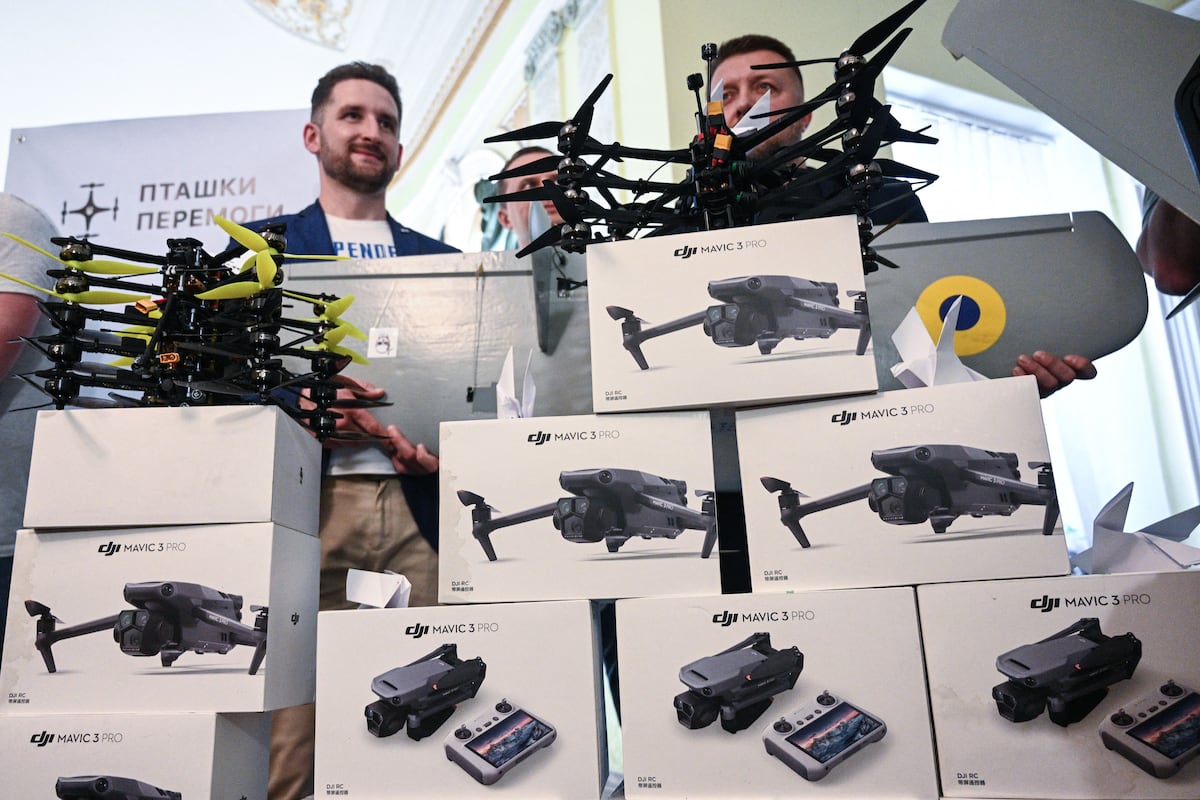
Drones and other unmanned systems are a “central driver” of the Russia-Ukraine war, Kyiv’s top general observed in an op-ed published this month. In terms of battlefield innovation, Ukraine’s “number one priority” is the “mastery of an entire arsenal of (relatively) cheap, modern and highly effective, unmanned vehicles and other technological means,” he wrote.
By leveraging their resources, technologies and production capacity, the U.S. and its allies can help Ukraine meet this challenge.
In addition to artillery shells, one of Ukraine’s most urgent battlefield needs is an enormous number of one-way attack unmanned aerial vehicles, also known as “kamikaze drones.” First and foremost, this means first-person view — or “FPV” — drones, combining cheap commercially available quadcopters rigged with munitions. Both Russia and Ukraine widely employ FPVs as improvised loitering munitions used to attack vehicles and personnel at or near the front line. But while the Ukrainians adopted FPV drones first, Russia now has the edge thanks to its advantage in production capacity.
With Western-provided shells currently in short supply , Ukraine will need to lean even more heavily on FPVs as a partial replacement for artillery. The Ukrainians are making many thousands of FPV drones every month, but they’re still well short of Kyiv’s goal of 1 million per year. Although Ukraine has received some loitering munitions from the United States and other Western countries, they’re far more expensive and aren’t produced at anywhere near the sufficient scale.
Ukraine also needs more long-range attack drones designed to strike targets far behind the frontlines. Here, too, Moscow currently has an advantage thanks to its Iranian-provided Shahed UAVs, which Russia began producing itself last year. According to Ukrainian intelligence, Russia can now make as many as 350 Shaheds per month.
Although U.S. companies don’t yet mass-produce anything like the Shahed, Ukrainian industry has begun making a variety of long-range attack drones and continues to develop new designs. Kyiv’s forces have repeatedly employed such UAVs to strike airbases and other deep targets both in occupied territory and inside Russia.
If Ukraine can sufficiently scale production, it could beat Russia at its own game. In 2024, Kyiv aims to make 11,000 one-way attack UAVs with a range of at least 300 kilometers. These drones can supplement Ukraine’s limited stocks of Western-supplied missiles .
Ukraine has an innovative and rapidly developing UAV industry, but a lack of resources is slowing progress. Western assistance can help Ukraine scale production and obtain access to advanced technologies and components. Europe intends to do its part. Latvia is leading a UAV coalition for Ukraine, while Lithuania has expressed interest in helping Ukraine produce drones. But the United States has an important role to play, too.
So, what’s to be done?
First, the Biden administration and Congress should incentivize U.S. defense companies to partner with Ukrainian firms. One option is the transfer of Ukrainian intellectual property to American companies for production at scale in the United States. U.S. firms could also invest in localization of production in Ukraine. This sort of cooperation is already beginning to happen, but U.S. government support could help it blossom.
In concert, the United States and Ukraine should consider establishing a working group that brings together government, military, and industry officials focused on unmanned systems. This forum would help institutionalize key relationships and promote defense-industrial cooperation. It would also benefit the U.S. military and American companies by helping them absorb lessons learned from the Russia-Ukraine conflict. Kyiv, for its part, is eager to engage in such a forum.
In the meantime, Congress should consider permitting Kyiv to spend a portion of its U.S. security assistance funding inside Ukraine to procure UAVs that American industry currently struggles to supply in sufficient quantities. This approach, after all, would not be some dramatic departure from current U.S. practice with other democratic partners.
Foreign Military Financing , or FMF, provides partner nations with grants or loans with which to procure U.S. defense articles, services, or training. Washington pledged over $1.6 billion in FMF for Ukraine during the 2022 and 2023 fiscal years. In its supplemental request for fiscal year 2024, the Biden administration asked Congress for $7.2 billion in FMF funding, including $1.7 billion for Kyiv and other European countries affected by Russia’s war in Ukraine. The rest would go to Israel and Indo-Pacific countries, including Taiwan.
Unlike Israel and Taiwan, however, Congress has not authorized Ukraine to use FMF funding for “offshore procurement.” Kyiv must spend all its FMF money in the United States, whereas Jerusalem and Taipei can use some of their U.S.-provided funds for purchases from their own defense industries.
As a general rule, there are good reasons for requiring partners to spend FMF money in the United States. Foreign demand for American-made weapons spurs the U.S. economy, employs Americans, builds valuable defense-industrial capacity, and strengthens political support for arming key partners to deter and defeat common adversaries.
Sometimes, however, U.S. interests are best served by making an exception to the rule. Ukraine’s urgent need for large quantities of cheap drones is just such instance. If and when Congress finally passes the supplemental, it should take that opportunity to revisit this issue.
With this additional funding, Kyiv not only could buy more UAVs but could also swap out Chinese-made drones and components for Ukrainian-made alternatives. In addition, Ukraine could scale up its integration of more expensive features, such as thermal imaging cameras , jamming resistance, home-on-jam capability, and machine vision . This would give Kyiv a boost in the ever-evolving race between Russian and Ukrainian drone technology and provide an offset for Russia’s superiority in electronic warfare and proliferation of small counter-drone jammers.
Vladimir Putin wants to weaken and control Ukraine. If he succeeds, Europeans and Americans will regret it for years to come. Washington and its allies can avoid that outcome by providing Kyiv with additional security assistance, which should include ensuring Ukrainian forces have the drones they need to fight Putin’s unprovoked invasion.
John Hardie is deputy director of the Russia Program at the Foundation for Defense of Democracies, where Bradley Bowman serves as senior director of the Center on Military and Political Power.
基辅最高将领在本月发表的一篇评论文章中指出,无人机和其他无人系统是俄乌战争的“核心驱动因素”。他写道,就战场创新而言,乌克兰的“首要任务”是“掌握一整套(相对)廉价、现代化且高效的无人车辆和其他技术手段”。
美国及其盟友可以利用自身的资源、技术和生产能力,帮助乌克兰应对这一挑战。
除了炮弹之外,乌克兰战场上最迫切的需求之一是大量的单向攻击无人机,也被称为“神风特攻队无人机”。这首先指的是第一人称视角(FPV)无人机,即在廉价的商用四旋翼飞行器上加装弹药。俄罗斯和乌克兰都广泛使用FPV无人机作为简易巡飞弹,用于攻击前线或前线附近的车辆和人员。虽然乌克兰率先采用了FPV无人机,但凭借其生产能力优势,俄罗斯现在占据了上风。
由于西方提供的炮弹目前供应短缺,乌克兰将不得不更加依赖无人机来部分替代火炮。乌克兰每月生产数万架无人机,但距离基辅设定的每年100万架的目标仍相去甚远。尽管乌克兰已从美国和其他西方国家获得一些巡飞弹,但这些弹药价格昂贵,而且产量远不足以满足需求。
乌克兰也需要更多远程攻击无人机,用于打击前线后方远处的作战目标。在这方面,莫斯科目前也占据优势,这得益于伊朗提供的“沙赫德”(Shahed)无人机,俄罗斯去年开始自行生产该型无人机。据乌克兰情报部门称,俄罗斯现在每月可生产多达350架“沙赫德”无人机。
尽管美国公司尚未大规模生产类似“沙赫德”无人机的产品,但乌克兰工业已开始制造各种远程攻击无人机,并持续研发新型设计。基辅军队已多次使用此类无人机打击被占领土和俄罗斯境内的空军基地及其他纵深目标。
如果乌克兰能够充分扩大生产规模,它就有可能在俄罗斯擅长的领域击败俄罗斯。基辅的目标是在2024年生产11000架单向攻击无人机,射程至少为300公里。这些无人机可以补充乌克兰有限的西方导弹库存。
乌克兰拥有创新且快速发展的无人机产业,但资源匮乏阻碍了其发展。西方的援助可以帮助乌克兰扩大生产规模,并获得先进技术和零部件。欧洲也打算尽其所能。拉脱维亚正在领导一个支持乌克兰的无人机联盟,而立陶宛也表示有兴趣帮助乌克兰生产无人机。但美国同样可以发挥重要作用。
那么,该怎么办呢?
首先,拜登政府和国会应该鼓励美国国防企业与乌克兰企业开展合作。一种方案是将乌克兰的知识产权转让给美国公司,以便在美国进行大规模生产。美国公司也可以投资在乌克兰进行本地化生产。这类合作已经开始出现,但美国政府的支持将有助于其蓬勃发展。
美国和乌克兰应共同考虑成立一个工作组,汇集政府、军方和业界官员,重点关注无人系统。该论坛将有助于巩固关键关系,促进国防工业合作。同时,它也将使美国军方和美国企业受益,帮助他们吸取俄乌冲突的经验教训。基辅方面也渴望参与这样的论坛。
与此同时,国会应考虑允许基辅将部分美国安全援助资金用于乌克兰境内采购无人机,因为美国工业目前难以提供足够数量的无人机。毕竟,这种做法与美国目前与其他民主伙伴国的做法并无本质区别。
对外军事融资(FMF)向伙伴国家提供赠款或贷款,用于采购美国国防物资、服务或培训。华盛顿承诺在2022和2023财年向乌克兰提供超过16亿美元的FMF资金。在2024财年的补充拨款申请中,拜登政府向国会申请72亿美元的FMF资金,其中包括17亿美元用于基辅和其他受俄罗斯在乌克兰战争影响的欧洲国家。剩余资金将用于以色列和印太地区国家,包括台湾。
然而,与以色列和台湾不同,美国国会并未授权乌克兰将外国军事基金用于“境外采购”。基辅必须将所有外国军事基金资金用于美国境内,而耶路撒冷和台北则可以使用部分美国提供的资金从本国国防工业采购。
一般来说,要求伙伴国将对外军费开支用于美国是有充分理由的。外国对美国制造武器的需求能够刺激美国经济,为美国人提供就业机会,建立宝贵的国防工业能力,并增强对武装关键伙伴国以威慑和击败共同敌人的政治支持。
然而,有时为了维护美国的利益,破例才是最佳选择。乌克兰急需大量廉价无人机正是如此。如果国会最终通过补充拨款法案,就应该借此机会重新审视这个问题。
有了这笔额外资金,基辅不仅可以购买更多无人机,还可以用乌克兰制造的替代品替换中国制造的无人机和零部件。此外,乌克兰还可以扩大无人机更昂贵功能的集成规模,例如热成像摄像头、抗干扰能力、干扰定位能力和机器视觉。这将使基辅在俄乌无人机技术不断演变的竞争中占据优势,并抵消俄罗斯在电子战和小型反无人机干扰器扩散方面的优势。
弗拉基米尔·普京意图削弱并控制乌克兰。如果他得逞,欧洲人和美国人将在未来数年为此后悔不已。华盛顿及其盟友可以通过向基辅提供更多安全援助来避免这种情况的发生,这其中应包括确保乌克兰军队拥有对抗普京无端入侵所需的无人机。
约翰·哈迪是保卫民主基金会俄罗斯项目的副主任,布拉德利·鲍曼是该基金会军事和政治力量中心的高级主任。