India to acquire more air defense systems and drones for modern warfare印度将采购更多防空系统和无人机用于现代战争
India will boost its inventory of Russian S-400 air defense systems, which were deemed effective during last year's brief war with Pakistan.
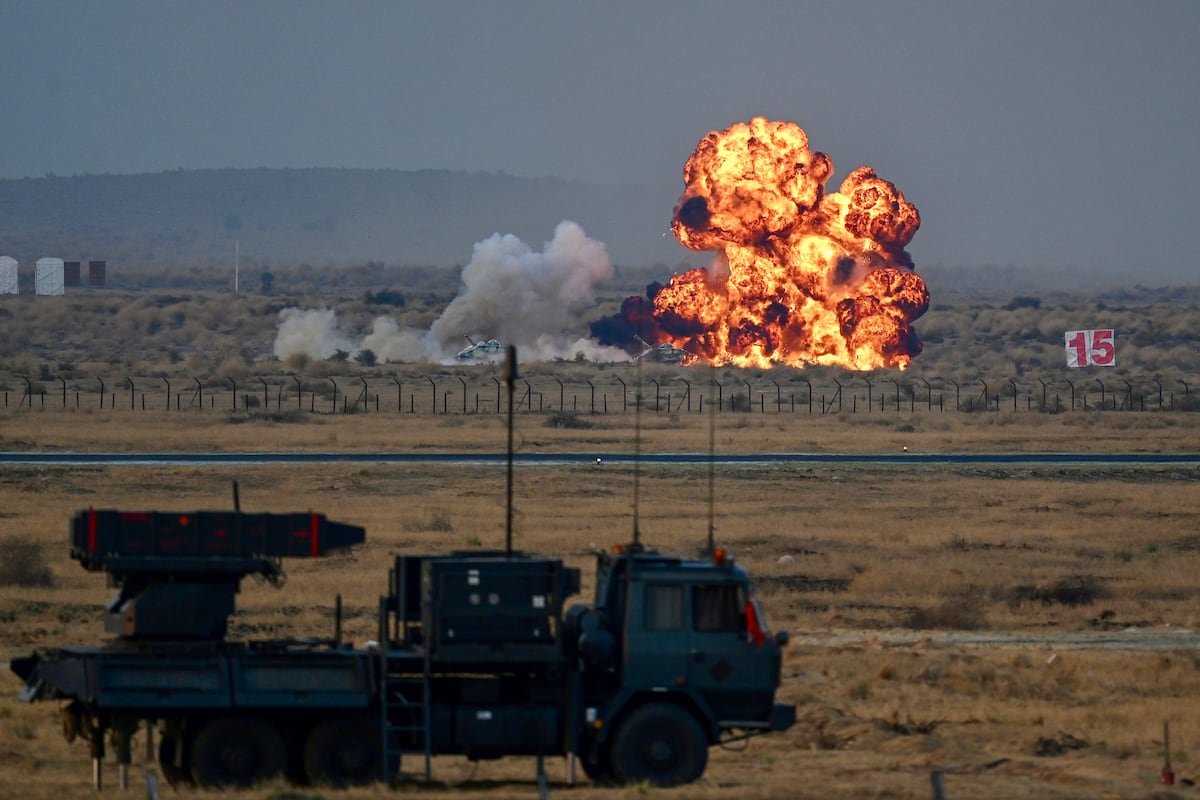
NEW DELHI — India has approved a massive $25 billion military modernization package that includes procuring new air-defense missile systems from Russia as well as remotely piloted strike platforms and transport aircraft.
The recent approvals represent a push to strengthen the country’s air defensive and offensive capabilities to bolster its preparedness for new-age warfare in which air power is taking center stage, according to analysts. New Delhi faces adversaries China and Pakistan along its northern and western borders. Its long frontier with Myanmar on the country’s eastern flank is also unstable.
The decision to acquire five additional S-400 Triumf air defense systems from Russia is among the key approvals by the Defense Acquisition Council headed by Defense Minister Rajnath Singh. These will be on top of five S-400’s India ordered in 2018 — three are deployed along its northern and western borders, while two are scheduled to be delivered this year.
The ten systems will eventually become the linchpin of India’s long range air defense. The additional platforms aim to plug coverage gaps when they are fully deployed.
The approval for the S-400’s comes nearly a year after the system, which can engage aerial threats including aircraft, drones and cruise missiles at extended ranges, played a crucial role during the brief India-Pakistan conflict last year, reinforcing confidence in its capabilities. Missile strikes and drones were extensively deployed during the four day hostilities.
“The S-400’s have proven their worth by intercepting aerial threats and bringing down some of the missiles fired by Islamabad, so now India knows it works well,” said Dinakar Peri, a fellow in the Security Studies program at Carnegie India. “By getting more of these systems, India will widen the perimeter of its air defense.”
Meanwhile, India’s decision to buy 60 more remotely piloted strike aircraft to strengthen its offensive capabilities signals the growing emphasis on unmanned operations in warfare, say experts. Undertaking strikes without putting pilots at risk, they have played a key role during recent conflicts.
“There is a fundamental shift in warfare. While you have your frontline platforms such as bombers and submarines, you also need to factor in the huge part played by drones in battlefield tactics,” said Peri. “That is the lesson military planners have learned from recent conflicts. In fact the Russia-Ukraine war in a sense prepared India for its own conflict with Pakistan last year – it demonstrated the importance of drones and air defenses.”
The defense ministry said in a statement that the approvals are intended to strengthen both offensive and defensive air capabilities. “The S-400 system will counter enemy long-range air vectors targeting vital areas, while remotely piloted strike aircraft will enable offensive counter and coordinated air operations, along with intelligence, surveillance and reconnaissance roles.”
India recently signed a $47 million contract for procurement of the Tunguska air defense missile system from Russia to fill a gap in short-range air defense. These aim to protect ground forces from low-altitude threats such as helicopters, drones and cruise missiles.
A chunk of the new funding package will be directed towards acquiring 60 new multirole transport aircraft that will replace the country’s aging fleet. From high mountains to strategic islands that lie far away from the mainland, Indian troops are deployed across a varied geography. The likely contenders for these could be Brazil’s Embraer, US-based Lockheed Martin and Russia’s Ilyushin aircraft, according to media reports.
Experts say the recent budget approvals demonstrate that despite Russia’s share of Indian defense imports declining, as New Delhi also begins to buy equipment from countries like France, Israel and the United States, Moscow remains a key supplier of military equipment.
“There are several reasons for this. For one, Russian equipment is relatively cheaper and it is very hardy. You can operate it anywhere from the minus temperatures in the mountains to hot deserts,” said Rahul Bedi, a defense analyst in New Delhi. “Also, the Indian military is very familiar with Russian equipment.”
The recent $25 billion military acquisition approvals reflect a record surge in defense spending, coming six weeks after India also cleared the purchase of 114 Rafale fighter jets estimated to be worth around $40 billion.
While many of the planned acquisitions were pending for years, the new emphasis on air power in conflicts has injected a sense of urgency amid intensifying global uncertainties.
“There is a marked reluctance on part of countries to put boots on the ground, and fight land wars. Although this is inescapable to some extent, the tendency is to avoid that to the extent possible, so that is where air warfare becomes important,” according to Amit Cowshish, a former financial adviser for acquisition for India’s Defence Ministry.
Although India is the world’s fifth-largest military spender and second-largest arms importer after Ukraine, according to the Stockholm International Peace Research Institute, modernizing its armed forces still represents a challenge.
新德里——印度已批准一项价值 250 亿美元的大规模军事现代化计划,其中包括从俄罗斯采购新的防空导弹系统以及遥控攻击平台和运输机。
分析人士认为,近期批准的这些项目表明,印度正努力加强其空中防御和进攻能力,以提升其应对以空中力量为核心的新型战争的准备。新德里北部和西部与中国和巴基斯坦接壤,东部与缅甸的漫长边界也存在不稳定因素。
国防部长拉杰纳特·辛格领导的国防采购委员会批准了多项重要决议,其中包括从俄罗斯增购五套S-400“凯旋”防空系统。此前,印度已于2018年订购了五套S-400系统——其中三套部署在其北部和西部边境,另外两套计划于今年交付。
这十套系统最终将成为印度远程防空体系的核心。其他平台全面部署后,旨在填补防空覆盖的空白区域。
S-400防空系统获批之际,距离该系统正式服役已近一年。该系统能够远距离拦截包括飞机、无人机和巡航导弹在内的空中威胁,并在去年短暂的印巴冲突中发挥了关键作用,进一步增强了人们对其性能的信心。在为期四天的冲突中,双方广泛部署了导弹和无人机。
卡内基印度安全研究项目研究员迪纳卡尔·佩里表示:“S-400系统已经证明了自身的价值,它成功拦截了空中威胁,并击落了伊斯兰堡发射的部分导弹,因此印度现在也知道它运行良好。通过采购更多此类系统,印度将扩大其防空范围。”
与此同时,专家表示,印度决定增购60架遥控攻击机以增强其进攻能力,表明战争中对无人作战的重视程度日益提高。无人攻击机能够在不危及飞行员安全的情况下执行打击任务,在近期的冲突中发挥了关键作用。
佩里表示:“战争形式正在发生根本性的转变。虽然轰炸机和潜艇等一线平台仍然重要,但无人机在战场战术中扮演的角色也不容忽视。这是军事策划者从近期冲突中吸取的教训。事实上,俄乌战争在某种程度上为印度去年与巴基斯坦的冲突做好了准备——它凸显了无人机和防空系统的重要性。”
国防部在一份声明中表示,这些批准旨在加强攻防空中能力。“S-400系统将对抗敌方针对重要区域的远程空中攻击,而遥控攻击机将能够执行进攻性反击和协同空中作战,以及情报、监视和侦察任务。”
印度最近签署了一份价值4700万美元的合同,从俄罗斯采购“通古斯卡”防空导弹系统,以填补短程防空方面的空白。该系统旨在保护地面部队免受直升机、无人机和巡航导弹等低空威胁。
新拨款方案的一部分将用于采购60架新型多用途运输机,以替换该国老旧的机队。从高山到远离大陆的战略岛屿,印度军队部署在地形多样的地区。据媒体报道,可能的竞标者包括巴西航空工业公司(Embraer)、美国洛克希德·马丁公司(Lockheed Martin)和俄罗斯伊留申公司(Ilyushin)。
专家表示,最近的预算批准表明,尽管俄罗斯在印度国防进口中所占份额有所下降,而且新德里也开始从法国、以色列和美国等国购买装备,但莫斯科仍然是军事装备的主要供应国。
“这其中有几个原因。首先,俄罗斯的装备相对便宜,而且非常耐用。从山区的严寒到沙漠的酷热,几乎任何环境都能使用,”新德里的一位国防分析师拉胡尔·贝迪说。“此外,印度军方对俄罗斯的装备非常熟悉。”
最近批准的 250 亿美元军事采购反映了国防开支的创纪录增长,而就在六周前,印度也批准购买了 114 架阵风战斗机,估计价值约 400 亿美元。
虽然许多计划中的采购项目已经搁置多年,但随着全球不确定性的加剧,冲突中对空中力量的新重视,带来了一种紧迫感。
“各国明显不愿派遣地面部队参与地面战争。虽然在某种程度上这是不可避免的,但各国倾向于尽可能避免这种情况,因此空中作战就显得尤为重要,”印度国防部前采购财务顾问阿米特·考什什表示。
尽管根据斯德哥尔摩国际和平研究所的数据,印度是世界第五大军费开支国和仅次于乌克兰的第二大武器进口国,但实现军队现代化仍然面临挑战。