Iranian strikes target the infrastructure behind US airpower伊朗的袭击目标是美国空军背后的基础设施。
Iran has struck radar systems, satellite communications and mission-critical aircraft at US bases across Bahrain, Qatar, Kuwait, Saudi Arabia and the UAE.
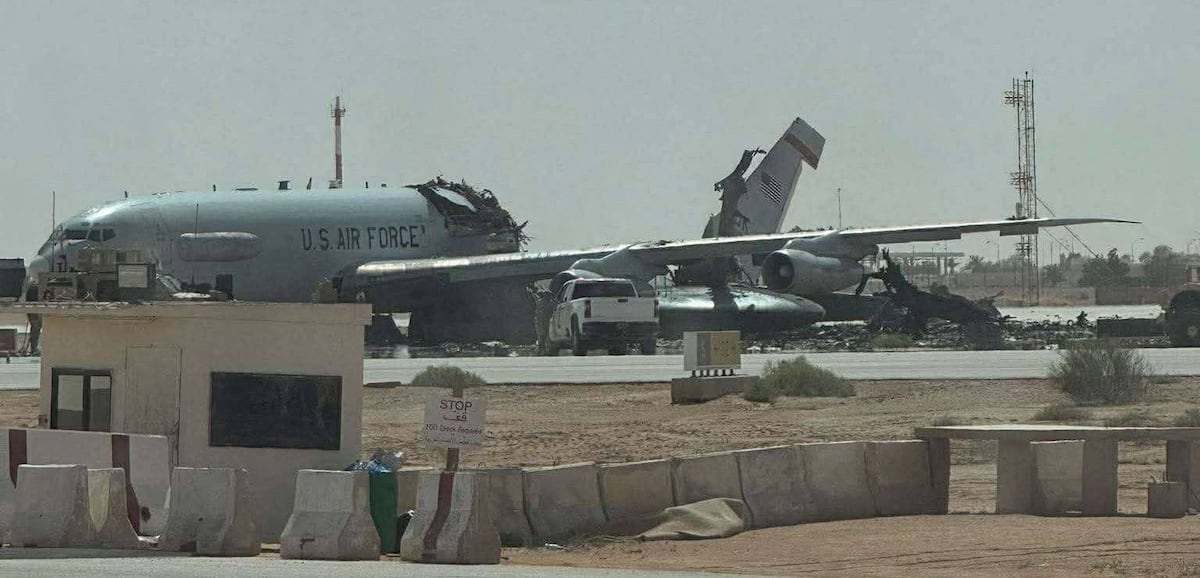
A U.S. Air Force E-3 Sentry, an airborne warning and control system, was among the aircraft damaged in a March 27 Iranian missile and drone attack on Prince Sultan Air Base, Saudi Arabia — one of several strikes on the installation since Operation Epic Fury began Feb. 28.
Two weeks earlier, on March 13, five KC-135 Stratotanker refueling aircraft were damaged on the flight line, two U.S. officials told the Wall Street Journal, as reported by Military Times .
Since Feb. 28, Iran has struck radar systems, satellite communications and mission-critical aircraft at at least seven U.S. bases across Bahrain, Qatar, Kuwait, Saudi Arabia and the UAE. The attacks have focused on infrastructure that U.S. forces depend on to detect threats, refuel aircraft and direct air operations in the region.
By late March, Iranian missile and drone launches had dropped more than 90% since the conflict began, according to U.S. Central Command. Meanwhile, the attacks that persist have zeroed in on radar sites, SATCOM terminals, tankers and now an AWACS.
Kelly Grieco, a senior fellow at the Stimson Center, said the pattern points to deliberate targeting, rather than opportunism. The strikes are systematic and target three “distinct functional categories,” she said, including radar and communications infrastructure, aerial refueling tankers and now the AWACS.
“Each is a critical enabler of U.S. air operations,” Grieco told Defense News. “That’s not random. That’s a target set derived from an understanding of how U.S. airpower functions and where it is most exposed. The pattern suggests deliberate doctrine, or something close enough to it, not opportunism.”
Joe Costa, director of the Atlantic Council’s Forward Defense program and former deputy assistant secretary of defense for plans and posture, said Iran’s targeting approach makes tactical sense.
“It’s much easier to hit stationary infrastructure on the ground than planes flying in the air,” Costa said. “The U.S. has a dynamic process to quickly reallocate global resources to mitigate risks to troops and the mission, but the real cost is the cumulative impacts this operation will have on long-term readiness for other U.S. priorities.
“The more assets we use and lose now, the less will be available later until maintenance cycles, repairs and new purchases are complete.”
Smoke rises after Iran carried out a missile strike on the main headquarters of the U.S. Navy's 5th Fleet in Manama, Bahrain, on Feb. 28. (Anadolu via Getty Images)
Strikes on communications, missile defense infrastructure
Iran’s retaliatory campaign targeted communications infrastructure from the opening hours of the conflict.
On Feb. 28, an Iranian drone struck Naval Support Activity Bahrain, home of the U.S. Navy’s 5th Fleet. Satellite imagery later obtained by The New York Times showed damage to large SATCOM terminals at the installation.
Satellite imagery also confirmed damage to the AN/FPS-132 phased array early warning radar in Qatar, with at least one of the system’s three arrays struck in the opening days of the conflict, according to Planet Labs imagery obtained by the Middlebury Institute of International Studies. Similar strikes hit radar facilities at Al Ruwais and Al Sader in the UAE, according to satellite imagery reported by The War Zone .
Qatar purchased the AN/FPS-132 radar system from the U.S. in 2013 for $1.1 billion. The Iranian drones used to strike it cost an estimated $20,000 to $60,000 per unit.
CENTCOM and Space Force Public Affairs directed Defense News to previously released operational updates and declined to comment further about the strikes.
The targeting also extended to missile defense infrastructure.
Satellite imagery confirmed the AN/TPY-2 radar for a U.S. THAAD battery at Muwaffaq Salti Air Base in Jordan was struck and apparently destroyed in the opening days of the conflict, later confirmed by a U.S. official . The AN/TPY-2 is the primary sensor for the THAAD system. Without it, a THAAD battery cannot independently search for or track targets.
A damaged U.S. Boeing E-3 Sentry airborne warning and control aircraft following an Iranian strike at Prince Sultan Air Base in Saudi Arabia. (Social media via Reuters)
An already waning E-3 fleet
The damage to the Prince Sultan E-3 on March 27 comes at a time when the fleet is already stretched thin. The Air Force’s E-3 inventory has dwindled to 16 aircraft, the last delivered by Boeing in 1992.
In fiscal 2024, the fleet posted a mission-capable rate of 55.68%, according to Air Force data reported by Air & Space Forces Magazine , meaning fewer than nine aircraft were operationally available on any given day.
As of March 26, the Atlantic Council’s Forward Defense program , which tracks U.S. military assets committed to Operation Epic Fury, estimated that between 66% and 75% of the available E-3 fleet was deployed to the theater.
Air & Space Forces Magazine , which reviewed imagery of the damaged aircraft, reported the extent of the damage likely renders the E-3 unrepairable.
Grieco said the near-term impact is real, but manageable. Prior to the damage, six aircraft were forward-deployed, and the theater was operating “at the margins of what continuous battle management coverage requires,” she told Defense News.
“Five aircraft means accepting either a single continuous orbit or periodic gaps when a second cannot be regularly sustained. In those gaps, the air picture degrades, air battle management is less effective and the theater’s ability to coordinate a complex, multi-aircraft operation becomes significantly more constrained,” she said.
“The United States could send another E-3 to the theater,” Grieco added, “but there are only 15 left in the entire fleet — and every one deployed to the Middle East is one less available everywhere else.”
Philip Sheers, an associate fellow in the Defense Program at the Center for a New American Security, said the loss emphasizes the burden on the airborne battle management fleet. About half of the 16-aircraft E-3 fleet is mission capable, he said, and with six in the Middle East, only two or three remain for other needs.
“There is very little slack remaining for flexibility and adjustment, and that places a huge burden on the remaining fleet as well as other systems to fill in the gaps, potentially at the expense of other priorities,” Sheers said.
The U.S. military's losses incurred during the Iran war could result in increased dependence on the Australian E-7 Wedgetail, pictured here in 2022. (Airman Trevor Bell/Air Force)
A ‘massive alarm bell’ for air defense
A March 2026 report by the Center for a New American Security warned that proposed alternatives to dedicated airborne battle management aircraft, including space-based sensors and fighter-based networks, are either longer-term technological prospects, unproven at battle management or highly vulnerable, and should be treated as complements rather than substitutes.
Replacing the airborne capability will take time.
The Pentagon moved to cancel the E-7 Wedgetail program in its fiscal 2026 budget request , citing cost growth, from $588 million to $724 million per aircraft, as well as survivability concerns in contested airspace. Congress reversed the decision, preserving the program in the fiscal 2026 National Defense Authorization Act and blocking further E-3 retirements until enough Wedgetails are in service.
According to the Government Accountability Office , the E-7’s first flight has slipped to May 2027, with full operational capability now projected for the early 2030s. Space-based systems proposed by the Pentagon as a longer-term alternative face a similar timeline, according to Space Force officials .
Near-term, Sheers said the loss will increase operational strain on the remaining E-3s and could result in increased dependence on carrier-based E-2 Hawkeyes and the Australian E-7 Wedgetail.
“The demand for airborne sensing to manage cruise missile and drone threats is not going anywhere,” he told Defense News. “Medium and long-term, this all bodes very poorly for E-3 readiness and highlights the need for DoD and Congress to resource a real solution to the shrinking and aging E-3 fleet.”
The KC-135 tanker fleet faces parallel pressures. Already cannibalizing parts from the boneyard, the Cold War-era jets have absorbed repeated strikes.
In addition to the five KC-135s damaged at Prince Sultan on March 13, multiple refueling aircraft were also hit in the March 27 strike, according to Air & Space Forces Magazine .
Costa pointed to broader implications that outlast the current conflict.
“The continued use and possible reallocation of high-demand, low-density assets like air defense systems will impact readiness for other U.S. global priorities,” Costa said. “That’s the real strategic tradeoff.”
Sheers said the conflict should serve as a warning well beyond the Middle East.
“The entirety of this conflict should be a massive alarm bell on the need for passive defenses, not just for U.S. forces in the Middle East, but over the homeland where drone incursions are increasingly frequent, and especially in the Indo-Pacific, where the Chinese missile threat is orders of magnitude larger and more difficult to suppress,” he told Defense News.
“Airbase vulnerability has been an issue for decades, and the drumbeat of independent analysis on this issue could not be louder,” he added. “If DoD doesn’t take these events as a wake-up call, we are setting ourselves up for disaster in a future great power conflict.”
Grieco suggested the effects may already be rippling through the campaign in ways that don’t show up in publicly available strike counts.
Those “less visible metrics” include tanker availability, AWACS coverage gaps and stockpile constraints, she said.
“If Iran’s strikes on radar and communications infrastructure are compressing warning times and creating gaps in the missile defense network, that’s operationally significant even if no additional aircraft are destroyed,” she said.
“The threshold for material degradation isn’t a single dramatic loss. It’s the accumulation of constraints that make the campaign more expensive, less flexible and less effective over time. We may already be past it in ways that won’t be visible until the campaign’s operational history is written.”
3 月 27 日,伊朗对沙特阿拉伯苏丹王子空军基地发动导弹和无人机袭击,造成包括美国空军 E-3 哨兵预警机在内的多架飞机受损。E-3 是一种空中预警和控制系统。这是自 2 月 28 日“史诗狂怒行动”开始以来,该基地遭受的多次袭击之一。
据《华尔街日报》报道,两名美国官员透露,两周前的 3 月 13 日,五架 KC-135 同温层加油机在飞行线上受损,军事时报也报道了此事。
自2月28日以来,伊朗袭击了至少七个位于巴林、卡塔尔、科威特、沙特阿拉伯和阿联酋的美国军事基地,目标包括雷达系统、卫星通信设施和关键任务飞机。这些袭击主要针对美军赖以探测威胁、为飞机加油和指挥该地区空中行动的基础设施。
据美国中央司令部称,截至3月下旬,伊朗导弹和无人机发射次数已比冲突爆发前下降了90%以上。与此同时,持续不断的袭击目标已转向雷达站、卫星通信终端、油轮,现在甚至包括一架预警机。
史汀生中心高级研究员凯莉·格里科表示,这种模式表明这是蓄意攻击,而非机会主义行为。她说,这些袭击是有组织的,目标分为三个“不同的功能类别”,包括雷达和通信基础设施、空中加油机,以及现在的预警机。
格里科告诉《防务新闻》:“每一项都是美国空中作战的关键保障。这并非随意之举。这是基于对美国空军运作方式及其最易受攻击之处的理解而制定的目标集。这种模式表明存在深思熟虑的战略,或者至少与之非常接近,而非机会主义。”
大西洋理事会前沿防御项目主任、前国防部计划与态势副助理部长乔·科斯塔表示,伊朗的目标选择方式在战术上是合理的。
科斯塔说:“攻击地面上的固定设施比攻击空中飞行的飞机容易得多。美国有一套动态流程,可以迅速重新分配全球资源,以降低部队和任务面临的风险,但真正的代价是这次行动对美国其他优先事项的长期战备能力造成的累积影响。”
“我们现在使用和损失的资产越多,在维护周期、维修和新购置完成之前,以后可用的资产就越少。”
2月28日,伊朗向位于巴林首都麦纳麦的美国海军第五舰队总部发射导弹,现场浓烟滚滚。(Anadolu via Getty Images)
对通信和导弹防御基础设施的打击
伊朗的报复行动从冲突爆发之初就将目标对准了通信基础设施。
2月28日,一架伊朗无人机袭击了美国海军第五舰队驻地——巴林海军支援基地。《纽约时报》随后获得的卫星图像显示,该基地的大型卫星通信终端遭到破坏。
卫星图像也证实了卡塔尔的AN/FPS-132相控阵预警雷达遭到破坏,据米德尔伯里国际研究学院获取的Planet Labs卫星图像显示,该系统的三个阵列中至少有一个在冲突初期遭到袭击。据《战区》报道,阿联酋的鲁瓦伊斯和萨德尔的雷达设施也遭到了类似的袭击。
卡塔尔于2013年以11亿美元的价格从美国购买了AN/FPS-132雷达系统。据估计,伊朗用于攻击该系统的无人机每架造价在2万至6万美元之间。
美国中央司令部和太空部队公共事务部门指示《防务新闻》参考之前发布的作战更新信息,并拒绝就此次袭击事件发表进一步评论。
打击目标还包括导弹防御基础设施。
卫星图像证实,位于约旦穆瓦法克·萨尔蒂空军基地的美国“萨德”反导系统AN/TPY-2雷达在冲突初期遭到袭击并被摧毁,这一消息随后得到一位美国官员的证实。AN/TPY-2是“萨德”系统的主要传感器。没有它,“萨德”系统将无法独立搜索或跟踪目标。
一架美国波音E-3“哨兵”空中预警和控制飞机在沙特阿拉伯苏丹王子空军基地遭伊朗袭击后受损。(社交媒体图片来自路透社)
E-3机队本已日渐衰落。
3月27日“苏丹王子”E-3预警机受损之际,空军机队本已捉襟见肘。空军的E-3预警机数量已锐减至16架,最后一架是波音公司于1992年交付的。
根据《空军与太空部队杂志》报道的空军数据,2024 财年该机队的任务可用率为 55.68%,这意味着在任何一天,可执行作战任务的飞机不足 9 架。
截至 3 月 26 日,大西洋理事会的“前沿防御”计划(该计划追踪美国投入“史诗狂怒行动”的军事资产)估计,可用 E-3 机队的 66% 至 75% 已部署到战区。
《空军与太空部队杂志》审阅了受损飞机的图片后报道称,受损程度可能使 E-3 无法修复。
格里科表示,短期影响确实存在,但可控。她告诉《防务新闻》,在受损之前,有六架飞机前沿部署,战区“勉强达到持续作战管理覆盖范围的要求”。
“五架飞机意味着要么接受一次连续的盘旋,要么接受在无法稳定维持第二次盘旋时出现的周期性空档。在这些空档期,空中态势感知能力会下降,空战指挥效率会降低,战区协调复杂多机作战的能力也会受到显著限制,”她说道。
格里科补充说:“美国可以再向战区派遣一架 E-3,但整个机队只剩下 15 架了——每部署到中东一架,其他地方就少了一架可用。”
新美国安全中心国防项目副研究员菲利普·希尔斯表示,此次损失凸显了空中作战管理机队的负担。他说,16架E-3预警机中约有一半具备作战能力,其中6架部署在中东,仅剩两三架可用于其他用途。
希尔斯说:“留给灵活性和调整的空间非常有限,这给剩余的舰队以及其他系统带来了巨大的负担,需要填补这些空缺,这可能会以牺牲其他优先事项为代价。”
美国军方在伊朗战争中遭受的损失可能导致其更加依赖澳大利亚的E-7“楔尾”预警机,如图所示,该机拍摄于2022年。(空军士兵特雷弗·贝尔/美国空军)
对防空系统而言,这是一个“巨大的警钟”。
美国新安全中心在 2026 年 3 月发布的一份报告中警告说,包括天基传感器和战斗机网络在内的专用空中作战管理飞机的替代方案,要么是长期的技术前景,要么在作战管理方面未经证实,要么非常脆弱,应该被视为补充而不是替代品。
取代空中作战能力需要时间。
五角大楼在其2026财年预算申请中拟取消E-7“楔尾”预警机项目,理由是单机成本从5.88亿美元增至7.24亿美元,以及在敌对空域的生存能力问题。国会推翻了这一决定,在2026财年国防授权法案中保留了该项目,并阻止了E-3预警机的进一步退役,直到有足够数量的“楔尾”预警机投入使用。
据美国政府问责局称,E-7预警机的首飞已推迟至2027年5月,全面具备作战能力预计将在2030年代初实现。据太空部队官员称,五角大楼提出的作为长期替代方案的天基系统也面临着类似的进度安排。
希尔斯表示,短期内,此次损失将增加剩余 E-3 的作战压力,并可能导致对舰载 E-2 鹰眼和澳大利亚 E-7 楔尾的依赖性增加。
“对用于应对巡航导弹和无人机威胁的机载传感设备的需求不会消失,”他告诉《防务新闻》。“从中长期来看,这对E-3预警机的战备状态来说是一个非常糟糕的预兆,也凸显了国防部和国会需要为日益萎缩和老化的E-3机队提供切实可行的解决方案。”
KC-135加油机机队也面临着类似的压力。这些冷战时期的喷气式飞机不仅已经从飞机坟场拆解零部件,而且还遭受了反复的打击。
据《空军与太空部队杂志》报道,除了 3 月 13 日在苏丹王子空军基地受损的 5 架 KC-135 加油机外,3 月 27 日的袭击中还有多架加油机被击中。
科斯塔指出,这场冲突的影响更为深远,其影响远不止于当前的冲突。
科斯塔表示:“继续使用并可能重新分配高需求、低密度资产(例如防空系统)将影响美国应对其他全球优先事项的战备能力。这才是真正的战略权衡。”
希尔斯表示,这场冲突应该起到警示作用,其影响远不止于中东地区。
“这场冲突的方方面面都应该敲响警钟,提醒我们被动防御的必要性,这不仅适用于驻中东的美军,也适用于无人机入侵日益频繁的本土,尤其是在印太地区,中国的导弹威胁要大得多,也更难压制,”他告诉《防务新闻》。
“空军基地的脆弱性问题已经存在几十年了,独立分析对此问题的呼声再高也不为过,”他补充道。“如果国防部不把这些事件视为警钟,我们将在未来的大国冲突中自食其果。”
格里科认为,这些影响可能已经以某种方式波及到竞选活动中,而这种影响并没有体现在公开的罢工统计数据中。
她表示,这些“不太明显的指标”包括油轮可用性、预警机覆盖范围缺口和库存限制。
“如果伊朗对雷达和通信基础设施的袭击缩短了预警时间,并在导弹防御网络中造成了漏洞,即使没有摧毁更多飞机,这在作战上也是意义重大的,”她说。
“物资损耗的临界点并非单一的重大损失,而是各种限制因素的累积,这些因素会随着时间的推移,使战役成本更高、灵活性更差、效果更差。我们或许已经在某些方面超过了这个临界点,而这些方面只有在战役的作战历史被书写之后才会显现出来。”