German military’s metaverse promises virtual foes with an AI punch德国军方的元宇宙承诺将推出拥有人工智能攻击能力的虚拟敌人
Researchers are developing an artificial intelligence-powered military sandbox for trying new weapons, or souping up old ones.
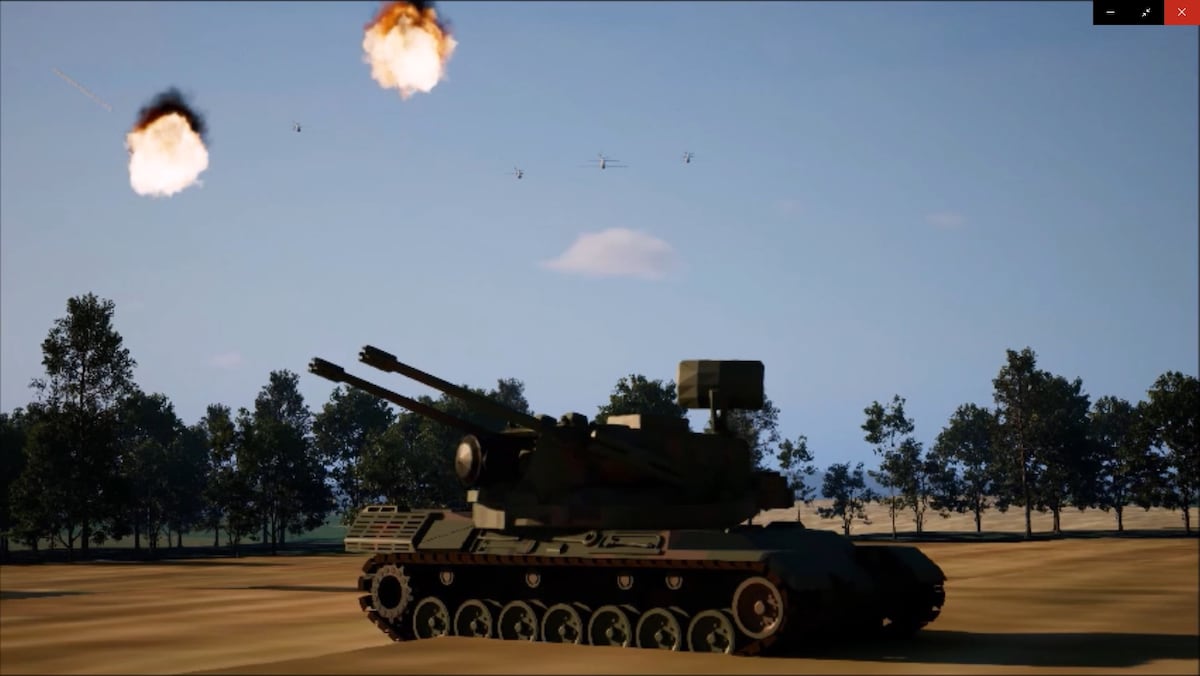
COLOGNE, Germany — Imagine a drone swarm so cunning it can overwhelm any air defense, or an air defense weapon so smart it can see through any drone swarm’s tactics. New investments in military equipment will soon lead to artificial intelligence-powered sniff tests to see how such ideas would perform in the real world.
At least, that’s the promise of a consortium of German startups and defense academics, who say their GhostPlay virtual battlefield offers acquisition officials the chance to game out new features for unmanned systems, counter-drone guns and everything in between in order to identify shortcomings during the design phase.
At the heart of the platform, internally dubbed a metaverse for the Bundeswehr, or German military, lies a kind of supercharged artificial intelligence engine built on self-learning and enhanced autonomy, according to Yvonne Hofstetter, the CEO of 21strategies. The German company, whose proprietary technology is already deployed by traders in the financial industry, leads the GhostPlay project along with local sensor specialist Hensoldt, the Bundeswehr University Hamburg, and Switzerland-based Borchert Consulting and Research.
The German Defence Ministry funded the idea in the course of a €500 million (U.S. $540 million) COVID-19 subsidy package, spread over four years and meant to jolt the country’s high-tech defense research sector into action. Grants are managed through a joint venture of Germany’s two Bundeswehr universities (there is also one in Munich) dubbed dtec.bw.
What sets GhostPlay apart from other military initiatives dabbling in artificial intelligence is its use of “third-wave” algorithms, Hofstetter said in an interview with Defense News, meaning the simulated battlefield actors make decisions that are more “human-like,” with surprises and unpredictability included.
That is compared to “second-wave” AI technologies that essentially behave as supporting acts to humans — optimizing or speeding up decisions instead of coming up with novel courses of action.
GhostPlay programmers say they can create would-be battlefields as digital twins of the real world. For example, if the assignment were to recreate Lithuania for a simulation, coders would fan out to copy the environment “down to the last leaf” using satellite photos and local authorities’ databases on everything from housing, infrastructure and vegetation, Hofstetter said.
Coders can also replicate the performance of enemy weapons, especially former Eastern bloc types, using data from open-source intelligence. That includes characteristics of air defense weapons or seeker technology in missiles.
“There is enough info ... kind of scary, really,” said Hofstetter, adding that old military handbooks of the German Democratic Republic have offered a window into warfighting tactics on display today in Russia’s invasion of Ukraine.
And even without data, the GhostPlay engine still serves up veritable foes by way of algorithms constantly fine-tuned via lessons learned in countless simulations.
Researchers have begun toying with the idea of transferring some of the project’s AI decision-making logic to existing military equipment. If successful, that could give legacy systems a new lease on life and surprise adversaries with new capabilities in old kit, said Heiko Borchert of Borchert Consulting,
A paper authored by GhostPlay officials last year states the fire control system of the German Gepard self-propelled anti-aircraft gun, for example, could significantly enhance the target hit rate and increase its own chance of survival when infused with advanced AI algorithms.
The German government has transferred 46 Gepards to Ukraine from the stocks of manufacturer Krauss-Maffei Wegmann. As of Aug. 24, a running online list of Berlin’s military support for Kyiv showed the transfer of six more vehicles was in the works.
No longer used by the Bundeswehr, the weapons reportedly have been instrumental in repelling some Russian missile and drone attacks in Ukraine, including against civilian targets.
In the context of GhostPlay, researchers trained the Gepard to fight a variety of platforms, including Bayraktar TB2 combat UAVs, drone swarms, as well as Russian Ka-52 and Mi-28 attack helicopters.
“Preliminary results suggest that the [simulated Gepard] platform learns very fine-granular engagement tactics for different types of threats and even senses when it’s important to destroy the target or only disable it,” according to the paper.
The platform also learned to optimize its sensor mix to detect targets and prioritize them based on the immediacy of a given threat. For example, the fire control algorithm learned to fire first at weapon-carrying platforms, like helicopters or missile-bearing drones , and engage loitering munitions later.
As for drone swarms, the simulated Gepard shot into what appeared on its radar as singular drone cloud; this thinned out the crowd until sensors were able to recognize tracks for each drone. And when a different, more urgent threat suddenly appeared from a different direction, the system managed to turn its turret and fire while a drone swarm conducted “fancy” maneuvers elsewhere meant to confuse the vehicle’s sensors.
Sebastian Sprenger is associate editor for Europe at Defense News, reporting on the state of the defense market in the region, and on U.S.-Europe cooperation and multi-national investments in defense and global security. Previously he served as managing editor for Defense News. He is based in Cologne, Germany.
德国科隆——试想一下,如果无人机群足够狡猾,能够突破任何防空系统;或者防空武器足够智能,能够识破任何无人机群的战术,那会是怎样一番景象?对军事装备的新投资即将催生人工智能驱动的“嗅探测试”,以检验这些设想在现实世界中的表现。
至少,德国初创企业和国防学者组成的联盟是这样承诺的。他们表示,他们的 GhostPlay 虚拟战场为采购官员提供了一个机会,让他们可以模拟无人系统、反无人机武器以及介于两者之间的一切的新功能,以便在设计阶段发现不足之处。
据21strategies首席执行官伊冯娜·霍夫施泰特(Yvonne Hofstetter)介绍,该平台的核心是一个基于自学习和增强自主性的超强人工智能引擎,德国联邦国防军内部将其称为“元宇宙”。这家德国公司拥有自主研发的技术,已被金融行业的交易员广泛应用。该公司与当地传感器专家亨索尔特(Hensoldt)、汉堡联邦国防军大学以及总部位于瑞士的博尔切特咨询研究公司(Borchert Consulting and Research)共同领导GhostPlay项目。
德国国防部通过一项为期四年、总额达 5 亿欧元(约合 5.4 亿美元)的新冠疫情补贴计划资助了这一项目,旨在推动德国高科技国防研究部门的行动。这些拨款由德国两所联邦国防军大学(慕尼黑也有一所)的合资企业 dtec.bw 管理。
霍夫施泰特在接受《防务新闻》采访时表示,GhostPlay 与其他涉足人工智能领域的军事计划的不同之处在于它使用了“第三波”算法,这意味着模拟战场上的行动者会做出更“像人类一样”的决策,其中包含惊喜和不可预测性。
相比之下,“第二波”人工智能技术本质上是作为人类的辅助工具——优化或加快决策,而不是提出新的行动方案。
GhostPlay的程序员表示,他们可以创建与现实世界高度相似的数字孪生战场。例如,如果任务是为模拟重建立陶宛,程序员们会利用卫星照片和地方政府的数据库,从住房、基础设施到植被等各个方面,细致入微地复制当地环境,Hofstetter说道。
程序员还可以利用开源情报数据,复制敌方武器的性能,特别是前东欧集团国家的武器。这包括防空武器的特性或导弹的导引头技术。
“信息已经足够多了……说实话,有点吓人,”霍夫施泰特说,他还补充道,德意志民主共和国的旧军事手册让我们得以窥见如今在俄罗斯入侵乌克兰中所展现的作战策略。
即使没有数据,GhostPlay 引擎仍然能够通过算法提供真正的敌人,这些算法通过无数次模拟中吸取的经验教训不断进行微调。
研究人员已经开始尝试将该项目的部分人工智能决策逻辑移植到现有的军事装备上。博尔切特咨询公司的海科·博尔切特表示,如果成功,这将使老旧系统焕发新生,并利用旧装备的新功能给对手带来惊喜。
GhostPlay 公司官员去年撰写的一篇论文指出,例如,德国猎豹自行高射炮的火控系统,如果融入先进的人工智能算法,可以显著提高目标命中率,并提高自身的生存机会。
德国政府已从克劳斯-玛菲·韦格曼公司(Krauss-Maffei Wegmann)的库存中向乌克兰移交了46辆猎豹装甲车。截至8月24日,一份柏林向基辅提供军事支持的在线清单显示,另有6辆装甲车的移交工作正在进行中。
据报道,这些武器已不再被德国联邦国防军使用,但它们在击退俄罗斯在乌克兰境内的一些导弹和无人机袭击(包括针对平民目标的袭击)方面发挥了重要作用。
在 GhostPlay 的背景下,研究人员训练了 Gepard 无人机与各种平台作战,包括 Bayraktar TB2 战斗无人机、无人机群以及俄罗斯 Ka-52 和 Mi-28 攻击直升机。
论文指出,“初步结果表明,[模拟的猎豹]平台能够学习针对不同类型威胁的非常精细的交战策略,甚至可以感知何时应该摧毁目标,何时应该仅仅使其失效。”
该平台还学会了优化其传感器组合,以便探测目标并根据威胁的紧迫程度确定优先级。例如,火控算法学会了优先攻击携带武器的平台,例如直升机或导弹无人机,然后再攻击巡飞弹。
至于无人机群,模拟的猎豹导弹系统会向雷达上看似单一的无人机云开火;这会逐渐削弱无人机群,直到传感器能够识别出每架无人机的轨迹。当另一种更紧迫的威胁突然从另一个方向出现时,该系统能够迅速调整炮塔并开火,同时另一群无人机在别处进行“花式”机动,旨在干扰车辆的传感器。
塞巴斯蒂安·斯普伦格是《防务新闻》欧洲版副主编,负责报道该地区的防务市场状况,以及美欧在防务和全球安全领域的合作和多国投资。此前,他曾担任《防务新闻》执行主编。他现居德国科隆。