One Of These Missiles Is Set To Be The Army’s Next Mid-Tier Anti-Air Interceptor其中一款导弹将成为陆军下一代中级防空拦截器。
The new Enduring Shield system paired with AIM-9X Sidewinders already gives the Army its first mid-range air defense capability in decades.
新闻视频
By Joseph Trevithick
Published Sep 11, 2026 1:45 PM EDT
Jamie Hunter/Lockheed Martin
Lockheed Martin and a team made up of Boeing and Anduril are now facing off head-to-head to supply a new middle-tier surface-to-air missile to the U.S. Army. The service wants a second interceptor for its new Enduring Shield system , which can already fire AIM-9X Sidewinders , to expand its capabilities, especially against incoming cruise missiles.
Boeing and Anduril announced their offering had been selected to move ahead to the next phase of the competition to develop what is formally called the Integrated Fires Protection Capability Increment 2 (IFPC Inc 2) Second Interceptor on Wednesday. The Army subsequently confirmed to Breaking Defense that Lockheed Martin advanced to phase 2 of this program. Rafael Systems Global Sustainment, a U.S. subsidiary of Israeli defense contractor Rafael, had also been in the running, but was not down-selected.
The Army’s search for a second interceptor for Enduring Shield traces back to at least 2023 . The system, developed by Leidos’ subsidiary Dynetics, is entering operational service now paired with the AIM-9X. It is designed to provide short-to-medium range defense against a variety of aerial threats, including drones. The Army has not had any kind of mid-range air defense capability since it retired its Hawk surface-to-air missile systems in the 1990s.
A US Army Enduring Shield launcher seen deployed in South Korea. USAF Pfc. Sang Woo Choi
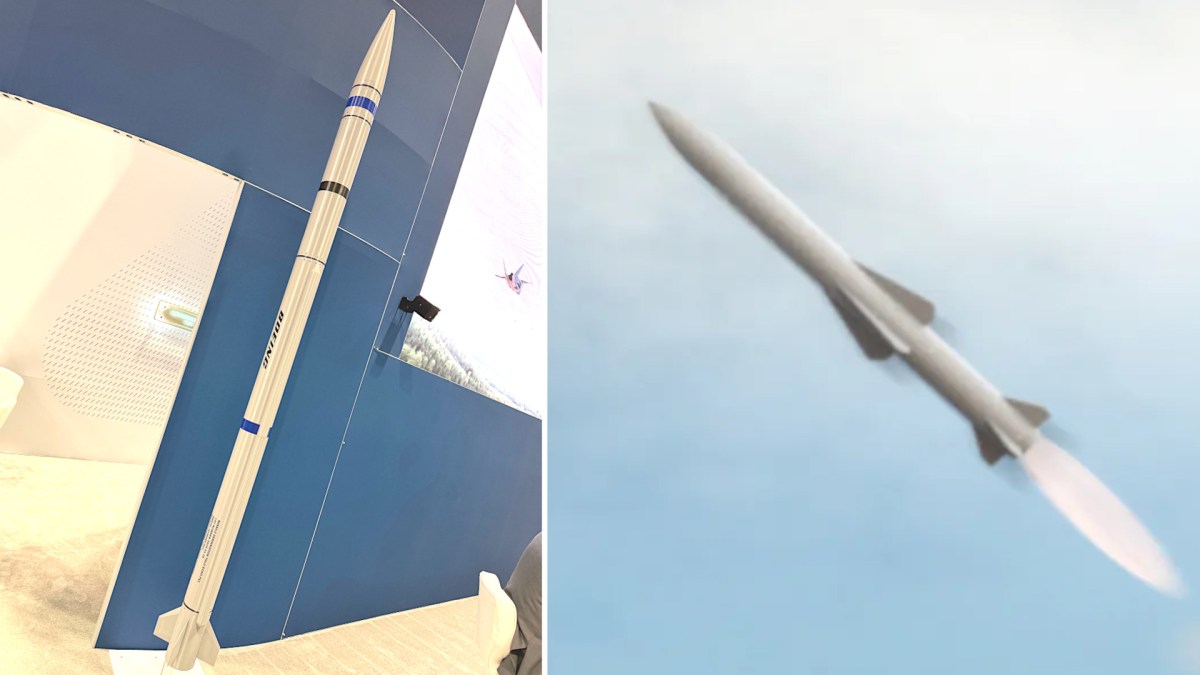
A model of the missile Boeing and Anduril have put forward was only shown publicly for the first time earlier this year. Boeing says it is a clean-sheet design and it uses a solid-fuel rocket motor provided by Anduril.
A model of the Boeing/Anduril interceptor seen on display at the 2026 Space & Missile Defense Symposium in August of this year. Jamie Hunter
In its announcement about the Army’s down-selection, Boeing shared a previously unreleased rendering of the design, which notably had two sets of fins toward the tail end of the body. The model that has been shown so far only has one set of fins at the very rear of the body. Whether the rendering reflects a newer or older version of the design is unclear. What is seen in the rendering may also be an additional booster rocket motor not seen on the model, which could be necessary for ground-launched applications.
The rendering that Boeing released this week as part of the announcement of its selection to proceed in the IFPC Inc Second Interceptor competition. Boeing
Boeing has also said that the new interceptor is being developed with an emphasis on lower cost and producibility. Modularity and open-architecture systems to enable “faster, lower-cost upgrades by allowing seeker, avionics or software blocks to be swapped without redesigning the entire weapon” have also been particular focus areas, according to the company.
Other details about the missile’s design and capabilities, including how it is guided, remain limited.
“Our scalable production approach is designed to provide a reliable, affordable layer of defense against a range of aerial threats to protect the warfighter with practical, dependable capability when it matters most,” Bob Ciesla, vice president of Boeing Precision Engagement Systems, had said in a statement earlier this week.
Lockheed Martin first showed a rendering of its design last year, but has also shared relatively specific details about it since then. For what has been seen so far, it is visually reminiscent, at least in broad strokes, of a compact air-to-air missile concept called Cuda , which the company previously promoted for a time in the 2010s.
A rendering depicting Lockheed Martin’s proposed interceptor being fired from Enduring Shield launchers. Lockheed Martin
The design is “not new,” Chris Murphy, senior manager of Business Development for Integrated Air and Missile Defense Advanced Programs at Lockheed Martin’s Missiles and Fire Control division, confirmed to TWZ in October 2025.
“There are technologies that we already have that we’re leveraging,” Murphy added at the time. “But the requirements for the missile are such that they’re going to be new technologies, and there’s going to be some level of development in order to get those integrated.”
“So you know that our [PAC-3] MSE missile [for the Patriot surface-to-air missile system] is a hit-to-kill system, right? We have great confidence in that technology,” he also said when asked specifically about whether the interceptor would have a traditional warhead. “We also work [on] blast-frag[mentation warheads] on other programs. So we will look at everything. That’s part of the trade space the Army has asked us to look at.”
The PAC-3 Missile Segment Enhancement (MSE) is generally presented as a hit-to-kill weapon, meaning that it is designed to destroy its target through sheer force of impact. However, it is actually something of a hybrid design that includes a high-explosive “lethality enhancer” charge to increase its chance of scoring a hit, something you can learn more about here .
A breakdown of the PAC-3 MSE’s key features, including the “lethality enhancer.” Lockheed Martin
For its part, the Army has talked in the past about wanting its second interceptor for Enduring Shield to offer roughly comparable capabilities to the AIM-120D Advanced Medium Range Air-to-Air Missile (AMRAAM), but in the same form factor as the AIM-9X. A key driving factor behind the size requirement is retaining magazine depth. The system’s existing palletized launchers can currently be loaded with up to 18 Sidewinders in individual canisters.
Magazine depth, together with more flexibility to engage different threats in different envelopes, is exactly in line with the stated purpose of the Enduring Shield system. The ongoing conflict with Iran , as well as other recent crises in the Middle East and the war in Ukraine , have underscored the threats posed by large-scale complex barrages that blend together long-range one-way-attack drones and cruise missiles . Ballistic missiles are also a very worrisome part of the equation , though Enduring Shield is not capable of engaging them. We will come back to this in a moment.
“I do want to highlight a couple of things that I think are very critical gaps that we have. I don’t think – I cannot add anything to the emphasis on magazine depth for currently fielded systems, or for the need for cheaper and [a] wide-ranging mix of interceptors,” Lt. Gen. John Rafferty, head of the Army’s Space and Missile Defense Command (SMDC), told TWZ and other attendees in a keynote address at the 2026 Space & Missile Defense Symposium last month. “That couldn’t be made more loud and clear from the highest levels of our government.”
At that time, Rafferty also stressed the need to further expand the Army’s ability to provide multi-layered air and missile defense capabilities. Enduring Shield, as the Army’s first middle-tier air defense system in decades, is already a key component of that broader effort.
The Army also more specifically sees Enduring Shield as central to reducing over-reliance on its Patriot surface-to-air missile systems. The immense strain on the service’s Patriot force and its inadequacy to meet existing operational demands are well established at this point, and have only been reinforced by the latest conflict with Iran . The Army is notably in the process of establishing its first new Patriot battalion in years, on Guam , which will actually be a composite unit also equipped with Enduring Shield. Pairing the two systems together helps free up Patriot batteries to engage higher-tier threats, especially ballistic missiles, which may themselves be targeting air defenders directly.
Additional efforts are underway now to further expand the Army’s array of available lower- and higher-end air and missile defense interceptors , as well as new and improved sensors and networks to go with them . This will only help further distribute capability and capacity, giving air defenders more operational space to employ systems when and where they are likely to be most effective.
There is still a question of whether the Army will actually start recieving new interceptors for Enduring Shield. A major issue that has emerged in recent years is being able to produce key munitions in a timely manner to bolster stocks ahead of conflicts and keep them replenished during sustained operations. To use the example of the Army’s Patriot units again, strain there has been further exacerbated by massive expenditures of interceptors in the course of operations in the Middle East in recent years, as well as demand emanating from Ukraine . There have been a succession of reports in recent months about stockpiles of Patriot interceptors, as well as other critical munitions, becoming ever more critically low. The Pentagon has been working with several companies to dramatically step up production of munitions, including existing and new designs , but it will still take time for those agreements to translate into physical results.
The Army has now at least moved to the next phase of the competition for a second interceptor for the Enduring Shield system, demand for which is already growing.
Contact the author: joe@twz.com
Comments couldn’t be loaded. Please refresh the page.
作者:约瑟夫·特雷维西克
发布于美国东部时间2026年9月11日下午1:45
杰米·亨特/洛克希德·马丁公司
洛克希德·马丁公司与波音公司和安杜里尔公司组成的联合团队正在展开激烈竞争,力图为美国陆军提供一种新型中级地对空导弹。美国陆军希望为其新型“持久盾牌”系统配备第二种拦截导弹。该系统目前已能发射AIM-9X“响尾蛇”导弹,此次竞标旨在增强其拦截能力,尤其是在拦截来袭巡航导弹方面。
波音公司和安杜里尔公司周三宣布,他们的方案已入选下一阶段的竞标,将参与正式名称为“集成火力防护能力增量2”(IFPC Inc 2)第二拦截器的研发。随后,美国陆军向《防务新闻》证实,洛克希德·马丁公司也进入了该项目的第二阶段。以色列国防承包商拉斐尔公司的美国子公司拉斐尔系统全球保障公司也参与了竞标,但最终未能入选。
美国陆军为“持久盾牌”系统寻找第二款拦截导弹的工作至少可以追溯到2023年。该系统由雷多斯公司旗下的Dynetics公司研发,目前正与AIM-9X导弹配合使用,投入作战服役。其设计目的是提供中短程防御,抵御包括无人机在内的各种空中威胁。自上世纪90年代退役“鹰”式地对空导弹系统以来,美国陆军一直缺乏中程防空能力。
一枚美国陆军“持久盾牌”导弹发射器在韩国部署。美国空军一等兵崔相佑
波音公司和安杜里尔公司联合研制的导弹模型今年早些时候才首次公开亮相。波音公司称,该导弹是全新设计的,并采用了安杜里尔公司提供的固体燃料火箭发动机。
图中所示为波音/安杜里尔拦截器的模型,该模型于今年8月在2026年太空与导弹防御研讨会上展出。杰米·亨特
在宣布陆军最终选定方案时,波音公司分享了一张此前未公开的设计渲染图,图中显示机身尾部有两组尾翼。而目前展示的模型仅在机身尾部有一组尾翼。目前尚不清楚这张渲染图反映的是新版本还是旧版本。渲染图中可能还包含一个模型上没有的助推火箭发动机,这对于地面发射应用来说可能必不可少。
波音公司本周发布了这张渲染图,作为其入选IFPC公司第二轮拦截机竞标公告的一部分。
波音公司还表示,新型拦截弹的研发重点在于降低成本和提高可生产性。该公司称,模块化和开放式架构系统也是研发的重点领域,旨在“通过更换导引头、航空电子设备或软件模块,无需重新设计整个武器,从而实现更快、更低成本的升级”。
关于该导弹的设计和性能的其他细节,包括其制导方式,仍然有限。
“我们可扩展的生产方式旨在提供可靠、经济的防御层,抵御各种空中威胁,在最关键的时刻为作战人员提供实用、可靠的能力,”波音精确交战系统副总裁鲍勃·西斯莱本周早些时候在一份声明中表示。
洛克希德·马丁公司去年首次展示了其设计效果图,此后也分享了一些较为具体的细节。就目前所见,该设计在外观上,至少在整体轮廓上,与该公司曾在2010年代推广过的一款名为“梭鱼”(Cuda)的紧凑型空空导弹概念颇为相似。
一张效果图,描绘了洛克希德·马丁公司提出的拦截弹方案从“持久护盾”发射器中发射的情景。洛克希德·马丁公司
洛克希德·马丁公司导弹与火控部门综合防空与导弹防御先进项目业务发展高级经理克里斯·墨菲在 2025 年 10 月向 TWZ 证实,该设计“并非全新”。
“我们已经掌握了一些技术,并且正在加以利用,”墨菲当时补充道。“但导弹的要求决定了它需要一些新技术,而且为了将这些技术整合起来,还需要进行一定程度的研发。”
“所以你知道我们为‘爱国者’地对空导弹系统研制的[PAC-3] MSE导弹是直接命中杀伤型导弹,对吧?我们对这项技术非常有信心,”当被问及拦截弹是否会配备传统弹头时,他补充道。“我们也在其他项目中研发爆破破片弹头。所以我们会考虑所有方案。这是陆军要求我们权衡的选项之一。”
PAC-3导弹段增强型(MSE)通常被认为是一种直接命中摧毁目标的武器,这意味着它的设计目的是通过强大的冲击力摧毁目标。然而,它实际上是一种混合设计,包含高爆炸性的“杀伤力增强剂”装药,以提高命中率,您可以在这里了解更多信息。
PAC-3 MSE 的主要特性详解,包括其“杀伤力增强器”。洛克希德·马丁公司
陆军方面此前曾表示,希望其“持久盾牌”系统的第二款拦截导弹能够提供与AIM-120D先进中程空空导弹(AMRAAM)大致相当的性能,但外形尺寸要与AIM-9X相同。尺寸要求的关键驱动因素是保持弹匣容量。该系统现有的托盘式发射器目前最多可装载18枚“响尾蛇”导弹,这些导弹分别装在独立的发射筒中。
弹匣容量的增加,以及应对不同威胁的灵活性,完全符合“持久盾牌”系统的既定目标。持续不断的伊朗冲突,以及近期中东其他危机和乌克兰战争,都凸显了大规模复杂火力压制所带来的威胁,这种火力压制融合了远程单向攻击无人机和巡航导弹。弹道导弹也是其中非常令人担忧的一部分,尽管“持久盾牌”系统目前尚不具备拦截能力。我们稍后会详细讨论这一点。
“我想强调几个我认为我们目前存在的非常关键的不足之处。我认为——我再怎么强调目前部署系统的弹药库深度,以及对更便宜、种类更丰富的拦截弹的需求,都不为过,”陆军太空与导弹防御司令部(SMDC)司令约翰·拉弗蒂中将在上个月举行的2026年太空与导弹防御研讨会上发表主旨演讲时告诉TWZ和其他与会者。“这一点,我们政府最高层已经表达得非常明确了。”
当时,拉弗蒂还强调,需要进一步提升陆军提供多层防空和导弹防御的能力。“持久盾牌”作为陆军数十年来首个中层防空系统,已成为这项更广泛努力的关键组成部分。
陆军尤其将“持久盾牌”系统视为减少对“爱国者”地对空导弹系统过度依赖的关键。目前,“爱国者”导弹部队面临的巨大压力及其无法满足现有作战需求已是众所周知,而最近与伊朗的冲突更是加剧了这一问题。值得注意的是,陆军正在关岛组建多年来首个新的“爱国者”导弹营,该营实际上是一个同时装备“持久盾牌”系统的混合部队。将这两个系统结合起来,有助于解放“爱国者”导弹部队,使其能够应对更高级别的威胁,特别是那些可能直接瞄准防空系统的弹道导弹。
目前,陆军正加大力度,进一步扩充其现有低端和高端防空反导拦截器的产品线,并研发与之配套的新型和改进型传感器及网络。这将有助于进一步分散作战能力和容量,使防空部队拥有更大的作战空间,能够在最可能发挥效用的时间和地点部署这些系统。
陆军是否真的会开始接收“持久盾牌”系统的新型拦截弹,目前仍是个未知数。近年来出现的一个主要问题是,能否及时生产关键弹药,以在冲突爆发前补充库存,并在持续作战期间保持库存充足。以陆军的“爱国者”导弹系统为例,近年来在中东作战中大量消耗拦截弹,以及来自乌克兰的需求,进一步加剧了该系统的紧张局势。近几个月来,不断有报道称,“爱国者”拦截弹以及其他关键弹药的库存日益告急。五角大楼一直在与多家公司合作,大幅提高包括现有和新型弹药在内的弹药产量,但这些协议仍需时间才能转化为实际成果。
目前,陆军至少已经进入了“持久盾牌”系统第二款拦截器的竞标下一阶段,而对这款拦截器的需求也正在不断增长。
联系作者:joe@twz.com
评论加载失败,请刷新页面。