Macron kicks off French race to build a new nuclear-powered aircraft carrier马克龙启动法国建造新型核动力航空母舰的竞赛
The ship is expected to be the biggest warship France has ever built.
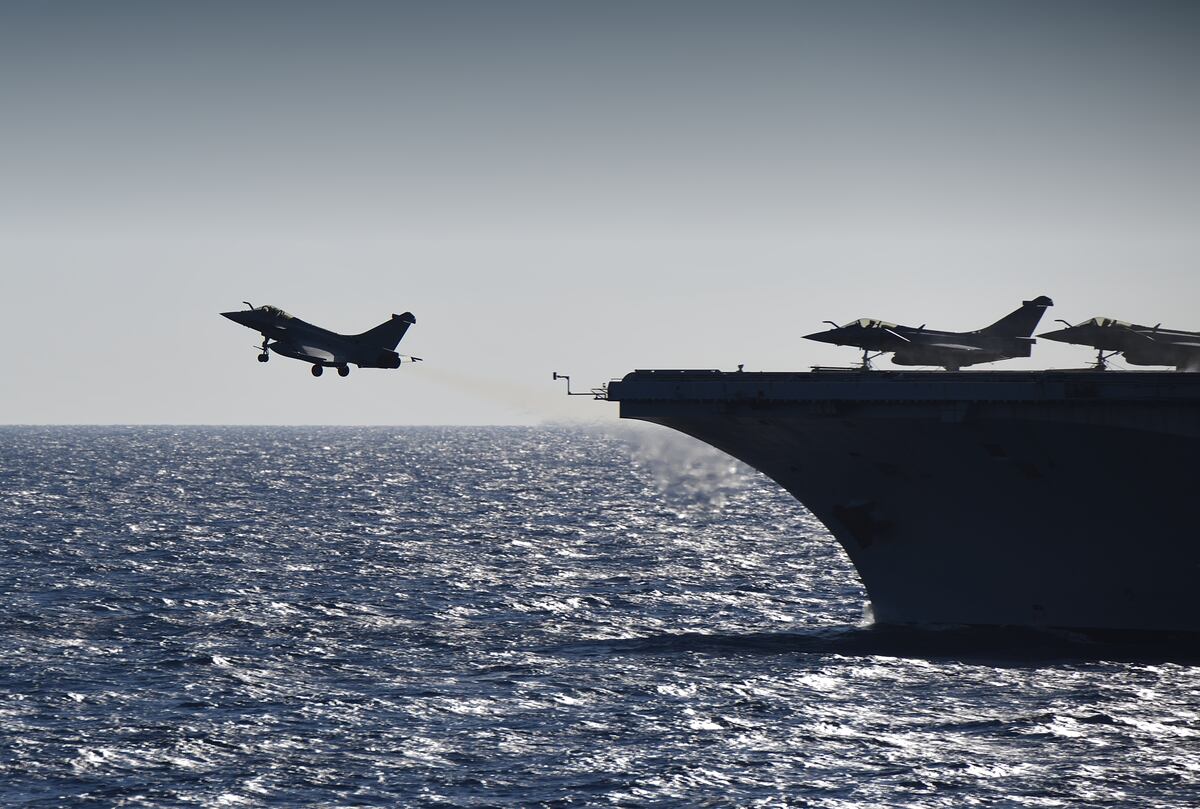
PARIS – French President Emmanuel Macron announced on Dec. 8 that his country’s next aircraft-carrier will be nuclear-powered and should be operational by 2038 in time to replace the Charles de Gaulle, which entered active service in 2001.
The new aircraft carrier is expected to be the biggest warship France has ever built. Florence Parly, the armed forces minister, said in October that the ship, whatever its propulsion, would be designed to deploy the future combat aircraft system (FCAS) and today her ministry confirmed that the vessel would deploy about 30 of these aircraft “which will be bigger than the Rafales.”
The ministry said the ship would be in the 75,000 tonne class (82,673 tons), be around 300 meters long (984 feet) and be able to sail at 27 knots (31 mph), even bigger than the second aircraft carrier that Naval Group was working on in the early 2000s until that program was shelved by the government for lack of money. In comparison, the Charles de Gaulle is 261m (856 feet) long and weighs 42,000 tonnes (46,297 tons) fully loaded. The new ship will have a crew of about 2,000, including the air group.
Speaking at Framatome, France’s principal nuclear-power company headquartered at Le Creusot in the centre of France, Macron announced just four minutes before the end of his 28 minute speech that he had “decided that the future aircraft-carrier which will serve our country and our navy will, like the Charles de Gaulle, be nuclear-propelled.”
It will have two K22 power generators each generating 220 megawatts (hence the 22) derived from the K15 (that generate 150 MW each) that currently power the Charles de Gaulle.
Naval Group , which is the prime contractor for these major ship-building projects, immediately issued a statement hailing the decision, pledging to work with its major industrial partners Chantiers de l’Atlantique, TechnicAtome and Dassault Aviation.
Pierre Eric Pommellet, chairman and CEO of Naval Group, said, “We are delighted with the announcement (…) which will enable France to maintain its position in the very restricted circle of major powers holding a nuclear aircraft carrier.”
Echoing what Macron had said in his speech, Pommellet stressed the importance of projects like this to “ensure the continuity of our skills” and of developing innovative solutions “in the fields of propulsion and high added-value military systems, thus maintaining France’s technological lead and its position as a key geostrategic player.”
Now that the nuclear option has been chosen to power France’s new aircraft carrier, other major decisions will have to be taken, notably concerning the catapults which are a vital part of the project. France has no expertise in this highly specialized technology and so will have to import the catapults from the United States, as it has done for the past 60 years. Those on the Charles de Gaulle are steam-powered, but those on the new aircraft carrier will be electromagnetic.
Naval Group and its partners will now start a two-year preliminary design study, which sources said may use a number of the ideas that had been worked on for the aborted second aircraft carrier. That will be followed by more detailed plans with the development phase expected to finish at the end of 2025 at which point the ministry will order the ship. The design phase up to the end of 2025 is expected to cost some €900 million ($1.09 billion) of which €117 million ($142 million) will be spent in 2021.
Christina Mackenzie was the France correspondent for Defense News.
巴黎——法国总统埃马纽埃尔·马克龙于12月8日宣布,法国的下一艘航空母舰将采用核动力,并应于2038年投入使用,届时将取代2001年服役的“戴高乐”号。
这艘新型航空母舰预计将是法国建造过的最大军舰。法国武装部队部长弗洛朗丝·帕利在10月份表示,无论采用何种动力系统,这艘航母都将配备未来作战飞机系统(FCAS)。今天,她的部门证实,该舰将部署约30架FCAS飞机,“这些飞机将比阵风战斗机更大”。
国防部表示,这艘新舰排水量将达到75000吨级(82673吨),舰长约300米(984英尺),航速可达27节(31英里/小时),甚至比法国海军集团在2000年代初期建造的第二艘航空母舰还要大。当时,由于资金短缺,该项目被政府搁置。相比之下,“戴高乐”号航母长261米(856英尺),满载排水量为42000吨(46297吨)。新舰的舰员编制约为2000人,其中包括舰载航空兵。
在法国主要核电公司法马通(Framatome)位于法国中部勒克勒佐的工厂,马克龙发表讲话。在他 28 分钟的演讲结束前四分钟,他宣布“未来将为我国和海军服务的航空母舰,将像戴高乐号一样,采用核动力推进”。
它将配备两台 K22 发电机,每台可产生 220 兆瓦的电力(因此得名 22),这两台发电机均源自目前为戴高乐号航母供电的 K15 发电机(每台可产生 150 兆瓦的电力)。
作为这些大型造船项目的主要承包商,法国海军集团立即发表声明,对这一决定表示欢迎,并承诺将与其主要工业合作伙伴 Chantiers de l'Atlantique、TechnicAtome 和 Dassault Aviation 合作。
法国海军集团董事长兼首席执行官皮埃尔·埃里克·波梅莱表示:“我们对这一消息感到非常高兴(……),这将使法国能够继续保持在拥有核动力航空母舰的主要大国行列中的地位。”
波梅莱特呼应了马克龙在讲话中所说的话,强调了此类项目的重要性,即“确保我们技能的延续”,以及在“推进和高附加值军事系统领域”开发创新解决方案,从而“保持法国的技术领先地位及其作为关键地缘战略参与者的地位”。
既然法国已决定采用核动力为新型航空母舰提供动力,接下来就必须做出其他重大决定,尤其是弹射器,它是该项目至关重要的组成部分。法国并不具备这项高度专业化技术的经验,因此不得不像过去60年一样从美国进口弹射器。“戴高乐”号上的弹射器是蒸汽动力的,而新型航母上的弹射器将采用电磁动力。
法国海军集团及其合作伙伴将启动为期两年的初步设计研究。消息人士称,该研究可能会借鉴此前为已取消的第二艘航母项目所做的部分设计理念。随后将制定更详细的计划,预计研发阶段将于2025年底完成,届时法国国防部将正式订购该舰。截至2025年底的设计阶段预计耗资约9亿欧元(10.9亿美元),其中1.17亿欧元(1.42亿美元)将在2021年支出。
克里斯蒂娜·麦肯齐是《防务新闻》的法国记者。