China drills show ambitions beyond island, Taiwan warns中国军演表明其野心超越岛屿,台湾发出警告
The warning came as Taipei conducted its own exercises Tuesday to underscore it’s ready to defend itself.
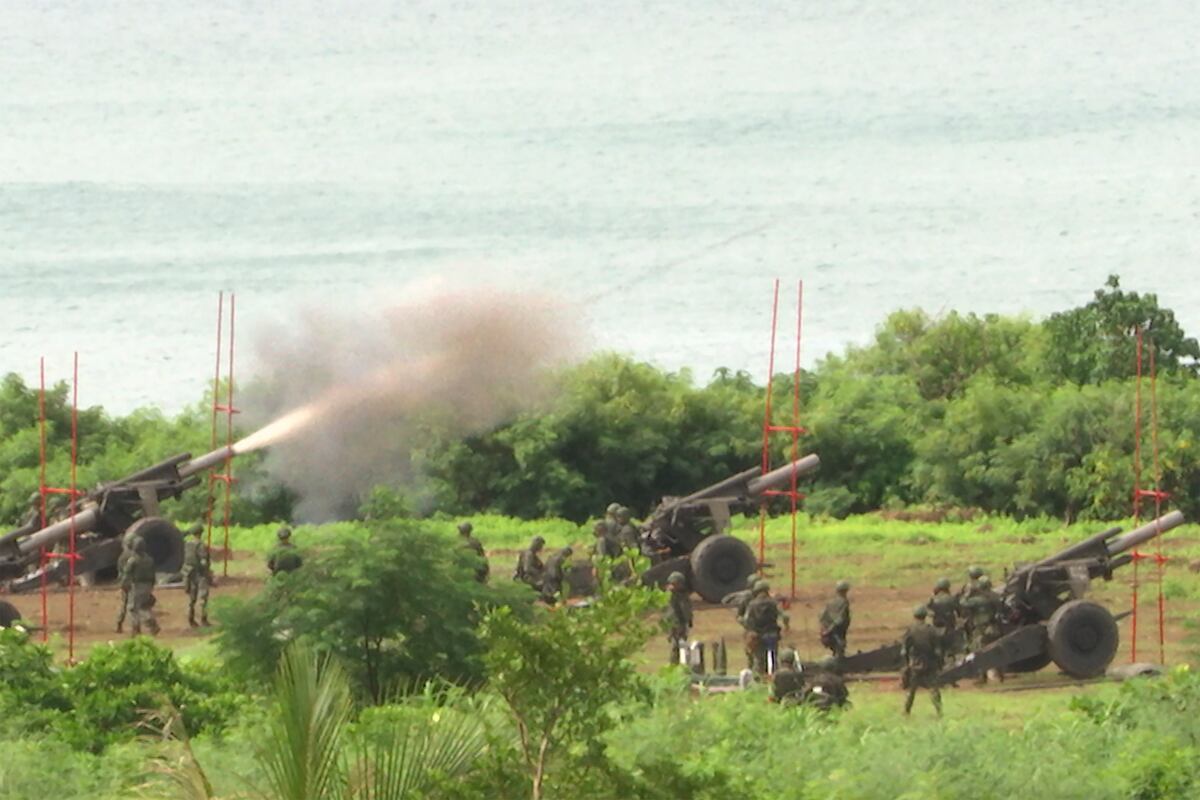
PINGTUNG, Taiwan — Taiwan warned Tuesday that Chinese military drills aren’t just a rehearsal for an invasion of the self-governing island but also reflect ambitions to control large swaths of the western Pacific, as Taipei conducted its own exercises to underscore it’s ready to defend itself.
Angered by U.S. House Speaker Nancy Pelosi’s recent visit to Taiwan , China has sent military ships and planes across the midline that separates the two sides in the Taiwan Strait and launched missiles into waters surrounding the island. The drills, which began Thursday, have disrupted flights and shipping in one of the busiest zones for global trade.
Ignoring calls to calm tensions, Beijing instead extended the exercises without announcing when they will end.
Taiwanese Foreign Minister Joseph Wu said that beyond aiming to annex the island democracy , which split with the mainland amid civil war in 1949, China wants to establish its dominance in the western Pacific. That would include controlling of the East and South China Seas via the Taiwan Strait and imposing a blockade to prevent the U.S. and its allies from aiding Taiwan in the event of an attack, he told a news conference in Taipei.
The exercises show China’s “geostrategic ambition beyond Taiwan,” which Beijing claims as its own territory, Wu said.
“China has no right to interfere in or alter” Taiwan’s democracy or its interactions with other nations, he added.
Wu’s assessment of China’s maneuvers was grimmer than that of other observers but echoed widespread concerns that Beijing is seeking to expand its influence in the Pacific, where the U.S. has military bases and extensive treaty partnerships.
China has said its drills were prompted by Pelosi’s visit , but Wu said Beijing was using her trip as a pretext for intimidating moves long in the works. China also banned some Taiwanese food imports after the visit and cut off dialogue with the U.S. on a range of issues from military contacts to combating transnational crime and climate change.
Pelosi also dismissed China’s outrage as a public stunt, noting on NBC’s “Today” show that “nobody said a word” about a Senate delegation a few visit months ago. Later on the MSNBC news network, she said Chinese President Xi Jinping was acting like a “scared bully.”
“I don’t think the president of China should control the schedules of members of Congress,” she said.
Through its maneuvers, China has pushed closer to Taiwan’s borders and may be seeking to establish a new normal in which it could eventually control access to the island’s ports and airspace. But that would likely elicit a strong response from the military on the island, whose people strongly favor the status quo of de-facto independence.
The U.S., Taipei’s main backer, has also shown itself to be willing to face down Beijing’s threats. Washington has no formal diplomatic ties with Taiwan in deference to Beijing, but is legally bound to ensure the island can defend itself and to treat all threats against it as matters of grave concern.
That leaves open the question of whether Washington would dispatch forces if China attacked Taiwan . U.S. President Joe Biden has said repeatedly the U.S. is bound to do so — but staff members have quickly walked back those comments.
Beyond the geopolitical risks, an extended crisis in the Taiwan Strait, a significant thoroughfare for global trade, could have major implications for international supply chains at a time when the world is already facing disruptions and uncertainty in the wake of the coronavirus pandemic and the war in Ukraine. In particular, Taiwan is a crucial provider of computer chips for the global economy, including China’s high-tech sectors.
In response to the drills, Taiwan has put its forces on alert, but has so far refrained from taking active counter measures.
On Tuesday, its military held live-fire artillery drills in Pingtung County on its southeastern coast.
The army will continue to train and accumulate strength to deal with the threat from China, said Maj, Gen. Lou Woei-jye, spokesperson for Taiwan’s 8th Army Command. “No matter what the situation is ... this is the best way to defend our country.”
Taiwan, once a Japanese colony, had only loose connections to imperial China and then split with the mainland in 1949. Despite never having governed the island, China’s ruling Communist Party regards it as its own territory and has sought to isolate it diplomatically and economically in addition to ratcheting up military threats.
Washington has insisted Pelosi’s visit did not change its “one China policy,” which holds that the United States has no position on the status of the two sides but wants their dispute settled peacefully.
Associated Press writer Ashraf Khalil in Washington contributed to this report.
台湾屏东——台湾周二警告称,中国的军事演习不仅是入侵这个自治岛屿的预演,也反映出其控制西太平洋大片地区的野心。与此同时,台北方面也举行了自己的演习,以强调其已做好自卫的准备。
由于美国众议院议长南希·佩洛西近日访问台湾,中国对此感到愤怒,派遣军舰和飞机越过台湾海峡中线,并向台湾岛周边海域发射导弹。这些从周四开始的演习扰乱了全球贸易最繁忙区域之一的航班和航运。
北京方面无视缓和紧张局势的呼吁,反而延长了演习时间,且未宣布何时结束。
台湾外交部长吴钊燮表示,除了企图吞并1949年内战后与大陆分裂的台湾岛之外,中国还希望在西太平洋地区确立主导地位。他在台北举行的新闻发布会上说,这包括通过台湾海峡控制东海和南海,并实施封锁,以阻止美国及其盟友在台湾遭受攻击时提供援助。
吴表示,这些演习表明了中国“超越台湾的地缘战略野心”,北京声称台湾是其领土的一部分。
他补充说,“中国无权干涉或改变”台湾的民主制度或其与其他国家的关系。
吴对中国此举的评估比其他观察家更为悲观,但也反映了人们普遍的担忧,即北京正试图扩大其在太平洋地区的影响力,而美国在该地区拥有军事基地和广泛的条约伙伴关系。
中国方面称,此次演习是受佩洛西访台影响,但吴钊燮表示,北京方面只是借佩洛西之行之机,实施酝酿已久的恐吓行动。佩洛西访台后,中国还禁止进口部分台湾食品,并切断了与美国在包括军事交流、打击跨国犯罪和气候变化等一系列问题上的对话。
佩洛西还驳斥了中国的愤怒,称其为一场作秀。她在NBC的“今日秀”节目中指出,几个月前参议院代表团访问中国时,“没人说什么”。之后,她在MSNBC新闻频道上表示,中国国家主席习近平的行为就像一个“害怕的恶霸”。
“我认为中国国家主席不应该干预国会议员的日程安排,”她说。
中国通过一系列举措,不断向台湾边境施压,并可能试图建立一种新的常态,最终控制台湾的港口和领空。但这很可能引发台湾军方的强烈反应,因为台湾民众强烈支持维持事实上的独立现状。
作为台北的主要支持者,美国也已表明愿意对抗北京的威胁。出于对北京的尊重,华盛顿与台湾没有正式外交关系,但其法律义务确保台湾拥有自卫能力,并将所有针对台湾的威胁视为严重关切事项。
这就引出了一个问题:如果中国攻击台湾,华盛顿是否会派遣军队?美国总统乔·拜登曾多次表示美国势必会这样做,但他的幕僚很快就收回了这些言论。
除了地缘政治风险之外,作为全球贸易重要通道的台湾海峡危机若持续,可能会对国际供应链造成重大影响。而目前,世界正因新冠疫情和乌克兰战争而面临诸多动荡和不确定性。尤其值得一提的是,台湾是全球经济(包括中国高科技产业)的重要芯片供应地。
针对此次演习,台湾已将部队置于戒备状态,但迄今为止尚未采取积极的反制措施。
周二,该国军队在其东南沿海的屏东县举行了实弹炮兵演习。
台湾第八军区发言人娄伟杰少将表示,军队将继续训练并积蓄力量,以应对来自中国的威胁。“无论情况如何……这都是保卫我们国家的最佳方式。”
台湾曾是日本的殖民地,与中华帝国只有松散的联系,并于1949年与大陆分离。尽管从未统治过该岛,但中国执政的共产党将其视为自己的领土,并试图在外交和经济上孤立它,同时不断加大军事威胁。
华盛顿方面坚称,佩洛西的访问并没有改变其“一个中国政策”,该政策认为美国对中美两国的地位不持立场,但希望两国争端能够和平解决。
美联社驻华盛顿记者阿什拉夫·哈利勒对本报道亦有贡献。