Here’s Who Has Been Flying The F-117 Stealth Jets And Why According To The Air Force以下是空军公布的驾驶F-117隐形战机的人员名单及其原因
There have long been rumors and speculation about what the jets, which the Air Force is supposed to be destroying, are still doing up in the air.
新闻视频
By Joseph Trevithick
Updated Dec 1, 2019 6:01 AM EST
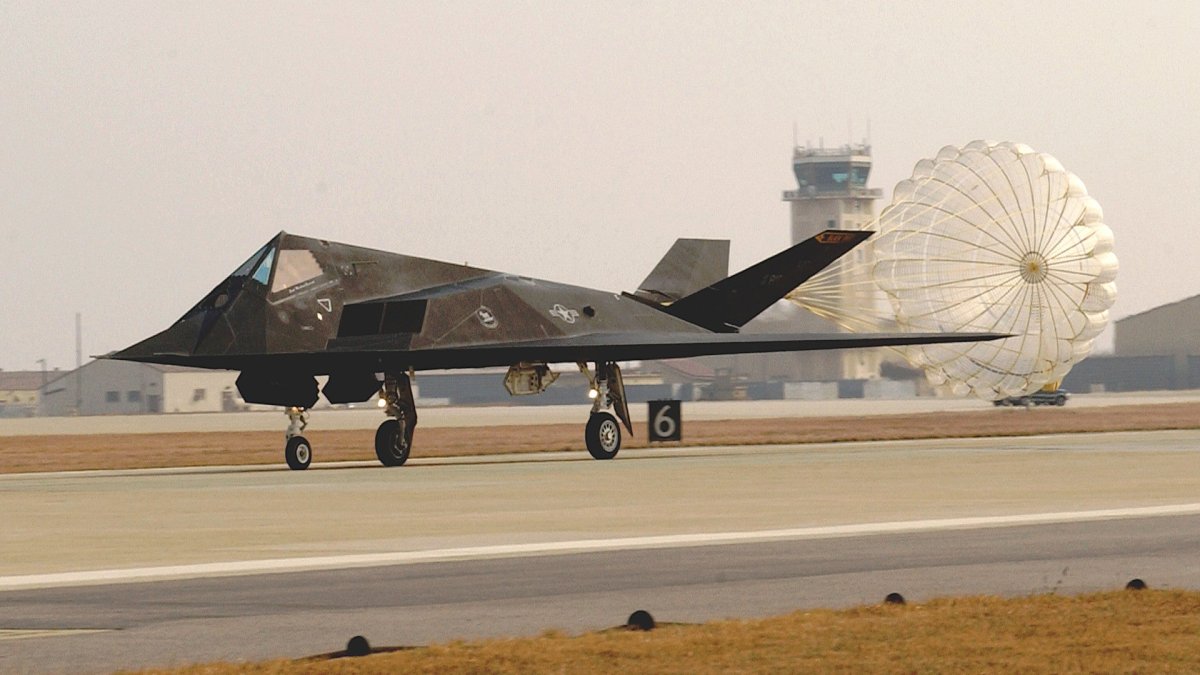
After months of effort, The War Zone has been making steady headway in obtaining new details about the status of the U.S. Air Force’s remaining F-117 Nighthawk stealth combat jets and their future fates, including that one is headed for the Ronald Reagan Presidential Library. Still, it has long proven difficult to get any details about who is still flying at least some of these jets and why, which has long been one of the hottest topics of interest regarding these aircraft. Now we can confirm that the Air Force Test Center has been operating some of the Nighthawks to help out with the service’s research and development efforts.
How many of the 51 remaining F-117s out at the secretive Tonopah Test Range Airport are airworthy is “not for public release,” Air Force spokesperson Brian Brackens recently told The War Zone by Email. This is not necessarily surprising as the service often chooses not to disclose details about the availability rates for specific aircraft fleets or its overall force posture absent a Freedom of Information Act (FOIA) request. At the same time, it is hardly a secret that some Nighthawks are still flying despite a 2017 Congressional mandate to begin physically destroying the remaining examples. This same mandate rescinded a previous requirement for the Air Force to keep them all in what is known as “ Type 1000 ” storage, which would have allowed personnel to relatively quickly return the aircraft to service, if necessary.
“On occasion, we [the Air Force] will fly certain aircraft to support limited research activities,” Brackens further explained to The War Zone . “Pilots from the Air Force Test Center” are behind the stick of the Nighthawks during those sorties, he added.
Since the Air Force officially retired the F-117s in 2008, there has been a relatively steady flow of pictures and video showing at least some of the aircraft still flying. Spotters have seen them in around the Nellis Range complex , wherein the Tonopah Test Range and its associated airport sit. Area 51 is also shielded, in part, from prying eyes in part by the Nellis Range and the Department of Energy’s adjacent Nevada National Security Site . They’ve also caught audio from some of the jets flying around Area 51’s highly restricted airspace, also known as “The Box” or “Dreamland,” and watched them zoom over the Mojave Desert in Southern California.
A map showing the Nellis Range complex, including the location of the Tonopah Test Range Airport, and other adjacent ranges., Finlay McWalter via Wikimedia
In that same period, there has been much discussion and speculation about what these Nighthawks are actually doing. This has included claims that some of the Air Force, or some other government agency, did reactivate a number of the aircraft and deploy them for combat operations in the Middle East. There is no evidence, of this, as The War Zone has previously explored in-depth , and we have also offered an equally detailed alternative explanation . In addition, FOIA requests we sent to U.S. Central Command, Air Force Material Command, the Air Force Safety Center and Hill Air Force Base, all turned up no records touching on the possible regeneration of the Nighthawks for combat missions.
It has always seemed more plausible that the Air Force, or even private contractors, would still be flying F-117s to support a variety of research and development and operational test and evaluation activities, relating to both other aircraft and ground-based systems. As The War Zone
has pointed out on multiple occasions , the Nighthawk’s stealth and other capabilities, while still obscure to the public in many regards , are very much a known quantity within the Air Force.
So, while it remains unclear exactly what work specifically the aircraft are supporting from time to time, there are ideal test assets for a wide variety of projects, such as developing new radars or radar-absorbing materials , testing new or improved sensors, or evaluating the signatures of new or existing stealthy materials against potential threats . The stealthy F-117s could also be valuable as aggressors .
As we at The War Zone
wrote earlier this year :
“We know for a fact that testing of advanced IRST systems is deeply underway. The F-15C/D and Super Hornet Forces are slated to get these sensors en masse soon. America’s enemies also use the technology for passive detection of airborne targets, which is totally immune to a stealthy plane’s small radar signature. In fact, we know an F-16 that flies test support out of Groom Lake/Area-51 is outfitted with the same IRST sensor intended for the Super Hornets and the Eagles. That aircraft was also caught on camera very near where the F-117 was, but it was blasting through “Star Wars Canyon.” “The F-117 was designed specifically for reduced infrared signature. Its elaborate planar exhaust system spreads out and attenuates the jet’s twin GE-F404 engines’ thermal signature. This makes it a very attractive and challenging target for testing the abilities and limits of IRST sensors. “New modular Active Electronically Scanned Array (AESA) radar systems are also being tested for a number of tactical jets and bombers , and the F-16, in particular . So the low-level profile the F-117s were flying, the location of the flights, and the positioning relationship with the F-16s makes near perfect sense in regards to air-to-air sensor testing. “
“We know for a fact that testing of advanced IRST systems is deeply underway. The F-15C/D and Super Hornet Forces are slated to get these sensors en masse soon. America’s enemies also use the technology for passive detection of airborne targets, which is totally immune to a stealthy plane’s small radar signature. In fact, we know an F-16 that flies test support out of Groom Lake/Area-51 is outfitted with the same IRST sensor intended for the Super Hornets and the Eagles. That aircraft was also caught on camera very near where the F-117 was, but it was blasting through “Star Wars Canyon.”
“The F-117 was designed specifically for reduced infrared signature. Its elaborate planar exhaust system spreads out and attenuates the jet’s twin GE-F404 engines’ thermal signature. This makes it a very attractive and challenging target for testing the abilities and limits of IRST sensors.
“New modular Active Electronically Scanned Array (AESA) radar systems are also being tested for a number of tactical jets and bombers , and the F-16, in particular . So the low-level profile the F-117s were flying, the location of the flights, and the positioning relationship with the F-16s makes near perfect sense in regards to air-to-air sensor testing. “
There had already been compelling circumstantial evidence to support the idea that the F-117s that were still flying were doing so in a test or evaluation role. Notably, in July 2018, Youtube user ‘ pdgls ‘ uploaded an audio recording of radio chatter between a pair of Nighthawks and a KC-135R tanker, as well as controllers on the ground. The two jets flew orbits near Area 51 and appeared to be going through a variety of test points. You can read our full analysis of that event here .
The confirmation that some of the F-117s are supporting “limited research activities” might help explain pictures that emerged earlier this year of one of the jets flying with what either appears to be some of its radar-absorbent skin removed or modified in some fashion. Of course, this could also be related to the demilitarization process , which the remaining aircraft, including those getting transferred to museums , are already beginning to go through.
All this said, it remains curious how secretive the Air Force has been about the F-117s and their continued activities, despite the aircraft certainly not being camera shy. While we now that the Air Force Test Center (AFTC), headquartered at Edwards Air Force Base in California and previously known as the Air Force Flight Test Center (AFFTC), has been supplying pilots when necessary, it remains unclear who exactly “owns” the Nighthawks and is managing this extended twilight period of their service lives. The F-117s do not appear in the inventory of aircraft under the management of the 309th Aerospace Maintenance and Regeneration Group at Davis-Monthan Air Force Base in Arizona, which oversees the U.S. military’s principal aircraft boneyard .
Adrian Harrison/@adrianh
By every indication, the F-117s remain highly controlled assets under the purview of AFTC. Brackens, the Air Force spokesperson, said that responses to our queries have come by way a “program office” handling the aircraft. This is almost certainly an entity within AFTC, known as the Specialized Management Office, and sometimes abbreviated AFFTC/SMO, which is located at Hill Air Force Base in Utah. Based on responses to our FOIA requests, after the official retirement of the Nighthawks in 2008, this office took ownership of all of the program records from Air Combat Command.
Whether or not the airworthy F-117s are grouped together in a formal unit remains unclear. It is possible that they are simply attached to the detachments of the AFTC that are understood to manage operations at secretive facilities, including Tonopah and Area 51.
Whatever the case, the Air Force has said it is now moving closer to begin finally destroying the remaining F-117s for good, with the exception of those that are headed for public display. Now that we were finally able to get some information on the current state of the F-117 force and its activities, hopefully, more details will become available about the second lease on life that at least some of the aircraft have been enjoying for a number of years now.
Contact the author: joe@thedrive.com
Comments couldn’t be loaded. Please refresh the page.
作者:约瑟夫·特雷维西克
更新于美国东部时间2019年12月1日上午6:01
经过数月的努力,《战区》网站在获取有关美国空军剩余F-117“夜鹰”隐形战斗机现状及其未来命运的新细节方面取得了稳步进展,其中包括一架将被送往罗纳德·里根总统图书馆。然而,长期以来,我们一直难以获得有关目前仍在驾驶这些战机的人员及其原因的任何信息,而这始终是关于这些战机最受关注的话题之一。现在我们可以确认,空军测试中心一直在使用部分“夜鹰”战机来协助空军的研发工作。
空军发言人布莱恩·布拉肯斯最近通过电子邮件告诉《战区》杂志,目前停放在神秘的托诺帕试验场机场的51架F-117战斗机中,有多少架适航“不予公开”。这并不令人意外,因为除非收到《信息自由法》(FOIA)的申请,否则空军通常不会披露特定机队的可用率或整体兵力部署情况。与此同时,尽管国会在2017年下令开始销毁剩余的F-117,但仍有一些“夜鹰”战斗机仍在飞行,这几乎已是公开的秘密。该命令还取消了此前空军将所有F-117存放在所谓的“1000型”仓库的要求,而这种仓库原本可以让人员在必要时相对快速地恢复飞机的服役。
布雷肯斯向《战区》进一步解释说:“有时,我们(空军)会派出某些飞机来支持有限的研究活动。”他还补充道,在这些飞行任务中,驾驶“夜鹰”战斗机的都是“来自空军测试中心的飞行员”。
自美国空军于2008年正式退役F-117战机以来,仍有不少图片和视频显示,至少部分F-117战机仍在飞行。观察员曾在内利斯靶场附近发现过它们的身影,该靶场包括托诺帕试验场及其附属机场。内利斯靶场和毗邻的能源部内华达国家安全基地也在一定程度上保护了51区免受外界窥探。观察员还截获了一些在51区高度管制空域(也被称为“盒子”或“梦境之地”)附近飞行的战机的音频,并目睹了它们飞越南加州莫哈韦沙漠的画面。
一张地图显示了内利斯靶场综合体,包括托诺帕试验场机场的位置以及其他邻近靶场。(图片来自Finlay McWalter via Wikimedia)
同期,关于这些“夜鹰”战机究竟在执行什么任务,引发了诸多讨论和猜测。其中一种说法是,空军或其他政府机构确实重新启用了一些“夜鹰”战机,并将其部署到中东执行作战任务。然而,没有任何证据支持这种说法,正如《战区》此前深入调查的那样,我们也提供了同样详尽的另一种解释。此外,我们根据《信息自由法》向美国中央司令部、空军物资司令部、空军安全中心和希尔空军基地提出的申请,均未找到任何关于“夜鹰”战机可能被重新启用执行作战任务的记录。
一直以来,人们都更倾向于认为,空军甚至私人承包商仍会继续使用F-117战机,以支持与其它飞机和地面系统相关的各种研发、作战测试和评估活动。正如《战区》杂志所报道的那样。
他曾多次指出,夜鹰的隐身性能和其他能力,虽然在很多方面对公众来说仍然晦涩难懂,但在空军内部却是众所周知的。
因此,虽然目前尚不清楚这些飞机具体参与哪些工作,但它们是各种项目的理想测试平台,例如开发新型雷达或雷达吸波材料、测试新型或改进型传感器,或评估新型或现有隐形材料在潜在威胁下的特征信号。此外,隐形F-117战机作为假想敌战机也可能发挥重要作用。
正如我们在战区所见
今年早些时候写道:
我们确切地知道,先进的红外搜索跟踪系统(IRST)测试正在如火如荼地进行。F-15C/D 和超级大黄蜂战机部队很快将大规模装备这些传感器。美国的敌人也利用这项技术进行被动探测空中目标,而这种探测完全不受隐形飞机极低雷达反射截面积的影响。事实上,我们知道一架从格鲁姆湖/51区起飞执行测试支援任务的F-16战机就配备了与超级大黄蜂和鹰式战机相同的IRST传感器。这架飞机也被拍到在F-117附近飞行,当时它正高速穿过“星球大战峡谷”。F-117的设计初衷就是为了降低红外特征。其精密的平面排气系统能够扩散并衰减战机两台GE-F404发动机的热辐射特征。这使得它成为测试IRST传感器性能和极限极具吸引力且极具挑战性的目标。 “新型模块化有源相控阵雷达(AESA)系统也正在多种战术喷气式飞机和轰炸机上进行测试,特别是F-16战斗机。因此,F-117战斗机的低空飞行姿态、飞行地点以及与F-16战斗机的位置关系,对于空对空传感器测试而言几乎是完全合理的。”
我们确切知道,先进的红外搜索跟踪系统(IRST)测试正在如火如荼地进行。F-15C/D 和超级大黄蜂战机部队很快将大规模装备这些传感器。美国的敌人也利用这项技术进行被动探测空中目标,而隐形飞机的低雷达反射截面积完全可以忽略不计。事实上,我们知道一架从格鲁姆湖/51区起飞执行测试支援任务的F-16战机就配备了与超级大黄蜂和鹰式战机相同的红外搜索跟踪传感器。这架飞机也被拍到在F-117附近飞行,当时它正在穿越“星球大战峡谷”。
“F-117的设计初衷就是为了降低红外特征。其精密的平面排气系统能够扩散并减弱飞机两台GE-F404发动机的热特征。这使得它成为测试红外搜索跟踪(IRST)传感器性能和极限的一个极具吸引力且充满挑战性的目标。”
“新型模块化有源相控阵雷达(AESA)系统也正在多种战术喷气式飞机和轰炸机上进行测试,特别是F-16战斗机。因此,F-117战斗机的低空飞行姿态、飞行地点以及与F-16战斗机的位置关系,对于空对空传感器测试而言几乎是完全合理的。”
此前已有充分的间接证据支持以下观点:仍在飞行的F-117战机正在执行测试或评估任务。值得注意的是,2018年7月,YouTube用户“pdgls”上传了一段录音,内容是两架“夜鹰”战机与一架KC-135R加油机以及地面控制人员之间的无线电通话。这两架战机在51区附近盘旋,似乎正在进行各种测试。您可以在这里阅读我们对该事件的完整分析。
部分F-117战机被用于“有限的研究活动”这一消息或许可以解释今年早些时候曝光的一张照片:照片显示,其中一架战机似乎部分雷达吸波蒙皮被移除或以某种方式进行了改装。当然,这也可能与退役程序有关,包括那些即将移交给博物馆的战机在内,剩余的F-117战机已经开始进行退役工作。
尽管如此,空军对F-117及其后续活动一直保持高度保密,这仍然令人费解,尽管这些战机显然并不惧怕镜头。我们知道,位于加利福尼亚州爱德华兹空军基地的空军测试中心(AFTC,前身为空军飞行测试中心AFFTC)一直在必要时提供飞行员,但究竟是谁“拥有”这些“夜鹰”战机,以及谁在管理它们服役生涯的最后阶段,目前仍不清楚。F-117战机并未出现在位于亚利桑那州戴维斯-蒙森空军基地的第309航空航天维护与再生大队(负责管理美军主要飞机坟场)的飞机清单中。
Adrian Harrison/@adrianh
种种迹象表明,F-117战机仍然是空军战术司令部(AFTC)高度管控的资产。空军发言人布雷肯斯表示,我们收到的问询均由负责该战机的“项目办公室”回复。这几乎可以肯定是AFTC下属的一个机构,即专业管理办公室(Specialized Management Office),有时缩写为AFFTC/SMO,位于犹他州希尔空军基地。根据我们根据《信息自由法》(FOIA)提出的申请所获得的回复,在“夜鹰”战机于2008年正式退役后,该办公室从空战司令部接管了所有项目记录。
目前尚不清楚这些适航的F-117战机是否被编入正式部队。它们有可能只是隶属于空军训练司令部(AFTC)的各个分遣队,据了解,这些分遣队负责管理包括托诺帕空军基地和51区在内的秘密设施的行动。
无论如何,空军已表示,除用于公开展示的飞机外,其余剩余的F-117战机将逐步销毁。现在我们终于获得了一些关于F-117部队现状及其活动的信息,希望能够进一步了解部分战机多年来一直在享受的“第二次生命”。
联系作者:joe@thedrive.com
评论加载失败,请刷新页面。