Check Out This Incredibly Rare Image Of An F-22 Pilot Wearing A Helmet Mounted Display看看这张极其罕见的F-22飞行员佩戴头盔显示器的照片
While initiatives and tests came and went, the F-22 still doesn't have a helmet-mounted display a decade and a half after being declared operational.
新闻视频
Updated Nov 27, 2020 6:34 PM EST
When discussing modern air-to-air fighter aircraft, the U.S. Air Force’s F-22A Raptor is typically smothered with superlatives, yet to this day its pilots still don’t wear a helmet-mounted display — one of the modern standards for even lesser fighters. After being dropped from the original program requirements due to time, cost, and integration hurdles, the U.S. Air Force openly discussed plans to try and upgrade the jet with such a system back in 2013, but operational squadrons have never received them.
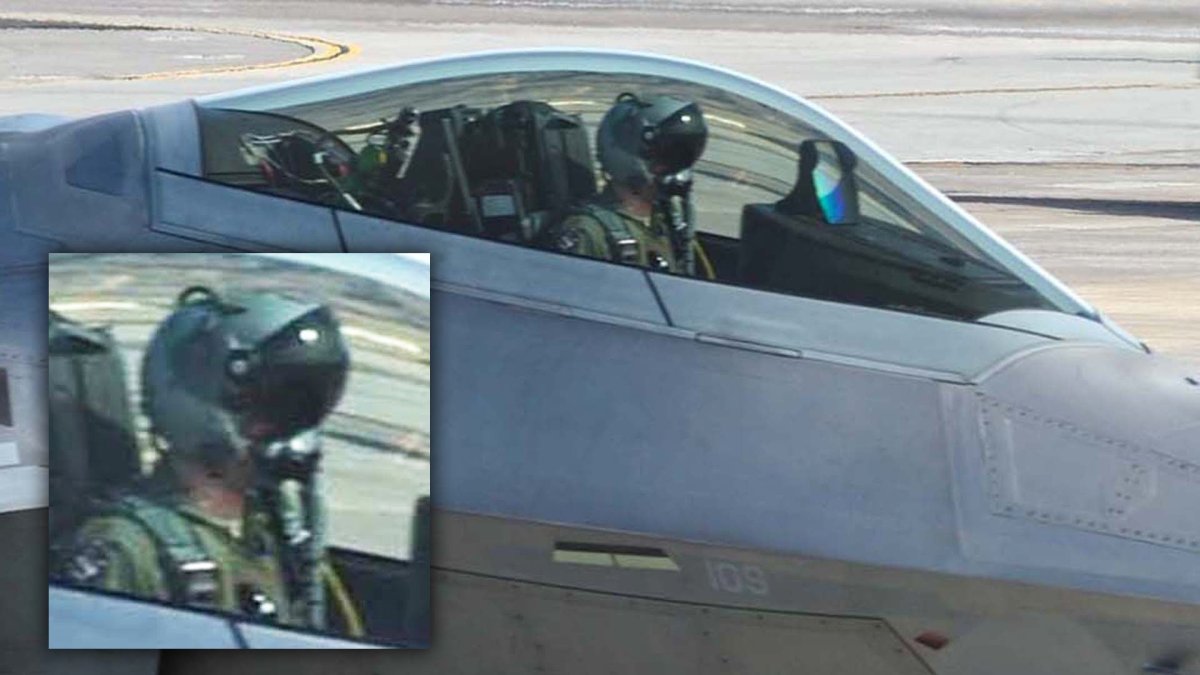
The War Zone has received an exclusive image that clearly shows a Raptor operational test pilot wearing the Thales Scorpion Helmet-Mounted Display (HMD) in 2014. The photograph was apparently taken at Nellis Air Force Base, Nevada, during the planned test program that was outlined the year before. However, the official results of this evaluation and any further fielding plans remain unknown.
The USAF wanted the F-22 to have an HMD by 2020 to tie in with weapons upgrades. Although pilots were reportedly impressed with Scorpion, unknown issues kept it from being deployed across much of the relatively small F-22 fleet .
The Scorpion HMD system fits onto the Raptor pilot’s existing helmet, adding a “monocle” in front of one eye to display high-definition color symbology. Unlike early iterations of the widely adopted Joint Helmet Mounted Cuing System JHMCS, it is adaptable to night vision goggles. These fit in front of the eyepiece so the pilot can still see the data it displays in darkness. The modification also adds a somewhat domed visor, which does appear rather large under the Raptor’s sleek canopy. Judging by the image, it seems the increased size of the helmet might have impedeed the pilot’s ability to look round at extreme angles in the rear hemisphere.
A frontal view of an F-22A Raptor., Jamie Hunter
As noted earlier, the Raptor was always intended to have an HMD. Although leveraging such a system for short-range air-to-air missile targeting has been standard fare for Russian fighters for decades, it wasn’t until the mid-2000s when the F-15 Eagle combined the Joint Helmet Mounted Cueing System (JHMCS) with the high-off-boresight capabilities of the AIM-9X Sidewinder that the USAF was able to employ such a capability. Since then it has become widespread across the Air Force and Navy tactical jet inventories.
Modern fighter pilots are bombarded with a wealth of information from the aircraft’s various sensors. Being able to stay “heads-up,” looking out of the cockpit, and monitoring critical flight information and targeting data, is a valuable part of overall situational awareness.
It is well known that attempts to magnetically “map” the F-22’s cockpit for JHMCS proved problematic, with low-observable treatments and other cockpit design elements hampering its integration. As F-22 procurement was slashed from 750 aircraft to just 187 production Raptors, the fighter became a lower priority for the Pentagon, especially as the larger and export-capable F-35 program grew in stature. Despite the Raptor exhibiting blistering performance in aerial engagements during exercises, funding for upgrades had to be rationed.
Meanwhile, most other tactical fighters in the U.S. inventory were receiving HMDs, initially JHMCS, and those not selected for this system subsequently began receiving the Scorpion system. It was initially fielded in the A-10C Thunderbolt II , and later in earlier-Block F-16C/Ds belonging to the Air National Guard and Reserve.
An A-10C pilot wearing a Scorpion HMD., Jamie Hunter
Meanwhile, F-22 upgrades became focused on its secondary air-to-ground capability amid a need to give the Raptor more diverse capabilities and not just focused on the air-to-air role. Increment 3.1 in 2011 added “Global Strike” capabilities, with provision for the GBU-39/B Small Diameter Bomb.
Increment 3.2A added a range of combat identification improvements and a receive-only mode for the Link-16 data link. However, the follow-on 3.2B was focused on improved air-to-air missiles via the short-range AIM-9X and AIM-120D Advanced Medium-Range Air-to-Air Missile (AMRAAM).
The USAF made significant ovation when the F-22 received the AIM-9X , which was a long-overdue upgrade over the AIM-9M that it previously carried. However, the lingering lack of an HMD meant Raptor pilots were unable to leverage the missile’s high-off-boresight abilities beyond using the radar alone to direct the missile’s seeker. Despite the Raptor’s impressive thrust-vectoring maneuverability, the ability to target enemy aircraft at short range without having to point the jet’s nose at them can mean the difference between winning and losing in a dogfight. The HMD also increases situational awareness dramatically for the pilot.
An AIM-9X loaded on an F-22A., Jamie Hunter
“ Thrust vectoring gives you the ability to point, but it doesn’t mean you’re automatically going to win,” an F-22 Weapons Officer told The War Zone .
The F-22’s strength starts with its prowess in beyond-visual-range (BVR) air combat — killing an enemy aircraft at long range. However, modern aerial engagements often require visual identification of the target before firing due to rules of engagement to mitigate the chance of killing a friendly asset. Moreover, an F-22 only carries six long-range AIM-120s, and therefore could easily be overwhelmed by enemy mass. Faced with a large formation of opposing fighters, “leakers” could potentially get past the barrage of long-range missiles and into close-quarters air combat. Moreover, the increasing use of modern infrared search and track (IRST) systems means the stealthy Raptor cannot count on the element of surprise.
The Raptor’s stealth, high-situational awareness, and blistering performance are a clear advantage. Theoretically, an adept F-22 pilot should be able to sneak up on an enemy aircraft and deliver a knockout punch without the opponent ever knowing it was there. But, as laid out above, that isn’t always the case and the possibility of getting into that close-in dogfight means that a surprisingly high emphasis is placed on this type of training at operational F-22 squadrons.
Slowing down to point the jet’s nose is a classic Achilles’ heel and risks potential attack. Maintaining a high energy state is key in multi-aircraft close-range engagements. While the thrust vectoring clearly has its uses in close-range air combat, being able to out-turn the enemy, and bring legacy air-to-air missiles and the gun to bear, the lack of HMD remains a critical deficiency now that the AIM-9X is integrated onto the jet.
The first guided launch of an AIM-9X from an F-22 Raptor was completed on February 26, 2015, by Maj Christopher Guarente., Lockheed Martin/David Henry
The F-22 first fielded the AIM-9X under Update 5 after a lengthy and drawn-out test program. This was an interim upgrade ahead of the full Increment 3.2B. While it provided the Raptor with an off-boresight close-in capability, it cannot be used to its full potential without a helmet cueing system.
“We have AIM-9X on the jet now, which is a great improvement, but we would love to have a helmet [mounted cueing system],” one Raptor pilot told The War Zone . “It’s more critical for our fourth-generation colleagues than it is for the Raptor, because typically I can arrive in the bandit’s six o’clock undetected.”
Another admitted the F-22 remains at a disadvantage under some circumstanced in the close fight due to the lack of helmet sight. “We are not equal to the threat in that environment.”
An F-22A with an AIM-9M extended out of the side weapons bay door., Jamie Hunter
As we mentioned earlier, without an HMD, the F-22 must rely on its radar to provide cueing and telemetry to AIM-9X’s Block II missile’s data-link in what is called “helmetless high off bore-sight” (HHOBS). So instead of the helmet providing the targeting info, the radar does. This has some great advantages and severe limitations, but suffice it to say the F-22 is unable to take full advantage of the missile’s engagement envelope without the pilot wearing an HMD. You can read more about the whole F-22 helmet-mounted display and AIM-9X saga in this past feature of ours.
A recent Air National Guard report entitled “Weapons Systems Modernization Priorities” states: “Multiple simulations and an operational utility assessment conducted by the 422nd Test and Evaluation Squadron demonstrated that using an HMD provides a distinct first- shot, first-kill advantage. Although this advantage applies primarily to within-visual-range engagements, the HMD also substantially increases situational awareness during beyond-visual- range intercepts.”
Various efforts have been ongoing since 2015 towards finally giving the F-22 an HMD by this year, however, none have come to fruition. Studies are reported to include options for an all-new helmet, which could see a “toned-down” version of the F-35’s HMD being adopted. We are not aware of any progress in fielding such a system at this time.
It is incredible that the world’s most expensive fighter aircraft, a thoroughbred design built to absolutely dominate air-to-air combat, still lacks a capability that is so prevalent in other types, especially when considering how the USAF relies so heavily on a small fleet of Raptors for air supremacy.
Contact the author: jamie@thedrive.com
Comments couldn’t be loaded. Please refresh the page.
更新于美国东部时间2020年11月27日下午6:34
在讨论现代空对空战斗机时,美国空军的F-22A“猛禽”战斗机通常被赞誉有加,然而时至今日,其飞行员仍然没有佩戴头盔显示器——这甚至是一些级别较低的战斗机的现代标准配置之一。由于时间、成本和集成方面的障碍,头盔显示器最初被从项目需求中移除。2013年,美国空军曾公开讨论过为该战机升级头盔显示器的计划,但作战中队至今仍未收到该系统。
《战区》独家获得一张照片,照片清晰地显示一名猛禽战斗机试飞员在2014年佩戴了泰雷兹蝎式头盔显示器(HMD)。这张照片显然是在内华达州内利斯空军基地拍摄的,当时正值前一年制定的测试计划期间。然而,此次评估的官方结果以及任何后续部署计划仍未可知。
美国空军希望F-22战机在2020年前配备头盔显示器(HMD),以配合武器升级。虽然据报道飞行员对“蝎子”头盔显示器印象深刻,但由于一些未知问题,它未能部署到规模相对较小的F-22机队中。
蝎式头盔显示器(HMD)系统可安装在猛禽战机飞行员现有的头盔上,在飞行员的一只眼睛前方增加一个“单片眼镜”,用于显示高清彩色符号。与早期广泛采用的联合头盔瞄准系统(JHMCS)不同,该系统可兼容夜视镜。夜视镜安装在目镜前方,使飞行员即使在黑暗中也能看清显示的数据。此外,该系统还增加了一个略呈拱形的面罩,在猛禽战机流线型的座舱盖下显得相当大。从图片来看,头盔尺寸的增加似乎会影响飞行员向后半球进行大角度观察的能力。
F-22A猛禽战斗机的正面照片。(杰米·亨特摄)
如前所述,猛禽战斗机从一开始就被设计配备头盔显示器(HMD)。虽然利用此类系统进行短程空空导弹瞄准对俄罗斯战斗机而言已是数十年来的标配,但直到2000年代中期,F-15鹰式战斗机将联合头盔瞄准系统(JHMCS)与AIM-9X响尾蛇导弹的高离轴角能力相结合,美国空军才得以运用这种能力。此后,这项技术已在空军和海军的战术喷气式飞机中得到广泛应用。
现代战斗机飞行员会接收到来自飞机各种传感器的海量信息。保持“抬头观察”,即透过座舱观察并监控关键的飞行信息和目标数据,是整体态势感知的重要组成部分。
众所周知,尝试利用磁性方法“绘制”F-22战机座舱图以配合联合头戴式显示器控制系统(JHMCS)的实施,由于低可探测性处理和其他座舱设计元素的阻碍,最终以失败告终。随着F-22采购数量从750架锐减至仅187架量产型“猛禽”战机,五角大楼对这款战机的优先级降低,尤其是在规模更大、具备出口能力的F-35项目日益壮大的情况下。尽管“猛禽”战机在演习中的空战表现十分出色,但用于升级的资金却不得不加以限制。
与此同时,美国现役的大多数其他战术战斗机都开始装备头盔显示器(HMD),最初是联合头盔瞄准系统(JHMCS),而那些未被选中装备该系统的战机随后开始装备“蝎子”系统。该系统最初装备于A-10C“雷电II”攻击机,后来又装备于国民警卫队和预备役部队早期批次的F-16C/D战斗机。
一名佩戴蝎式头戴式显示器的A-10C飞行员,杰米·亨特
与此同时,F-22的升级重点转向了其辅助的空对地攻击能力,因为需要赋予猛禽战斗机更多样化的作战能力,而不仅仅局限于空对空作战。2011年的3.1版本升级增加了“全球打击”能力,并预留了使用GBU-39/B小直径炸弹的空间。
3.2A 版本增加了一系列作战识别改进功能,并为 Link-16 数据链增加了仅接收模式。然而,后续的 3.2B 版本则专注于通过短程 AIM-9X 和 AIM-120D 先进中程空空导弹 (AMRAAM) 来改进空空导弹。
当F-22战斗机换装AIM-9X导弹时,美国空军欢呼雀跃,这标志着F-22对之前使用的AIM-9M导弹进行了期待已久的升级。然而,由于一直缺少头盔显示器(HMD),猛禽战斗机的飞行员无法充分利用该导弹的高离轴角能力,只能依靠雷达引导导弹的导引头。尽管猛禽战斗机拥有令人印象深刻的推力矢量机动能力,但在近距离无需将机头对准敌机的情况下锁定目标的能力,往往是空战胜负的关键。此外,头盔显示器还能显著提升飞行员的态势感知能力。
一枚装载在F-22A上的AIM-9X导弹。——杰米·亨特
“推力矢量控制让你能够瞄准目标,但这并不意味着你一定会赢,”一位 F-22 武器官告诉《战区》杂志。
F-22的优势首先在于其超视距空战(BVR)能力——远距离击落敌机。然而,由于交战规则的限制,现代空战通常需要在开火前目视识别目标,以降低误伤友军的风险。此外,一架F-22仅携带六枚远程AIM-120导弹,因此很容易被敌方数量优势压制。面对庞大的敌方战斗机编队,“漏网之鱼”有可能突破远程导弹的封锁,进入近距离空战。而且,现代红外搜索跟踪(IRST)系统的日益普及意味着,隐身猛禽战机无法再依靠出其不意的优势。
猛禽战机的隐蔽性、高度态势感知能力和卓越的性能是其明显的优势。理论上,一名熟练的F-22飞行员应该能够悄无声息地接近敌机,并在对手毫无察觉的情况下给予致命一击。但是,正如上文所述,实际情况并非总是如此,近距离空战的可能性意味着作战F-22中队对这类训练的重视程度远超预期。
减速以调整机头指向是该机型的经典弱点,容易招致攻击。在多机近距离交战中,保持高能量状态至关重要。虽然推力矢量控制在近距离空战中显然有用,例如能够使飞机转向超过敌机,并使传统的空空导弹和机炮发挥作用,但随着AIM-9X导弹集成到该机型上,缺少头盔显示器(HMD)仍然是一个关键缺陷。
2015年2月26日,克里斯托弗·瓜伦特少校驾驶F-22猛禽战斗机完成了AIM-9X导弹的首次制导发射。(洛克希德·马丁/大卫·亨利摄)
F-22在经过漫长而繁琐的测试项目后,于第五次升级中首次装备了AIM-9X导弹。这是在完整的3.2B增量升级之前的过渡性升级。虽然它赋予了猛禽战斗机近距离偏离瞄准线作战的能力,但如果没有头盔瞄准系统,就无法充分发挥其潜力。
一位猛禽战斗机飞行员告诉《战区》杂志:“我们现在的战机上配备了AIM-9X导弹,这是一个很大的进步,但我们更希望能够配备头盔瞄准系统。这对于我们的第四代战机同行来说比对猛禽战斗机来说更为重要,因为通常情况下,我可以神不知鬼不觉地从敌机六点钟方向接近目标。”
另一位人士承认,由于缺乏头盔瞄准具,F-22在某些情况下近距离空战中仍然处于劣势。“在那种环境下,我们无法与威胁匹敌。”
一架F-22A战斗机,侧面武器舱门伸出一枚AIM-9M导弹。——杰米·亨特
正如我们之前提到的,如果没有头盔显示器(HMD),F-22 就必须依靠雷达为 AIM-9X Block II 导弹的数据链提供瞄准指示和遥测数据,这种方式被称为“无头盔高离轴瞄准”(HHOBS)。也就是说,目标信息不再由头盔提供,而是由雷达提供。这种方式既有显著优势,也有严重的局限性,但总而言之,如果没有飞行员佩戴头盔显示器,F-22 就无法充分发挥导弹的作战效能。您可以在我们之前的专题文章中了解更多关于 F-22 头盔显示器和 AIM-9X 导弹的故事。
美国空军国民警卫队近期发布的一份题为《武器系统现代化优先事项》的报告指出:“第422测试与评估中队进行的多次模拟和作战效用评估表明,使用头盔显示器(HMD)能够显著提升先发制人、先杀敌的优势。虽然这种优势主要体现在视距内交战中,但HMD也能大幅提高超视距拦截时的态势感知能力。”
自2015年以来,各方一直在努力争取在今年为F-22战斗机配备头盔显示器(HMD),但至今尚未取得任何成果。据报道,相关研究包括一种全新头盔的方案,该方案可能采用F-35头盔显示器的“简化版”。目前我们尚未获悉此类系统在部署方面有任何进展。
令人难以置信的是,世界上最昂贵的战斗机,一款旨在绝对主宰空战的纯种设计,仍然缺乏其他机型普遍具备的能力,尤其考虑到美国空军如此依赖一小队猛禽战斗机来取得空中优势。
联系作者:jamie@thedrive.com
评论加载失败,请刷新页面。