This Kamikaze Impact Mark On A British Cruiser Is A Testament To The Brutality Of The Pacific War这艘英国巡洋舰上的神风特攻队撞击痕迹,是太平洋战争残酷性的明证。
The British cruiser HMS Sussex had a lucky escape on this day in 1945, but others were far less fortunate.
新闻视频
Updated Jul 26, 2021 8:03 PM EDT
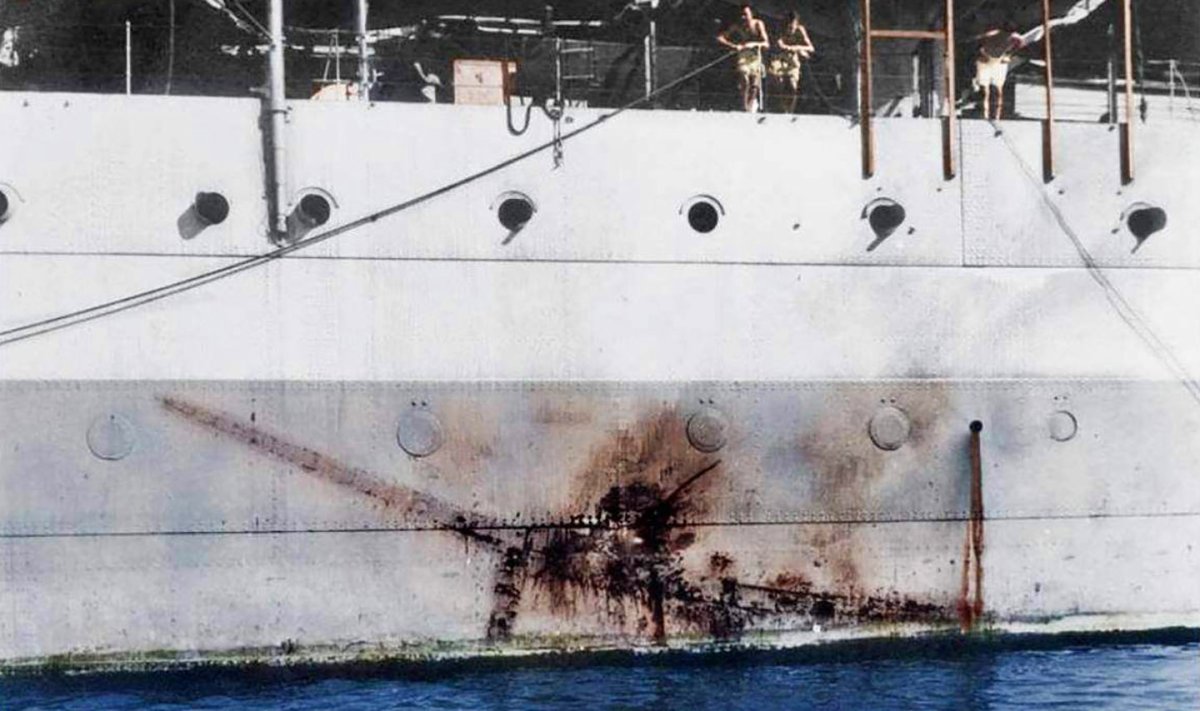
The kamikaze attacks launched by the Imperial Japanese military during the tail-end of the fighting in the Pacific during World War II are justly remembered as some of the most desperate, terrifying tactics employed by any of the combatants during that global conflict. While they inflicted a heavy toll on Allied warships and personnel, they claimed the lives of thousands of Japanese pilots in the process and, of course, failed to turn the tide of the war. One photo, in particular, seems to sum up both the ferocity and the futility of this campaign, showing the telltale silhouette of a Japanese raider that slammed, more or less ineffectively, into the side of a British Royal Navy warship on this day, in 1945.
The remarkable image was taken after the County class heavy cruiser HMS Sussex had been struck by a Mitsubishi Ki-51 — a monoplane light bomber that carried the Allied reporting name Sonia — near the Dutch East Indies on July 26, 1945. This was one of two kamikaze raiders that had attempted to target the ship. This particular aircraft impacted the warship just above the waterline, leaving a near-perfect imprint of its shape, but failed entirely to penetrate the cruiser’s hull or cause any significant damage.
Wearing dazzle paint, the heavy cruiser HMS Sussex anchored in the Firth of Clyde, Scotland, in October 1940., PUBLIC DOMAIN
According to a Tweet today from the U.S. Naval Institute, HMS Sussex was protected by belt armor that was 4.5 inches thick, although other accounts from naval warfare experts point out that the County class did not carry any additional belt armor, as a result of limits placed on protection by interwar naval treaties , with the kamikaze raider instead ultimately being defeated by an inch of steel.
Some reports suggest that the Ki-51 may have come in so low that it bounced off the top of the waves before impact, with the result that its velocity was significantly reduced. While the aircraft utilized a mainly metal construction, with fabric-covered control surfaces, its overall mass was fairly light, with a maximum takeoff weight of fewer than 6,500 pounds.
Contemporary accounts indicate it wasn’t even initially clear which aircraft type had been responsible, suggesting there was very little left in the way of wreckage. One after-action report describes HMS Sussex being attacked by a Val — the codename for an Aichi D3A dive-bomber. The aircraft “was sighted approaching from the starboard beam, flying straight and at about deck level, heading for the after superstructure. He was engaged by the close-range armament and was shot down in flames, the pilot being seen to throw up his hands before the aircraft finally crashed, hitting the ship’s side abreast the mainmast.”
This same account goes on to detail the damage to the warship — an eight-foot split in the side plating located around 8 feet above the waterline, and some minor distortion to panels on the hull.
Being shot down by the warship’s anti-aircraft defenses was by no means an unusual fate for the suicide raiders.
Of course, the Sonia would have been armed with explosives as well — this adapted light bomber could carry up to around 550 pounds of bombs for kamikaze operations. But these clearly didn’t detonate, and they may well have been torn off the aircraft once it first impacted the water.
An Imperial Japanese Army Air Force Mitsubishi Ki-51., U.S. Navy
The War Zone spoke to Mike Yeo, author of Desperate Sunset: Japan’s kamikazes against Allied ships, 1944–45 , who has identified the particular unit from which the Ki-51 was drawn. This was an Imperial Japanese Army Air Force training establishment based in northern Malaya, where it was preparing to try and repulse an expected Allied invasion of Malaya and Singapore, and it was involved in several waves of attacks against Allied warships on the 26th.
In Yeo’s account, it was the first Ki-51 that was successfully shot down by the anti-aircraft guns on Sussex , while the second managed to press home its attack, striking the vessel and leaving its imprint on its hull. His findings include reports of “dents, scrapes, and scorch marks on the side of its hull,” together with the possibility, at least, that the aircraft’s fixed undercarriage impacted the water prior to impact.
A colorized image of the kamikaze impact on HMS Sussex :
That there is still some confusion surrounding the exact sequence of events of the attack on HMS Sussex is hardly surprising, given the chaos of a kamikaze raid.
While this particular suicide raider was unsuccessful, it’s worth noting, too, that another Sonia pressed home its attack on the Royal Navy minesweeper HMS Vestal on the same day, causing critical damage and killing 20 of the ship’s crew. This would be the last British naval vessel to be lost to enemy action during World War II.
HMS Vestal , the victim of a successful kamikaze attack on the same day., PUBLIC DOMAIN
In another strange twist to the HMS Sussex ’s campaign, one sailor, George Coyne, later recalled that a Japanese ship was sunk, too, leaving around 20 survivors in the water. “One of our ships, at great risk to themselves, stopped to rescue them,” Coyne said, “Without exception, they refused help and so drowned.”
Less than a month after the attack, Japan had surrendered, the commander of the Japanese garrison in Singapore, General Seishirō Itagaki, signing the surrender documents on behalf of the army aboard the Sussex on September 5, 1945.
General Itagaki signs surrender documents onboard HMS Sussex ., PUBLIC DOMAIN
“Thank God for the bomb ,” Coyne wrote in his diary at the time. “We should now get home safely.”
As it is, this haunting image from the attack on HMS Sussex stands testimony to the brutality of the Pacific campaign and the fine line between those ships that survived to fight another day, and those that would not.
With thanks to Mike Yeo, who you can follow on Twitter here .
Contact the author: thomas@thedrive.com
Comments couldn’t be loaded. Please refresh the page.
更新于美国东部时间2021年7月26日晚上8:03
二战太平洋战争末期,日本帝国军发动的神风特攻队袭击,被公认为是这场全球冲突中交战各方所采用的最绝望、最恐怖的战术之一。尽管这些袭击给盟军的军舰和人员造成了惨重损失,但也夺去了数千名日本飞行员的生命,当然,最终也未能扭转战局。有一张照片似乎完美地诠释了这场袭击的残酷与徒劳:照片中,一架日本袭击机的轮廓清晰可见,它于1945年的某一天,几乎毫无效果地撞击了一艘英国皇家海军军舰的侧舷。
这张非凡的照片拍摄于1945年7月26日,地点是荷属东印度群岛附近海域。当时,英国皇家海军“苏塞克斯”号郡级重巡洋舰遭到一架三菱Ki-51单翼轻型轰炸机的袭击。这架轰炸机是两架试图袭击该舰的神风特攻队飞机之一。这架飞机撞击了军舰水线以上的部分,留下了近乎完美的弹痕,但并未完全穿透巡洋舰的船体,也没有造成任何重大损坏。
1940年10月,涂有眩目迷彩的重型巡洋舰“苏塞克斯”号停泊在苏格兰克莱德湾。(公共领域)
根据美国海军学会今天发布的一条推文,苏塞克斯号战列舰的舷侧装甲厚度为 4.5 英寸,但其他海军作战专家的说法指出,由于两次世界大战之间的海军条约对防护的限制,郡级战列舰没有配备任何额外的舷侧装甲,最终神风特攻队袭击者被一英寸厚的钢板击败。
一些报告指出,Ki-51战斗机可能以极低的高度飞入海面,在撞击前曾从浪尖弹开,导致速度显著降低。虽然该机主要采用金属结构,控制面则覆盖织物,但其整体重量相当轻,最大起飞重量不足6500磅。
当时的记载表明,最初甚至无法确定是哪种型号的飞机发动了袭击,这意味着残骸所剩无几。一份事后报告描述了“苏塞克斯”号巡洋舰遭到一架“瓦尔”(Val,爱知D3A俯冲轰炸机的代号)的攻击。报告称,这架飞机“从右舷接近,直线飞行,高度与甲板齐平,目标是后部上层建筑。它遭到近程火力攻击,被击落并燃起熊熊大火。人们看到飞行员在飞机最终坠毁前举起了双手,飞机最终撞上了主桅旁边的船舷。”
该报道还详细描述了军舰的损坏情况——水线以上约 8 英尺处的侧板出现了一道 8 英尺长的裂缝,船体面板也出现了一些轻微的变形。
被军舰的防空系统击落,对于自杀式袭击者来说绝非罕见的命运。
当然,“索尼娅”号也肯定携带了炸药——这架改装的轻型轰炸机最多可携带约550磅炸弹用于神风特攻队行动。但这些炸弹显然没有引爆,很可能在飞机首次撞击水面时就被扯掉了。
日本帝国陆军航空队的三菱Ki-51战斗机,美国海军
《战区》采访了《绝望的日落:日本神风特攻队对盟军舰艇的攻击,1944-45》一书的作者迈克·叶奥,他指出了Ki-51所属的具体部队。该部队是位于马来亚北部的一个日本帝国陆军航空兵训练基地,当时正准备抵御盟军对马来亚和新加坡的入侵,并参与了11月26日对盟军军舰艇的多波攻击。
根据叶奥的描述,第一架Ki-51战斗机被“苏塞克斯”号上的防空炮成功击落,而第二架则继续攻击,击中了该舰并在船体上留下了痕迹。他的发现包括“船体侧面有凹痕、刮痕和烧焦痕迹”的报告,以及至少存在这样一种可能性:飞机的固定起落架在撞击前曾触及水面。
一张彩色照片,展现了神风特攻队撞击苏塞克斯号巡洋舰的情景:
考虑到神风特攻队的袭击造成的混乱,对于苏塞克斯号战舰遇袭事件的确切经过仍然存在一些困惑,这并不奇怪。
虽然这次自杀式袭击并未成功,但值得注意的是,同一天,另一艘索尼亚号潜艇对英国皇家海军扫雷舰“维斯塔尔”号发动了猛烈攻击,造成该舰严重受损,并导致20名船员丧生。这将是二战期间英国海军最后一艘因敌方行动而沉没的舰艇。
同一天,皇家海军“维斯塔尔”号驱逐舰也遭遇了神风特攻队的成功袭击。(公共领域)
在苏塞克斯号战列舰的战役中,还有另一件令人匪夷所思的事。一名水手乔治·科因后来回忆说,一艘日本船只也被击沉,约有20名幸存者落水。“我们的一艘船冒着生命危险停下来营救他们,”科因说,“但他们无一例外地拒绝了救援,最终溺水身亡。”
袭击发生不到一个月后,日本就投降了。1945 年 9 月 5 日,驻新加坡日本守备队司令官板垣征四郎将军在苏塞克斯号军舰上代表军队签署了投降文件。
板垣将军在苏塞克斯号巡洋舰上签署投降文件。(公共领域)
“感谢上帝赐予我们这颗炸弹,”科因当时在日记中写道,“我们现在应该可以安全回家了。”
这张来自苏塞克斯号战舰遇袭的令人难忘的照片,见证了太平洋战争的残酷,以及那些幸存下来继续战斗的战舰与那些最终覆灭的战舰之间那条微妙的界限。
感谢Mike Yeo,你可以在这里关注他的推特账号。
联系作者:thomas@thedrive.com
评论加载失败,请刷新页面。