Europeans trumpet Arctic defense in bid to soften US Greenland claims欧洲人高调宣扬北极防御,试图削弱美国对格陵兰岛的主权声索。
To many Europeans, the most urgent threat to Greenland right now seems not to be China, Russia or North Korea but rather their longtime U.S. ally.
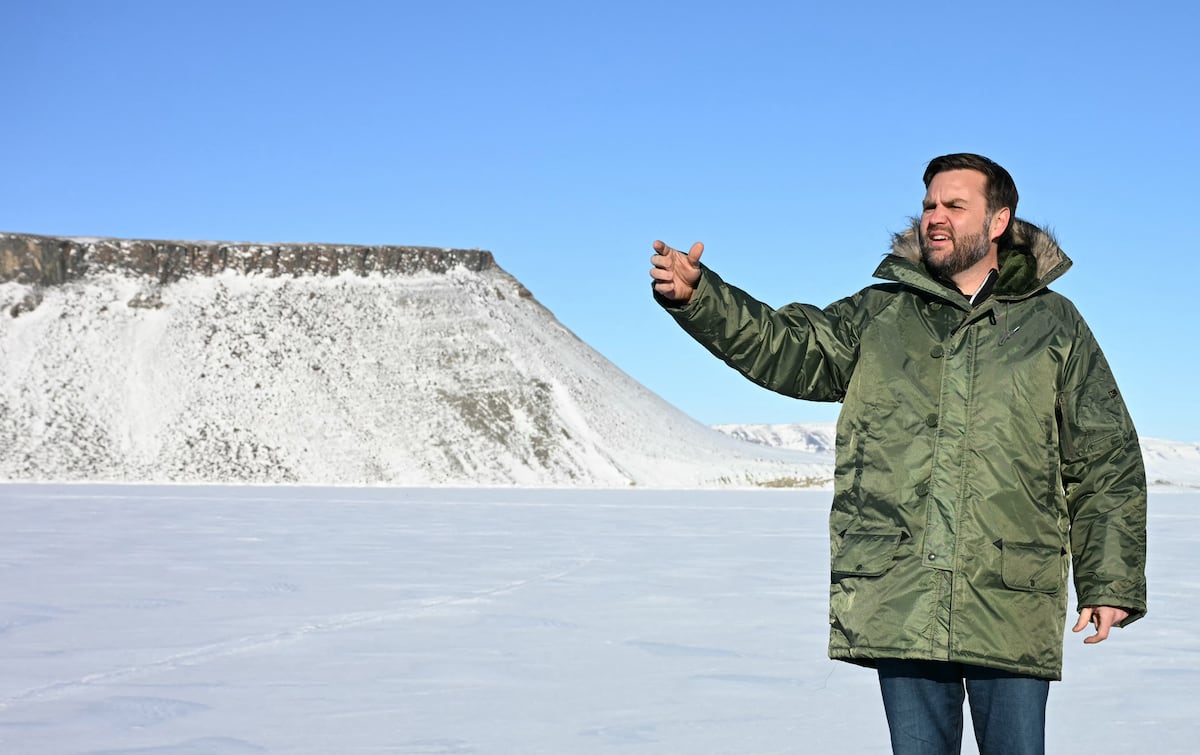
BERLIN — European NATO nations have vowed to strengthen their contributions to Arctic defense, with Greenland front and center.
Governments here are pouncing on an opening in the rhetoric from the White House, where Vice President J.D. Vance has presented an ostensible neglect in Europeans securing Greenland as the main driver in the Trump administration’s push to acquire the island, which is a territory of Denmark.
President Donald Trump has repeatedly proffered the idea of the United States taking over Greenland on account of its geostrategic location for U.S. homeland defense, by military force if necessary − a move that would be unprecedented among NATO alliance members.
New efforts by governments here now seem to be aimed at boosting Europe’s and Denmark’s footprint in and around Greenland in the spirit of assuaging U.S. concerns, effectively giving the American partner no reason for going rogue.
Talk has been loud among European policy elites that a NATO Arctic mission modeled on the alliance’s Baltic Sentry project might be forthcoming. The idea has been discussed by top-level officials from Germany, the U.K., France, Belgium and other European NATO countries, mostly behind closed doors. Belgian Defense Minister Theo Francken was the first official to publicly call for the creation of such a mission earlier this month.
Germany’s counterpart, Boris Pistorius, announced prospects for a stronger European NATO presence in the Arctic on Jan. 13 during a meeting with EU foreign policy and defense chief Kaja Kallas in Berlin. He specifically referenced a possible NATO mission called “Arctic Sentry,” though he cautioned that this would require a NATO framework and “that cannot be ready in the next four weeks or, in my estimation, even three months,” he said.
Until then, he said, key European NATO nations agreed they will need to send clear signals that the continent was stepping up to better defend the Arctic territory together with the U.S.
The U.S. military already has a base on Greenland, currently housing 150 troops in Pituffik who are mainly devoted to ballistic missile early warning and space surveillance. That number is down from well over a thousand troops previously deployed under a still-valid contract with Denmark that has allowed Washington to establish bases and move military assets at will on the Arctic Island since 1951 and for as long as NATO exists.
Alliance officials insist there has been no decision made yet to create an Arctic Sentry mission. Speaking at a Swedish security conference over the weekend, Alexus Grynkewich, NATO’s Supreme Allied Commander Europe, said that while all Arctic operations had been merged under Joint Force Command Norfolk last month, it was premature to assume that the alliance would launch a dedicated mission.
Despite the newfound urgency from European capitals, Arctic defense is hardly new on the radar of treaty organization officials, with the region’s existing and growing strategic importance being well-known for decades and NATO forces working in and around Greenland since the Cold War.
In that vein, NATO had a “very good discussion” on the topic of Arctic security in the summer of last year, and the alliance is now working on the next steps, NATO Secretary General Mark Rutte said at the Global Europe Forum in Brussels on Jan. 13. He said security in the high north was already raised by Trump in his first term, with sea lanes opening up, and Russia and China being more active.
“It’s not for peaceful purposes, they’re not studying the seals and the polar bears,” Grynkewich said, referring to Russian and Chinese vessels in the area. “They’re out there doing bathymetric surveys and trying to figure out how they can counter NATO capabilities on and under the sea. So that’s something that could grow very quickly, and we need to be mindful of it and ready.”
“In NATO, we all agree that when it comes to the protection of the Arctic, we have to work together, and that’s exactly what we are doing,” Rutte said. That goes beyond the seven NATO members that border the Arctic, he noted, citing comments by the United Kingdom and Germany on their willingness to keep the region safe.
Rutte also cited Denmark’s investment in Boeing P-8 maritime patrol aircraft, long-range drones, F-35s and air-to-air refueling, saying all of those are capabilities for defending the country, NATO and the Arctic region as a whole.
Any NATO presence in the region would include a package combining manned platforms, such as frigates, with unmanned technologies like drones, a NATO official told Defense News on Tuesday, speaking on the condition of anonymity. However, the official noted that integrating these types of technologies in the harsh conditions found in an Arctic environment will be significantly more challenging than in the Baltic or Mediterranean seas.
Meanwhile, one Danish lawmaker challenged Trump’s characterization of threats to Greenland, specifically refuting his claims about Chinese and Russian ships in the region. The pushback by Stine Bosse, a Danish member of the European Parliament, centers on Trump’s Jan. 11 statement that Greenland “is covered with Russian and Chinese ships all over the place.”
In conversation with Mark Rutte days later, Bosse said there was “not one single Chinese or Russian ship around Greenland, let that be stated as a fact.”
One of the Trump administration’s key talking points to justify its threats to seize Greenland has been that Denmark is unable to adequately defend its autonomous territory in the high north.
To many Europeans, the most urgent threat to Greenland right now seems not to be China, Russia or North Korea but rather their longtime ally in the form of the United States.
The people of Greenland are “scared stiff, they’re stressed and they’re more than just worried,” Bosse told Rutte in Brussels. And they overwhelmingly reject annexation by the United States: A mere six percent of Greenlanders were in favor when asked in an early 2025 poll .
“Nothing about Greenland without Greenland,” Greenland’s Foreign Minister Vivian Motzfeldt told reporters while speaking in Denmark earlier this week. And Greenland has chosen to side with Denmark, in no uncertain terms.
“We are now facing a geopolitical crisis, and if we have to choose between the United States and Denmark here and now, we choose Denmark,” Greenland’s prime minister Jens-Frederik Nielsen said while speaking alongside Danish prime minister Mette Frederiksen on Tuesday. “We choose NATO. We choose the Kingdom of Denmark. We choose the EU,” he added.
Speaking in Berlin yesterday, the EU foreign policy chief Kaja Kallas suggested there were ongoing discussions behind closed doors on what concrete measures were available to counter the threats from the United States.
“The least we can say is that would be a really unprecedented situation in the history of NATO and the history of any defense alliance in the world,” added Pistorius, referring to a situation in which the Trump administration would follow through and take over Greenland one way or another.
And while the 1951 agreement between Washington and Copenhagen on U.S. troops on the island remains active, so too is a Danish standing order from the same period that requires the country’s troops to open fire even without orders if foreign troops were to try and capture Greenland.
Linus Höller is Defense News' Europe correspondent and OSINT investigator. He reports on the arms deals, sanctions, and geopolitics shaping Europe and the world. He holds master’s degrees in WMD nonproliferation, terrorism studies, and international relations, and works in four languages: English, German, Russian, and Spanish.
Rudy Ruitenberg is a Europe correspondent for Defense News. He started his career at Bloomberg News and has experience reporting on technology, commodity markets and politics.
Elisabeth Gosselin-Malo was a Europe correspondent for Defense News. She covers a wide range of topics related to military procurement and international security, and specializes in reporting on the aviation sector. She is based in Milan, Italy.
柏林——欧洲北约国家誓言要加强对北极防御的贡献,格陵兰岛是其中的核心。
这里各国政府正抓住白宫言论中的一个漏洞,副总统 JD Vance 将欧洲人对确保格陵兰岛的利益漠不关心作为特朗普政府推动获取该岛(丹麦领土)的主要驱动力。
唐纳德·特朗普总统曾多次提出美国接管格陵兰岛的想法,理由是格陵兰岛具有重要的地缘战略意义,有利于美国本土防御,必要时可动用武力——此举在北约成员国中将是前所未有的。
目前各国政府似乎正努力扩大欧洲和丹麦在格陵兰岛及其周边地区的影响力,以缓解美国的担忧,从而有效地让美国伙伴没有理由采取不正当行动。
欧洲政策精英圈内盛传,北约可能会效仿其波罗的海哨兵计划,在北极地区设立一项类似任务。德国、英国、法国、比利时和其他欧洲北约国家的高级官员都曾讨论过这一想法,但大多是在闭门会议中进行的。比利时国防部长西奥·弗兰肯本月初率先公开呼吁设立这样一项任务。
德国外长鲍里斯·皮斯托瑞斯1月13日在柏林与欧盟外交与国防事务负责人卡娅·卡拉斯会晤时,宣布了加强北约在北极地区存在的可能性。他特别提到了一项名为“北极哨兵”的北约任务,但他同时指出,这需要北约框架,“而且据我估计,这在未来四周内,甚至三个月内都无法完成。”
他表示,在此之前,欧洲主要北约国家一致认为,它们需要发出明确信号,表明欧洲大陆正在与美国一道,加大力度保卫北极地区。
美国军方在格陵兰岛已设有一个基地,目前在皮图菲克驻扎着150名士兵,主要负责弹道导弹预警和太空监视。这一数字较之前根据与丹麦签订的、至今仍然有效的合同部署的1000多名士兵有所下降。该合同自1951年以来一直允许华盛顿在北极岛屿上建立基地并随意调动军事资产,只要北约存在,该合同就一直有效。
北约官员坚称,尚未决定设立北极哨兵任务。北约欧洲盟军最高司令亚历克西斯·格林克维奇周末在瑞典举行的一次安全会议上表示,虽然所有北极行动已于上月合并至诺福克联合部队司令部,但现在就断言北约会启动一项专门的任务还为时过早。
尽管欧洲各国首都表现出了新的紧迫感,但北极防御对于条约组织官员来说并非新鲜事,该地区现有的和日益增长的战略重要性几十年来众所周知,北约部队自冷战以来就在格陵兰岛及其周边地区开展行动。
北约秘书长马克·吕特1月13日在布鲁塞尔举行的全球欧洲论坛上表示,北约去年夏天就北极安全问题进行了“非常好的讨论”,目前北约正在制定下一步措施。他还表示,特朗普在其第一任期内就已经提高了北极地区的安全问题关注度,因为海上航道已经开放,俄罗斯和中国也变得更加活跃。
格林克维奇说:“他们的目的并非和平,他们不是在研究海豹和北极熊。”他指的是该地区的俄罗斯和中国船只。“他们在那里进行水深测量,试图弄清楚如何对抗北约在海上和水下的能力。所以这种情况可能会迅速发展,我们需要对此保持警惕并做好准备。”
“在北约内部,我们一致认为,在保护北极方面,我们必须携手合作,而我们也正是这样做的,”吕特说道。他指出,这种合作不仅限于与北极接壤的七个北约成员国,并援引英国和德国此前发表的关于维护该地区安全的声明。
吕特还提到丹麦投资了波音 P-8 海上巡逻机、远程无人机、F-35 战斗机和空中加油技术,称所有这些都是为了保卫国家、北约和整个北极地区。
一位不愿透露姓名的北约官员周二告诉《防务新闻》,北约在该地区的任何存在都将包括一个结合有人平台(例如护卫舰)和无人技术(例如无人机)的方案。然而,这位官员指出,在北极恶劣的环境下整合这些技术将比在波罗的海或地中海更具挑战性。
与此同时,一位丹麦议员对特朗普关于格陵兰岛面临威胁的描述提出质疑,尤其驳斥了他关于该地区有中国和俄罗斯船只的说法。这位名叫斯蒂娜·博斯的丹麦籍欧洲议会议员的反驳主要针对特朗普1月11日发表的言论,即格陵兰岛“到处都是俄罗斯和中国的船只”。
几天后,博斯在与马克·吕特的谈话中表示,“格陵兰岛附近没有一艘中国或俄罗斯的船只,这可以作为事实陈述。”
特朗普政府为威胁吞并格陵兰岛辩护的一个关键论点是,丹麦无法充分保卫其位于北极地区的自治领土。
对许多欧洲人来说,格陵兰岛目前面临的最紧迫的威胁似乎不是中国、俄罗斯或朝鲜,而是它们的长期盟友美国。
博斯在布鲁塞尔告诉吕特,格陵兰人民“吓坏了,他们压力很大,而且不仅仅是担忧”。他们绝大多数反对美国吞并格陵兰:在2025年初的一项民意调查中,只有6%的格陵兰人表示赞成。
“没有格陵兰,就谈不上格陵兰,”格陵兰外交大臣薇薇安·莫茨费尔特本周早些时候在丹麦对记者表示。格陵兰已明确选择与丹麦站在一起。
“我们现在正面临地缘政治危机,如果此时此刻必须在美国和丹麦之间做出选择,我们选择丹麦,”格陵兰首相延斯-弗雷德里克·尼尔森周二与丹麦首相梅特·弗雷德里克森一同发表讲话时表示。“我们选择北约。我们选择丹麦王国。我们选择欧盟,”他补充道。
欧盟外交政策负责人卡娅·卡拉斯昨天在柏林发表讲话时表示,欧盟内部正在闭门讨论有哪些具体措施可以应对来自美国的威胁。
皮斯托瑞斯补充说:“至少可以说,这将是北约历史上乃至世界任何防务联盟历史上前所未有的局面。”他指的是特朗普政府无论如何都会采取行动接管格陵兰岛的情况。
虽然华盛顿和哥本哈根于 1951 年就美国军队驻扎格陵兰岛达成的协议仍然有效,但同一时期丹麦的一项常设命令也仍然有效,该命令要求,如果外国军队试图占领格陵兰岛,即使没有命令,丹麦军队也必须开火。
林努斯·霍勒是《防务新闻》的欧洲记者和开源情报调查员。他报道影响欧洲乃至全球的军火交易、制裁和地缘政治。他拥有大规模杀伤性武器不扩散、恐怖主义研究和国际关系三个硕士学位,并精通英语、德语、俄语和西班牙语四种语言。
鲁迪·鲁伊滕贝格是《防务新闻》的欧洲记者。他的职业生涯始于彭博新闻社,拥有报道科技、大宗商品市场和政治方面的经验。
伊丽莎白·戈斯林-马洛曾任《防务新闻》欧洲通讯员。她的报道涵盖军事采购和国际安全等广泛领域,尤其擅长航空领域的报道。她常驻意大利米兰。