Ukraine offers Gulf allies drone defense in bid for scarce Patriot missiles乌克兰向海湾盟国提供无人机防御系统,以换取稀缺的爱国者导弹。
Ukraine is offering what it has learned to do at scale while still scrambling for what it cannot manufacture fast enough.
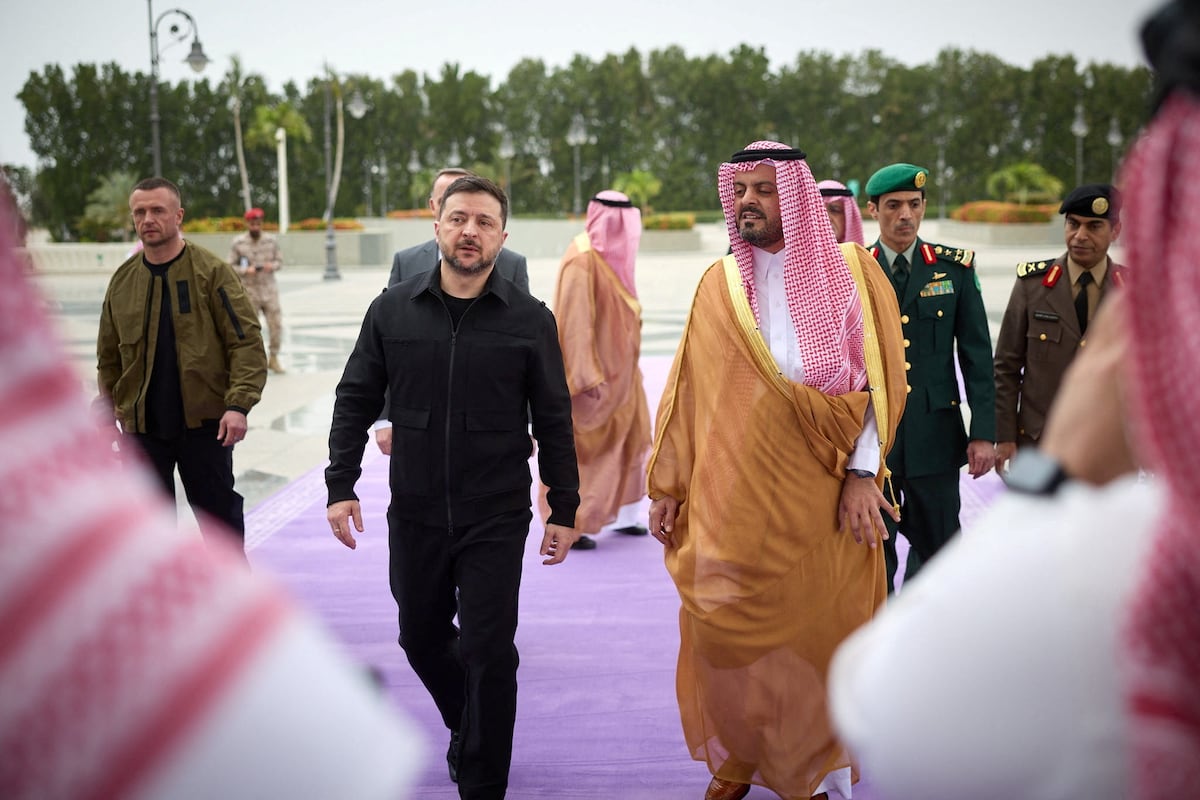
KYIV, Ukraine — After years of trying to stop Iran-designed Shahed drones over its own cities, Ukraine is now sending counter-drone teams to Gulf partners — and pitching the help as a trade between equals.
As the same one-way attack drones ripple across the Middle East, Ukrainian President Volodymyr Zelenskyy says Ukraine has deployed 228 counter-drone specialists across five regional partners — Jordan, Qatar, the United Arab Emirates, Saudi Arabia and Kuwait — to help intercept incoming threats , an expansion up from roughly 201 personnel a week earlier.
Zelenskyy has framed Ukraine’s pitch in explicitly transactional terms: If partners can spare the high-end interceptors Ukraine can’t get in sufficient quantity — Patriot Advanced Capability-3 missiles — Kyiv can help fill the gap with what it can scale faster and cheaper: interceptor drones, plus the crews and tactics that make them work.
“If they give them to us, we will give them interceptors,” Zelenskyy told reporters earlier this month, describing a PAC-3-for-interceptor swap.
He argued Ukraine’s industry could produce around 2,000 interceptor drones per day — a volume that, if it can be sustained, dwarfs the annual output of many premium missile-defense lines, he later said in a speech to the British parliament, per Ukrainska Pravda.
In the first three days of the Iran war, the United States and its Gulf partners burned through more than 800 Patriot interceptors — more than Ukraine got all winter — even as U.S. forces simultaneously struck over 2,000 targets across Iran.
That dual consumption rate is why Kyiv is trying to trade a cheap layer of defense for a scarce one, Ed Arnold, a senior research fellow at the Royal United Services Institute, told Military Times.
Ukraine is offering what it has learned to do at scale — stop drones — while still scrambling for what it cannot manufacture fast enough: the interceptors that matter when the threat is ballistic. Kyiv is trying to turn one shortage into leverage for the other.
PAC-3 interceptors can cost millions of dollars per shot, and production is limited.
The result is triage: Air-defense inventories are being stretched across U.S. forces and partners in the Middle East, Indo-Pacific planning, European requirements and Ukraine — leaving Kyiv stuck at the back of the line for the missiles it needs most.
“Interceptors like Patriot, forget it,” Arnold told Military Times earlier this month.
“The Ukrainians aren’t getting any more now because they’re all going to go to the U.S. military — either Middle East or Taiwan," he said.
“Out of those priorities, Ukraine is at the bottom if you’re the U.S.”
Ukraine’s alternative has become mass producing cheap, expendable drones engineered to last just a single season before replacement by a more advanced iteration for roughly the cost of a used car .
This price curve is why Ukraine’s drone ecosystem has become a strategic commodity just as the Iran conflict has expanded demand for air defense.
Kyiv says it has been fielding dozens of requests from allies for help with interceptor drones specifically, as the Middle East conflict intensifies with drones at its center.
Kyiv’s bet is that being indispensable in the Gulf also exposes it to retaliation from an enemy that has, so far, only helped Russia secondarily.
An Iranian member of parliament said March 14 that Ukraine’s support to Gulf states made it Iran’s “legitimate war target.”
For Kyiv, that kind of warning doesn’t change the logic — it underlines it: The same Shaheds that hit Ukrainian cities are now hitting partners across the Gulf, and Ukraine is betting that helping contain the threat abroad can translate into more protection at home.
The Iran war has also delivered another indirect hit to Ukraine through the disruption in energy markets that has bolstered Russian oil sales — especially after the White House suspended economic sanctions against the Kremlin to ease the crisis.
Brent crude oil has shot above $100 per barrel in recent weeks, up sharply since the war began, and analysts say higher prices expand Russia’s fiscal room to sustain a long war.
A senior official in Kyiv, speaking on condition of anonymity to discuss sensitive negotiations, described the price spike as handing leverage back to Russia, right when the country appeared to have started feeling the economic strain of over four years of all-out war.
“This is throwing a massive lifeline to Putin. He can’t take full advantage yet, but within a couple of months we will see the effect hit Ukraine — and I’m worried it will be negative.”
There are other hurdles to overcome, too.
Although Kyiv may already be producing a surplus of killer flyers, there is still a bureaucratic catch that has plagued the country for years: Ukraine’s wartime export restrictions have not fully kept pace with demand.
Manufacturers are still not permitted to sell abroad without official approval, even as they field inquiries for purchases from dozens of countries.
The deployment of specialists is one way to export capability without exporting hardware — at least until permits and contracts catch up.
Kyiv says neither it nor its partners can afford a symbolic partnership any longer — not as adversaries rearm and air-defense inventories thin.
“Russia is preparing for a broader attack against the alliance in the coming years,” Adm. Pierre Vandier, NATO’s supreme allied commander transformation, said during a recent visit to Kyiv.
He argued that NATO needs to accelerate how fast it turns battlefield lessons into real capability while upping weapons production across the board.
“We are in a moment where we are in a hurry. We need to ramp up this production, and it’s a complex weapon. So it will take some time,” Vandier said.
The problem is not just capability — it is consumption: High-end interceptors are being burned faster than they can be replaced by the West.
That reality is why Arnold argues Washington should treat Ukraine’s defense industry less like a stopgap and more like a capacity it can build up.
“If the U.S. [is] going to not be able to provide any long-range strike in the future, then actually invest in Ukrainian organic production,” he said.
乌克兰基辅——多年来,乌克兰一直试图阻止伊朗设计的“沙赫德”无人机飞越其城市,如今,乌克兰正向海湾伙伴派遣反无人机小组,并将这种帮助包装成平等互助的交换。
随着同样的单向攻击无人机在中东地区蔓延,乌克兰总统泽连斯基表示,乌克兰已向五个地区伙伴——约旦、卡塔尔、阿拉伯联合酋长国、沙特阿拉伯和科威特——部署了 228 名反无人机专家,以帮助拦截来袭威胁,这一规模比一周前的约 201 人有所扩大。
泽连斯基以明确的交易性措辞阐述了乌克兰的提议:如果合作伙伴能够提供乌克兰无法获得足够数量的高端拦截器——爱国者先进能力-3型导弹——基辅就可以用其能够更快、更便宜地扩大规模的产品来填补缺口:拦截无人机,以及使其发挥作用的机组人员和战术。
“如果他们把导弹给我们,我们也会把拦截器给他们,”泽连斯基本月早些时候告诉记者,描述了用PAC-3导弹交换拦截器的情形。
据《乌克兰真理报》报道,他后来在英国议会发表讲话时表示,乌克兰工业每天可以生产约 2000 架拦截无人机——如果能够保持这一产量,那么这个产量将远远超过许多高级导弹防御系统的年产量。
在伊朗战争的头三天,美国及其海湾盟友消耗了 800 多枚爱国者导弹拦截器——比乌克兰整个冬天消耗的还多——与此同时,美军还袭击了伊朗境内的 2000 多个目标。
皇家联合军种研究所高级研究员埃德·阿诺德告诉《军事时报》:“正是由于这种双重消耗率,基辅才试图用廉价的防御层换取稀缺的防御层。”
乌克兰正努力运用其已掌握的大规模拦截无人机技术,同时仍在竭力生产其无法快速制造的拦截弹:在应对弹道导弹威胁时至关重要的拦截弹。基辅正试图将一种短缺转化为另一种短缺的筹码。
PAC-3 拦截器每次发射成本可能高达数百万美元,而且产量有限。
结果是资源分配不均:防空物资被分散到美国在中东的部队和伙伴、印太地区规划、欧洲需求以及乌克兰——导致基辅在最需要的导弹方面被排在最后。
“像爱国者导弹这样的拦截器,想都别想,”阿诺德本月早些时候告诉《军事时报》。
他说:“乌克兰人现在不会再得到任何好处了,因为他们都要去美国军队——要么去中东,要么去台湾。”
“如果美国站在这些优先事项上,乌克兰肯定排在最后。”
乌克兰的替代方案是大规模生产廉价的一次性无人机,这些无人机的设计寿命仅为一个季度,之后会被更先进的版本所取代,而其价格大约相当于一辆二手车。
正是由于这种价格曲线,乌克兰的无人机生态系统才成为一种战略商品,而伊朗冲突也扩大了对防空的需求。
基辅方面表示,随着中东冲突愈演愈烈,无人机成为冲突的核心,盟国已向基辅提出数十项请求,希望获得拦截无人机方面的帮助。
基辅的赌注是,在海湾地区不可或缺的地位也使其容易受到敌人的报复,而迄今为止,这个敌人对俄罗斯的帮助只是次要的。
3月14日,一名伊朗议员表示,乌克兰对海湾国家的支持使其成为伊朗的“合法战争目标”。
对基辅而言,这种警告并不会改变其逻辑,反而会强化这种逻辑:袭击乌克兰城市的“烈士”武装分子现在正在袭击海湾地区的伙伴国,而乌克兰则寄希望于帮助遏制国外的威胁,从而在国内获得更大的保护。
伊朗战争也通过能源市场的混乱给乌克兰带来了另一次间接打击,这提振了俄罗斯的石油销售——尤其是在白宫暂停对克里姆林宫的经济制裁以缓解危机之后。
近几周来,布伦特原油价格飙升至每桶 100 美元以上,自战争开始以来涨幅显著。分析人士表示,油价上涨扩大了俄罗斯维持长期战争的财政空间。
基辅一位不愿透露姓名的高级官员在谈到敏感谈判时表示,价格飙升让俄罗斯重新掌握了谈判筹码,而此时俄罗斯似乎已经开始感受到四年多全面战争带来的经济压力。
“这无异于给普京抛出一剂强心针。他现在还无法充分利用,但几个月内我们就会看到其对乌克兰的影响——我担心这会是负面的。”
此外,还有其他障碍需要克服。
尽管基辅可能已经生产了过剩的杀手级飞机,但多年来一直困扰着该国的一个官僚主义难题仍然存在:乌克兰战时的出口限制并没有完全跟上需求。
即使制造商收到来自数十个国家的采购询价,他们仍然不允许未经官方批准向国外销售产品。
派遣专家是输出能力而不输出硬件的一种方法——至少在许可证和合同到位之前是这样。
基辅方面表示,它及其伙伴再也负担不起象征性的伙伴关系了——尤其是在对手重新武装、防空武器库存日益减少的情况下。
“俄罗斯正准备在未来几年对北约发动更大规模的攻击,”北约转型盟军最高司令皮埃尔·范迪耶海军上将在最近访问基辅期间表示。
他认为,北约需要加快将战场经验转化为实际能力的速度,同时全面提高武器产量。
“我们现在形势紧迫。我们需要提高这种武器的产量,而且它是一种复杂的武器。所以这需要一些时间,”范迪尔说。
问题不仅在于能力,还在于消耗:高端拦截器的消耗速度超过了西方国家补充的速度。
正是基于这种现实,阿诺德认为华盛顿应该把乌克兰的国防工业视为一种可以培养的能力,而不是权宜之计。
他说:“如果美国未来无法进行任何远程打击,那就应该投资乌克兰的有机农业生产。”