Role reversal: Ukraine moves training home and exports the lessons abroad角色互换:乌克兰将培训转移到国内,并将经验输出到国外
For 12 years, the West trained Ukraine. Now Ukraine is training the West.
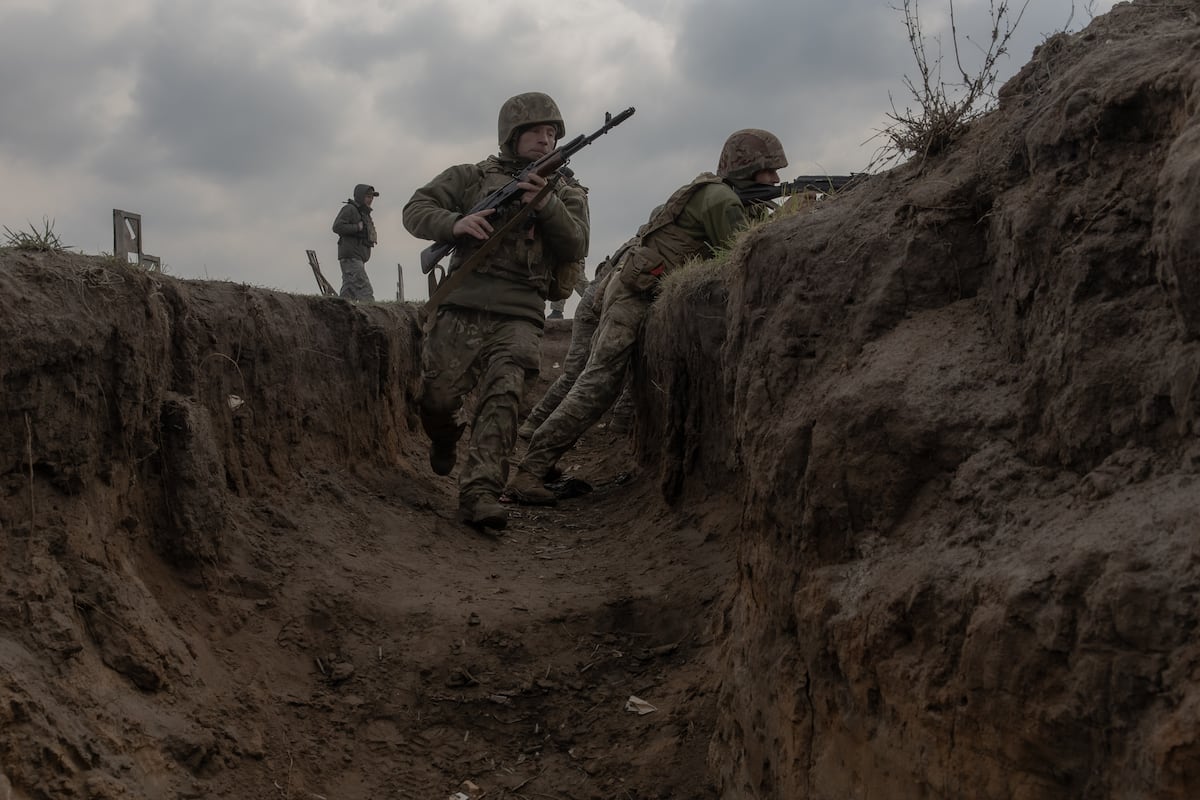
KYIV, Ukraine — Ukraine’s military leadership plans to phase out sending troops abroad for basic training, with a senior official saying much of what Western armies teach is “detached from our realities.”
The idea is to move all basic training fully onto Ukrainian soil, while keeping more specialized courses abroad, Yevhen Mezhivikin, deputy chief of the General Staff’s Main Directorate of Doctrine and Training, told Militarnyi last week.
NATO’s Supreme Allied Commander Transformation, Adm. Pierre Vandier, explained the logic during his first visit to Ukraine last weekend, calling Ukraine’s warfighting adaptation “one of the strongest lessons” for the alliance back in February and acknowledging that Russia is outpacing NATO in absorbing those same lessons, per Ukrinform .
“Russia is very good at adapting, really, better than we are today,” Vandier said. “So we need to put oil in all the gears.”
The role reversal is already in motion.
Despite Russia launching a massive spring offensive this week, Ukraine has clawed back more territory in its counteroffensive than at any point since 2023. It’s also knocked out an estimated 40% of Russia’s oil export capacity with long-range strikes on its export terminals — and still had enough experts and drones to send 228 drone specialists to the Middle East to help allies intercept Iranian Shaheds that have attacked over a dozen countries.
In an interview last month, Deputy Minister of Defense Lt. Col. Yurii Myronenko, who was appointed on Wednesday as the Defense Ministry’s inspector general and who previously led the team behind the DELTA battlefield situational-awareness system, had already seen what was coming.
Ukraine needs “powerful partners” in NATO, he said, but it also has something to trade back, including “technological exchanges,” and the ability to make decisions “very close to the front line.”
Allied governments have been pushing for this reversal, too.
Britain was “the first country to propose moving all training to Ukraine and concentrating efforts on specific centers,” Mezhivikin had said.
This month, Kyiv sent a cadre of military advisers to Germany to teach drone warfare, counter-UAS tactics and electronic warfare integration — subjects NATO armies have studied in doctrine but never tested under persistent combat conditions. Germany is the first NATO member to formally invite Ukrainian trainers into its own army’s schools .
“We have high expectations,” Lt. Gen. Christian Freuding, head of the German army, told Reuters . “The Ukrainian military is currently the only one in the world with frontline experience against Russia.”
Overseas training “has not been cancelled,” military spokesperson Dmytro Lykhovii clarified three days after the original statement. It is simply scaling down, he said, according to Ukrainska Pravda .
Courses abroad will be “clustered and optimized,” Lykhovii said, with a short list of partner nations specializing in specific lanes. Weapons and equipment courses, commander-leader education and senior NCO training all continue outside Ukraine.
But the volume of troops sent abroad for basic training has “noticeably decreased over the past two years,” Lykhovii told RBC-Ukraine .
Basic training will continue to run in three EU countries with support from four NATO states through 2026, he said — down from the 18 EU member states that hosted Ukrainian brigade-level training of all types through late 2025, per RBC-Ukraine .
The shift has been twelve years in the making. Ukraine is now the one doing the teaching, exporting hard-won expertise in drone warfare, counter-UAS and electronic warfare to allied armies that have studied these subjects in doctrine but never tested them under fire.
Ukraine’s DELTA system — the battlefield operating picture its units use to fuse feeds, track activity and pass targeting data — has entered NATO’s own training exercises.
The Defense Ministry said DELTA served as the primary command platform for the Ukrainian “red team” during NATO’s REPMUS 2025 unmanned-systems exercise in Portugal, where the team won all five scenarios, coordinating more than 100 drones across maritime, air, ground and underwater domains, and simulating the destruction of a NATO frigate whose detection systems failed to spot the incoming Magura V7 naval drones in time.
And in Estonia, a small Ukrainian drone team playing opposing force during Exercise Hedgehog 2025 used drones and rapid-targeting analysis to render a mechanized NATO unit combat-ineffective in half a day, destroying 17 armored vehicles and roughly 30 additional targets, according to The Wall Street Journal .
The timeline for training across allied forces is tight. Western intelligence assessments put a possible large-scale Russian offensive against NATO as early as 2029.
“That’s almost the day after tomorrow,” he told Reuters . “We have no time — the enemy doesn’t wait for us to declare we’re ready.”
That’s why Ukraine keeps pushing the alliance forward and offering up its experience to help, officials say.
“Having very powerful partners from NATO countries,” Myronenko said, “we will all have a very good chance to always be ahead of the Russians.
乌克兰基辅——乌克兰军方领导层计划逐步取消向国外派遣部队进行基础训练,一位高级官员表示,西方军队教授的很多内容“脱离了我们的现实”。
上周,乌克兰总参谋部条令与训练总局副局长叶夫根·梅日维金告诉《军事报》,其理念是将所有基础训练完全转移到乌克兰境内,同时将更专业的课程保留在国外。
据乌克兰通讯社报道,北约最高盟军转型司令皮埃尔·范迪耶海军上将在上周末首次访问乌克兰期间解释了其中的逻辑,称乌克兰的作战适应是北约在2月份吸取的“最深刻的教训之一”,并承认俄罗斯在吸收这些教训方面比北约走得更快。
“俄罗斯的适应能力很强,真的比我们现在强多了,”范迪尔说。“所以我们需要给所有环节都加满油。”
角色互换的趋势已经开始了。
尽管俄罗斯本周发动了大规模春季攻势,但乌克兰在反攻中夺回的领土比2023年以来的任何时候都多。乌克兰还通过对俄罗斯出口码头的远程打击,瘫痪了俄罗斯约40%的石油出口能力——而且乌克兰仍然拥有足够的专家和无人机,可以向中东派遣228名无人机专家,帮助盟友拦截袭击了十几个国家的伊朗“烈士”无人机。
国防部副部长尤里·米罗年科中校上个月在接受采访时表示,他已经预见到了即将发生的事情。米罗年科中校于周三被任命为国防部监察长,他此前曾领导过DELTA战场态势感知系统背后的团队。
他说,乌克兰需要在北约拥有“强大的伙伴”,但它也有一些东西可以交换,包括“技术交流”以及“在前线附近”做出决策的能力。
盟国政府也一直在推动这一逆转。
梅日维金曾表示,英国是“第一个提议将所有训练转移到乌克兰,并将精力集中在特定中心的国家”。
本月,基辅派遣了一批军事顾问前往德国,教授无人机作战、反无人机系统战术和电子战一体化——这些内容北约军队在理论中有所研究,但从未在持续的实战条件下进行过检验。德国是第一个正式邀请乌克兰教官到其军队院校任教的北约成员国。
德国陆军总司令克里斯蒂安·弗罗伊丁中将告诉路透社:“我们寄予厚望。乌克兰军队是目前世界上唯一一支拥有与俄罗斯一线作战经验的军队。”
乌克兰军方发言人德米特罗·利霍维在最初声明发布三天后澄清说,海外训练“并未取消”。据《乌克兰真理报》报道,他表示,训练规模只是缩小了。
利霍维表示,海外课程将进行“集中化和优化”,合作国家名单上的国家将专注于特定领域。武器装备课程、指挥官领导力培训和高级士官培训都将继续在乌克兰境外进行。
Lykhovii告诉RBC-Ukraine,过去两年里,被派往国外接受基础训练的部队人数“明显减少”。
他表示,基础训练将在三个欧盟国家继续进行,并得到四个北约国家的支持,直至 2026 年——据 RBC-Ukraine 报道,此前在 2025 年底之前,共有 18 个欧盟成员国承办乌克兰旅级各类训练。
这一转变历经十二年才得以实现。如今,乌克兰扮演着教学者的角色,向盟军输出来之不易的无人机作战、反无人机系统和电子战方面的专业知识。这些盟军虽然在理论中学习过这些内容,但从未在实战中检验过。
乌克兰的 DELTA 系统——其部队用于融合信息、跟踪活动和传递目标数据的战场作战图——已进入北约的训练演习。
国防部表示,在北约于葡萄牙举行的 REPMUS 2025 无人系统演习中,DELTA 系统作为乌克兰“红队”的主要指挥平台,该队赢得了全部五个场景的胜利,协调了海上、空中、陆地和水下领域的 100 多架无人机,并模拟摧毁了一艘北约护卫舰,该护卫舰的探测系统未能及时发现来袭的 Magura V7 海军无人机。
据《华尔街日报》报道,在爱沙尼亚举行的“刺猬2025”演习中,一支扮演敌对势力的乌克兰小型无人机队利用无人机和快速目标分析,在半天内使一支北约机械化部队丧失了战斗力,摧毁了17辆装甲车和大约30个其他目标。
盟军的训练时间非常紧迫。西方情报机构评估认为,俄罗斯最早可能在2029年对北约发动大规模进攻。
“那几乎就是后天了,”他告诉路透社。“我们没有时间了——敌人不会等我们宣布准备就绪。”
官员们表示,正因如此,乌克兰才不断推动联盟向前发展,并提供自身经验以提供帮助。
米罗年科说:“有了来自北约国家的强大伙伴,我们都有很大的机会始终领先于俄罗斯。”