Navy’s Blue Ridge Class Command Ships Once Had This Wacky Air Defense Missile System海军蓝岭级指挥舰曾经配备过这种奇特的防空导弹系统
Although the ability to fire Sea Sparrow missiles seems impressive, in actuality the system was lacking in almost every regard.
新闻视频
Updated Jan 25, 2018 5:00 PM EST
With USS Blue Ridge (LCC-19) recently coming out of a major upgrade and maintenance period, The War Zone ran a feature on the often misunderstood, half century old class of command and control ships. After posting the article we got a flood of email, comments, and instant messages from people who had served on the ships or visited them for a period of time during their careers in the military. We were told repeatedly how great the food was, how the ships’ abilities were far more limited and even neglected in decades past, and other interesting tidbits of information. Maybe the most interesting was about the class’s armament. It turns out the vessels were once equipped with an austere point air defense capability, one that is almost laughably incapable by today’s standards.
At its commissioning, USS Blue Ridge was outfitted with a pair of twin Mark 33 three inch guns mounted amidships. These rudimentary deck guns were quickly augmented by a pair of Mark 25 box launchers installed nearby. The Mark 25s housed early versions of the RIM-7 Sea Sparrow surface-to-air missile—which was adapted from the air-to-air missile of a similar name, specifically the AIM-7E.
USS Mount Whitney seen in 1986 sporting an air search radar, Mk 25 launchers, and 3 inch gun turrets. , USN
The box launchers themselves were adapted from RUR-5 ASROC anti-submarine rocket launchers that were first introduced around 1960. The Mark 25 contained eight RIM-7s, with the launcher being bulkier than the Mark 29 launchers used on aircraft carriers and amphibious assault ships over the last few decades. The reason being is that early RIM-7s didn’t have folding fins that pop-open as they leave their launch cells, and as we mentioned earlier, the launcher was originally built to accommodate the ASROC. It wasn’t until the RIM-7H that the new fin configuration was put into production.
The Basic Point Defense Missile System and its bulky Mark 25 launcher was installed on dozens of Knox class frigates, carriers, and amphibious assault ships., USN
This launcher-missile combo was trained to a manually operated turret that had a pair of radar illuminators fixed on both of its sides. This system was called the Mark 115 Manually Aimed Target Illuminator or Manned Director. Wherever this turret was pointed by a sailor standing behind it looking through a scope, the box launcher would point too. When a missile was fired, the idea was that it would immediately lock onto the target being “painted” by the manned illuminator and streak out directly toward it.
Targeting was a goofy affair in which the guy operating the illuminator would be directed via voice commands to where shipboard radar was seeing a target. The, operator would then swivel the contraption best he could in the direction and elevation he was being told. The system didn’t require perfect visual targeting by the operator as the beam was fairly wide, but he had to keep tracking the target in order for the semi-active radar homing RIM-7 missile to make its way to the target and destroy it.
The system became known as the Basic Point Defense Missile System (BPDMS) and was rapidly deployed to ships in the 1970s as a modular design that could take the place of archaic anti-aircraft guns. Clearly it had major limitations. First of all, earlier RIM-7s were terribly suited for surface-to-air missile duty and had anemic range. Half a dozen miles or so was likely the actual reach of this system. The AIM-7E Sparrow missile was designed for sustained cruise in thin air with the kinetic advantage of being launched by a fighter already moving at hundreds of miles per hour, not from the surface of the ocean out of a can. Its centrally-mounted maneuvering fins were also far from ideal for quick reactionary adjustments that a point defense missile systems needs to swat down incoming missiles and aircraft.
USS Blue Ridge seen with its Mk 25 launchers and three inch guns, as well as Phalanx mounts, sometime in the late 1990s. The ship also sported a AN/SPS-48 air search radar . , USN
Later RIM-7 variations would fix many of these issues, but it wasn’t until the redesigned RIM-162 Evolved Sea Sparrow Missile (ESSM) was introduced in 2004 that most all of the missile’s deficiencies were overcome. The latest versions of the ESSM don’t even rely on any kind of radar illuminator at all, leveraging data-links for initial and midcourse guidance and an active seeker for terminal homing.
Sea Sparrow missile being launched from a Mark 25 launcher aboard the USS Midway in 1983. , USN
The system was also limited at night and especially in foggy conditions, which are common on the high seas. The ability to engage multiple targets relatively quickly was also sorely lacking, but at least the ship had something to defend itself from enemy aircraft and from Russian anti-ship missiles that could leak through a battle group’s defensive screen. Still, this was a cobbled-together last resort defensive system, and with the installation of the Mark 15 Phalanx close-in weapon system in the early 1980s, the need for marginally effective BPDMS aboard the Blue Ridge class was questioned.
USS Blue Ridge and USS Mount Whitney soldiered on with the setup into the early 1990s, when the Mk 25 launchers and Mk 115 directors were finally removed.
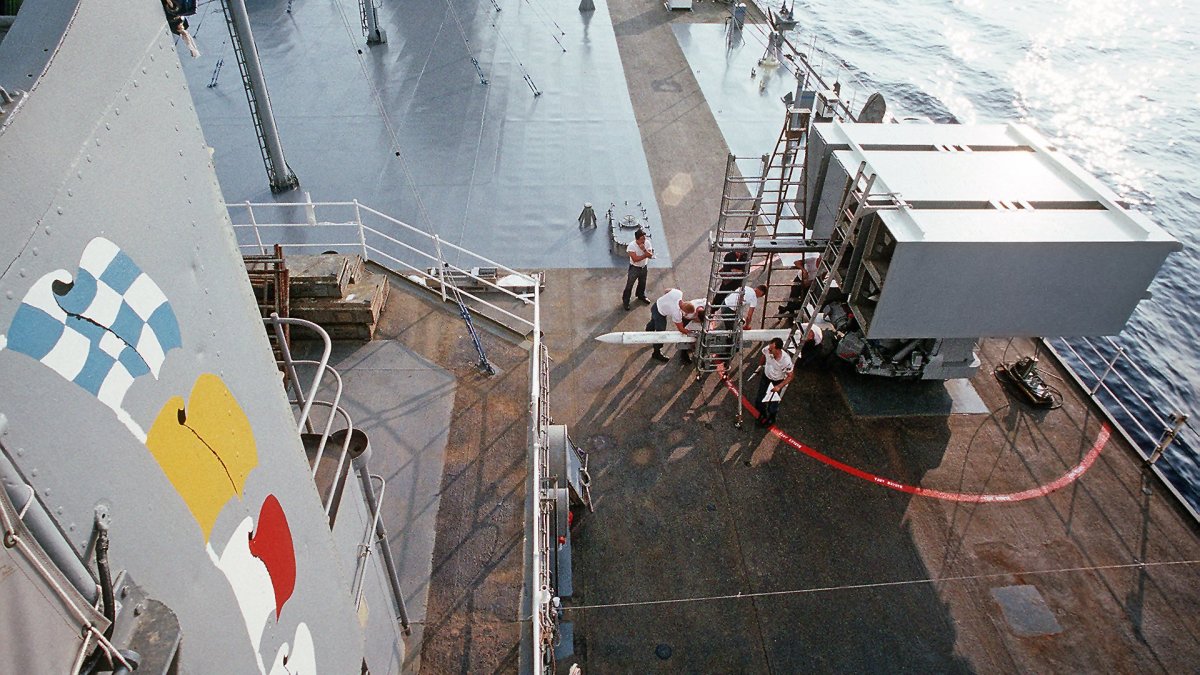
A Mark 115 fire control director for the Mark 25 SEA SPARROW missile launcher is being removed from the deck of the amphibious command ship USS BLUE RIDGE (LCC-19) in 1993., USN
With the Navy investing heavily in these ships—their out of service dates now placed over two decades into the future—it will be interesting to see if the seagoing force provides them with enhanced defensive systems once again. A pair of 25mm Bushmaster cannons on remote weapons mounts were added in recent years for defense against swarming boat attacks and other lower-end threats, and the ships still have their fore and aft Mk 15 Phalanx mounts, but nothing that can reach beyond couple miles.
The SeaRAM system, which melds the RIM-116 Rolling Airframe Missile and the Phalanx’s independent search and fire control radars into a single self contained package, seems like the most likely option. They could be mounted amidships near where the Mark 25 launchers once sat. It’s also possible that a single SeaRAM system could replace one of the Phalanx mounts.
The combination of SeaRAM and Phalanx seems to be the Navy’s defensive mix of choice for ships operating independently in potential super anti-ship missile engagement zones. The Navy’s Arleigh Burke class destroyers forward based in Spain have been modified to this configuration. USS Mount Whitney in particular operates independently in the Mediterranean and even the Black Sea.
The somewhat scary thing is the BPDMS equipped American aircraft carriers, amphibious assault ships, and dozens of Knox class frigates for multiple decades during the Cold War before they were replaced by far more automated and capable systems. One has to think just how bloody a full on barrage of anti-ship missiles by a Russian battlegroup , SSGNs, and/or strategic airpower would have actually been to the American Navy of that era. I don’t think it would have been pretty to say the least.
If anything else, the Blue Ridge class’s old manually operated air defense system, which lacked any hard integration with an overall sensor and weapons architecture, is a reminder of just how far the U.S. Navy has come in regards to point defense in the last 50 years.
Contact the author: Tyler@thedrive.com
Comments couldn’t be loaded. Please refresh the page.
更新于美国东部时间2018年1月25日下午5:00。
随着“蓝岭”号(LCC-19)近期完成一次大规模升级和维护,《战区》栏目刊登了一篇关于这艘服役半个世纪、常被误解的指挥控制舰的专题报道。文章发表后,我们收到了大量电子邮件、评论和即时消息,发件人大多曾在该舰服役或在其军旅生涯中曾到访过该舰。他们反复提及舰上的伙食有多么美味,以及该舰在过去几十年里能力远不如现在,甚至一度被忽视,并分享了其他一些有趣的信息。其中最引人入胜的或许是关于该舰武器装备的介绍。原来,这些舰艇曾经配备过一套简陋的近程防空系统,以今天的标准来看,这套系统简直形同虚设。
“蓝岭”号两栖攻击舰服役时,舰体中部安装了两门双联装Mk 33型三英寸舰炮。这些简易的甲板炮很快被附近安装的两座Mk 25型箱式导弹发射器所取代。Mk 25型发射器内装有早期版本的RIM-7“海麻雀”舰空导弹——该导弹由同名的空空导弹AIM-7E改进而来。
1986年拍摄的“惠特尼山”号两栖攻击舰,舰上配备了空中搜索雷达、Mk 25型导弹发射器和3英寸舰炮炮塔。
这些箱式发射器本身是由1960年左右首次投入使用的RUR-5 ASROC反潜火箭发射器改进而来。Mark 25型发射器可容纳八枚RIM-7火箭,其体积比过去几十年在航空母舰和两栖攻击舰上使用的Mark 29型发射器更大。原因在于早期的RIM-7火箭没有在离开发射舱时自动展开的折叠翼,而且正如我们之前提到的,该发射器最初是为ASROC反潜火箭设计的。直到RIM-7H型火箭,新的折叠翼设计才投入生产。
基本点防御导弹系统及其笨重的Mk 25发射器被安装在数十艘诺克斯级护卫舰、航空母舰和两栖攻击舰上。(美国海军)
这种发射器-导弹组合装置被对准一个手动操作的炮塔,炮塔两侧各装有一对雷达照射器。这套系统被称为Mark 115手动瞄准目标照射器或有人指挥仪。站在炮塔后面的水兵通过瞄准镜观察,炮塔指向哪里,发射器就会指向哪里。导弹发射后,其原理是立即锁定由有人指挥仪“标记”的目标,并径直射向目标。
瞄准过程十分繁琐:操作员会通过语音指令将照射器对准舰载雷达探测到的目标位置。然后,操作员会尽力按照指令的方向和仰角调整照射器。由于光束较宽,这套系统并不需要操作员进行完美的目视瞄准,但他必须持续跟踪目标,才能确保半主动雷达制导的RIM-7导弹能够准确命中目标并将其摧毁。
该系统被称为基本点防御导弹系统(BPDMS),并在20世纪70年代迅速部署到舰艇上,其模块化设计旨在取代老旧的防空炮。显然,它存在诸多局限性。首先,早期的RIM-7导弹并不适合作为地对空导弹使用,射程也十分有限。该系统的实际射程可能只有六英里左右。AIM-7E“麻雀”导弹的设计用途是在稀薄空气中进行持续巡航,其动能优势在于由战斗机以数百英里/小时的速度发射,而不是从海面发射。其中央安装的机动翼也远非理想,无法满足点防御导弹系统快速反应调整以拦截来袭导弹和飞机的需求。
20世纪90年代末,蓝岭号两栖攻击舰(USS Blue Ridge)上配备了Mk 25型导弹发射器、3英寸舰炮以及密集阵近防系统。该舰还装备了AN/SPS-48型对空搜索雷达。
后来的RIM-7改进型解决了许多此类问题,但直到2004年重新设计的RIM-162改进型海麻雀导弹(ESSM)问世,该导弹的大部分缺陷才得以克服。最新版本的ESSM甚至完全不再依赖任何雷达照射器,而是利用数据链进行初始和中段制导,并使用主动导引头进行末端寻的。
1983年,一枚“海麻雀”导弹从“中途岛”号航空母舰上的Mk 25型发射器发射。(美国海军)
该系统在夜间,尤其是在远海常见的雾天条件下,性能也十分有限。快速打击多个目标的能力也严重不足,但至少该舰拥有防御敌机和可能突破战斗群防御屏障的俄制反舰导弹的能力。然而,这套系统毕竟是拼凑起来的最后防线,随着20世纪80年代初Mark 15“密集阵”近程防御系统的安装,蓝岭级护卫舰上这套效果有限的近程防御系统的必要性也受到了质疑。
“蓝岭”号和“惠特尼山”号继续使用这套装置到 20 世纪 90 年代初,直到 Mk 25 发射器和 Mk 115 指挥仪最终被拆除。
1993年,美国海军正在从两栖指挥舰“蓝岭”号(LCC-19)的甲板上拆卸用于Mark 25“海麻雀”导弹发射器的Mark 115型火控指挥仪。
海军对这些舰艇投入巨资,其退役日期预计在二十多年后,因此,海军是否会再次为其配备增强型防御系统,值得关注。近年来,这些舰艇加装了两门25毫米“大毒蛇”遥控炮,用于防御蜂拥而至的快艇攻击和其他低端威胁。舰艇前后仍保留着Mk 15“密集阵”近防系统,但射程仅限于几英里。
SeaRAM系统将RIM-116滚体导弹和密集阵导弹防御系统的独立搜索和火控雷达集成到一个独立的组件中,似乎是最有可能的方案。它可以安装在舰体中部,靠近之前Mark 25发射架的位置。此外,一套SeaRAM系统也可能取代一个密集阵导弹发射架。
对于在潜在的超级反舰导弹交战区域独立作战的舰艇而言,SeaRAM和Phalanx的组合似乎是海军首选的防御方案。海军部署在西班牙前沿的阿利·伯克级驱逐舰已改装为这种配置。特别是“惠特尼山”号驱逐舰,它在地中海甚至黑海都能独立作战。
令人有些担忧的是,冷战期间,美国航母、两栖攻击舰以及数十艘诺克斯级护卫舰都曾装备过BPDMS系统,并服役数十年之久,直到后来才被更加自动化、功能更强大的系统所取代。试想一下,如果当时美国海军遭到俄罗斯战斗群、巡航导弹核潜艇和/或战略空军的全面反舰导弹攻击,将会造成多么惨重的后果。毫不夸张地说,那场面绝对不堪设想。
如果说还有什么意义的话,那就是蓝岭级舰艇老旧的手动操作防空系统缺乏与整体传感器和武器架构的任何硬性集成,这提醒我们,在过去的 50 年里,美国海军在点防御方面取得了多么大的进步。
联系作者:Tyler@thedrive.com
评论加载失败,请刷新页面。