The para-athlete who once won a medal for Singapore and now sells art on the streets of Kuala Lumpur这位曾为新加坡赢得奖牌的残疾人运动员,如今在吉隆坡街头售卖艺术品。
Nearly three decades after setting off with little more than a backpack and skateboard, Mr Dasuki Johari reflects on the choices he made that had him sleeping in mosques and working on prawning boats.
新闻视频
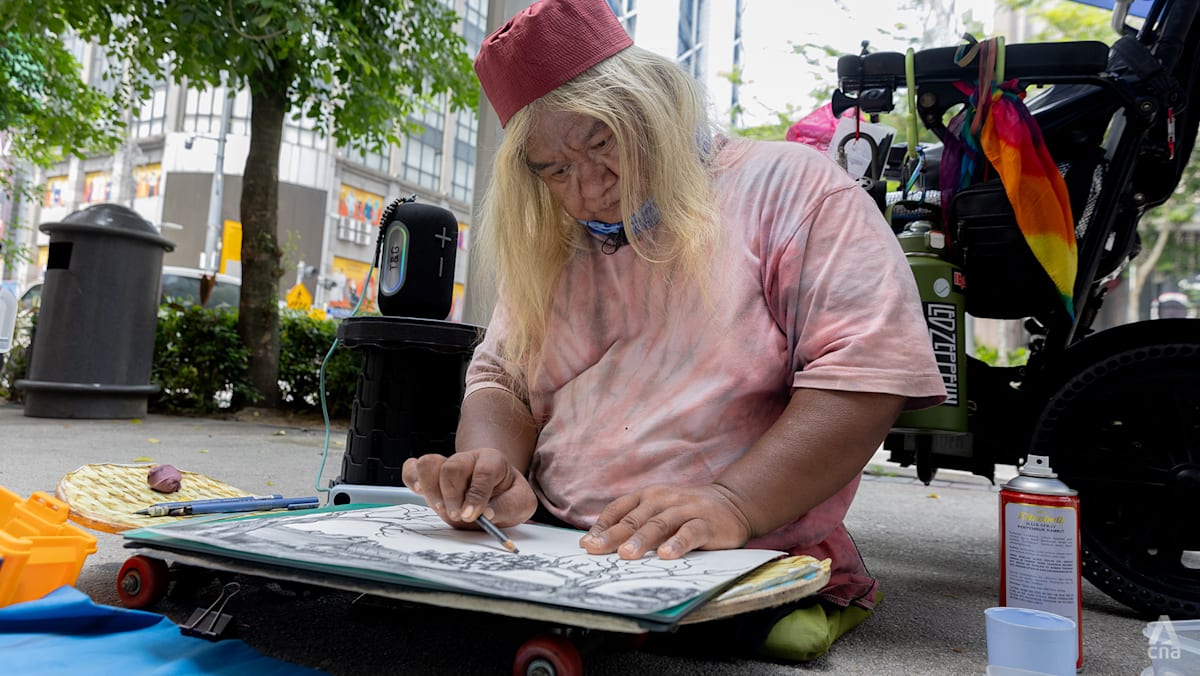
Nearly three decades after setting off with little more than a backpack and skateboard, Mr Dasuki Johari reflects on the choices he made that had him sleeping in mosques and working on prawning boats.
Street artist and former para-athlete Dasuki Johari drawing along Jalan Tuanku Abdul Rahman near the Sogo shopping mall in Kuala Lumpur, Malaysia, on Aug 27, 2026. (Photo: CNA/Ili Mansor)
This audio is generated by an AI tool.
Every morning, 58-year-old Dasuki Johari wakes up alone on his motorised wheelchair, which doubles as his bed in a tiny room in Kuala Lumpur, Malaysia.
He takes a sip of last night's iced teh-o (tea with sugar) from his insulated tumbler, heavily decorated with stickers of his favourite heavy metal bands and Liverpool Football Club.
With no one to exchange "good morning" greetings or eat breakfast with, he gets dressed in an old, worn T-shirt – one of several in a plastic bag in a corner of his room.
Then he sets out on his morning commute, a 10-minute journey in his wheelchair from his room in a building along Jalan Masjid India to an open spot on Jalan Tuanku Abdul Rahman, just across from the Sogo mall.
CNA Games Guess Word Crack the word, one row at a time Buzzword Create words using the given letters Mini Sudoku Tiny puzzle, mighty brain teaser Mini Crossword Small grid, big challenge Word Search Spot as many words as you can Show More Show Less He has no colleagues to greet or make small talk with upon reaching his "workplace". He ties an umbrella to the back of his wheelchair and crawls down to the pavement to lay out a cloth, a donation box, a portable speaker and a skateboard that he uses as his work desk. He puts on a slow rock tune, picks up a charcoal pencil and starts sketching. "I need to listen to music, then I'll have the 'feel' to draw," he told me when I visited him in August.
He has no colleagues to greet or make small talk with upon reaching his "workplace". He ties an umbrella to the back of his wheelchair and crawls down to the pavement to lay out a cloth, a donation box, a portable speaker and a skateboard that he uses as his work desk.
He puts on a slow rock tune, picks up a charcoal pencil and starts sketching.
"I need to listen to music, then I'll have the 'feel' to draw," he told me when I visited him in August.
Mr Dasuki Johari setting up his street-side workspace near the Sogo shopping mall in Kuala Lumpur, Malaysia, on Aug 27, 2026. (Photo: CNA/Ili Mansor)
With music playing from a portable speaker, Mr Dasuki Johari works on a sketch along Jalan Tuanku Abdul Rahman in Kuala Lumpur, Malaysia, on Aug 27, 2026. (Photo: CNA/Ili Mansor)
Street artist Dasuki Johari using his skateboard as a makeshift desk while working on a sketch along Jalan Tuanku Abdul Rahman in Kuala Lumpur, Malaysia, on Aug 27, 2026. (Photo: CNA/Ili Mansor)
Apart from the music he constantly has playing while at work, Mr Dasuki makes little sound. He interacts little with others, outside of the occasional customer and a handful of regular passers-by who stop to say hello.
This is how he has spent nearly every day of the last five or six years, eking out a meagre living as a street artist in Kuala Lumpur. But his life was not always this solitary.
Over three decades ago, Mr Dasuki was working as a data entry clerk in Singapore, where he was born. He even became a competitive para-athlete for some time, clinching a bronze medal for Singapore in para-skiing in 1995.
In 1998, he decided to leave behind his life in Singapore – his job, family and friends – to "find something for myself" in Malaysia.
Now, nearly three decades on, it's hard to determine what exactly Mr Dasuki set out to find.
LONG HAIR AND A LONGING FOR SOMETHING MORE
Born without legs, Mr Dasuki has relied on mobility aids for as long as he can remember.
At age 12, he made headlines in Singapore for coming in second place in a 50-metre wheelchair dash at a sports meet for the handicapped.
He studied in a schooling programme run by the Red Cross Home for the disabled in Changi Village, completing it in 1983.
Soon after, he developed a taste for moving around on a skateboard instead of a wheelchair, eventually earning him the moniker "Dasuki Skate" among his friends.
"I'd (skate) to the MRT station, take the escalator up and down, get on the train and everything." He recalled a particular fondness for hanging out with his friends around City Hall MRT station.
He was so distinctive that when he started resurfacing in news media over the last few months, several online users piped up, easily recognising him as Dasuki Skate.
Despite working as a street artist for the last 10 years, Mr Dasuki was completely inept at art when he was growing up.
"In school, when a teacher asked me to draw even an apple, I couldn't."
Instead, music was his main creative preoccupation during his youth, especially rock and heavy metal bands such as Led Zeppelin and Iron Maiden. He spent many a night watching live performances by pioneer rock bands in Singapore, including Sweet Charity and Bumiputra Rockers.
The long-haired look of these 1970s and 1980s rockers motivated him to keep his own hair long – which didn't always go down well.
"When my oldest sister made me cut my hair when I was in school, I cried," he said, adding that his shoulder-length mane remains his pride and joy to this day.
In 1995, Mr Dasuki again made headlines when he took home a bronze medal for Singapore at the 2nd World Disabled Water Ski Championships in Australia, his very first pro sports outing.
He had picked up para-skiing when a friend told him of an opportunity to learn it in the Kallang area. The instructors quickly saw potential in Mr Dasuki and invited him to train and to represent Singapore at the world championships.
He competed in the slalom, a version of water skiing that requires competitors to navigate buoys in a zig-zag pattern.
"When I saw the Singapore flag go up after I won third in the slalom event for my (disability) category, I was proud and I cried. I was so happy," he reminisced.
Despite his stellar debut, his competitive sporting days were cut short because of his severe fear of flying – one he developed as a teenager from watching La Bamba, a 1987 biographical film of American singer Ritchie Valens who died at age 17 in a plane crash.
Even the Australia trip had been a traumatic ordeal for Mr Dasuki, and he had no inclination to travel for other overseas competitions.
I thought it unfortunate that his prospects wound up dashed by such a fear, but Mr Dasuki had a surprisingly zen attitude towards it.
"I was sad at first, but that's how it is," he said. "Even though I didn't get to represent Singapore (anymore), I still got to do the sport while I was working at the Singapore Water Ski Centre."
Street artist Dasuki Johari, a former Singapore para-athlete, showing a photo of himself training for the 1995 World Disabled Waterski Championships in Australia. (Photo: CNA/Ili Mansor)
For all that he had – a full-time job and a rich social life in Singapore – Mr Dasuki still felt that something missing in his life.
When a friend in the music scene suggested that he travel up north to Malaysia to "make something of yourself", he readily agreed – though he admitted that at the time, even he didn't know what that something was.
"I just know Malaysia is bigger than Singapore," he said.
"I wanted to have an adventure and to know what life is like for me outside (my) world."
With a backpack in tow, the then 30-year-old made his skateboard sojourn to Malaysia in 1998 by bus and train.
His departure was so sudden that his family in Singapore had no idea where he had gone. Mr Dasuki now reckons his mother may have later figured out that he was in Malaysia, since he had briefly stayed at his sister's place in Johor.
With no idea where to go or what to do, he spent the next several years wandering through Peninsular Malaysia, taking up odd jobs and seeking temporary shelter at mosques or whatever he could find.
"At one point, my backpack was stolen while I was asleep in a mosque in Johor," he recounted. "Luckily, I slept with my skateboard under my head (like a pillow), or else it might have been stolen, too."
One of his pit stops was Langkawi, an island in the northwestern state of Kedah. He spent about six months helping out on prawning boats, which he enjoyed.
"When we had nothing to do out at sea, I'd jump off (the boat) and swim," Mr Dasuki said, adding that he had been an avid swimmer in his youth.
Next, he headed to the northeastern state of Terengganu, where he found work as a packer for keropok lekor (traditional fish cracker), earning RM7 (S$2.20) a day.
More unexpectedly, he also found a new family of sorts.
"When I reached there, a resident saw me at a mosque and asked, 'Where are you going to spend the night?' When I said I planned to sleep at the mosque, he told me to go live with him and his family instead."
Mr Dasuki still acknowledges them as his "adoptive" family, returning to Terengganu to visit them many times over the years. Those visits later came to an end, for a reason some may find peculiar.
"The patriarch kept asking me to cut my hair each time I visited. And he's an elder, so I tried my best to show him respect. So I eventually stopped visiting."
I just know Malaysia is bigger than Singapore. I wanted to have an adventure.
During his travels, he met people who had a keen interest in art: a scenery sketch artist in Langkawi, Kedah, and a portrait artist in Kuala Pilah, Negeri Sembilan.
He recalled being entranced by the Langkawi-based artist, who used a ballpoint pen to draw "beautiful sceneries" on white cloth.
Mr Dasuki spent about six months learning from that artist, and then went to Kuala Pilah, where he met the portraitist, with whom he spent another six months. He sat with each of them daily for hours to hone his budding skills – skills that would later turn out to be his main source of income.
On his visibly aged smartphone, Mr Dasuki showed me dozens of portraits and sketches he had drawn. A coloured painting of a sailboat immediately stood out to me, the 2.1m-tall artwork more than twice Mr Dasuki's full height.
The oil-on-canvas painting was commissioned by a German expatriate family who had read about him in Malaysian media and saw him practising his art in Johor around 2013.
The colourful painting depicts a sailboat competing in the America's Cup sailing race in San Francisco Bay, with Alcatraz Island and the Golden Gate Bridge in the background. Mr Dasuki about two weeks to complete it.
The German family paid him RM3,500. To date, it remains the most expensive piece of artwork Mr Dasuki has ever sold.
While some of his commissioned works fetch a pretty penny – he charges RM350 for a single portrait, which takes about a week to complete – the reality is that they are few and far between, numbering less than 10 a year.
A fan of rock music, Mr Dasuki Johari drew a portrait of pioneering Singaporean rock singer Ramli Sarip. (Photo: Dasuki Johari)
Mr Dasuki Johari posing next to his trusty skateboard in this undated photo while in Langkawi, Kedah, Malaysia. (Photo: Dasuki Johari)
Mr Dasuki Johari posing next to a painting that he said was the biggest and most expensive artwork he has ever created. (Photo: Dasuki Johari)
The morning we spent along Jalan Tunku Abdul Rahman, he sold nothing, though three passers-by did stop to drop some money in his donation box.
His scenery pencil sketches used to sell for RM50, but he brought the price down to RM20 after the COVID-19 pandemic because they were not selling. Even then, sales have remained low.
On a decent day, he earns about RM50 to RM60 on average. "But if there are beggars along the same street, I'll get much, much less," he said.
Weather is another issue. On rainy days, he can't work at all.
Mr Dasuki receives about RM900 through financial assistance schemes for people with disabilities and those on very low incomes.
The monthly rental for his room is already RM450, which means that to cover his day-to-day living costs, he must rely heavily on his street art earnings – but working the streets requires money, too.
"There were days ... I could not work for a while because I ran out of art supplies and had to wait for the handouts at the end of the month to replenish them before I can resume busking."
"I'D BE LYING IF I SAID I'M HAPPY"
From the first time I spoke to him – on the phone about a week before we met in KL – Mr Dasuki immediately struck me as a happy-go-lucky guy.
Every conversation with him is generously peppered with laughter, thanks to his droll comments and larger-than-life anecdotes, delivered in rapidly alternating English and Malay.
As we set off to his place, my colleague and I asked Mr Dasuki to hold a 360-degree camera to record his journey.
He quickly sped off with his new toy, rambling merrily into the camera to a pretend audience: "Hello, guys, my name is Dasuki Johari. Welcome to my vlog!"
He even stopped to conduct mock interviews with stallholders along the street, who were as tickled as we were by his behaviour.
His cheery demeanour stands in stark contrast to his living conditions.
Mr Dasuki Johari pictured in his motorised wheelchair in a small room he calls home in Kuala Lumpur, Malaysia. The wheelchair also doubles as his bed. (Photo: CNA/Ili Mansor)
A view of the small room where Mr Dasuki Johari lives alone in Kuala Lumpur, Malaysia, on Aug 27, 2026. (Photo: CNA/Ili Mansor)
His "apartment" is a single room, one of seven formed from subdividing a small flat in an aged building.
His room is sparse but organised, with two wall shelves holding a stash of instant noodles, an electric kettle, a mini pocket-size stove and some art supplies – practically everything he owns in the world.
Even with the little that he had, the room could barely accommodate both of us at the same time. My colleague had to sit by the door.
And yet, "it's okay, lah", he said almost jovially.
"I've already tasted what youngsters typically go through – nightlife and enjoyment. Now that I'm getting old, I just (take things) day by day."
Despite his carefree, animated demeanour, Mr Dasuki turned noticeably subdued when our conversation turned to his family and personal relationships.
He has long grown apart from his six siblings – of whom two have died, and the rest are living either in Singapore or Malaysia. He had a "very good" relationship with his mother, but she died in 2007. His parents were divorced when he was very young.
He still harbours regrets about not being by his mother's side when she died, and not visiting her grave in Singapore more frequently owing to the distance.
He himself has been married twice and divorced twice. He has one teenage son from his first marriage, whom he hardly sees.
"I'd be lying to you if I said I'm happy," he said.
He expressed gratitude to Allah for his good health and what he called "rezeki" (sustenance) through art, but acknowledged feeling lonely.
"The only thing (Allah) didn't give me was a relationship – relationship, companionship or whatever, as long as there's a 'ship' behind it, I'm still finding it."
He still exchanges the occasional text message with friends in both Malaysia and Singapore, but it's far from the close companionship he craves most.
"Once I finish my (work) as a street artist, I'm all alone in my room, in my own world."
I noted that he left his home and loved ones more than 30 years ago, looking for "something". Has he successfully found it, whatever it was?
"I won't say that I've failed," he said, pensive but firm. "I've found my art."
All the same, there might be one or two things he would do differently if he could turn back the clock.
As stories go viral online of young, successful professionals leaving traditional career pathways in search of greater purpose in life, Mr Dasuki offered a word of caution, hard-won from years of struggling to survive.
For anyone seeking to uproot themselves and move somewhere without friends or family, he urged them to plan ahead and put in place a financial safety net before taking the plunge.
"Then, if you think you have it in you to work hard, go and chase your dream."
Get our pick of top stories and thought-provoking articles in your inbox
Stay updated with notifications for breaking news and our best stories
Join our channel for the top reads for the day on your preferred chat app
近三十年前,达苏基·乔哈里先生背着背包,踩着滑板出发。如今,他回想起自己当年所做的选择,那些让他睡在清真寺、在捕虾船上工作的种种经历。
2026 年 8 月 27 日,街头艺术家兼前残疾人运动员 Dasuki Johari 沿着马来西亚吉隆坡崇光百货购物中心附近的 Jalan Tuanku Abdul Rahman 绘画。(照片:CNA/Ili Mansor)
这段音频由人工智能工具生成。
每天早上,58 岁的 Dasuki Johari 都会独自一人醒来,他的电动轮椅同时也是他在马来西亚吉隆坡一间狭小房间里的床。
他从保温杯里啜饮了一口昨晚的冰茶(加糖的茶),保温杯上贴满了他的最爱的重金属乐队和利物浦足球俱乐部的贴纸。
由于没有人和他互道“早上好”,也没有人和他一起吃早餐,他穿上了一件旧旧的T恤——这是他房间角落里一个塑料袋里装着的几件T恤中的一件。
然后,他开始了每天早晨的通勤,从他位于 Jalan Masjid India 沿线一栋楼里的房间,坐着轮椅,10 分钟的路程,到达 Jalan Tuanku Abdul Rahman 上的一个空地,就在 Sogo 购物中心对面。
CNA游戏 猜词游戏 逐行破解单词 流行词游戏 用给定的字母组成单词 迷你数独 小谜题,大挑战 迷你填字游戏 小方格,大挑战 单词搜索 尽可能多地找出单词 显示更多 显示更少 他到达“工作场所”时,没有同事可以打招呼或闲聊。他把一把伞绑在轮椅后面,爬到人行道上,铺开一块布、一个捐款箱、一个便携式音箱和一块滑板,滑板就是他的工作台。他放了一首舒缓的摇滚乐,拿起一支炭笔开始素描。“我需要听音乐,这样我才能有画画的感觉,”八月份我去看望他时,他告诉我。
他到达“工作场所”后,没有同事可以打招呼或闲聊。他把一把伞绑在轮椅后面,爬到人行道上,铺开一块布、一个捐款箱、一个便携式音箱和一块滑板,滑板就是他的办公桌。
他放了一首舒缓的摇滚乐,拿起一支炭笔开始素描。
“我需要听音乐,然后才能有画画的‘感觉’,”八月份我去看望他时,他这样告诉我。
2026 年 8 月 27 日,Dasuki Johari 先生在马来西亚吉隆坡崇光百货购物中心附近设立他的街边工作空间。(照片:CNA/Ili Mansor)
2026 年 8 月 27 日,在马来西亚吉隆坡,Dasuki Johari 先生伴随着便携式扬声器播放的音乐,沿着 Jalan Tuanku Abdul Rahman 创作草图。(照片:CNA/Ili Mansor)
2026 年 8 月 27 日,马来西亚吉隆坡,街头艺术家 Dasuki Johari 在沿着 Jalan Tuanku Abdul Rahman 创作素描时,用他的滑板作为临时办公桌。(照片:CNA/Ili Mansor)
除了工作时一直播放的音乐外,达苏基先生很少发出声音。除了偶尔的顾客和几个停下来打招呼的常客之外,他很少与他人交流。
过去五六年里,他几乎每天都这样度过,在吉隆坡靠街头艺术勉强糊口。但他的生活并非一直如此孤独。
三十多年前,达苏基先生在新加坡(他的出生地)担任数据录入员。他还曾一度成为一名竞技残疾人运动员,并在1995年为新加坡赢得了一枚残疾人滑雪铜牌。
1998年,他决定离开新加坡的生活——他的工作、家人和朋友——到马来西亚“为自己寻找一些东西”。
如今,近三十年过去了,很难确定达苏基先生究竟想要找到什么。
长发与对更多事物的渴望
达苏基先生天生没有双腿,从记事起就一直依靠辅助行走工具。
12岁时,他在新加坡的一次残疾人运动会上获得50米轮椅短跑第二名,成为新闻头条人物。
他在樟宜村红十字会残疾人之家开办的学校项目中学习,并于 1983 年完成学业。
不久之后,他开始喜欢上用滑板而不是轮椅出行,最终在朋友中赢得了“滑板达斯基”的绰号。
“我会滑滑板到地铁站,乘扶梯上下,然后上车什么的。”他回忆起自己特别喜欢和朋友们在市政厅地铁站附近闲逛。
他的外形非常独特,以至于在过去几个月里,当他再次出现在新闻媒体上时,许多网友立刻认出他就是 Dasuki Skate。
尽管达苏基先生在过去的 10 年里一直从事街头艺术创作,但他在成长过程中却完全不懂艺术。
“在学校里,老师让我画个苹果,我都画不出来。”
相反,音乐才是他青年时期的主要创作重心,尤其是像齐柏林飞艇和铁娘子这样的摇滚和重金属乐队。他经常在新加坡观看先锋摇滚乐队的现场演出,包括甜心慈善乐队和土著摇滚乐队。
20 世纪 70 年代和 80 年代摇滚歌手的长发造型激励他留长发——但这并不总是受欢迎。
“我上学的时候,我姐姐让我剪头发,我哭了,”他说,并补充说,他及肩的长发至今仍是他的骄傲和快乐。
1995 年,达苏基先生再次成为新闻焦点,他在澳大利亚举行的第二届世界残疾人滑水锦标赛上为新加坡赢得了一枚铜牌,这是他第一次参加职业体育比赛。
一位朋友告诉他加冷地区有个学习滑翔伞滑雪的机会,于是他开始接触这项运动。教练们很快就发现了达苏基先生的潜力,并邀请他参加训练,代表新加坡参加世界锦标赛。
他参加的是激流回旋滑水比赛,这是一种水上滑水运动,要求参赛者以之字形路线绕过浮标。
“当我在残疾人组回转滑雪比赛中获得第三名后看到新加坡国旗升起时,我感到无比自豪,忍不住哭了。我太高兴了,”他回忆道。
尽管他首次亮相就表现出色,但由于他严重害怕飞行,他的竞技体育生涯很短暂——这种恐惧是他十几岁时观看《拉班巴》(La Bamba)后产生的,这是一部 1987 年上映的传记电影,讲述了美国歌手里奇·瓦伦斯(Ritchie Valens)的故事,他 17 岁时死于空难。
就连去澳大利亚的旅行对达苏基先生来说也是一次痛苦的经历,他没有意愿再去参加其他海外比赛。
我认为很可惜,他的前途最终因为这种恐惧而破灭,但达苏基先生对此却出人意料地保持着一种禅定的态度。
“起初我很伤心,但事情就是这样,”他说。“虽然我没能再代表新加坡参赛,但我在新加坡滑水中心工作期间仍然有机会从事这项运动。”
街头艺术家达苏基·乔哈里(Dasuki Johari)曾是新加坡残疾人运动员,他展示了一张自己备战1995年澳大利亚世界残疾人滑水锦标赛的照片。(图片:CNA/伊利·曼索尔)
尽管达苏基先生在新加坡拥有全职工作和丰富的社交生活,但他仍然觉得生活中缺少了什么。
当一位音乐圈的朋友建议他去马来西亚北部“闯出一番天地”时,他欣然同意了——尽管他承认,当时连他自己都不知道那“闯出一番天地”是什么。
“我只知道马来西亚比新加坡大,”他说。
“我想去冒险,想了解一下我的世界之外的生活是什么样的。”
1998年,当时30岁的他背着背包,乘坐公共汽车和火车,开始了前往马来西亚的滑板之旅。
他的离开如此突然,以至于他在新加坡的家人完全不知道他去了哪里。达苏基先生现在认为,他的母亲后来可能发现他去了马来西亚,因为他曾在柔佛州姐姐家短暂居住过。
由于不知道该去哪里或该做什么,他在接下来的几年里在马来西亚半岛四处游荡,打零工,并在清真寺或任何他能找到的地方寻求暂时的栖身之所。
“有一次,我在柔佛州的一座清真寺睡觉时,背包被偷了,”他回忆道。“幸运的是,我睡觉时把滑板垫在头下(当枕头),否则滑板可能也会被偷走。”
他途中停留的其中一站是兰卡威岛,位于西北部的吉打州。他在那里待了大约六个月,在捕虾船上帮忙,他很喜欢这份工作。
“当我们在海上无所事事时,我就会跳下船去游泳,”达苏基先生说,并补充说他年轻时曾是一名游泳爱好者。
接下来,他前往东北部的登嘉楼州,在那里找到了一份包装鱼饼(传统鱼片)的工作,每天挣 7 令吉(2.20 新元)。
更出乎意料的是,他还找到了一个类似新家庭的归属感。
“我到达那里时,一位居民在清真寺里看到了我,问:‘你今晚打算在哪里过夜?’当我说我打算在清真寺过夜时,他却让我去和他以及他的家人一起住。”
达苏基先生仍然视他们为自己的“养父母”,多年来多次返回登嘉楼探望他们。但后来,由于一些可能令人费解的原因,这些探望就此停止了。
“每次我去拜访那位长者,他都让我剪头发。他是一位长辈,所以我尽力表示尊敬。因此,我最终不再去拜访他了。”
我只知道马来西亚比新加坡大。我想去冒险。
在他的旅行中,他遇到了对艺术充满热情的人:吉打州兰卡威的一位风景素描艺术家,以及森美兰州瓜拉庇劳的一位肖像画家。
他回忆起自己被这位居住在兰卡威的艺术家深深吸引,这位艺术家用圆珠笔在白布上绘制“美丽的风景”。
达苏基先生跟随那位艺术家学习了大约六个月,然后去了瓜拉庇劳,在那里他遇到了那位肖像画家,并又跟随他学习了六个月。他每天都花几个小时与他们一起练习,磨练自己初露锋芒的技艺——这些技艺后来成为了他的主要收入来源。
达苏基先生用他那部明显老旧的智能手机给我展示了他画的几十幅肖像画和素描。其中一幅彩色帆船油画立刻吸引了我的目光,这幅2.1米高的画作是达苏基先生身高的两倍多。
这幅布面油画是一位德国侨民家庭委托创作的,他们曾在马来西亚媒体上读到过他的事迹,并在 2013 年左右在柔佛州亲眼目睹他练习绘画。
这幅色彩斑斓的画作描绘了一艘帆船在旧金山湾参加美洲杯帆船赛的场景,背景是恶魔岛和金门大桥。达苏基先生大约用了两周时间完成这幅画。
德国这家人付给他3500令吉。迄今为止,这仍然是达苏基先生售出的最昂贵的艺术品。
虽然他的一些委托作品能卖个好价钱——一幅肖像画他收费 350 马币,大约需要一周时间才能完成——但实际上,这类作品很少,每年不到 10 幅。
Dasuki Johari 先生是一位摇滚音乐迷,他为新加坡摇滚歌手拉姆利·沙立 (Ramli Sarip) 创作了一幅肖像。 (照片:Dasuki Johari)
这张未注明日期的照片中,Dasuki Johari 先生在马来西亚吉打州兰卡威,在他值得信赖的滑板旁边摆姿势。 (照片:Dasuki Johari)
达苏基·乔哈里先生站在一幅画作旁,他称这是他创作过的最大、最昂贵的艺术品。(图片:达苏基·乔哈里)
我们沿着 Jalan Tunku Abdul Rahman 度过的那个上午,他什么也没卖,不过有三位路人停下来,往他的捐款箱里投了一些钱。
他的风景铅笔素描以前售价50令吉,但新冠疫情爆发后销量惨淡,于是他将价格降至20令吉。即便如此,销量依然低迷。
情况好的时候,他平均每天能挣到50到60令吉。“但如果街上有乞丐,我挣的钱就会少得多,”他说。
天气也是个问题。下雨天,他根本没法工作。
Dasuki 先生通过残疾人和低收入人群的经济援助计划,每年获得约 900 令吉的补助。
他房间的月租金已经高达 450 马币,这意味着为了支付日常开销,他必须严重依赖街头艺术的收入——但街头艺术也需要钱。
“有些日子……我因为美术用品用完了而无法工作,只能等到月底的救济金来补充用品,才能继续街头卖艺。”
“如果我说我很快乐,那我就在撒谎。”
从我第一次和他交谈——大约在我们在吉隆坡见面前一周通过电话——达苏基先生就给我留下了乐天派的印象。
与他交谈,总是充满欢声笑语,这要归功于他诙谐的评论和夸张的轶事,他用英语和马来语快速交替地讲述这些故事。
在我们出发前往他家的路上,我和我的同事请达苏基先生拿着一台 360 度相机记录他的旅程。
他带着新玩具飞快地跑开了,对着镜头兴高采烈地对着假想的观众滔滔不绝地说:“大家好,我叫达苏基·乔哈里。欢迎收看我的vlog!”
他甚至停下来与街边的摊贩进行模拟面试,摊贩们和我们一样,都被他的行为逗乐了。
他开朗的性格与他的生活条件形成了鲜明的对比。
照片中,达苏基·乔哈里先生坐在他的电动轮椅上,在他位于马来西亚吉隆坡的一间小房间里。这间小房间也是他的家。(图片:CNA/伊利·曼索尔)
2026 年 8 月 27 日,Dasuki Johari 先生在马来西亚吉隆坡独自居住的小房间。(照片:CNA/Ili Mansor)
他的“公寓”其实是一个房间,是老建筑里一间小公寓分割成的七个房间之一。
他的房间虽然简朴,但井然有序,两个壁架上摆放着一堆方便面、一个电水壶、一个迷你袖珍炉和一些美术用品——几乎是他全部的家当。
即使他拥有的房间不多,也勉强能容纳我们两个人同时待着。我的同事只好坐在门口。
然而,他却几乎带着几分玩味的语气说:“没关系啦。”
“我已经体验过年轻人通常会经历的一切——夜生活和享乐。现在我年纪大了,就顺其自然,过好每一天。”
尽管达苏基先生一向神态轻松活泼,但当我们的谈话转向他的家庭和人际关系时,他的情绪明显低落下来。
他与六个兄弟姐妹的关系早已疏远——其中两个已经去世,其余的则居住在新加坡或马来西亚。他与母亲的关系“非常好”,但母亲于2007年去世。他的父母在他很小的时候就离婚了。
他至今仍对母亲去世时自己没能陪伴在她身边感到遗憾,也因为距离遥远而未能更频繁地去新加坡祭拜母亲的墓地。
他本人结过两次婚,离过两次婚。他和前妻育有一个十几岁的儿子,但他几乎不和儿子见面。
“如果我说我很快乐,那我就在撒谎了,”他说。
他感谢真主赐予他健康的身体,以及他所谓的通过艺术获得的“rezeki”(生计),但也承认感到孤独。
“真主唯一没有赐予我的就是一段感情——无论是感情、陪伴还是其他什么,只要背后有‘船’(伴侣),我还在寻找。”
他仍然偶尔会和马来西亚和新加坡的朋友互发短信,但这与他最渴望的亲密陪伴相去甚远。
“当我结束街头艺术创作后,我就独自一人待在房间里,沉浸在自己的世界里。”
我注意到他30多年前离开家乡和亲人,去寻找“某种东西”。他最终找到了吗?不管那是什么?
“我不会说我失败了,”他沉思但坚定地说,“我找到了我的艺术。”
尽管如此,如果时光倒流,他或许会做一两件不同的事。
随着网上流传着许多年轻有为的专业人士放弃传统职业道路,去寻找更有意义的人生的故事,达苏基先生提出了一条忠告,这是他多年挣扎求生后得出的宝贵经验。
他敦促那些想要离开家乡,搬到没有朋友或家人的地方的人,在做出决定之前要提前做好计划,建立起经济安全网。
“那么,如果你觉得自己有能力努力奋斗,那就去追逐你的梦想吧。”
订阅我们的邮件,即可获取精选热点新闻和引人深思的文章。
订阅通知,第一时间获取突发新闻和精彩报道。
加入我们的频道,即可在您常用的聊天应用上获取当日热门文章。