The Time When The USAF Got Caught Trying To Sneak F-117s Through Austrian Airspace美国空军试图偷偷让F-117战机飞越奥地利领空时被抓获的那次
The clandestine stealth fighter overflight that outraged Austria in the months leading up to a second war with Iraq.
新闻视频
Published Jul 21, 2020 4:08 PM EDT
Recent media reports regarding the Republic of Ireland’s ability to defend its own airspace have unearthed the hitherto scarcely reported story of when the U.S Air Force tried to sneak two Lockheed F-117A Nighthawks through Austrian airspace. A related post on Twitter referred to the Austrian story as a reminder that fighter aircraft are an integral part of a modern air defense system and vital to the ability to conduct air policing.
The story dates back to Oct. 18, 2002, when the USAF filed a flight plan for what turned out to be a McDonnell Douglas KC-10A Extender tanker to fly through Austrian airspace. What the USAF reportedly didn’t divulge was that two F-117s were neatly tucked under the wings of the big tanker in close formation during the flight. The U.S. military regularly overflew Austria and Switzerland when routing from Germany to Italy or to the Middle East to avoid long transits over France, however, the two the neutral countries could block any unwanted transits.
It was a time when the U.S. military was building up its forces in the Middle East ahead of a possible offensive against Saddam Hussein’s Iraq. Even NATO member states were struggling to secure public support for American overflights or support from their bases.
Austria’s lack of credible air policing aircraft underscored a feeling of weakness in the face of U.S. strength. It flew a fairly ancient fleet of Saab J-35ÖE Drakens for quick reaction alert, armed only with AIM-9P3 Sidewinders, as well as two internal 30mm cannons. However, it remained bullish about the use of its airspace. “Not a single American plane has any business flying over Austria,” said Peter Pilz, a Green Party member of the Austrian Parliament in a report in the Wall Street Journal in 2003 . Austria retains clear guidance for the procedures of transiting its airspace, as detailed on this web page .
Generally, diplomatic clearance was more straightforward for big unarmed tankers and transports than aircraft capable of employing weaponry. Moreover, the flight plan stated the aircraft seeking the transit was a “DC-10,” which would largely go unnoticed. This was submitted and an application was made for permission for the aircraft to fly from Spangdahlem, Germany, routing over Austrian airspace, using the radio callsign “Cacti 31.” It was approved. However, Austrian air traffic control officials spotted that the plan included a DC-10 serial plus others. This serial was subsequently changed, which aroused further suspicion. Shortly before 3:00 PM, the aircraft was detected by the Austrian air defense network’s new Goldhaube radar system as the aircraft approached the Austrian Tyrol region.
Due to the irregularities in the flight plan, two Austrian Air Force Drakens were “Alpha Scrambled” from Zeltweg air base. At 3:03 PM, the “DC-10” entered Austrian airspace and then deviated from its intended track. According to Austrian aviation writer Georg Mader: “After our two Drakens closed-in, we identified two F-117s very close below the KC-10.” Mader adds: “[The] US formation was in our airspace for exactly 10 mins.” It was also said at the time that the formation tried a “defensive maneuver” as the Austrian fighters closed in.
A KC-10 refueling an F-117., USAF
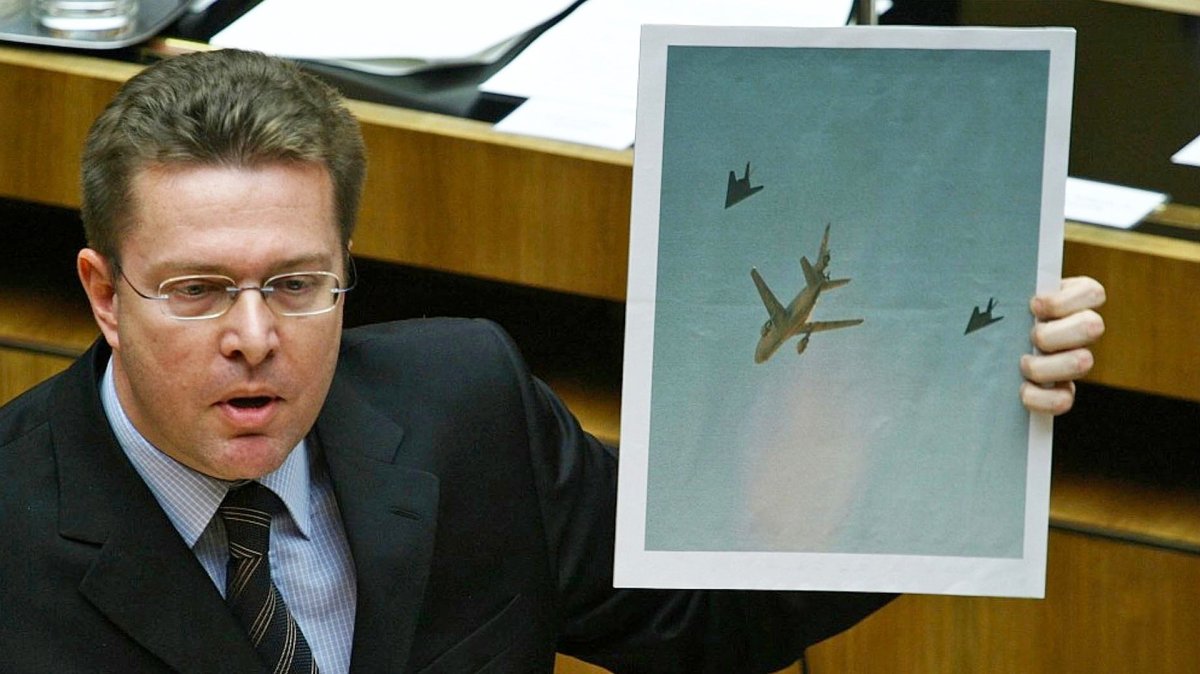
The two Sidewinder-toting Drakens shadowed the formation and captured imagery, which was presented by the Austrian Minister of Defense Herbert Scheiber during a meeting of the National Security Council and was presented as part of a diplomatic protest lodged at the US embassy in Vienna.
According to the Wall Street Journal report and an online feature by Austrian defense journalists, MP Peter Pilz spoke at the National Security Council meeting on Oct. 24 accusing the government of authorizing illegal overflights. However, the Austrian Ministry of Defense presented the imagery to prove that such incidents were being taken very seriously.
Austria was highly alert to airspace incursions, which were of particular significance during the Balkan Wars of the 1990s. It increased its quick reaction alert to include primary and standby pairs of Drakens. Due to the country’s geography, incursions often only occur for a few fleeting minutes, especially where the flight time between German and Italian airspace is very short.
According to reporting at the time, the U.S. Embassy said the flights had been properly planned and after the story broke, the Austrian Defense Ministry said there had been confusion, but stopped short of accusing the U.S. of breaking the rules. It remains unknown if the F-117s were equipped with radar reflectors or not during their transit close to the KC-10, but either way, it would have likely appeared as one target.
Austria retired its last Drakens in 2005., Bundesheer
Austria’s air policing remains a thorny subject to this day. The acquisition of 15 Eurofighter Typhoons has been a contentious issue since it was announced in 2002. Austria recently announced that it is planning to retire its aging Saab 105ÖE jet trainers that have been used for air surveillance and that the Eurofighters would be retained for the foreseeable future. As if to add more confusion, a report from Jane’s has subsequently revealed a move by Indonesia to purchase Austria’s Eurofighters.
At a time when air policing in the European Union is under the spotlight, the Austrian F-117 overflight fiasco has not only reemerged, but it has been held up as an example of why a credible air defense force is so important. It also serves as a useful reminder of a tactic that remains in use to this day when air forces want to move fighter aircraft without drawing unwanted attention.
Contact the author: Jamie@thedrive.com
Comments couldn’t be loaded. Please refresh the page.
发布于美国东部时间2020年7月21日下午4:08
近期媒体对爱尔兰共和国领空防御能力的报道,揭开了此前鲜为人知的美国空军试图秘密派遣两架洛克希德F-117A“夜鹰”战斗机穿越奥地利领空的事件。一条相关的推特帖子援引奥地利事件,提醒人们战斗机是现代防空系统不可或缺的一部分,对执行空中警戒任务至关重要。
故事要追溯到2002年10月18日,当时美国空军提交了一份飞行计划,计划让一架麦克唐纳·道格拉斯KC-10A“延展者”加油机飞越奥地利领空。据报道,美国空军没有透露的是,飞行期间,两架F-117战斗机以紧密编队紧贴着这架大型加油机的机翼下方。美军经常在从德国飞往意大利或中东的航线上飞越奥地利和瑞士,以避免长时间飞越法国。然而,这两个中立国可以阻止任何不必要的飞越。
当时,美国军方正在中东地区集结兵力,准备对萨达姆·侯赛因统治下的伊拉克发动可能的进攻。就连北约成员国也难以获得公众对美国飞机飞越其领空或在其军事基地提供支持的认可。
奥地利缺乏可靠的空中警戒飞机,这凸显了其在美国强大实力面前的弱势感。奥地利仅拥有一支相当老旧的萨博J-35ÖE“龙”式战斗机机队用于快速反应警戒,这些飞机仅配备AIM-9P3“响尾蛇”导弹和两门内置30毫米机炮。然而,奥地利对其领空的使用仍然充满信心。“任何一架美国飞机都没有资格飞越奥地利领空,”奥地利议会绿党议员彼得·皮尔茨在2003年《华尔街日报》的一篇报道中写道。奥地利对飞越其领空的程序有着明确的指导,详情请见此网页。
一般来说,大型非武装加油机和运输机的外交审批流程比携带武器的飞机要简单得多。此外,飞行计划中注明寻求过境的飞机是一架“DC-10”,这通常不会引起注意。该计划已提交,并申请允许飞机从德国施潘达勒姆起飞,途经奥地利领空,使用无线电呼号“Cacti 31”。申请获得批准。然而,奥地利空中交通管制官员发现,飞行计划中包含的序列号除了DC-10之外还有其他序列号。随后,该序列号被更改,这引起了进一步的怀疑。下午3点前不久,当飞机接近奥地利蒂罗尔地区时,奥地利防空网络的新型“金盔”(Goldhaube)雷达系统探测到了这架飞机。
由于飞行计划出现异常,两架奥地利空军的“龙”式战斗机从泽尔特韦格空军基地紧急起飞。下午3点03分,这架DC-10进入奥地利领空,随后偏离了预定航线。据奥地利航空作家格奥尔格·马德尔称:“在我们两架‘龙’式战斗机逼近后,我们发现两架F-117战斗机在KC-10下方非常接近。”马德尔补充道:“美军编队在我们的领空停留了整整10分钟。”当时还有消息称,在奥地利战斗机逼近时,美军编队试图进行“防御机动”。
美国空军一架KC-10加油机正在为一架F-117战斗机进行空中加油。
两架携带响尾蛇导弹的“龙”式飞机尾随编队并拍摄了图像,奥地利国防部长赫伯特·沙伊伯在国家安全委员会会议上展示了这些图像,这些图像也作为外交抗议的一部分提交给了美国驻维也纳大使馆。
据《华尔街日报》报道以及奥地利国防记者的一篇网络专题文章称,奥地利议员彼得·皮尔茨于10月24日在国家安全委员会会议上发言,指责政府授权非法飞越领空。然而,奥地利国防部出示了相关图像,以证明政府对此类事件高度重视。
奥地利对领空入侵保持高度警惕,这在20世纪90年代的巴尔干战争期间尤为重要。奥地利加强了快速反应警戒,部署了主备两组“龙”式防空导弹系统。由于奥地利的地理位置,领空入侵通常只持续几分钟,尤其是在德国和意大利领空之间的飞行时间非常短的情况下。
据当时的报道,美国大使馆称这些飞行任务是经过妥善计划的。消息曝光后,奥地利国防部表示存在一些混乱,但并未指责美国违反规定。目前尚不清楚F-117战机在接近KC-10加油机时是否配备了雷达反射器,但无论如何,它们都可能被视为同一个目标。
奥地利于 2005 年退役了最后一批 Drakes。, Bundesheer
奥地利的空中警戒任务至今仍是一个棘手的问题。自2002年宣布采购15架“台风”战斗机以来,这一计划就一直备受争议。奥地利近期宣布计划退役其用于空中监视的老旧萨博105ÖE喷气式教练机,并表示将在可预见的未来继续保留“台风”战斗机。雪上加霜的是,《简氏防务周刊》随后的一份报告披露,印度尼西亚有意购买奥地利的“台风”战斗机。
在欧盟空中警戒备受关注之际,奥地利F-117战机飞越事件不仅再次被提起,而且还被视为一支可靠的防空力量至关重要的例证。它也提醒人们,空军在调动战斗机时,至今仍在使用一种战术,以避免引起不必要的注意。
联系作者:Jamie@thedrive.com
评论加载失败,请刷新页面。