NATO calls Ukraine’s path to membership ‘irreversible’ in new pledge北约在新承诺中称乌克兰的入盟之路“不可逆转”。
The Washington Summit's final plan included a package of material support for Ukraine, alongside sharp critiques of China.
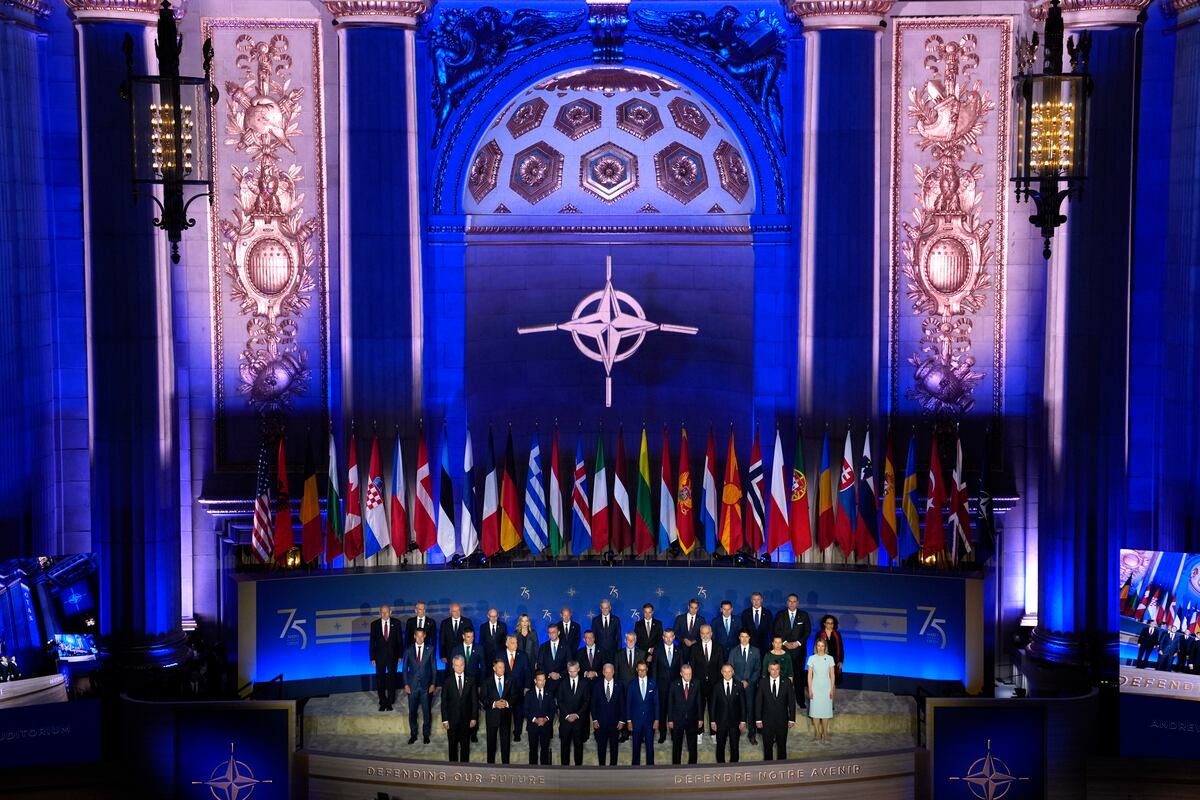
The members of NATO issued their plan for the next year during the 75th anniversary summit in Washington, calling Ukraine’s path to membership in the alliance “irreversible.”
The communique is a rhetorical flourish to the document issued last year in Vilnius, Lithuania, and the strongest commitment to date on having the embattled country join the security pact.
“We welcome the concrete progress Ukraine has made since the Vilnius Summit on its required democratic, economic, and security reforms,” the Washington Declaration reads. “As Ukraine continues this vital work, we will continue to support it on its irreversible path to full Euro-Atlantic integration, including NATO membership.”
Outgoing NATO Secretary General Jens Stoltenberg told reporters the alliance will ensure “that when the time is right, Ukraine will join without delay.”
“It is not a question of if but when,” he said.
But to the disappointment of Ukraine’s biggest supporters, there is no invitation for the nation to join, nor is there a more specific plan to do so.
Unlike during last year’s summit, Ukraine’s delegation understood that such an offer almost certainly wouldn’t arrive. Officials in Kyiv instead turned to the material support they could gather from the summit, like air defense, F-16 fighter jets and an expanded role for NATO to aid Ukraine’s military.
Negotiators working on the communique had jostled over whether it would call Ukraine’s path “irreversible” or a “bridge.” In the end, both made it into the document — a win for those pushing to harden last year’s language. But as many Ukrainian officials and analysts told Defense News this week, it’s still only language.
“Beside the political decisions, which we understand can only go so far now, we need practical decisions” on equipment, Igor Zhovkva, a top adviser to Ukrainian President Volodymyr Zelenskyy, told Defense News.
The pledge includes a large package of such support for Ukraine, including a long-term support for its self-defense. Next year, the allies have pledged to send Ukraine at least $43 billion in funding, some of which will go toward security. Part of the motivation for this commitment is the U.S. presidential election in November, when former President Donald Trump — a skeptic of NATO and the support for Ukraine — could return to the White House.
It also confirms a NATO command in Wiesbaden, Germany, made up of 700 personnel. As Ukraine wanted, this new group will supplement — rather than entirely replace — the work of another forum convened every month by the U.S.
That said, there is still some disagreement within the alliance over which group will lead assistance to Ukraine in the longer run.
In June, speaking at NATO headquarters in Brussels, a senior U.S. defense official said the new command wouldn’t replace the American-led Ukraine Defense Contact Group.
But speaking the week before the summit at an embassy in Washington, a European official said something different.
“Progressively NATO will take that responsibility,” the official said.
Speaking with reporters on Monday, a senior NATO official attributed the disconnect in part to nascency.
“This is a new mechanism that has been set up,” the official said of the Wiesbaden command. “There will be an incremental stepping up of NATO’s role.”
The communique also takes the harshest line on China to date, calling it “a decisive enabler of Russia’s war against Ukraine” through support for the Russian defense industry, part of a bigger partnership between the two autocracies.
NATO called on China to cease such support, and also named two other partners offering military assistance to Russia: North Korea and Iran.
“We strongly condemn [North Korea’s] exports of artillery shells and ballistic missiles, which are in violation of numerous United Nations Security Council resolutions, and note with great concern the deepening ties between [North Korea] and Russia,” the document reads. “Any transfer of ballistic missiles and related technology by Iran to Russia would represent a substantial escalation.”
One of the core struggles for NATO since the war has been surging its member states’ defense industries to compete in the kind of slogging warfare occurring in Ukraine.
As a companion to the communique, the alliance also released a defense-industrial pledge , intended to help marshal their collective manufacturing sectors. Among its commitments are joint procurements, the lowering trade barriers and the fortification of supply chains.
In the next five years, according to the pledge, the allies plan to buy “thousands of air defense and artillery systems, 850 modern aircraft, mostly 5th generation F-35″ jets and other weapons.
Noah Robertson is the Pentagon reporter at Defense News. He previously covered national security for the Christian Science Monitor. He holds a bachelor’s degree in English and government from the College of William & Mary in his hometown of Williamsburg, Virginia.
北约成员国在华盛顿举行的北约成立 75 周年峰会上公布了未来一年的计划,称乌克兰加入北约的道路是“不可逆转的”。
这份公报是对去年在立陶宛维尔纽斯发表的文件的修辞性补充,也是迄今为止对这个陷入困境的国家加入安全条约的最强承诺。
《华盛顿宣言》指出:“我们欢迎乌克兰自维尔纽斯峰会以来在必要的民主、经济和安全改革方面取得的切实进展。随着乌克兰继续推进这项至关重要的工作,我们将继续支持其不可逆转地走上全面融入欧洲-大西洋一体化的道路,包括加入北约。”
即将卸任的北约秘书长延斯·斯托尔滕贝格告诉记者,北约将确保“时机成熟时,乌克兰将毫不拖延地加入”。
“这不是会不会发生的问题,而是何时发生的问题,”他说。
但令乌克兰最大的支持者失望的是,既没有邀请乌克兰加入,也没有更具体的加入计划。
与去年峰会不同,乌克兰代表团这次明白,这样的提议几乎肯定不会到来。基辅官员转而寻求从峰会中获得的物质支持,例如防空系统、F-16战斗机以及北约在援助乌克兰军队方面发挥的更大作用。
参与公报起草的谈判代表们曾就乌克兰的道路究竟应该被称为“不可逆转”还是“桥梁”争论不休。最终,两种说法都被写入了文件——这对那些力主强化去年措辞的人来说无疑是一次胜利。但正如许多乌克兰官员和分析人士本周告诉《防务新闻》的那样,这仍然只是措辞而已。
乌克兰总统泽连斯基的高级顾问伊戈尔·若夫克瓦告诉《防务新闻》:“除了政治决策(我们明白这些决策现在只能做到这一步),我们还需要就装备做出实际的决定。”
该承诺包含一系列对乌克兰的援助,其中包括对其自卫能力的长期支持。明年,盟国承诺向乌克兰提供至少430亿美元的资金,其中一部分将用于安全领域。促成这一承诺的部分原因是11月的美国总统大选,届时对北约及其对乌克兰的支持持怀疑态度的前总统唐纳德·特朗普可能重返白宫。
报告还证实,北约在德国威斯巴登设立了一个由700人组成的指挥部。正如乌克兰所希望的那样,这个新机构将补充而非完全取代美国每月召开的另一个论坛的工作。
尽管如此,联盟内部对于哪个集团将在长期内领导对乌克兰的援助仍然存在一些分歧。
今年6月,一位美国高级国防官员在布鲁塞尔北约总部发表讲话时表示,新成立的指挥部不会取代美国领导的乌克兰防务联络小组。
但在峰会召开前一周,一位欧洲官员在华盛顿的大使馆发表讲话时却说了不同的话。
“北约将逐步承担起这一责任,”这位官员说。
周一,一位北约高级官员在接受记者采访时表示,这种脱节部分原因是由于该机制尚处于起步阶段。
“这是新设立的机制,”这位官员在谈到威斯巴登指挥部时说。“北约的作用将逐步加强。”
该公报对中国采取了迄今为止最严厉的立场,称中国通过支持俄罗斯国防工业,成为“俄罗斯对乌克兰战争的决定性推动者”,这是两国专制政权之间更大伙伴关系的一部分。
北约呼吁中国停止这种支持,并点名了另外两个向俄罗斯提供军事援助的伙伴:朝鲜和伊朗。
文件指出:“我们强烈谴责朝鲜出口炮弹和弹道导弹,这违反了多项联合国安理会决议,并高度关注朝鲜与俄罗斯之间日益密切的关系。伊朗向俄罗斯转让弹道导弹及相关技术将构成局势的重大升级。”
自战争以来,北约面临的核心挑战之一就是推动其成员国的国防工业发展,以参与乌克兰正在发生的这种艰苦卓绝的战争。
作为公报的配套文件,该联盟还发布了一项国防工业承诺,旨在整合其共同的制造业部门。承诺内容包括联合采购、降低贸易壁垒和加强供应链。
根据承诺,未来五年内,盟军计划购买“数千套防空和火炮系统、850架现代化飞机(主要是第五代F-35战斗机)”以及其他武器。
诺亚·罗伯逊是《防务新闻》的五角大楼记者。他此前曾为《基督教科学箴言报》报道国家安全新闻。他拥有弗吉尼亚州威廉斯堡威廉与玛丽学院的英语和政治学学士学位。