As more NATO countries meet spending targets, some push to raise goals随着越来越多的北约国家达到支出目标,一些国家开始推动提高目标。
Over 2/3 of NATO allies now meet the minimum defense spending requirement but some are pushing to raise the target amid uncertainty over Russia and Trump.
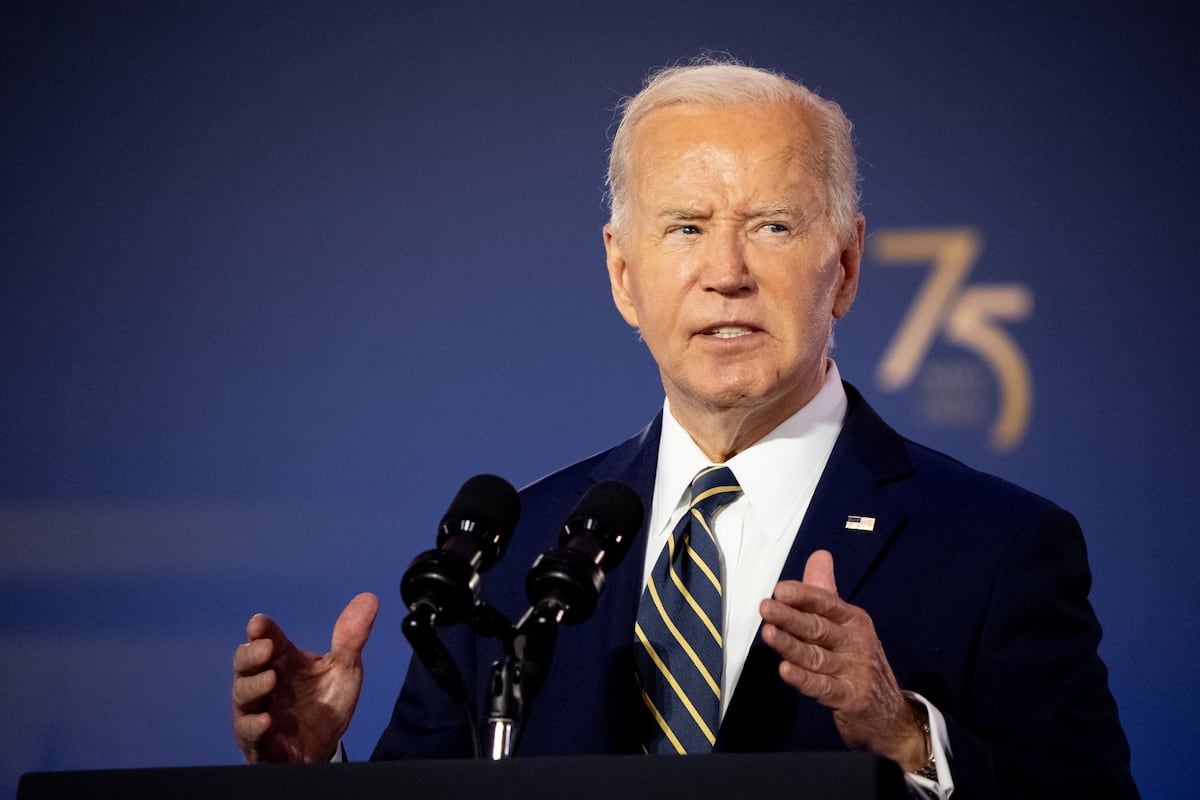
After years of failing to meet NATO’s military spending targets, most of the alliance’s 32 members entered the 75th anniversary summit touting a statistic: more than two-thirds now meet the minimum threshold.
It marks a rapid turnaround in a short period dominated by Russia’s invasion of Ukraine and comes a decade after NATO allies agreed to spend at least 2% of GDP on defense with 20% of that going to major equipment purchases.
Still, some allies on Europe’s eastern flank and Republicans in the U.S. say that’s not enough. They’re pushing to increase the alliance’s defense spending targets beyond 2%, given the war in Ukraine and the risk of an American conflict with China.
None of that stopped President Joe Biden from lauding Washington’s progress in getting its NATO allies to shoulder a greater share of the defense burden, a longstanding gripe of U.S. presidents from both parties.
“In the year 2020, the year I was elected president, only nine NATO allies were spending 2% of their GDP on defense,” Biden said in his opening remarks to kick off the summit on Tuesday. “This year, 23 will spend at least 2 percent. And some will spend more than that.”
Still, some in the alliance consider that an almost hollow victory. The Wales Summit was 10 years ago, well before Russia’s full-scale invasion of Ukraine.
“We reaffirm that, in many cases, expenditure beyond 2% of GDP will be needed in order to remedy existing shortfalls and meet the requirements across all domains arising from a more contested security order,” the allies wrote in a joint communique on Wednesday.
The Baltic states in particular are pushing their allies to go beyond the mandatory 2% floor for defense spending as Russia shows no signs of backing down after more than two years of war in Ukraine.
“We’ll start to talk at least about 2.5% as a floor,” Lithuanian Defense Minister Laurynas Kasčiūnas told Defense News, pointing to NATO’s “capability gaps.”
“When we analyze what the countries need to develop in the near-future, for a decade maybe, it’s not even 2.5%. It’s not even 3%. It should be more if you want more air defense systems, if you want more long-range strike capabilities.”
Tuuli Duneton, Estonia’s Undersecretary for Defense Policy, praised the 23 countries who now meet the 2% spending target but added “we should start already the discussions on putting the target for defense spending even higher.”
“We would support to have the discussion to set in the new target for the next NATO summit in the Hague to either 2.5% or 3% of GDP,” Duneton told reporters.
The U.S. spends roughly 3% of GDP on defense, but the Congressional Budget Office projects that will fall to 2.5% by 2034.
Republicans in the U.S. are also starting to join the Baltic countries’ call to move the defense spending floor beyond 2% of GDP.
“Given these dangerous times, the alliance must do more,” Sen. Dan Sullivan, R-Alaska, said in a Tuesday statement. “We must start working toward a greater defense spending commitment than the current 2% of GDP defense spending benchmark that better reflects this new era of authoritarian aggression we find ourselves in.”
Trump said this year that should he return to the White House, he would allow Russia “to do whatever the hell they want” to NATO allies who do not meet the minimum defense spending benchmark.
Republican presidential candidate former President Donald Trump walks to the podium at a campaign event Tuesday, June 18, 2024, in Racine, Wis. (AP Photo/Jeffrey Phelps)
The former president’s allies are calling on NATO allies to replace the U.S. as Ukraine’s primary security guarantor – a task made all the more complicated by years of Europe’s chronic underinvestment in weapons production lines.
“The things that Europeans most need are not necessarily guys with guns, as important as they are, but lift, logistics, C4ISR, long-range munitions, air defense, but those are exactly the things that are most needed in the Pacific and are most difficult to reconstitute,” Bridge Colby, Trump’s former assistant secretary of defense for strategy, said Tuesday at the Heritage Foundation.
“The best way to manage the situation is to be practical and candid with our European allies and say ‘here’s what we can provide.’ And this is what I’ve said to the Europeans is ‘we’re going to have to withhold some of these key capabilities.”
Collin Meisel, the associate director of geopolitical analysis at the University of Denver’s Frederick S. Pardee Center for International Futures, cautioned “it’s going to take years for the European countries to make up that shortfall and be able to provide adequate support for Ukraine.”
“If the U.S. pulls back its materiel support of Ukraine, then Ukraine is going to be in pretty rough shape.”
He also noted that when Ukraine military aid is framed as a percentage of GDP, the U.S. ranks far below multiple European countries, including countries like the Netherlands that have not met NATO’s 2% of GDP benchmark for overall defense spending.
And the spending targets themselves don’t guarantee a ready military.
“Greece is the poster child for this,” said John Deni, a former political adviser to U.S. military leaders in Europe.
Athens has long spent more than 2% on defense, he noted, but much of it goes to areas that don’t create a strong force, such as personnel and pensions.
“It’s a jobs program,” Deni said.
The 2% and 20% thresholds are the only public thresholds — affirmed as a floor, rather than a ceiling in the 2022 communique in Vilnius, Lithuania.
NATO has 11 private metrics to measure burden sharing, which help assess the readiness of each force, Deni said. It’s also working to finalize regional defense and deterrence plans that will in part guide procurement decisions for member states. Proponents of increasing the 2% benchmark hope these regional plans will also grow military spending.
“It’s not only the percentage itself that matters, but taking into account that NATO military authorities have been assessing based on the regional plans: all military requirements for defense forces and capabilities” said Estonia’s Duneton. “The increased defense spending is most of all necessary for us to be able to deliver on those critical capabilities.”
This story was updated on Wednesday at 4:48 PM to include a statement from the NATO summit communique.
Bryant Harris is the Congress reporter for Defense News. He has covered U.S. foreign policy, national security, international affairs and politics in Washington since 2014. He has also written for Foreign Policy, Al-Monitor, Al Jazeera English and IPS News.
Noah Robertson is the Pentagon reporter at Defense News. He previously covered national security for the Christian Science Monitor. He holds a bachelor’s degree in English and government from the College of William & Mary in his hometown of Williamsburg, Virginia.
多年来,北约32个成员国大多未能达到其军事开支目标。在北约成立75周年峰会上,这些成员国中的大多数都宣称:超过三分之二的成员国现在达到了最低门槛。
这标志着在俄罗斯入侵乌克兰的短暂时期内局势的迅速转变,而就在十年前,北约盟国同意将至少 2% 的 GDP 用于国防,其中 20% 用于购买主要装备。
然而,欧洲东翼的一些盟友和美国共和党人认为这还不够。鉴于乌克兰战争以及美国与中国发生冲突的风险,他们正力促将联盟的国防开支目标提高到2%以上。
尽管如此,拜登总统仍然赞扬了华盛顿在促使其北约盟国承担更大国防责任方面取得的进展,而这正是美国两党总统长期以来一直抱怨的问题。
拜登在周二峰会开幕致辞中表示:“2020年,也就是我当选总统的那一年,只有9个北约盟国将国内生产总值的2%用于国防开支。今年,将有23个盟国至少将国防开支提高到2%,有些盟国的国防开支还会更高。”
然而,联盟内部一些人认为这几乎是一场空洞的胜利。威尔士峰会是十年前举行的,远在俄罗斯全面入侵乌克兰之前。
“我们重申,在许多情况下,需要支出超过国内生产总值的2%,以弥补现有缺口,并满足在更具争议的安全秩序下各个领域提出的需求,”盟国周三在一份联合公报中写道。
波罗的海国家尤其敦促其盟友将国防开支提高到超过强制性的 2% 最低限额,因为在乌克兰战争持续两年多之后,俄罗斯没有丝毫退让的迹象。
立陶宛国防部长劳里纳斯·卡斯丘纳斯在接受《防务新闻》采访时表示:“我们将至少以 2.5% 为底线进行讨论”,他指出北约存在“能力差距”。
“当我们分析各国在不久的将来,或许十年内需要发展什么时,这个比例甚至不到2.5%,不到3%。如果你想要更多的防空系统,如果你想要更强的远程打击能力,这个比例应该更高。”
爱沙尼亚国防政策副部长图利·杜内顿赞扬了目前达到 2% 国防开支目标的 23 个国家,但他补充说:“我们应该立即开始讨论将国防开支目标提高到更高水平。”
“我们支持在海牙举行的下一次北约峰会上讨论将新的目标设定为GDP的2.5%或3%。”杜内顿告诉记者。
美国国防开支约占GDP的3%,但国会预算办公室预测,到2034年这一比例将下降到2.5%。
美国共和党人也开始响应波罗的海国家的呼吁,将国防开支的最低限额提高到GDP的2%以上。
“鉴于当前形势的危险,盟军必须采取更多行动,”阿拉斯加州共和党参议员丹·沙利文周二在一份声明中表示。“我们必须开始努力提高国防开支,使其超过目前占GDP 2%的国防开支基准,以更好地反映我们所处的这个威权侵略的新时代。”
特朗普今年曾表示,如果他重返白宫,他将允许俄罗斯对那些未达到最低国防开支标准的北约盟国“为所欲为”。
2024年6月18日星期二,共和党总统候选人、前总统唐纳德·特朗普在威斯康星州拉辛市的一场竞选活动中走向讲台。(美联社照片/杰弗里·菲尔普斯)
这位前总统的盟友呼吁北约盟国取代美国成为乌克兰的主要安全保障者——由于欧洲多年来对武器生产线的长期投资不足,这项任务变得更加复杂。
“欧洲人最需要的不一定是持枪的人,尽管他们也很重要,而是运输能力、后勤保障、C4ISR(指挥、控制、通信、计算机、情报、监视与侦察)、远程弹药、防空能力,但这些恰恰是太平洋地区最需要的,也是最难重建的,”特朗普的前国防部战略助理部长布里奇·科尔比周二在传统基金会表示。
“处理这种情况的最佳方法是务实坦诚地与我们的欧洲盟友沟通,告诉他们‘这是我们能提供的’。而我对欧洲人说的是,‘我们将不得不保留一些关键能力’。”
丹佛大学弗雷德里克·S·帕迪国际未来中心地缘政治分析副主任科林·梅塞尔警告说,“欧洲国家需要数年时间才能弥补这一缺口,并能够为乌克兰提供足够的援助。”
“如果美国撤回对乌克兰的物资支持,那么乌克兰的处境将会非常糟糕。”
他还指出,如果将对乌克兰的军事援助按GDP的百分比来衡量,美国的排名远远低于多个欧洲国家,包括荷兰等尚未达到北约国防开支占GDP 2%基准的国家。
而且,支出目标本身并不能保证军队随时待命。
“希腊就是这方面的典型例子,”曾担任美国驻欧洲军事领导人政治顾问的约翰·德尼说道。
他指出,雅典长期以来在国防上的支出超过财政收入的2%,但其中很大一部分用于人员和养老金等无法打造强大军队的领域。
“这是一个就业计划,”德尼说。
2% 和 20% 的门槛是仅有的公开门槛——在 2022 年立陶宛维尔纽斯公报中被确认为下限,而不是上限。
德尼表示,北约有11项内部指标来衡量责任分担情况,这些指标有助于评估各部队的战备状态。北约还在努力敲定区域防御和威慑计划,这些计划将在一定程度上指导成员国的采购决策。支持将军费开支基准提高到2%的人士希望,这些区域计划也能促进军费开支的增长。
爱沙尼亚国防部长杜内顿表示:“重要的不仅是百分比本身,还要考虑到北约军事当局一直在根据区域计划评估国防力量和能力的全部军事需求。增加国防开支最重要的是,这能让我们具备这些关键能力。”
本文于周三下午 4:48 更新,加入了北约峰会公报中的一份声明。
布莱恩特·哈里斯是《防务新闻》的国会记者。自2014年以来,他一直在华盛顿报道美国外交政策、国家安全、国际事务和政治。他还曾为《外交政策》、《Al-Monitor》、《半岛电视台英语频道》和IPS新闻撰稿。
诺亚·罗伯逊是《防务新闻》的五角大楼记者。他此前曾为《基督教科学箴言报》报道国家安全新闻。他拥有弗吉尼亚州威廉斯堡威廉与玛丽学院的英语和政治学学士学位。