MBDA to show tank gun-launched missile, cheap cruise missile at DSEIMBDA将在DSEI防务展上展示坦克炮发射导弹和廉价巡航导弹。
The weapon was developed with feedback from the war in Ukraine, where soldiers improvise non-line-of-sight attacks by blind firing high-explosive shells.
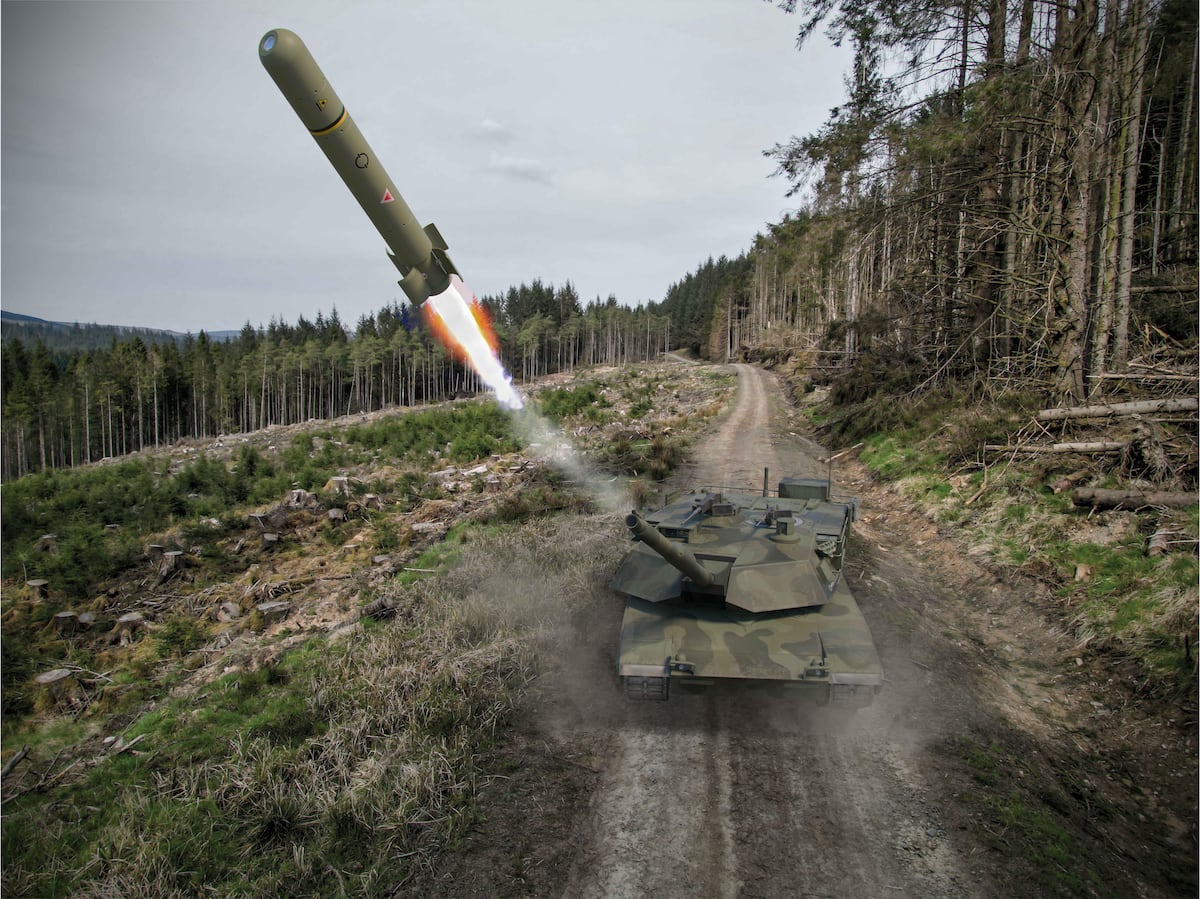
LONDON — MBDA, Europe’s largest missile maker, is developing a non-line-of-sight missile for tanks that crews can load like a regular shell and launch from their 120 millimeter cannon, giving them a way to hit adversaries hiding behind buildings, tree cover or a hill using the main gun.
The new munition allows tanks to fight “in a completely different way,” boosting survivability by allowing them to target enemy armor while staying out of sight, MBDA said in a briefing ahead of the DSEI U.K. show starting in London on Tuesday, where it will present the missile.
The pan-European company will also unveil a low-cost effector with 800-kilometer plus range at the show, a glide version of the Spear air-to-surface missile, and the shape of a stealthy cruise missile being developed for the United Kingdom and France within the Future Cruise/Anti-Ship Weapon program.
The new tank missile, called Akeron MBT 120, was developed based on feedback from the war in Ukraine, where main battle tanks from both sides are improvising non-line-of-sight attacks by blind firing high-explosive shells, and where most tank engagements happen at less than 1,500 meters, according to the company.
MBDA is marketing the missile as a “cost-effective NLOS solution,” and will display a mock-up at DSEI show here. The aim is for test firings next year, depending on customer appetite, with deployment within a “couple of years” at the latest, the company said.
While both Russia and Ukraine have been using gun-launched missiles for added range, those are light-of-sight munitions that require painting the target, putting tank crews at risk of return fire and decreasing survivability, MBDA said.
Akeron MBT will match the specifications of a NATO 120 mm tank round, with a length of less than 1 meter and weighing around 20 kilograms, meaning the missile can be stored under armor and loaded in the turret. MBDA says the missile enables any tank with a 120 mm gun to become a “non-line-of-sight hunter killer,” without changing the vehicle’s signature.
The weapon will use a top attack mode to target enemy armor weak points, with fire-and-forget functionality and a passive electronic-optical/infrared seeker. The passive seeker will allow the missile to bypass laser-activated defensive aids and active protection systems such as Russia’s Shtora-1 electro-optical jammer, MBDA said.
The missile will be fitted in a gun-fit casing with data link, allowing tanks such as Leopard 2 and Challenger 3 to recognize the loaded ammunition. A rocket engine will launch the missile from the gun barrel at low G forces, avoiding the need for expensive high G-force hardened components, before accelerating to low supersonic speeds, MBDA said.
The company will also unveil Crossbow, a weapon for “affordable” deep strike being marketed as “one-way effector heavy,” as opposed to a shorter-range one-way munition presented at the Paris Air Show earlier this year. Whereas the light version presented in Paris is a “saturation solution,” the product on show in London is a “lethality solution,” MBDA said.
The idea has been to keep costs low by using off-the-shelf components and relying on multiple supply chains. Crossbow will have a modular payload of up to 300 kilograms, and while MBDA will offer a warhead, countries can also choose to integrate warheads already in their inventory.
The effector will effectively be a customizable cruise missile weighing 750 kilograms, with a range of more than 800 kilometers, a length of 5.3 meters and a 3-meter wingspan, and powered by a turbojet for high subsonic speeds.
The missile will use AI-enabled image-based navigation, as well satellite and inertial navigation. Final cost of the weapon will depend on customer specifications, which could include more expensive subsystems for higher-threat environments. Launch will be in a single or double configuration from vehicles that can carry a standard 20-foot container.
MBDA is aiming for a demonstration phase in the fourth quarter of this year, seven months after the initial design, and is in talks with a number of potential customers. The company expects to be ready to start production at scale in the second quarter of 2026.
The company says it’s organized an ecosystem of small, medium-sized and large companies across Europe that can supply off-the-shelf subsystems for Crossbow, allowing for high-volume production while ensuring robust and sovereign supply chains.
A glide variant of the Spear missile is another product seeking to provide armed forces with a lower-cost weapon, with the turbojet and fuel of the original missile replaced with a full-caliber, kinetic-energy penetrator. Range will depend on launch conditions, but would be similar to rival glide weapons that claim ranges of 80 to 100 kilometers, according to the company.
Spear Glide is mainly aimed at equipping fourth-generation fighter jets such as Saab’s Gripen, the Eurofighter Typhoon and South Korea’s KF 21, MBDA said. The weapon is designed for use after the first few days of a conflict, once enemy air-defense capability has been reduced.
The lower cost of the glide variant means it can be produced and delivered en masse for a saturation effect, according to the company.
The glide version of Spear will use an EO/IR seeker similar to the one in Crossbow, rather than the radio-frequency seeker of the powered Spear missiles, with cost also kept down by using off-the-shelf components.
MBDA will also display a surface-launched option for the ASRAAM anti-air missile at DSEI UK, as a low-cost system for point defense against uncrewed aerial vehicles and missiles, or as a component in an integrated air-defense system.
Regarding the FC/ASW program, which consists of a high-speed supersonic precision missile and a stealthy long-range cruise missile, MBDA will present a model of the stealthy missile showing the real shape rather than a concept-based artistic vision. The intention remains for both missiles to enter service in the early 2030s, according to the company.
Rudy Ruitenberg is a Europe correspondent for Defense News. He started his career at Bloomberg News and has experience reporting on technology, commodity markets and politics.
伦敦——欧洲最大的导弹制造商MBDA正在开发一种非视线导弹,用于坦克,乘员可以像装填普通炮弹一样装填这种导弹,并从他们的120毫米炮发射出去,使他们能够用主炮击中躲在建筑物、树丛或山丘后面的敌人。
MBDA 在周二于伦敦开幕的 DSEI 英国防务展之前的一次简报会上表示,这种新型弹药使坦克能够以“完全不同的方式”作战,通过使其能够在不被发现的情况下瞄准敌方装甲来提高生存能力,该公司将在展会上展示该导弹。
这家泛欧公司还将在展会上推出一款射程超过 800 公里的低成本效应器、一款滑翔版的“矛”空对地导弹,以及正在为英国和法国在未来巡航/反舰武器计划下开发的隐形巡航导弹的外形。
据该公司称,新型坦克导弹名为 Akeron MBT 120,是根据乌克兰战争的反馈而开发的。在乌克兰战争中,交战双方的主战坦克都在盲射高爆弹进行非视线攻击,而且大多数坦克交战都发生在 1500 米以内。
MBDA公司将这款导弹定位为“高性价比的非视距攻击解决方案”,并将在此次DSEI防务展上展示其模型。该公司表示,目标是在明年进行试射,具体时间取决于客户需求,最迟将在“几年内”投入使用。
MBDA表示,虽然俄罗斯和乌克兰都使用炮射导弹来增加射程,但这些是视距外弹药,需要标记目标,这会使坦克乘员面临被反击的风险,并降低生存能力。
Akeron MBT导弹将符合北约120毫米坦克炮弹的规格,长度不足1米,重量约20公斤,这意味着该导弹可以储存在装甲下方,并在炮塔内装填。MBDA公司表示,该导弹能够使任何装备120毫米火炮的坦克成为“非视线猎杀型”武器,且不会改变车辆的隐身特征。
MBDA公司表示,该武器将采用顶部攻击模式,瞄准敌方装甲弱点,具备发射后不管功能,并配备被动式光电/红外导引头。被动式导引头将使导弹能够绕过激光激活防御系统和主动防护系统,例如俄罗斯的“Shtora-1”光电干扰器。
MBDA公司表示,该导弹将安装在炮管专用弹体中,并配备数据链,使豹2和挑战者3等坦克能够识别已装载的弹药。火箭发动机将以低过载从炮管发射导弹,从而避免使用昂贵的高过载加固部件,之后导弹将加速至低超音速。
该公司还将推出一款名为“十字弓”(Crossbow)的武器,该武器定位为“价格适中”的纵深打击武器,并以“单向效应器重型武器”的形式进行销售,这与今年早些时候在巴黎航展上展示的短程单向弹药有所不同。MBDA公司表示,巴黎航展上展示的轻型版本是一种“饱和打击方案”,而伦敦航展上展出的产品则是一种“致命打击方案”。
其理念是通过使用现成的零部件和依赖多条供应链来降低成本。“弩”导弹的有效载荷将采用模块化设计,最大可达300公斤。MBDA公司将提供弹头,但各国也可以选择集成其库存中已有的弹头。
该效应器实际上将是一款可定制的巡航导弹,重 750 公斤,射程超过 800 公里,长 5.3 米,翼展 3 米,由涡轮喷气发动机提供动力,可实现高亚音速飞行。
该导弹将采用人工智能图像导航、卫星导航和惯性导航。武器的最终成本将取决于客户的具体要求,例如在高威胁环境下可能需要更昂贵的子系统。发射方式可以是单枚或双枚发射,发射车可搭载标准20英尺集装箱。
MBDA的目标是在今年第四季度启动演示阶段,距离最初设计完成已有七个月,目前正在与多家潜在客户洽谈。该公司预计将于2026年第二季度开始大规模生产。
该公司表示,它已在欧洲各地组织了一个由小型、中型和大型公司组成的生态系统,这些公司可以为 Crossbow 提供现成的子系统,从而实现大批量生产,同时确保强大和自主的供应链。
“矛”导弹的滑翔型是另一款旨在为军队提供低成本武器的产品,它用全口径动能穿甲弹取代了原导弹的涡轮喷气发动机和燃料。据该公司称,射程将取决于发射条件,但与其他声称射程为80至100公里的滑翔武器类似。
MBDA公司表示,“矛滑翔”导弹主要面向第四代战斗机,例如萨博的“鹰狮”战斗机、欧洲战斗机“台风”以及韩国的KF-21战斗机。该武器的设计用途是在冲突开始几天后,敌方防空能力削弱之后使用。
该公司表示,滑翔型产品的成本较低,可以大规模生产和交付,从而达到饱和式销售的效果。
滑翔版的“矛”导弹将使用与“弩”导弹类似的光电/红外导引头,而不是动力版“矛”导弹的射频导引头,并且通过使用现成的组件来降低成本。
MBDA 还将在英国防务展 (DSEI UK) 上展示 ASRAAM 防空导弹的地面发射选项,作为一种低成本的点防御系统,用于防御无人驾驶飞行器和导弹,或作为综合防空系统的组成部分。
关于包含高速超音速精确制导导弹和隐形远程巡航导弹的FC/ASW项目,MBDA将展示隐形导弹的真实模型,而非概念性的艺术效果图。该公司表示,两款导弹的计划仍是2030年代初投入使用。
鲁迪·鲁伊滕贝格是《防务新闻》的欧洲记者。他的职业生涯始于彭博新闻社,拥有报道科技、大宗商品市场和政治方面的经验。