The AH-1W Super Cobra Has Been Retired From The Marine Corps After 34 Years Of Service服役34年后,AH-1W“超级眼镜蛇”武装直升机已从美国海军陆战队退役。
The iconic helicopter gunship has stood down from the Marine Corps to be replaced by the much-improved AH-1Z.
新闻视频
Updated Nov 27, 2020 6:12 PM EST
The curtain has finally come down on one of the U.S. Marine Corps’ most battle-hardened helicopters. The branch has officially retired the Bell AH-1W Super Cobra from its ranks, after over three decades of service that included combat operations during Operations Desert Storm, Iraqi Freedom, and Enduring Freedom in Afghanistan, among other campaigns.
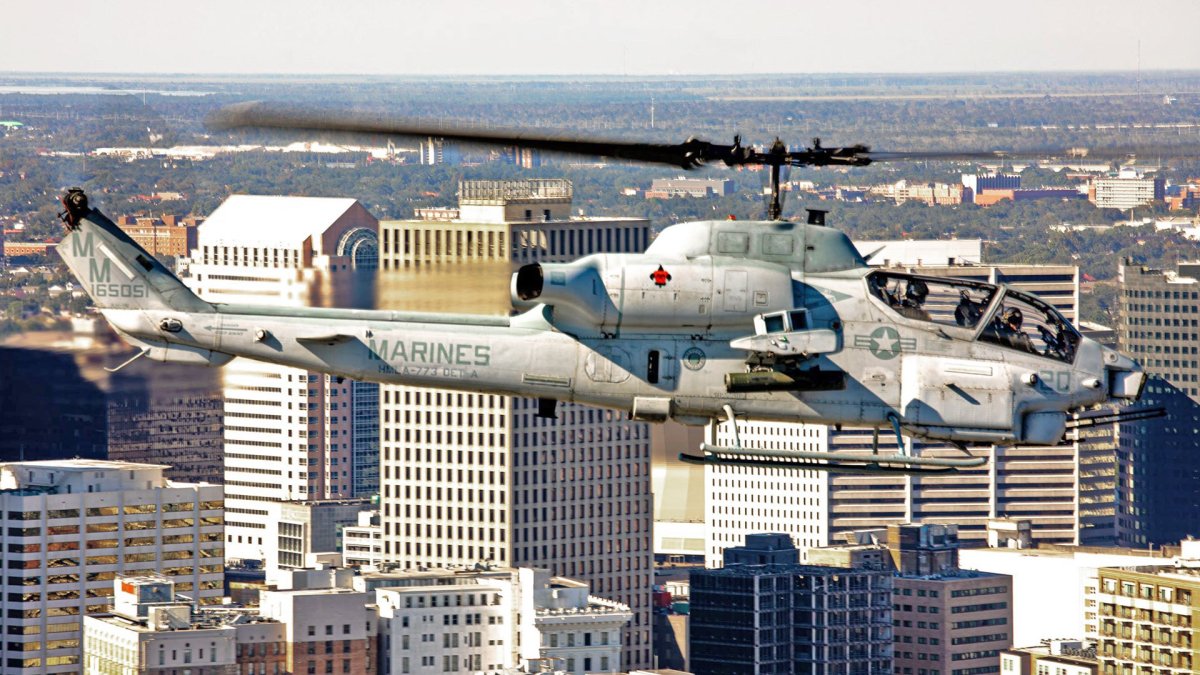
An official final flight for the AH-1W took place at Naval Air Station Joint Reserve Base New Orleans, Louisiana, on October 14, 2020, as part of the “Whiskey Sundown Ceremony.” This also included a photo sortie over New Orleans together with its successor, the AH-1Z Viper . The last “Whiskey” sortie was performed by Detachment A of Marine Light Attack Helicopter Squadron 773, the “Red Dogs,” part of the Reserve Forces, based at New Orleans.
As the U.S. Marine Corps’ premier attack helicopter, the Super Cobra’s career included 933,614 flight hours as of August 2020, according to a press release from the service.
“The AH-1W Super Cobra has served admirably and leaves a remarkable legacy of on-time, on-target attack helicopter support for our Marines,” said Marine Corps Colonel David Walsh, the program manager for Light/Attack Helicopter Programs (PMA-276). “Although the AH-1W chapter is closing, the AH-1Z Viper stands ready with even greater capability to support our Marines for years to come.”
“We are tremendously proud of the capabilities the AH-1W has brought to the United States Marines for the past 34 years,” added Michael Deslatte, H-1 Bell Program Manager. “The Super Cobra’s tremendous legacy is a testament to the excellence and dedication the men and women at Bell put into these platforms for generations and we look forward to continuing that legacy for years to come.”
An AH-1W participates in a final flight during the “Whiskey Sundown Ceremony” at Naval Air Station Joint Reserve Base, New Orleans, on October 14, 2020., U.S. MARINE CORPS/LANCE CPL. CHRISTOPHER ENGLAND
AH-1Z (nearest camera) and AH-1W over New Orleans., U.S. MARINE CORPS/LANCE CPL. CHRISTOPHER ENGLAND
U.S. MARINE CORPS/LANCE CPL. CHRISTOPHER ENGLAND
The Marines first flew the single-engine AH-1G — on loan from the U.S. Army — in Vietnam in 1969, before introducing the twin-engine AH-1J Sea Cobra that entered service in 1971 and which saw combat at the end of the conflict in Southeast Asia, including during Operation Frequent Wind , the evacuation of American diplomatic personnel from the U.S. Embassy in Saigon in April 1975. The Marines then got the improved AH-1T version in 1976, this adding a precision weapons capability with the BGM-71 TOW (Tube-launched, Optically tracked, Wire-guided) anti-tank missile.
The story of the “Whiskey,” meanwhile, can be traced back to the AH-1T+ demonstrator. This version had originally been developed for Iran under the Shah. The Iranians were looking for an enhanced AH-1J that would incorporate new General Electric T700-GE-700 engines and transmission of the Bell Model 214ST helicopter. There were also plans for license-production of the 214ST, which you can read about more in this past War Zone feature , in Iran.
The overthrow of the Shah in 1979 put an end to any Iranian AH-1T+ ambitions, but the U.S. Marine Corps’ plans at that time to acquire a navalized version of the U.S. Army’s AH-64 Apache would also soon run into its own problems. The T+ variant emerged as a suitable replacement after Congress refused to grant any funds for a Marine procurement of the AH-64 in 1981.
Fortunately, Bell had meanwhile continued to work on the AH-1T+ on its own. The helicopter had completed a maiden flight in April 1980 powered by a pair of 1,258-shaft-horsepower General Electric T700-GE-700 engines. This is notably the same engine found on initial AH-64s, as well as early versions of the UH-60 Black Hawk transport helicopter.
The AH-1T+ then returned to the air with T700-GE-401s, a version of the T700 optimized for maritime environments, on November 16, 1983, at Bell’s Flight Research Center in Arlington, Texas. By that time, the helicopter was effectively serving as the AH-1W prototype and the new powerplant had been integrated under a $4.1-million contract.
Besides the new engines, the prototype added a raft of other new features, most prominently bulged “cheek” fairings accommodating electronics associated with the TOW missile, relocated from their previous position in the tail boom, plus large exhaust suppressors to reduce the infrared signature.
As well as the TOW, the prototype also trialed AIM-9 Sidewinder air-to-air missiles and AGM-114 Hellfire air-to-ground missiles, both of which would eventually find places in the arsenal of the production aircraft. Other additions included an AN/ALQ-144 infrared-guided missile countermeasure device, as well as AN/ALE-39 chaff and flare dispensers. New electronics in the nose meant the new attack helicopter could undertake attack missions day or night.
The first production version of this helicopter was designated AH-1W, for which the Marines had placed orders for an initial batch of 44, plus a single TAH-1W training helicopter. Bell delivered the first of these to the Marines on March 27, 1986, and delivered the final aircraft in 1999, ultimately providing a fleet of 179 aircraft. By procuring AH-1Ws, the Marines retained valuable commonality with the “Huey” fleet, an advantage that is optimized today with the AH-1Z and UH-1Y.
The AH-1W went on to serve with distinction during almost three decades of combat in theaters that included Afghanistan, Iraq, Libya, and Somalia. A succession of upgrades ensured the effectiveness of the gunship until the end of its U.S. Marine Corps career.
Lieutenant Colonel Charles Daniel, a pilot with Marine Light Attack Helicopter Squadron 773, walks towards the AH-1W prior to its final flight at Naval Air Station Joint Reserve Base, New Orleans, on October 14, 2020., U.S. MARINE CORPS/MASTER SGT. ROBERT BROWN
Major Patrick Richardson, the executive officer of Marine Light Attack Helicopter Squadron 773, and Lieutenant Colonel Charles Daniel, a pilot with the same unit., U.S. MARINE CORPS/MASTER SGT. ROBERT BROWN
Corporal Reginald Smith, a helicopter mechanic with Marine Light Attack Helicopter Squadron 773, prepares the AH-1W for its final flight., U.S. MARINE CORPS/MASTER SGT. ROBERT BROWN
Lieutenant Colonel Charles Daniel, a pilot with Marine Light Attack Helicopter Squadron 773., U.S. MARINE CORPS/MASTER SGT. ROBERT BROWN
Retirement may mean the official end of the AH-1W in Marine Corps service, but some of the venerable “Whiskey” airframes fly on after they were remanufactured as significantly upgraded AH-1Zs.
The AH-1Z Viper that has replaced the Marine AH-1W began life as a “four-bladed Whiskey” and has been introduced together with the UH-1Y Venom, with which it shares 84 percent parts commonality, as part of the H-1 Upgrade Program. The vastly more capable AH-1Z entered U.S. Marine Corps service in 2010, and you can read all about its attributes here .
True AH-1Ws will continue to serve abroad, as well, with Taiwan and with Turkey. There’s also still a chance that surplus U.S. Marine Corps “Whiskeys” could end up being transferred to one or more foreign air arms, extending this classic type’s illustrious legacy still further, perhaps with its capabilities further enhanced by additional upgrades . While the Marines announced plans to offload most of the “Whiskey” fleet in the past, so far this has not resulted in any export sales.
While some AH-1Ws may continue to fly with the Marines in spirit after getting rebuilt as “Zulus,” the type’s official days of flying with the Corps are now over, after 35 years of service.
Contact the author: thomas@thedrive.com
Comments couldn’t be loaded. Please refresh the page.
更新于美国东部时间2020年11月27日下午6:12
美国海军陆战队最久经沙场的直升机之一终于落下帷幕。贝尔AH-1W“超级眼镜蛇”直升机在服役三十余年后,正式从其队伍中退役。该机曾参与过包括“沙漠风暴行动”、“伊拉克自由行动”和“阿富汗持久自由行动”在内的多项军事行动。
2020年10月14日,AH-1W直升机在路易斯安那州新奥尔良海军航空站联合后备基地举行了正式的最后一次飞行,作为“威士忌日落仪式”的一部分。仪式上,AH-1W与其后继机型AH-1Z“蝰蛇”一同在新奥尔良上空进行了拍照飞行。最后一次“威士忌”飞行由驻扎在新奥尔良的海军陆战队轻型攻击直升机中队773“红狗”A分遣队执行,该中队隶属于后备部队。
据美国海军陆战队发布的新闻稿称,作为美国海军陆战队首屈一指的攻击直升机,截至 2020 年 8 月,超级眼镜蛇的飞行生涯累计飞行时间为 933,614 小时。
“AH-1W超级眼镜蛇直升机表现出色,为我们的海军陆战队提供了及时、精准的攻击直升机支援,留下了卓越的战功,”海军陆战队轻型/攻击直升机项目(PMA-276)项目经理大卫·沃尔什上校说道。“虽然AH-1W的篇章即将落幕,但AH-1Z蝰蛇直升机已做好准备,拥有更强大的能力,将在未来数年继续为我们的海军陆战队提供支持。”
“我们为AH-1W在过去34年中为美国海军陆战队带来的卓越能力感到无比自豪,”贝尔公司H-1项目经理迈克尔·德斯拉特补充道。“超级眼镜蛇的辉煌成就证明了贝尔公司几代员工为这些平台倾注的卓越技艺和奉献精神,我们期待在未来继续传承这一辉煌。”
2020年10月14日,一架AH-1W直升机在位于新奥尔良的海军航空站联合后备基地举行的“威士忌日落仪式”上进行最后一次飞行。(美国海军陆战队/下士克里斯托弗·英格兰摄)
AH-1Z(最近的摄像头)和 AH-1W 直升机飞越新奥尔良上空。美国海军陆战队/下士克里斯托弗·英格兰
美国海军陆战队/下士克里斯托弗·英格兰
1969年,美国海军陆战队首次在越南使用从美国陆军借来的单引擎AH-1G直升机。随后,他们引进了双引擎AH-1J“海眼镜蛇”直升机,该机于1971年服役,并在东南亚冲突末期参与了战斗,包括在1975年4月的“常风行动”(Operation Frequent Wind)中,该行动旨在从美国驻西贡大使馆撤离美国外交人员。1976年,海军陆战队又接收了改进型AH-1T,该机增加了BGM-71 TOW(管式发射、光学跟踪、线导)反坦克导弹的精确制导能力。
与此同时,“威士忌”的故事可以追溯到AH-1T+验证机。该型号最初是为伊朗国王时期开发的。伊朗人当时想要一款改进型的AH-1J,该改进型将采用通用电气T700-GE-700发动机和贝尔214ST型直升机的传动系统。此外,伊朗还计划获得214ST型直升机的特许生产许可,您可以在之前的“战区”专题报道中了解更多相关信息。
1979年伊朗国王被推翻,伊朗的AH-1T+计划就此终结。但与此同时,美国海军陆战队采购陆军AH-64“阿帕奇”武装直升机的海军版计划也很快遭遇挫折。1981年,国会拒绝为海军陆战队采购AH-64拨款,T+型应运而生,成为合适的替代方案。
幸运的是,贝尔公司在此期间继续自主研发AH-1T+直升机。该机于1980年4月完成首飞,动力来自两台1258轴马力的通用电气T700-GE-700发动机。值得注意的是,这款发动机也用于早期的AH-64直升机以及早期型号的UH-60“黑鹰”运输直升机。
1983年11月16日,AH-1T+直升机在位于德克萨斯州阿灵顿的贝尔飞行研究中心重新升空,并搭载了T700-GE-401发动机,这是T700发动机针对海上环境优化的改进型。当时,这架直升机实际上已成为AH-1W的原型机,而新的动力装置也已根据一份价值410万美元的合同完成集成。
除了新发动机外,原型机还增加了一系列其他新功能,最突出的是凸起的“脸颊”整流罩,用于容纳与 TOW 导弹相关的电子设备,这些电子设备从之前的尾梁位置移到了此处,此外还有大型排气抑制器,以减少红外特征。
除了TOW导弹外,原型机还测试了AIM-9“响尾蛇”空空导弹和AGM-114“地狱火”空地导弹,这两种导弹最终都列入了量产型飞机的武器库。其他新增设备包括AN/ALQ-144红外制导导弹对抗装置以及AN/ALE-39箔条和曳光弹投放器。机头的新型电子设备使这款新型攻击直升机能够执行昼夜攻击任务。
这款直升机的首个生产型号被命名为AH-1W,海军陆战队最初订购了44架,外加一架TAH-1W教练直升机。贝尔公司于1986年3月27日向海军陆战队交付了首架飞机,并于1999年交付了最后一架,最终海军陆战队拥有了179架该型直升机。通过采购AH-1W,海军陆战队保留了与“休伊”直升机机队宝贵的通用性,而如今AH-1Z和UH-1Y的出现进一步优化了这一优势。
AH-1W武装直升机在阿富汗、伊拉克、利比亚和索马里等战区近三十年的战斗中屡立战功。一系列的升级改造确保了这款武装直升机在其美国海军陆战队服役生涯结束前始终保持着强大的作战效能。
2020年10月14日,在位于新奥尔良的海军航空站联合后备基地,海军陆战队第773轻型攻击直升机中队飞行员查尔斯·丹尼尔中校走向即将进行最后一次飞行的AH-1W直升机。(美国海军陆战队/罗伯特·布朗中士摄)
美国海军陆战队第773轻型攻击直升机中队执行官帕特里克·理查森少校和该中队飞行员查尔斯·丹尼尔中校。(美国海军陆战队/罗伯特·布朗中士)
美国海军陆战队第773轻型攻击直升机中队的直升机机械师雷金纳德·史密斯下士正在为AH-1W的最后一次飞行做准备。(美国海军陆战队/罗伯特·布朗中士)
美国海军陆战队第773轻型攻击直升机中队飞行员查尔斯·丹尼尔中校/美国海军陆战队一级军士长罗伯特·布朗
退役可能意味着 AH-1W 在海军陆战队服役的正式结束,但一些久经考验的“威士忌”机身在经过大幅升级改造后,作为 AH-1Z 继续飞行。
取代海军陆战队AH-1W的AH-1Z“蝰蛇”直升机最初是“四叶草威士忌”直升机,它与UH-1Y“毒液”直升机一同作为H-1升级计划的一部分推出,两者零部件通用率高达84%。性能大幅提升的AH-1Z于2010年正式加入美国海军陆战队服役,您可以在这里了解它的全部性能。
真正的AH-1W直升机也将继续在海外服役,例如台湾和土耳其。此外,美国海军陆战队剩余的“威士忌”直升机仍有可能转让给一个或多个外国空军,从而进一步延续这款经典机型的辉煌历史,或许还能通过升级进一步提升其性能。虽然海军陆战队过去曾宣布计划出售大部分“威士忌”机队,但迄今为止尚未达成任何出口交易。
虽然一些 AH-1W 直升机在被改装成“祖鲁”之后,可能仍会在精神上继续为海军陆战队效力,但经过 35 年的服役,该机型在海军陆战队的正式飞行生涯已经结束。
联系作者:thomas@thedrive.com
评论加载失败,请刷新页面。