askST Jobs: Should I turn down a promotion to protect my work-life balance?askST Jobs:为了保持工作与生活的平衡,我应该拒绝升职吗?
Should you turn down a promotion to protect your work-life balance? Explore expert advice on weighing career growth against personal priorities and sustainable success. Read more at straitstimes.com.
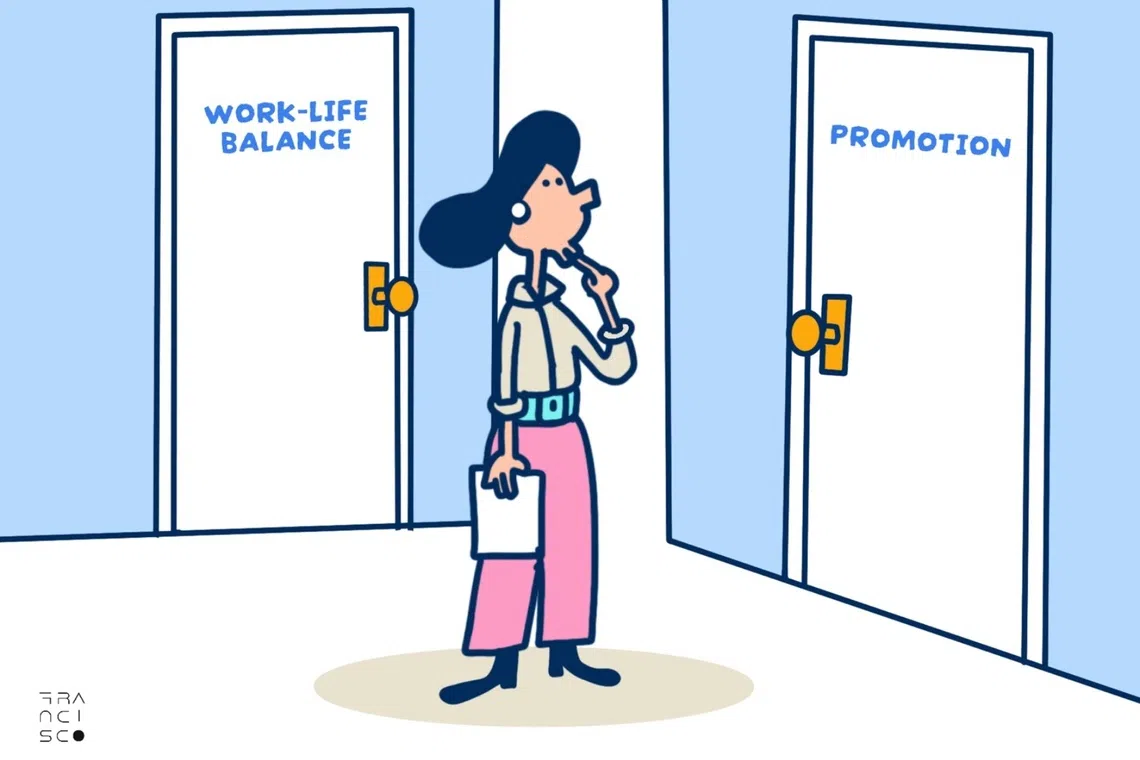
Employees should consider discussing workload, resources, travel, flexibility and even the timing of the promotion with their employer, says the writer.
ST ILLUSTRATION: MANNY FRANCISCO
Published Sep 14, 2026, 05:00 AM
Updated Sep 14, 2026, 06:33 AM
In this series, business correspondent Timothy Goh offers practical answers to candid questions on navigating workplace challenges and getting ahead in your career. Get more tips by signing up to The Straits Times’ Headstart newsletter .
Is it worth giving up higher pay and career progression for better work-life balance?
For many employees, a promotion is supposed to be an automatic “yes”.
It brings higher pay, greater responsibility and a sense that their career is moving forward, which can make turning one down feel like a sign that they are not ambitious enough.
But accepting every promotion is not necessarily a sign of ambition. Sometimes, the more strategic career decision is to say “not now”, said Don Leow, human resources director at the National Institute of Education.
“For someone earlier in their career, taking on a bigger role may make sense because of the exposure, learning and opportunities that come with it. At another stage of life, family, caregiving or personal commitments may matter more,” he said.
“That does not mean the person lacks ambition... Careers are long, and not everyone moves up at the same pace throughout their career.”
Leow added he would also look at what the promotion actually entails for the individual.
“A bigger role does not necessarily translate into longer hours. Sometimes it means more accountability, more complex decisions and getting work done through others,” he said.
“But if it just means more work, more people issues and more pressure without the authority, resources or support to do the job properly, then the trade-off may not be worth it.”
Before deciding, employees should understand what would actually change with the new role, Leow said.
This includes what they would be responsible for, what support they would receive, how much flexibility they would have and whether the workload would be realistic.
A higher pay is attractive, particularly for someone with family commitments, a mortgage or longer-term financial goals. Turning down a promotion may also affect future earnings and opportunities.
“But there is a cost to taking on a role that is not sustainable... If it consistently affects someone’s health, relationships or ability to perform well, the higher salary may not be worth it,” said Leow.
Employees should consider discussing workload, resources, travel, flexibility and even the timing of the promotion with their employer.
“A good employer is prepared to have these conversations,” said Leow.
“Promoting capable people into roles that eventually burn them out is not good talent management policy and there is an organisational price to it.
“A promotion should expand your career, not consume the rest of your life... Sometimes accepting it is the right move, and sometimes asking for different terms, or deciding that the timing is wrong, is the wiser one,” he said.
Carol Poh, HR director at The Edge Partnership, noted that a promotion does not necessarily mean a heavier workload or longer working hours.
Depending on the role, it could instead involve greater responsibility, more complex stakeholder management, broader decision-making or increased strategic influence, without requiring a significant increase in time commitment.
“It is therefore important to consider not only the immediate demands of a promotion, but also how the role contributes to one’s longer-term career progression and opportunities within the organisation,” said Poh.
Employers are increasingly recognising the importance of work-life integration and offering greater flexibility through initiatives such as flexible working hours, hybrid work arrangements and greater autonomy in managing work commitments.
“These options give employees more choice in balancing their career aspirations with personal and family priorities, while still allowing them to pursue meaningful career growth when the right opportunities arise,” Poh said.
Timothy Goh is a business correspondent at The Straits Times. He covers commodities and currencies, with occasional forays into listed companies.
作者表示,员工应该考虑与雇主讨论工作量、资源、出差、灵活性,甚至晋升时间。
插图:曼尼·弗朗西斯科
发布于 2026 年 9 月 14 日上午 5:00
更新于2026年9月14日上午6:33
在本系列文章中,商业记者Timothy Goh将就如何应对职场挑战和如何在职业生涯中取得成功等坦诚问题,提供切实可行的解答。订阅《海峡时报》的“Headstart”新闻简报,获取更多实用技巧。
为了更好的工作与生活平衡,放弃更高的薪水和职业发展机会值得吗?
对许多员工来说,升职应该意味着“当然可以”。
它会带来更高的薪水、更大的责任,以及一种职业发展的感觉,这可能会让拒绝这样的机会感觉像是自己不够有抱负的表现。
但接受每一次晋升并不一定意味着雄心勃勃。新加坡国立教育学院人力资源总监唐·廖表示,有时,更具战略意义的职业选择是说“现在还不是时候”。
“对于职业生涯早期的人来说,承担更重要的角色可能是有意义的,因为这会带来更多的经验、学习机会和发展机遇。而在人生的另一个阶段,家庭、照顾家人或个人责任可能更为重要,”他说道。
“这并不意味着这个人缺乏抱负……职业生涯很长,并非每个人在整个职业生涯中都能以相同的速度晋升。”
廖先生补充说,他还会考虑晋升对个人实际意味着什么。
“承担更重要的角色并不一定意味着工作时间更长。有时它意味着承担更多责任、做出更复杂的决策,以及通过他人完成工作,”他说道。
“但如果这意味着更多的工作、更多的人事问题和更大的压力,却没有相应的权力、资源或支持来妥善完成工作,那么这种权衡可能并不值得。”
Leow表示,员工在做出决定之前应该了解新角色究竟会带来哪些变化。
这包括他们的职责、他们将获得的支持、他们的灵活性以及工作量是否合理。
更高的薪水很有吸引力,尤其对于那些有家庭责任、房贷或长期财务目标的人来说更是如此。拒绝晋升也可能影响未来的收入和发展机会。
“但是,承担一份无法持续的工作是有代价的……如果它持续影响到一个人的健康、人际关系或工作能力,那么更高的薪水可能就得不偿失了,”Leow说道。
员工应考虑与雇主讨论工作量、资源、出差、灵活性,甚至晋升时间等事宜。
“一个好的雇主会做好进行这些对话的准备,”Leow说道。
“提拔有能力的人担任最终会让他们精疲力竭的职位,这不是好的人才管理政策,而且会给组织带来代价。”
“升职应该拓展你的职业生涯,而不是占据你生活的全部……有时候接受升职是正确的选择,而有时候要求不同的条件,或者认为时机不对,才是更明智的做法。”他说。
The Edge Partnership 的人力资源总监 Carol Poh 指出,晋升并不一定意味着工作量增加或工作时间延长。
根据职位不同,它可能涉及更大的责任、更复杂的利益相关者管理、更广泛的决策或更大的战略影响力,而无需大幅增加时间投入。
“因此,不仅要考虑晋升的直接需求,还要考虑该职位如何促进个人在组织内的长期职业发展和机会,” Poh 说。
雇主们越来越认识到工作与生活平衡的重要性,并通过弹性工作时间、混合工作安排以及在管理工作方面更大的自主权等举措,提供更大的灵活性。
Poh表示:“这些选择让员工在平衡职业抱负与个人和家庭优先事项方面拥有更多选择,同时还能让他们在合适的机遇出现时追求有意义的职业发展。”
Timothy Goh是《海峡时报》的商业记者,主要报道大宗商品和货币,偶尔也关注上市公司。