Australia details its nuclear-submarine ambitions澳大利亚详细阐述其核潜艇计划
The Australian government has established a Future Nuclear Submarine Task Force which will work with U.K. and U.S. counterparts over the next twelve to eighteen months to determine the best way to acquire the boats.
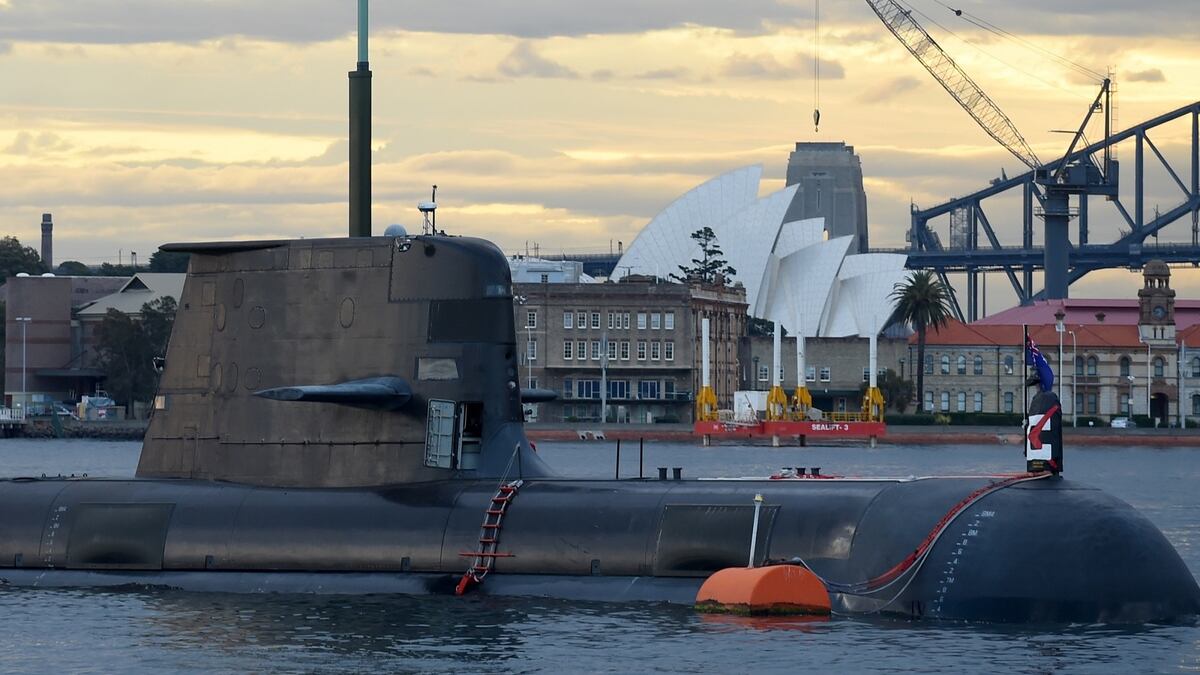
MELBOURNE, Australia — The Australian government has established a Future Nuclear Submarine Task Force which will work with U.K. and U.S. counterparts over the next twelve to eighteen months to determine the best way to acquire the boats.
While a specific type of nuclear submarine is yet to be determined, likely candidates would appear to be either Britain’s Astute-class attack submarine or the U.S. Virginia-class vessel. Construction is slated to take place locally at Osborne in South Australia.
Australian Prime Minister Scott Morrison, U.S. President Joe Biden and U.K. Prime Minister Boris Johnson jointly announced the formation of a new tripartite alliance known as AUKUS on Thursday (local time), under which the first initiative will to build at least eight nuclear-powered submarines for the Royal Australian Navy.
Morrison also announced that a previous $90 billion (US$65.88 billion) contract Australia holds with France’s Naval Group for the construction of 12 conventional submarines, which were to have been known as the Attack class in Royal Australian Navy’s service, has been terminated.
A decision on the final number of new submarines is expected to be made by Canberra during the upcoming analysis phase.
“We intend to build these submarines in Adelaide, Australia in close cooperation with the United Kingdom and the United States,” Morrison said, “But let me be clear: Australia is not seeking to acquire nuclear weapons or establish a civil nuclear capability and we will continue of meet all our nuclear non-proliferation obligations.”
The change to a nuclear-powered boat in lieu of the conventional submarine Australia was designing in conjunction with Naval Group and Lockheed Martin Australia (for the Combat System) was made as a result of the meeting between the three leaders at the G7 Summit held in the UK in June, during which the AUKUS alliance concept was formulated.
The decision is understood to have been brought about by the deteriorating security environment and rapidly evolving military technologies in the Indo-Pacific region, and it is enabled by new technology which allows Australia to build nuclear-powered boats that do not require a supporting civil nuclear industry.
Australia has spent around AU$2.4 billion (U.S. $1.76 billion) on the Attack-class design so far, but the additional cost of terminating the current contract is yet to be negotiated. The projected cost of the new future nuclear submarine has also yet to be determined or announced.
In a statement following Thursday’s announcement, Naval Group described the Australian decision a “major” disappointment. “Naval Group was offering Australia a regionally superior conventional submarine with exceptional performances. A sovereign submarine capability making unrivaled commitments in terms of technology transfer, jobs and local content,” the company said.
“For five years, Naval Group teams, both in France and in Australia, as well as our partners, have given their best and Naval Group has delivered on all its commitments.”
The company said an analysis of the consequences of the decision will be conducted with the Commonwealth of Australia in the coming days.
The deputy secretary for the national naval shipbuilding program, Tony Dalton, told Defense News that “the decision to not proceed with the Attack Class Submarine Program was driven by a consideration of the strategic circumstances and the impact this has on Australia’s submarine capability requirements.”
“It was not related to the performance of Naval Group or Lockheed Martin,” Dalton added. “Over the coming months, the Department will conduct negotiations with both Naval Group Australia and Lockheed Martin Australia to reach a fair and equitable agreement to wind up the Attack class submarine program. "
The change of heart is likely to mean the Royal Australian Navy’s Collins-class submarines will now remain in service, in diminishing numbers, until the late 2040s. The six Collins boats will cycle through a further Full Cycle Docking (FSD) activity and Life of Type Extension (LOTE) program to ensure their effectiveness until withdrawal. The scope of the LOTE upgrade has not been made public, but an announcement by South Australian Premier Steven Marshal Thursday revealed the work will also be done at Osborne.
Nigel Pittaway is the Australia correspondent for Defense News.
澳大利亚墨尔本——澳大利亚政府成立了未来核潜艇工作组,该工作组将在未来十二至十八个月内与英国和美国的同行合作,以确定获取这些潜艇的最佳方式。
虽然具体型号的核潜艇尚未确定,但可能的候选方案似乎是英国的机敏级攻击型核潜艇或美国的弗吉尼亚级核潜艇。建造工作计划在南澳大利亚的奥斯本进行。
澳大利亚总理斯科特·莫里森、美国总统乔·拜登和英国首相鲍里斯·约翰逊于周四(当地时间)共同宣布成立名为 AUKUS 的三方联盟,该联盟的首要任务是为澳大利亚皇家海军建造至少八艘核动力潜艇。
莫里森还宣布,澳大利亚此前与法国海军集团签订的价值 900 亿澳元(658.8 亿美元)的建造 12 艘常规潜艇的合同已被终止,这些潜艇原本将在澳大利亚皇家海军中被称为“攻击级”潜艇。
预计堪培拉将在即将到来的分析阶段就新潜艇的最终数量做出决定。
莫里森说:“我们计划在澳大利亚阿德莱德与英国和美国密切合作建造这些潜艇。但我要明确指出:澳大利亚不寻求获取核武器或建立民用核能力,我们将继续履行所有核不扩散义务。”
澳大利亚与海军集团和洛克希德·马丁澳大利亚公司(作战系统)联合设计的常规潜艇,被改为核动力潜艇,这是由于三位领导人在6月于英国举行的七国集团峰会上会晤,期间制定了AUKUS联盟概念。
据了解,这一决定是由于印太地区安全环境恶化和军事技术快速发展所致,而这项新技术使澳大利亚能够建造无需民用核工业支持的核动力船。
澳大利亚迄今已在“攻击”级潜艇设计上花费了约24亿澳元(17.6亿美元),但终止现有合同的额外费用尚未协商。新型未来核潜艇的预计成本也尚未确定或公布。
在周四的声明发布后,法国海军集团称澳大利亚的决定“令人大失所望”。该公司表示:“法国海军集团向澳大利亚提供的是性能卓越的区域领先常规潜艇,具备自主潜艇能力,并在技术转让、就业和本地化方面做出了无与伦比的承诺。”
“五年来,法国海军集团在法国和澳大利亚的团队以及我们的合作伙伴都尽了全力,法国海军集团也履行了所有承诺。”
该公司表示,将在未来几天与澳大利亚联邦政府一起分析该决定的后果。
国家海军造船计划副部长托尼·道尔顿告诉《防务新闻》:“决定不继续推进攻击级潜艇计划是出于对战略形势以及这对澳大利亚潜艇能力需求的影响的考虑。”
达尔顿补充说:“这与海军集团或洛克希德·马丁公司的业绩无关。未来几个月,国防部将与海军集团澳大利亚公司和洛克希德·马丁澳大利亚公司进行谈判,以达成一项公平合理的协议,结束攻击级潜艇项目。”
这一政策转变可能意味着澳大利亚皇家海军的柯林斯级潜艇将继续服役至2040年代末,但数量将逐渐减少。这六艘柯林斯级潜艇将再次进行全周期坞修(FSD)和延寿升级(LOTE)计划,以确保其在退役前的作战效能。延寿升级的具体内容尚未公开,但南澳大利亚州州长史蒂文·马歇尔周四宣布,这项工作也将在奥斯本进行。
Nigel Pittaway 是《国防新闻》驻澳大利亚记者。