Procurement decision for powerful Navy jammer heads to court海军强力干扰器的采购决定即将提交法院审理
L3Harris Technologies has filed suit in the Court of Federal Claims protesting a decision by the Government Accountability Office.
This story was updated Sept. 17, 2021, with comment from the U.S. Navy.
WASHINGTON — L3Harris Technologies has filed suit Sept. 7 in the Court of Federal Claims protesting a decision by the Government Accountability Office requiring the Navy to potentially reopen discussion and request revised proposals for the next increment of a powerful airborne jammer.
The Aug. 18 GAO decision sided with Northrop Grumman, who alleged the Navy failed to consider the impact of a potential conflict of interest for a Navy employee that developed specifications for the system in question — the Next Generation Jammer Low Band pod — while simultaneously negotiating for employment with L3Harris during the solicitation.
The decision agreed with Northrop that there was the appearance of an unfair competitive advantage in favor of L3Harris. The GAO also said the Navy must engage individuals with the requisite technical expertise to conduct an independent review of the individual in question’s input during the relevant period of conflict to determine if their input was consistent with the Navy’s actual requirements.
If the Navy determines the specifications reflect needs, GAO recommended the Navy reopen discussions, request revised proposals, evaluate proposals and make a new source-selection decision.
However, if the Navy decides its specifications have changed, GAO recommended the service issue an amendment reflecting updated requirements, request revised proposals and make a new source selection decision.
The Navy previously determined allegations did not rise to the level of a significant conflict of interest.
All the relevant court documents are under seal.
“We fundamentally believe the GAO decision is wrong and we filed a protest of that effect in the Court of Federal Claims to support the Navy’s award decision,” Dana Mehnert, president of the Communications Systems segment at L3Harris, told C4ISRNET.
In a statement, Northrop told C4ISRNET it is looking forward to continuing to support the Navy as it determines how best to meet its Next Generation Jammer Low Band requirements.
“Program Executive Officer for Tactical Aircraft Programs (PEO(T)), who oversees PMA-234, is assembling the Independent Review Team and PMA-234 is developing the revised evaluation schedule. The program expects the Independent Review Team (IRT) to begin their review this month. The IRT’s review will not be limited to any specific amount of time, but rather the IRT will be asked to conduct a comprehensive review pursuant to the GAO’s recommendations,” a Navy spokesperson told C4ISRNET. “If the specification is validated, PMA-234 will determine the best way to deliver this critical capability to the fleet expeditiously. If the IRT finds the specification does not accurately trace to the Navy’s operational requirements, PMA-234 will issue an amendment to the Request for Proposal with updated requirements, request revised proposals, and make a new source selection decision.”
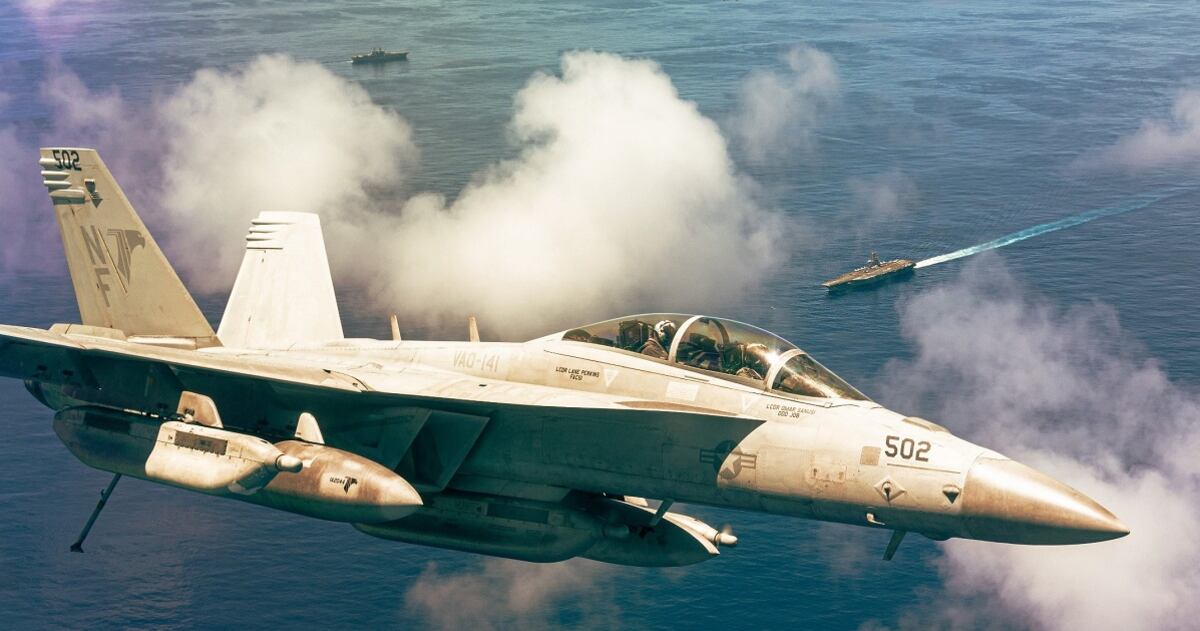
The program in question is the Next Generation Jammer, which will serve as the Navy’s premier aerial electronic attack platform that will replace the ALQ-99 jamming pod and be mounted aboard EA-18 Growler aircraft. It has been broken into three pods covering three portions of the electromagnetic spectrum: mid, low and high.
Raytheon was awarded the mid-band pod in 2016.
The Navy has not included a specific line item on par with the mid- or high-band in at least the last three budget requests.
For the low-band procurement, the Navy decided to undergo a different approach it described as a demonstration of existing technologies. In 2018, it awarded Northrop and L3 Technologies a contract to help inform the Navy of how to continue to mature the program for the Low-Band jammer .
At the time of the award, L3 Technologies had not yet merged with Harris Corporation , which was completed in July 2019. Harris Corporation was part of the Northrop team at the time.
L3Harris eventually won the contract in December 2020 under what was dubbed Capability Baseline 1, which seeks to take the demonstration technology to the preproduction phase and fully evolve the solution.
The GAO’s report noted the “technical factor is significantly more important than the cost factor, and under the technical factor, proposals will be assigned a technical rating and a technical risk rating.”
The report cited the Navy’s description of Northrop’s technical rating as “unacceptable,” with an “unacceptable” technical risk rating. The report also cited the Navy’s description of L3Harris’ technical rating as “outstanding,” with a “moderate” technical risk rating despite being $48 million more costly.
“Fundamentally, you have to look at the differences in the ratings. … That’s not a gap you close by an amendment to a bid. That’s not something that somebody multiple levels down in an organization is going to steer,” Mehnert said. “That’s a fundamental disconnect between the solutions versus the Navy’s requirement.”
Work on the project is currently stalled while the protest is hashed out.
L3Harris believes its suit could lead to a more expeditious decision.
“One of the reasons we filed the protest in the Court of Federal Claims was to try to preclude a further drawn out process if the Navy went back and went through an evaluation process and there was another GAO protest,” Mehnert said.
Mark Pomerleau is a reporter for C4ISRNET, covering information warfare and cyberspace.
本文于 2021 年 9 月 17 日更新,加入了美国海军的评论。
华盛顿——L3Harris Technologies 于 9 月 7 日向联邦索赔法院提起诉讼,抗议政府问责局的一项决定,该决定要求海军重新讨论并要求对下一代强大的机载干扰器提出修改后的方案。
8 月 18 日,美国政府问责局 (GAO) 的裁决支持了诺斯罗普·格鲁曼公司,该公司声称海军未能考虑潜在的利益冲突的影响,因为一名海军雇员在为相关系统(下一代低频干扰吊舱)制定规格的同时,还在招标期间与 L3Harris 公司洽谈就业事宜。
该决定认同诺斯罗普的观点,即L3Harris公司似乎获得了不公平的竞争优势。美国政府问责局(GAO)还表示,海军必须聘请具备必要技术专长的人员,对涉事人员在冲突期间的贡献进行独立审查,以确定其贡献是否符合海军的实际需求。
如果海军认定规格反映了需求,美国政府问责局建议海军重新展开讨论,要求修改提案,评估提案,并做出新的采购选择决定。
但是,如果海军认为其规格发生了变化,美国政府问责局建议海军发布一项修正案,反映更新后的要求,要求提交修改后的提案,并做出新的供应商选择决定。
海军此前认定,这些指控并未构成重大利益冲突。
所有相关法庭文件均已封存。
L3Harris 通信系统部门总裁 Dana Mehnert 告诉 C4ISRNET:“我们从根本上认为 GAO 的决定是错误的,我们已向联邦索赔法院提出抗议,以支持海军的授标决定。”
诺斯罗普公司在一份声明中告诉 C4ISRNET,该公司期待继续支持海军,帮助其确定如何最好地满足其下一代低频段干扰机的需求。
海军发言人告诉C4ISRNET:“负责PMA-234项目的战术飞机项目执行官(PEO(T))正在组建独立审查小组,PMA-234项目也在制定修订后的评估计划。该项目预计独立审查小组(IRT)将于本月开始审查工作。IRT的审查时间没有具体限制,而是将根据美国政府问责局(GAO)的建议进行全面审查。如果规范得到验证,PMA-234将确定向舰队快速交付这项关键能力的最佳途径。如果IRT发现规范与海军的作战需求不符,PMA-234将发布一份包含更新需求的征求建议书修正案,要求提交修订后的提案,并做出新的供应商选择决定。”
该项目名为“下一代干扰机”,将成为海军首屈一指的空中电子攻击平台,取代现有的ALQ-99干扰吊舱,并安装在EA-18“咆哮者”电子战飞机上。该系统分为三个吊舱,分别覆盖电磁频谱的三个部分:中频、低频和高频。
雷神公司于 2016 年获得了中频段模块的合同。
海军在最近至少三份预算申请中都没有列入与中高端预算相当的具体项目。
在低频段采购方面,海军决定采取一种不同的方法,并将其描述为现有技术的演示。2018年,海军授予诺斯罗普·格鲁曼公司和L3技术公司一份合同,以帮助海军了解如何继续完善低频段干扰机项目。
在获奖时,L3 Technologies 尚未与 Harris Corporation 合并,该合并于 2019 年 7 月完成。当时 Harris Corporation 是 Northrop 团队的一部分。
L3Harris 最终在 2020 年 12 月赢得了这份合同,该合同被称为能力基线 1,旨在将演示技术推进到预生产阶段并全面发展该解决方案。
美国政府问责局的报告指出,“技术因素比成本因素重要得多,根据技术因素,提案将被赋予技术评级和技术风险评级。”
报告援引海军对诺斯罗普公司技术评级的评价,称其“不合格”,技术风险评级也“不合格”。报告还援引海军对L3Harris公司技术评级的评价,称其“优秀”,技术风险评级为“中等”,尽管L3Harris的造价高出4800万美元。
“从根本上讲,你必须关注评级之间的差异……这不是通过修改投标书就能弥合的差距。这不是组织中层级较低的人能够左右的事情,”梅纳特说。“这是解决方案与海军需求之间根本性的脱节。”
目前,由于抗议活动仍在处理中,该项目的工作暂时停滞。
L3Harris认为其诉讼可能会促使法院更快地做出裁决。
梅纳特说:“我们向联邦索赔法院提起抗议的原因之一是为了防止海军重新进行评估程序,导致政府问责局再次提出抗议,从而使程序进一步拖延。”
Mark Pomerleau 是 C4ISRNET 的记者,报道信息战和网络空间。