France tests space lasers for secure satellite downlink in world first法国首次测试用于安全卫星下行链路的空间激光器
The point-to-point nature of lasers makes them more secure than radio frequencies, and they can’t be jammed the way radio can.
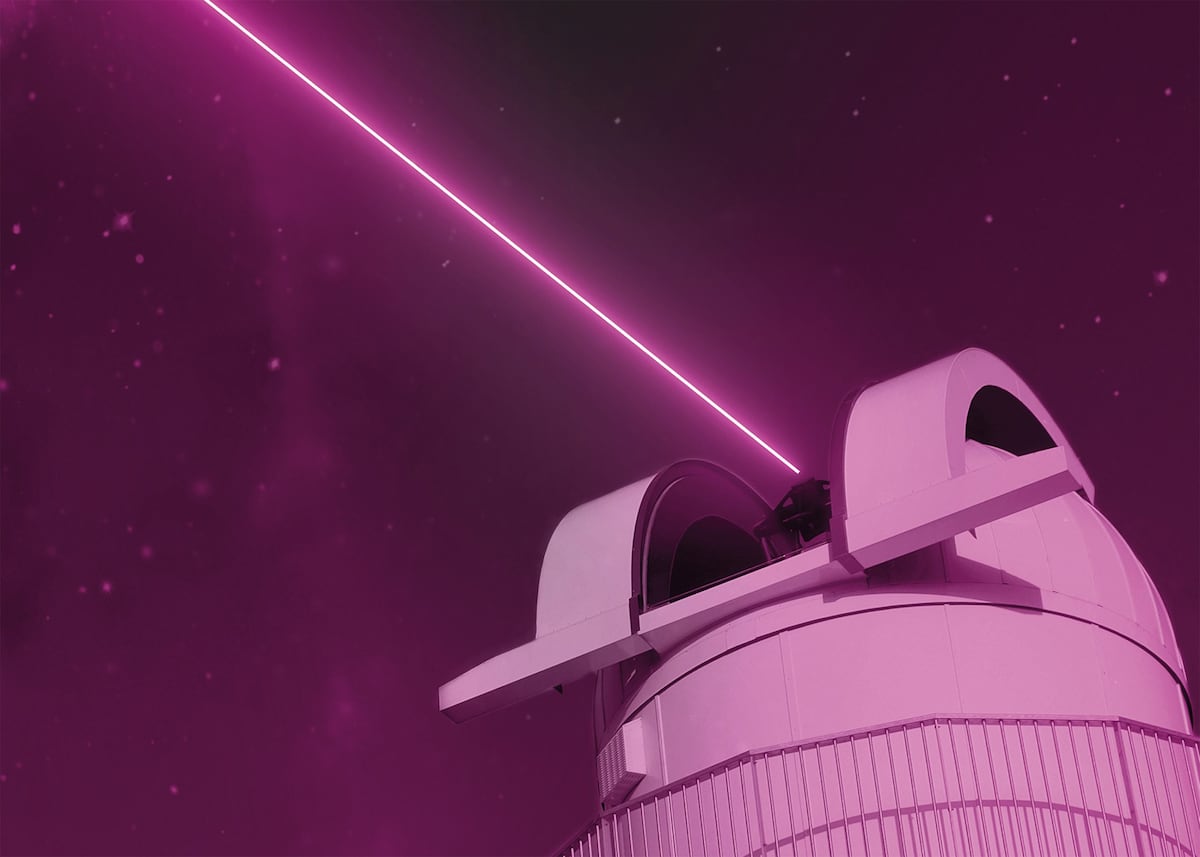
PARIS — French technology firms used laser to communicate between a low-orbit nano satellite and a commercial ground station in an experiment sponsored by the French Defence Innovation Agency, with France’s Armed Forces Ministry dubbing the test a world first.
A satellite from Unseenlabs with a laser payload established a stable link for several minutes with an optical ground station supplied by Cailabs, according to the ministry, which provided €5.5 million ($6.1 million) in funding for the project. The successful test this summer opens the way to integrating the system on France’s future military satellites, the ministry said .
The point-to-point nature of lasers makes them more secure than radio frequencies, and they can’t be jammed the way radio can, Cailabs CEO Jean-François Morizur told Defense News in an interview on Thursday. Additionally, a laser link can transfer very large files such as detailed Earth images in minutes, something that might require multiple orbits using radio signals, the CEO said.
“Anti-jamming is a big one,” Morizur said. “Low probability of detection, low probability of intercept means you can deploy it in some difficult contexts, you just don’t have the same signature as an RF antenna. Putting that on a ship makes sense, because you then reduce the radio footprint of your ship – both for ship-to-ship and ship to satellite.”
The higher data rates offered by laser are important for intelligence applications, as the growing volume of detailed satellite images of Earth is creating “very, very big files” that can be “quite tricky” to transfer with today’s satellite radio transmitters, according to the Cailabs CEO.
The successful test will make it possible to use space-based laser comms on mobile, land-based, naval and airborne platforms, the Armed Forces Ministry said. While the experiment is not the first for space-to-Earth laser communications, it’s the first using a commercially available ground station, according to Morizur.
The French government is keeping some information around the testing under wraps, including details on the date or who provided the laser payload. The ministry said the Keraunos project contributes to objectives in the 2024-2030 Military Programming Law to strengthen France’s space capabilities.
One of the goals of the Keraunos optical communications satellite project is to mitigate the effect of atmospheric turbulence that can hurt transmission quality, the ministry said. While the laser system used in the test will pass through some clouds, it can’t penetrate heavy cloud cover, according to Morizur.
The changed security situation in the world has accelerated government thinking around space, “one of the battlegrounds,” with a growing realization that space supremacy will be important, according to Morizur. In addition, the reduction in launch costs and cheap access to space are speeding up the space economy, he said.
“The more the space economy is growing, the more you have new tools, it becomes a field like any other, basically, where battle happens.”
The Cailabs ground station used in the test consists of a dome with a large telescope and several smaller ones, with the complexity being in processing the laser light, “that’s kind of where the magic happens,” Morizur said. The ground station can be made truck-sized, according to the CEO. Cailabs competitors include Safran in France and BridgeCom in the United States, he said.
Cailabs has seven ground stations under contract, including the one used in the test for the Armed Forces Ministry and a second one on order for the French government, as well as stations to be built for civilian clients including the European Space Agency and South Korea’s Contec. Most orders are for civilian applications, mainly for imagery, according to Morizur.
Morizur said the market for radio satellite gateways is valued at around $3 billion a year, and while optical ground stations will initially be a fragment of that, over time the opportunity will be “in the billions.”
Cailabs is currently leading in technology, price point and product maturity with its ground stations, and was picked for a number of recent competitive contracts, according to the CEO. The company has set up a team in the United States, where it sees contract opportunities, “and we are looking forward to supporting the U.S. government in many different ways,” Morizur said.
The company, which was co-founded by Morizur in 2013 and which has raised €46 million from investors, is unprofitable for now as it continues to spend on R&D and expansion, the CEO said. Cailabs received more than €10 million in orders last year, and “we stopped calling ourselves a startup a few years ago,” he added.
Rudy Ruitenberg is a Europe correspondent for Defense News. He started his career at Bloomberg News and has experience reporting on technology, commodity markets and politics.
巴黎——法国科技公司利用激光在低轨道纳米卫星和商业地面站之间进行通信,这是法国国防创新局赞助的一项实验,法国武装部队部称该测试是世界首例。
据法国国防部称,Unseenlabs公司一颗搭载激光有效载荷的卫星与Cailabs公司提供的光学地面站建立了数分钟的稳定链路。国防部为该项目提供了550万欧元(约合610万美元)的资金。国防部表示,今年夏天的成功测试为将该系统集成到法国未来的军用卫星上铺平了道路。
Cailabs首席执行官让-弗朗索瓦·莫里祖尔周四在接受《防务新闻》采访时表示,激光的点对点特性使其比无线电频率更安全,而且不会像无线电那样受到干扰。此外,他还指出,激光链路可以在几分钟内传输非常大的文件,例如详细的地球图像,而使用无线电信号则可能需要多次绕地球轨道传输才能完成同样的操作。
“抗干扰能力非常重要,”莫里祖尔说。“低探测概率、低拦截概率意味着它可以部署在一些复杂的环境中,而且它不像射频天线那样具有相同的信号特征。将其安装在舰船上是合理的,因为这样可以减少舰船的无线电信号覆盖范围——无论是舰对舰通信还是舰对卫星通信。”
Cailabs 首席执行官表示,激光提供的更高数据速率对于情报应用至关重要,因为不断增长的地球详细卫星图像正在产生“非常非常大的文件”,而使用当今的卫星无线电发射器传输这些文件“相当棘手”。
武装部队部表示,此次测试成功将使在移动、陆地、海上和空中平台上使用天基激光通信成为可能。莫里祖尔称,虽然此次试验并非首次进行天地激光通信,但却是首次使用商用地面站。
法国政府对此次测试的部分信息严格保密,包括测试日期和激光有效载荷的提供方等细节。法国国防部表示,Keraunos项目有助于实现2024-2030年军事规划法中旨在加强法国太空能力的目标。
该部表示,Keraunos光通信卫星项目的目标之一是减轻大气湍流对传输质量的影响。莫里祖尔称,虽然测试中使用的激光系统可以穿过部分云层,但无法穿透厚厚的云层。
莫里祖尔表示,全球安全形势的变化加速了各国政府对太空——“战场之一”——的思考,人们越来越意识到太空优势的重要性。此外,发射成本的降低和太空准入的便捷也正在加速太空经济的发展。
“太空经济发展得越快,拥有的新工具就越多,它基本上就会像其他领域一样,成为一个会发生战斗的领域。”
此次测试中使用的Cailabs地面站由一个圆顶组成,圆顶内装有一台大型望远镜和几台小型望远镜。莫里祖尔表示,复杂之处在于激光信号的处理,“这才是真正神奇的地方”。据首席执行官称,该地面站可以设计成卡车大小。他还提到,Cailabs的竞争对手包括法国的赛峰集团和美国的BridgeCom公司。
Cailabs公司目前有七个地面站正在承建中,其中包括为法国武装部队部进行测试的地面站,以及法国政府订购的另一个地面站。此外,该公司还将为包括欧洲航天局和韩国康泰克公司在内的民用客户建造地面站。据莫里祖尔称,大多数订单用于民用领域,主要用于图像采集。
Morizur 表示,无线电卫星网关的市场价值约为每年 30 亿美元,虽然光地面站最初只会占其中的一小部分,但随着时间的推移,其市场机会将达到“数十亿美元”。
据首席执行官称,Cailabs 的地面站目前在技术、价格和产品成熟度方面均处于领先地位,并赢得了近期多项竞争性合同。该公司已在美国设立团队,因为美国市场蕴藏着许多合同机会,“我们期待以多种方式为美国政府提供支持,”Morizur 表示。
莫里祖尔表示,该公司由他于2013年联合创立,已从投资者那里筹集了4600万欧元,但由于持续投入研发和扩张,目前尚未盈利。Cailabs去年获得了超过1000万欧元的订单,“几年前我们就不再称自己为初创公司了,”他补充道。
鲁迪·鲁伊滕贝格是《防务新闻》的欧洲记者。他的职业生涯始于彭博新闻社,拥有报道科技、大宗商品市场和政治方面的经验。