Singapore start-ups show that AI isn’t just a Big Tech playground新加坡的初创企业表明,人工智能并非只是大型科技公司的专属领域。
Two AI start-ups from JTC’s LaunchPad @ One-North offer a glimpse of how smaller firms are trying to turn advances in AI into commercial businesses. Read more at straitstimes.com.
The testbed in Punggol Digital District is set to launch later in 2026, which allows robots and AI systems to be continuously tested and refined.
ST PHOTO: KUA CHEE SIONG
Published Sep 14, 2026, 12:01 PM
Updated Sep 14, 2026, 12:01 PM
SINGAPORE – AI was once largely a Big Tech game, requiring billions of dollars to develop powerful models and the computing infrastructure to run them.
But that chapter of the AI transition is more or less done.
The industry’s next challenge is about maximising frontier intelligence’s impact and reach to deliver on the promise of boosting productivity.
The World Economic Forum estimates AI tools could contribute up to 14 per cent of global GDP by 2030, equivalent to about US$15.7 trillion (S$19.90 trillion). Goldman Sachs estimates the technology could lift world productivity growth by 1.5 percentage points over a 10-year period.
Agile start-ups worldwide – and here in Singapore – are slowly taking a leadership role in showing how raw, unpredictable artificial intelligence can be packaged into predictable and valuable workflows that businesses would actually pay for.
“Start-ups are really the canary in the coal mine,” said Juliana Lim, chief startup launchpad officer at JTC, who oversees the agency’s start-up ecosystem initiatives aimed at growing Singapore’s innovation landscape.
She said start-ups are usually quick at sniffing out potential opportunities that even large multinationals would miss.
“JTC’s role in this story is that we provide the space and structures that enable our startups to find a footing...a home,” noted Lim, who is also executive director at technology ecosystem builder and investor SGInnovate, where she oversees the national Deep Tech Central strategy.
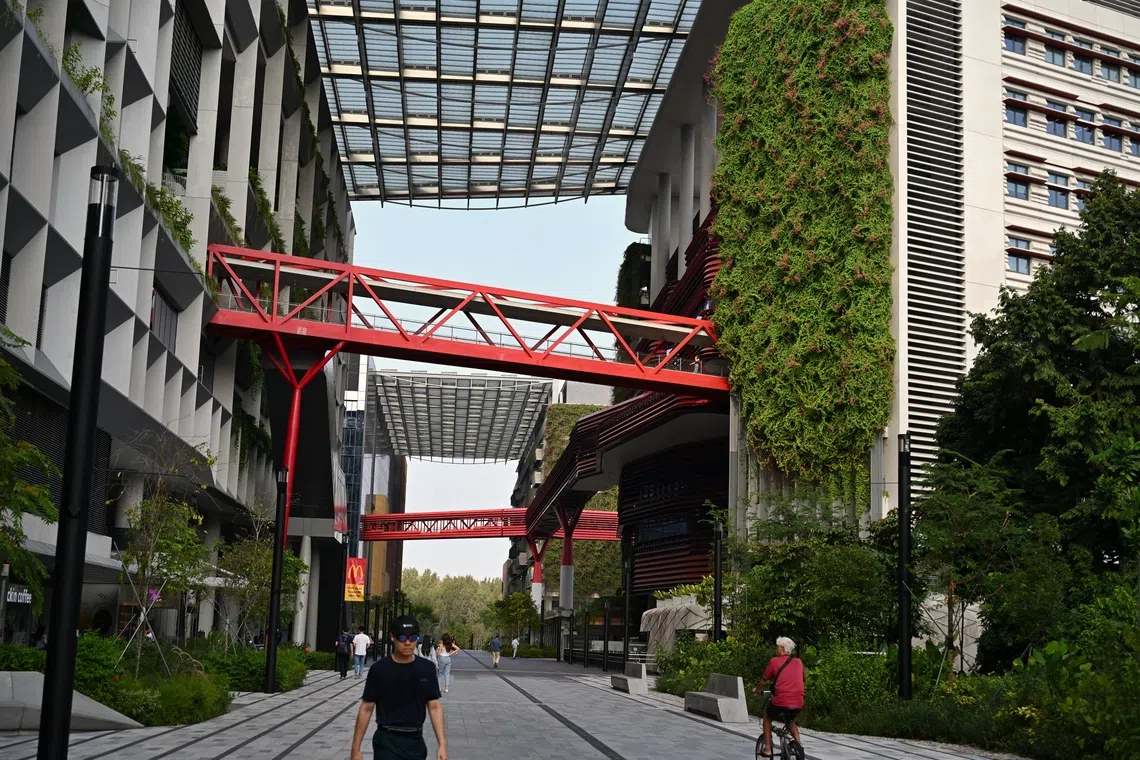
JTC’s LaunchPad @ One-North is part of Singapore’s multi-agency effort to scale up the local AI start-up ecosystem. It has grown from one block in 2015 to seven today and has housed more than 2,400 start-ups, including unicorns Carousell, PatSnap and Nium.
JTC’s LaunchPad @ One-North is part of Singapore’s multi-agency effort to scale up the local AI start-up ecosystem. PHOTO: JTC
JTC’s LaunchPad @ One-North is part of Singapore’s multi-agency effort to scale up the local AI start-up ecosystem.
Two AI start-ups from One North offer a glimpse of how smaller firms are trying to turn advances in AI into commercial businesses – and the challenges of doing so.
Workplace safety start-up Invigilo was co-founded in 2021 by Vishnu Saran and Anand Kumar.
Its AI-powered platform uses computer vision and video analytics on existing webcams or portable cameras the firm provides to identify unsafe acts and high-risk conditions in real time, helping improve safety and productivity across construction and industrial sites.
A web-based dashboard enables safety observations and collaborative case management.
Today, Invigilo’s applications are used across oil and gas facilities, construction sites, industrial plants and large-scale infrastructure projects worldwide that require continuous, camera-based safety enforcement at scale.
A HDB construction project, for instance, saw 60 per cent fewer safety incidents 12 months after Invigilo was deployed on 30 existing cameras.
Saran, Invigilo’s chief executive, said traditional video-based surveillance analytics have been around for decades, but such systems were limited to motion detection and rule-based alerts and could thus identify only what they were programmed to recognise.
AI, on the other hand, is redefining the future of video surveillance.
By applying deep learning, contextual understanding, and self-improving models, AI can transform video from a passive recording tool into an intelligent decision-making system.
But to achieve that, Saran and Kumar had to train their AI model to understand different work environments and unsafe behaviour that increases the risk of accidents and injuries.
A construction site’s safety and compliance requirements, for instance, are quite different from those of an offshore oil and gas exploration platform.
“So you have to install the cameras and train the model accordingly, so that it can actually catch all the scenarios that can possibly happen... and then the AI eventually learns,” said Saran.
Beyond safety and compliance, Invigilo’s AI-powered surveillance can also instruct companies on improving their procedures and processes.
For instance, its Invigilo’s software suite uses AI to break down recorded video sequences of construction site operations into structured, step-by-step procedures such as where a truck should make deliveries, where those deliveries should be stored, and how storage could be optimised. This can help speed up construction and cut costs.
“You must take the companies along with you on the journey of technology. And it’s a journey. Whatever you have made will be constantly improving as the AI technology improves,” Saran said.
Invigilo’s systems are at work at about 200 active sites, according to its website. Its clients include two global petroleum giants: a national oil company in the Middle East and a Western major’s drilling and production operations in Australia.
In June 2026, Invigilo was one of the first three start-ups awarded the Government’s Innovative Procurement Partnership tender. Under the pilot, Invigilo provides JTC with computer-vision technology to track and assess productivity on infrastructure and construction sites.
If successful, Invigilo can scale its technology across other JTC projects without going through traditional re-tendering.
Saran said the startup is making enough to invest back in product development.
From a two-man outfit incubated at BLOCK71, the startup hub run by NUS Enterprise, the firm has grown to 50 staff, with some working remotely from neighbouring countries.
The team is mainly composed of coders, machine learning engineers and computer vision engineers. Kumar is the chief technology officer.
“We are building cutting-edge AI that is not on the market,” Saran said. “ So we need somebody to teach the AI what is the ground truth– what exactly is the true and what is false. We need humans to do that.”
dConstruct Robotics, co-founded by Chinn Lim and Hazel Kuok in 2021, specialises in AI and autonomous robotics solutions.
Located at One-North, dConstruct builds software and hardware that allow autonomous robots, drones, and unmanned vehicles to navigate, map and inspect complex environments safely – even where GPS signals are unavailable or disrupted.
Their proprietary platform combines AI, 3D mapping and robotics to support applications across construction, infrastructure inspection, security and logistics.
But Lim, a veteran tech entrepreneur and former civil servant at GovTech, said the endeavour was very challenging from the beginning.
“It was a very big risk – not because of AI, but because for robotics you need a very deep pocket. And the value proposition was not distinct or clear outside a factory.”
Chinn Lim (pictured) co-founded dConstruct Robotics with Hazel Kuok in 2021. PHOTO: DCONSTRUCT ROBOTICS
Chinn Lim (pictured) co-founded dConstruct Robotics with Hazel Kuok in 2021.
PHOTO: DCONSTRUCT ROBOTICS
Robots have been used for decades almost exclusively in heavy manufacturing environments where tasks were repetitive, dangerous, or required extreme precision. In the automotive industry, for instance, massive, caged robotic arms are used for spot welding, high-precision painting and heavy lifting.
Now AI is driving a massive paradigm shift in robotics, transitioning machines from rigid, pre-programmed tools into adaptive, autonomous and intelligent entities.
“Autonomy implies that you need to be situationally aware and react to a changing environment,” said Lim, who put together a team of talented engineers from Singapore to achieve this.
“So today, after five years, we have four patents filed. We also found a niche – autonomous navigation in GPS-denied environments. And from there, we obviously got addicted and continued to develop more and more innovations.”
He explained that AI gives robots a perception system. Even without GPS for navigation, robots with a camera or LiDAR (light detection and ranging) sensors can map their surroundings.
In construction, for instance, dConstruct’s robots do not build physical structures like laying bricks or painting. Instead, they provide real-time visibility to ensure a building is being constructed exactly as designed.
The robots can perform centimetre-accurate mapping, spotting costly mistakes early.
dConstruct systems can also build a digital twin of an entire active construction site within hours, allowing engineers to catch structural errors.
The firm’s clients include industrial property developer and manager Boustead Pro jects; Defence Science and Technology Agency; SBS Transit; and Softbank Robotics Singapore, a global leader in commercial automation.
The start-up is also working on humanoid robotics under a strategic partnership with Texas-based Persona AI to test and scale heavy-duty humanoid platforms alongside standard wheeled and quadruped – or robot dog – models.
dConstruct is working on humanoid robotics under a strategic partnership with Texas-based Persona AI. ST PHOTO: JASON QUAH
dConstruct is working on humanoid robotics under a strategic partnership with Texas-based Persona AI.
ST PHOTO: JASON QUAH
The challenge the start-up is facing now is how to scale up.
“No matter how advanced Singapore is, there isn’t enough of a local market that can absorb the high research and development costs or pay for it,” said Lim.
Companies in Europe, the US and in China can naturally do better due to the size of their domestic markets.
While Asia, led by China, is the fastest-growing region for the autonomous mobile robots market. Europe holds the largest market share at around 35 per cent. North America represents the largest regional market for last-mile autonomous delivery robots.
Hence, the start-up has a global expansion plan. It has an R&D team in Canada, and is setting up offices in Germany, the US and Japan. It is also growing its workforce, which now stands at 75, in Singapore.
dConstruct recently announced the successful close of its US$125 million Series A funding to scale up commercial deployment of its robots, research and development, and build its massive 42,000 sqm global headquarters, dC Plus, at the Punggol Digital District (PDD).
Its robots will be deployed at PDD, Singapore’s first public-space test site where multiple operators can run robots simultaneously in a mixed-use environment.
To overcome its financial constraints, dConstruct might launch an initial public offering or seek a merger with, or acquisition by, another company.
“We need to be able to have enough financial muscle in the long run... (to have) a share in the global market.”
Ovais Subhani is senior business correspondent at The Straits Times. He writes stories that demystify the latest economics, trade and finance news.
AI/artificial intelligence
Workplace safety and health
榜鹅数码区的测试平台预计将于 2026 年晚些时候推出,届时将可以持续测试和改进机器人和人工智能系统。
《海峡时报》摄影:郭志雄
发布于 2026 年 9 月 14 日下午 12:01
更新于2026年9月14日下午12:01
新加坡——人工智能曾经主要是大型科技公司的领域,需要数十亿美元来开发强大的模型和运行这些模型的计算基础设施。
但人工智能转型的这一阶段已经基本结束了。
该行业面临的下一个挑战是如何最大限度地发挥前沿情报的影响和覆盖范围,从而兑现提高生产力的承诺。
世界经济论坛估计,到2030年,人工智能工具对全球GDP的贡献可能高达14%,相当于约15.7万亿美元(19.9万亿新元)。高盛估计,这项技术可在未来十年内将全球生产率增长率提高1.5个百分点。
全球范围内的敏捷型初创企业——包括新加坡的——正在逐渐发挥领导作用,展示如何将原始、不可预测的人工智能打包成可预测且有价值的工作流程,而企业也愿意为此付费。
“初创企业就像煤矿里的金丝雀,”裕廊集团首席初创企业启动官朱莉安娜·林说道,她负责监督该机构旨在发展新加坡创新环境的初创企业生态系统计划。
她表示,初创企业通常能迅速嗅到潜在的商机,而这些商机甚至连大型跨国公司都会错过。
“裕廊集团在这个故事中的作用是,我们提供空间和结构,使我们的初创企业能够站稳脚跟……找到归宿,”林女士指出。她同时也是科技生态系统建设者和投资者SGInnovate的执行董事,负责监督国家深度科技中心战略。
裕廊集团 (JTC) 的 LaunchPad @ One-North 是新加坡多机构合作扩大本地人工智能初创企业生态系统的一部分。该园区已从 2015 年的一个街区发展到如今的七个街区,并已容纳了超过 2400 家初创企业,其中包括独角兽企业 Carousell、PatSnap 和 Nium。
裕廊集团 (JTC) 的 LaunchPad @ One-North 是新加坡多机构合作,旨在扩大本地人工智能初创企业生态系统的一部分。图片:裕廊集团
裕廊集团的 LaunchPad @ One-North 是新加坡多机构合作扩大本地人工智能初创企业生态系统的一部分。
来自 One North 的两家人工智能初创公司让我们得以一窥规模较小的公司如何尝试将人工智能的进步转化为商业业务,以及他们面临的挑战。
工作场所安全初创公司 Invigilo 由 Vishnu Saran 和 Anand Kumar 于 2021 年联合创立。
其人工智能平台利用计算机视觉和视频分析技术,对公司提供的现有网络摄像头或便携式摄像头进行实时识别不安全行为和高风险情况,从而帮助提高建筑工地和工业场所的安全性和生产力。
基于网络的仪表盘可实现安全观察和协作案例管理。
如今,Invigilo 的应用已遍及全球的石油和天然气设施、建筑工地、工业厂房和大型基础设施项目,这些场所都需要大规模的、基于摄像头的持续安全执法。
例如,在建屋发展局的一个建筑项目中,在 30 个现有摄像头上部署 Invigilo 12 个月后,安全事故减少了 60%。
Invigilo 的首席执行官 Saran 表示,传统的基于视频的监控分析技术已经存在了几十年,但此类系统仅限于运动检测和基于规则的警报,因此只能识别它们被编程识别的内容。
另一方面,人工智能正在重新定义视频监控的未来。
通过应用深度学习、上下文理解和自我改进模型,人工智能可以将视频从被动的录制工具转变为智能决策系统。
但要实现这一目标,Saran 和 Kumar 必须训练他们的 AI 模型来理解不同的工作环境和不安全行为,这些行为会增加事故和伤害的风险。
例如,建筑工地的安全和合规要求与海上石油和天然气勘探平台的安全和合规要求截然不同。
“所以你必须安装摄像头并相应地训练模型,以便它能够捕捉到所有可能发生的场景……然后人工智能最终会学习,”萨兰说。
除了安全和合规性之外,Invigilo 的人工智能监控还可以指导公司改进其程序和流程。
例如,Invigilo 的软件套件利用人工智能技术,将建筑工地作业的录制视频序列分解成结构化的分步流程,例如卡车应该在哪里送货、货物应该存放在哪里以及如何优化存储。这有助于加快施工速度并降低成本。
萨兰表示:“你必须带领公司一起踏上技术发展之路。这是一段旅程。随着人工智能技术的进步,你所创造的一切也将不断改进。”
据Invigilo官网显示,其系统目前在约200个活跃站点投入使用。其客户包括两家全球石油巨头:一家中东国家石油公司和一家西方大型石油公司在澳大利亚的钻井和生产业务部门。
2026年6月,Invigilo成为首批三家获得政府创新采购合作项目招标的初创公司之一。在该试点项目中,Invigilo为裕廊集团(JTC)提供计算机视觉技术,用于追踪和评估基础设施和建筑工地的生产效率。
如果成功,Invigilo 可以将其技术推广到 JTC 的其他项目中,而无需经过传统的重新招标程序。
萨兰表示,这家初创公司盈利足以将其投入产品研发。
这家公司最初是由两名员工在新加坡国立大学企业运营的创业中心 BLOCK71 孵化而成,如今已发展到 50 名员工,其中一些员工在邻国远程办公。
团队主要由程序员、机器学习工程师和计算机视觉工程师组成。库马尔是首席技术官。
萨兰说:“我们正在开发市面上还没有的尖端人工智能。所以我们需要有人来教人工智能什么是真相——什么是真,什么是假。我们需要人类来完成这项工作。”
dConstruct Robotics 由 Chinn Lim 和 Hazel Kuok 于 2021 年共同创立,专门从事人工智能和自主机器人解决方案。
dConstruct 公司位于 One-North,致力于开发软件和硬件,使自主机器人、无人机和无人驾驶车辆能够安全地导航、绘制地图和检查复杂的环境——即使在 GPS 信号不可用或中断的情况下也能如此。
他们的专有平台结合了人工智能、3D 地图绘制和机器人技术,为建筑、基础设施检查、安全和物流等领域的应用提供支持。
但资深科技企业家、前政府科技局公务员林先生表示,这项事业从一开始就极具挑战性。
“这风险非常大——不是因为人工智能,而是因为机器人技术需要雄厚的资金。而且在工厂之外,其价值主张并不明确。”
图中人物Chinn Lim与Hazel Kuok于2021年共同创立了dConstruct Robotics公司。图片来源:dConstruct Robotics
Chinn Lim(如图)于 2021 年与 Hazel Kuok 共同创立了 dConstruct Robotics 公司。
图片:DCONSTRUCT ROBOTICS
几十年来,机器人几乎完全应用于重型制造业环境中,用于执行重复性高、危险性大或需要极高精度的任务。例如,在汽车行业,大型的笼式机械臂被用于点焊、高精度喷涂和重型设备搬运。
如今,人工智能正在推动机器人技术发生巨大的范式转变,使机器从僵化的、预先编程的工具转变为适应性强、自主且智能的实体。
“自主性意味着你需要具备情境意识并对不断变化的环境做出反应,”林说道。为了实现这一目标,他组建了一支来自新加坡的优秀工程师团队。
“所以今天,五年过去了,我们已经申请了四项专利。我们也找到了一个市场空白——在无GPS环境下的自主导航。从那以后,我们显然就沉迷其中,并不断开发出更多创新技术。”
他解释说,人工智能赋予机器人感知系统。即使没有GPS导航,配备摄像头或激光雷达(LiDAR)传感器的机器人也能绘制周围环境地图。
例如,在建筑领域,dConstruct 的机器人并不像砌砖或粉刷那样建造实体结构。相反,它们提供实时可视性,以确保建筑物完全按照设计建造。
这些机器人可以进行厘米级精度的测绘,及早发现代价高昂的错误。
dConstruct 系统还可以在数小时内构建整个在建工地的数字孪生模型,使工程师能够发现结构错误。
该公司的客户包括工业地产开发商和管理公司 Boustead Projects;国防科技局;SBS Transit;以及全球商业自动化领导者 Softbank Robotics Singapore。
这家初创公司还与位于德克萨斯州的 Persona AI 建立了战略合作伙伴关系,致力于研发人形机器人,以测试和扩展重型人形平台,以及标准的轮式和四足机器人(或机器狗)模型。
dConstruct正与总部位于德克萨斯州的Persona AI公司建立战略合作伙伴关系,共同研发人形机器人。ST摄影:JASON QUAH
dConstruct 与总部位于德克萨斯州的 Persona AI 建立了战略合作伙伴关系,共同研发人形机器人。
《海峡时报》摄影:JASON QUAH
这家初创公司目前面临的挑战是如何扩大规模。
林说:“无论新加坡的科技多么发达,本地市场都不足以消化高昂的研发成本或支付相关费用。”
由于国内市场规模庞大,欧洲、美国和中国的公司自然能够做得更好。
亚洲,尤其是中国,是自主移动机器人市场增长最快的地区。欧洲占据最大的市场份额,约为35%。北美是最后一公里自主配送机器人最大的区域市场。
因此,这家初创公司制定了全球扩张计划。它在加拿大设有研发团队,并正在德国、美国和日本设立办事处。此外,它在新加坡的员工人数也在不断增加,目前已达75人。
dConstruct 近日宣布成功完成 1.25 亿美元的 A 轮融资,用于扩大其机器人的商业部署、研发,并在榜鹅数码区 (PDD) 建造其占地 42,000 平方米的庞大全球总部 dC Plus。
其机器人将部署在新加坡首个公共空间测试场地——PDD,该场地允许多个操作员在混合用途环境中同时运行机器人。
为了克服财务限制,dConstruct 可能会进行首次公开募股,或者寻求与其他公司合并或被其他公司收购。
“从长远来看,我们需要拥有足够的财力……(才能)在全球市场占有一席之地。”
奥瓦伊斯·苏巴尼是《海峡时报》的资深商业记者。他撰写的文章深入浅出地解读最新的经济、贸易和金融新闻。
人工智能
工作场所安全与健康