Launched in the shadows: Ukraine’s long-range drones rattle Russia秘密部署:乌克兰远程无人机令俄罗斯感到不安
Since the summer, Ukraine’s long-range drone campaign has ramped up dramatically, pounding infrastructure across Russia and testing Moscow’s air defenses.
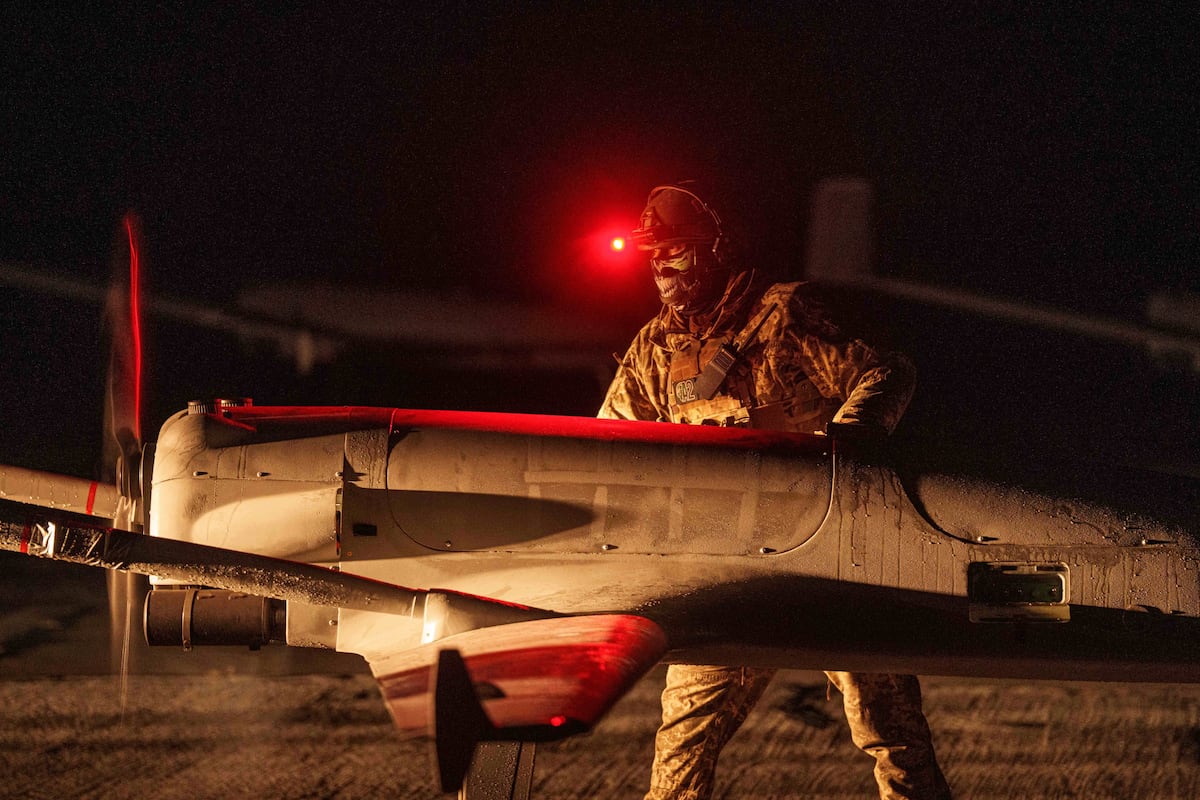
KYIV, Ukraine (AP) — At a secret location in rural Ukraine , columns of attack drones are assembled at night and in near silence to strike deep inside Russia.
Their targets are strategic: oil refineries, fuel depots, and military logistics hubs. Since the summer, Ukraine’s long-range drone campaign has ramped up dramatically, pounding energy infrastructure across Russia and stretching Moscow’s air defenses thin.
Built from parts made in a scattered network of workshops, these drones now fly much further than at any point in the war.
Officers in body armor move with quick precision; headlamps glow red to stay hidden. Engines sputter like old motorcycles as exhaust fumes drift into the moonless night. Minutes later, one after another, the drones lift from a makeshift runway and head east.
The strikes have caused gasoline shortages in Russia, even forcing rationing in some regions and underscoring a growing vulnerability in the country’s infrastructure.
Lt. Gen. Vasyl Maliuk, head of the Ukrainian Security Service, said Friday that more than 160 successful strikes had been carried out against Russia’s oil extraction and refining facilities so far this year.
Drones hammer refineries
Western analysts say the attacks on energy infrastructure so far have had a serious — but not crippling — effect.
Ukrainian drones have repeatedly hit 16 major Russian refineries, representing about 38% of the country’s nominal refining capacity, according to a recent review by the Carnegie Endowment, a U.S.-based think tank.
But it argues the actual impact has been considerably more limited: most plants resumed operations within weeks, and Russia’s refining output has been cushioned by idle capacity and existing fuel surpluses.
The deep strikes have, however, given Kyiv the initiative at an important moment. The United States and Europe are ramping up sanctions on Russia’s oil industry even as Kyiv’s request for U.S. long-range Tomahawk missiles has stalled.
President Volodymyr Zelenskyy says Ukraine’s improved long-range strike capability is causing real damage – forcing the Kremlin to import fuel and curb exports.
“We believe they’ve lost up to 20% of their gasoline supply — directly as a result of our strikes,” he told reporters at a briefing in Kyiv.
A Ukrainian commander looks through night vision before a long-range drone launch toward Russia, Oct. 14, 2025. (Evgeniy Maloletka/AP)
At the secret launch site, the commander overseeing the operation — a broad-shouldered man identified by his call sign, “Fidel,” in accordance with Ukrainian military regulations — watches through night-vision goggles as the drones climb into the star-filled sky.
“Drones are evolving,” Fidel told The Associated Press. “Instead of flying 500 kilometers (310 miles), now they fly 1,000 ... Three factors go into a successful operation: the drones, the people and the planning. We want to deliver the best result. For us, this is a holy mission.”
Ukraine thrives on no-frills weapons
Much of Ukraine’s fleet is homegrown. The Liutyi, a workhorse of the nightly attacks, is a waist-high craft with a sausage-shaped body, a propeller at the back, and a distinctive triangular tail.
It looks neither sleek nor intimidating — more Home Depot than Lockheed Martin — but the ease of assembly means it can be kept hidden and constantly tweaked: optimized to slip through heavily monitored frontline airspace.
Typical of Ukraine’s no-frills war production philosophy, the Liutyi — whose name means “fierce” in Ukrainian — has become a symbol of national pride and recently featured on a local postage stamp.
The reach of these drones — with some models doubling in range over the past year to routinely strike targets within a 1,000-kilometer radius of the border — marks a shift in the geography of the conflict.
Attacks a year ago damaged refineries in a much narrower range, mostly in western Russian border regions. Costs have also come down, further testing expensive air defense systems, with long-range drones now being produced in Ukraine for as little as $55,000.
A shift in conflict geography
“What we’re seeing is that Ukraine is getting better at taking the war inside Russia,” said Adriano Bosoni, director of analysis at RANE, a global risk analysis firm. “For most of the war, Russia operated on the assumption that its own territory was safe. That’s no longer the case.”
The strategic logic is attrition by logistics, he argued: by forcing Russia to reroute supplies and commit air defenses to a wider area, Kyiv seeks to degrade Moscow’s capacity to sustain large-scale operations.
The Paris-based International Energy Agency says repeated drone strikes have cut Russia’s refining capacity by about 500,000 barrels a day.
That’s triggered domestic fuel shortages and curbed exports of diesel and jet fuel, even as overall global oil production remains steady and prices stable.
Kyiv’s homegrown strike capability allows independent drone launches, bypassing the Western approval required for imported long-range weapons .
That autonomy preceded tougher sanctions on Russia: allies escalated only after Ukraine had spent months hitting Russian refineries.
On the ground, each mission is a study in tradeoffs. Fewer than 30% of drones even reach the target area, so meticulous planning is essential, said Fidel, who reflected on the human cost.
“War has fallen to our generation so that we can fight for our kids and they can live in a free democratic country,” he said. “We are currently obtaining experience that will be used by every country in the world, and we are paying the price with our lives and the lives of our friends.”
Associated Press journalists Hanna Arhirova, Illia Novikov, Evgeniy Maloletka, Dmytro Zhyhinas and Alex Babenko contributed to this report from Ukraine.
乌克兰基辅(美联社)——在乌克兰农村的一个秘密地点,攻击型无人机群在夜间几乎悄无声息地集结起来,准备深入俄罗斯境内进行打击。
他们的目标具有战略意义:炼油厂、燃料库和军事后勤枢纽。自夏季以来,乌克兰的远程无人机行动急剧升级,猛烈攻击俄罗斯各地的能源基础设施,并削弱了莫斯科的防空力量。
这些无人机由分散在各地的作坊生产的零件组装而成,现在它们的飞行距离比战争期间的任何时候都要远得多。
身着防弹衣的警员行动迅速精准;为了隐蔽,前灯发出红光。引擎发出如同老式摩托车般的突突声,废气飘散在没有月光的夜空。几分钟后,一架又一架无人机从临时跑道上起飞,向东飞去。
罢工导致俄罗斯汽油短缺,甚至迫使一些地区实行配给制,凸显了该国基础设施日益严重的脆弱性。
乌克兰安全局局长瓦西里·马柳克中将周五表示,今年迄今为止,乌克兰已对俄罗斯的石油开采和炼油设施发动了 160 多次成功的袭击。
无人机袭击炼油厂
西方分析人士表示,迄今为止,对能源基础设施的袭击已经造成了严重影响,但并未造成毁灭性后果。
据美国智库卡内基国际和平基金会最近的一项评估显示,乌克兰无人机多次袭击俄罗斯 16 家主要炼油厂,约占该国名义炼油产能的 38%。
但报告认为,实际影响要有限得多:大多数炼油厂在几周内就恢复了运营,而且俄罗斯的炼油产量也因闲置产能和现有的燃料盈余而得到缓冲。
然而,这些纵深打击行动让基辅在关键时刻掌握了主动权。尽管基辅向美国索要远程“战斧”导弹的请求陷入停滞,但美国和欧洲仍在加大对俄罗斯石油行业的制裁力度。
乌克兰总统泽连斯基表示,乌克兰远程打击能力的提升正在造成真正的损害——迫使克里姆林宫进口燃料并限制出口。
“我们认为,由于我们的打击,他们的汽油供应损失高达 20%。”他在基辅举行的新闻发布会上告诉记者。
2025年10月14日,一名乌克兰指挥官在向俄罗斯发射远程无人机前通过夜视镜观察。(Evgeniy Maloletka/AP)
在秘密发射场,负责指挥行动的指挥官——一位肩膀宽阔的男子,按照乌克兰军方规定,他的呼号是“菲德尔”——透过夜视镜观察无人机升入繁星点点的夜空。
菲德尔告诉美联社:“无人机正在不断发展。以前它们只能飞500公里(310英里),现在能飞1000公里……一次成功的行动包含三个要素:无人机、人员和计划。我们希望取得最佳成果。对我们来说,这是一项神圣的使命。”
乌克兰依靠朴素的武器蓬勃发展。
乌克兰的大部分舰队都是国产的。“柳蒂”号是夜间袭击的主力舰,它是一种齐腰高的船体,呈香肠状,尾部装有螺旋桨,并有一个独特的三角形尾翼。
它看起来既不时尚也不吓人——更像是家得宝的产品,而不是洛克希德·马丁的产品——但由于组装简便,它可以被隐藏起来并不断进行调整:经过优化,可以悄无声息地穿过严密监控的前线空域。
乌克兰的“柳蒂”坦克(Liutyi,其名称在乌克兰语中意为“凶猛”)体现了乌克兰务实的战争生产理念,它已成为民族自豪的象征,最近还被印在了当地的邮票上。
这些无人机的打击范围——有些型号的无人机在过去一年中打击范围扩大了一倍,能够例行打击边境方圆 1000 公里内的目标——标志着冲突地理格局的转变。
一年前的袭击造成的炼油厂破坏范围要小得多,主要集中在俄罗斯西部边境地区。成本也已下降,这进一步考验了昂贵的防空系统,乌克兰现在生产的远程无人机成本低至5.5万美元。
冲突地理格局的转变
“我们看到的是,乌克兰越来越擅长将战争转移到俄罗斯境内,”全球风险分析公司RANE的分析主管阿德里亚诺·博索尼表示。“在战争的大部分时间里,俄罗斯都认为其领土是安全的。但现在情况已经不同了。”
他认为,战略逻辑是通过后勤消耗战:通过迫使俄罗斯重新安排补给路线并将防空力量投入到更广阔的区域,基辅试图削弱莫斯科维持大规模作战的能力。
总部位于巴黎的国际能源署表示,无人机的反复袭击已使俄罗斯的炼油能力每天减少约 50 万桶。
这引发了国内燃料短缺,并抑制了柴油和航空燃油的出口,尽管全球石油总产量保持稳定,价格也保持稳定。
基辅自主研发的打击能力使其能够独立发射无人机,绕过了进口远程武器所需的西方批准。
这种自主权先于对俄罗斯更严厉的制裁:在乌克兰对俄罗斯炼油厂进行了数月的袭击之后,盟友才升级了制裁。
地面上的每一次任务都是一次权衡取舍的考验。菲德尔说,只有不到30%的无人机能够到达目标区域,因此周密的计划至关重要,他还反思了人员伤亡问题。
他说:“战争的重担落在了我们这一代人身上,这样我们才能为我们的孩子而战,让他们生活在一个自由民主的国家。我们目前正在积累的经验将被世界各国借鉴,而我们为此付出的代价是自己的生命和朋友的生命。”
美联社记者 Hanna Arhirova、Illia Novikov、Evgeniy Maloletka、Dmytro Zhyhinas 和 Alex Babenko 对乌克兰的这篇报道做出了贡献。