Germany, UK tap GDELS to build new floating bridges for frontline ops德国和英国委托GDELS公司建造用于前线作战的新型浮桥
Dubbed Schwimmschnellbrücke 2 in German, the vehicles will be constructed by General Dynamics European Land Systems.
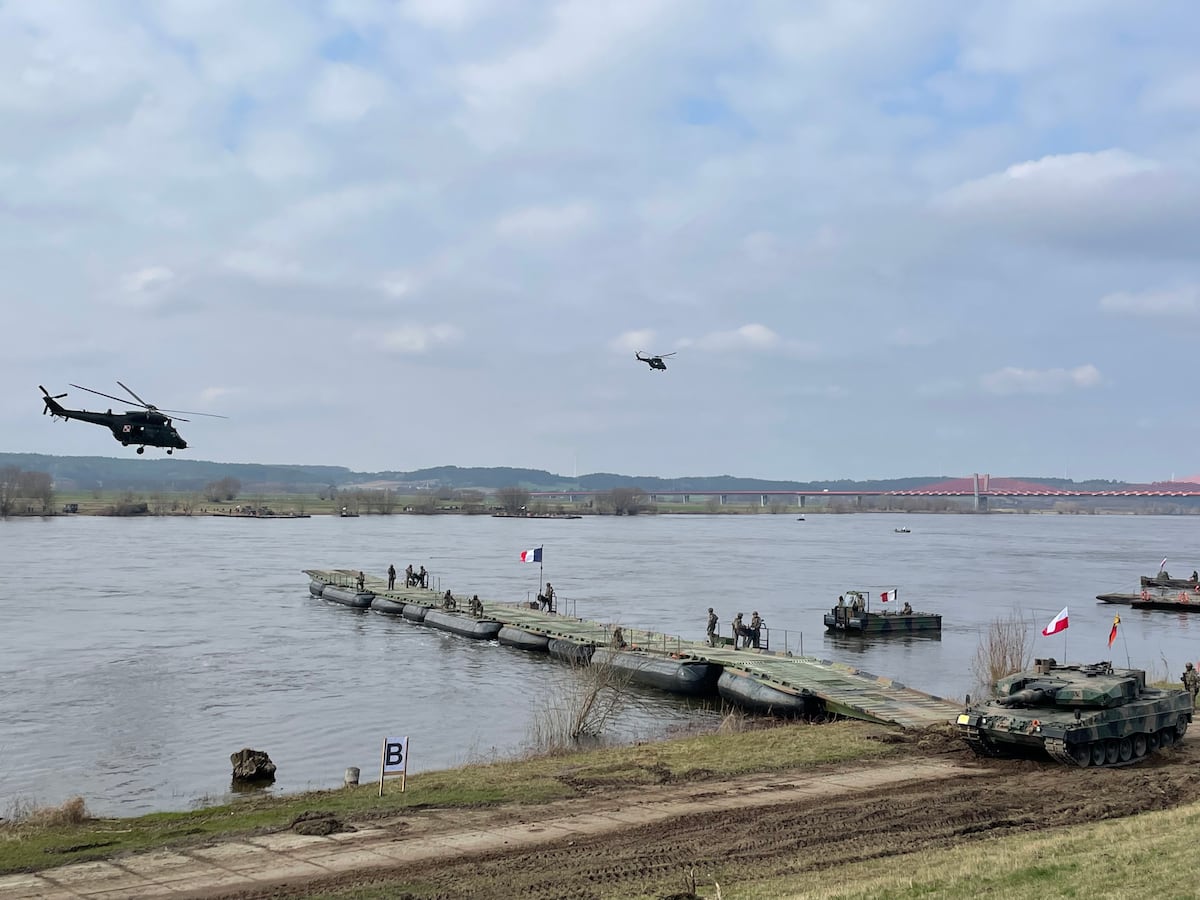
BERLIN — Germany and the United Kingdom will jointly procure a new generation of rapidly deployable floating bridges, the German military announced on Thursday.
Dubbed Schwimmschnellbrücke 2 in German, the vehicles will be constructed by General Dynamics European Land Systems. They act as self-propelled all-wheel-drive vehicles that can either be daisy-chained to bridge bodies of water or used as ferries to move equipment from one shore to another. The UK has dubbed the project TRITON.
The Bundeswehr, Germany’s armed forces, said that the new vehicles, created through a bilateral project officially called “Wide Wet Gap Crossing,” would replace existing German systems such as the M3 bridge and ferry system as well as the German military’s existing folding bridges. Compared to its predecessor, the new equipment will have better off-road capabilities and maneuverability, the German armed forces said.
The new system will be interoperable with the existing gear used by partner countries and will be compatible with the pontoon family of temporary bridges used by NATO countries, too.
The new vehicles will be deployed to the joint British-German multinational pioneer bridging battalion 130 based in Minden, Germany, and will fulfill a key NATO role. The bridges are being procured through the Organisation for Joint Armament Cooperation, an intergovernmental organisation that was set up in the 90s to facilitate multilateral defense procurements across several Western European countries.
The procurement will be carried out jointly by Berlin and London “to strengthen German-British cooperation,” the Bundeswehr’s office for materiel said.
Germany will pay €53 million ($61 million) for the bridges, with an option to place an additional €331 million ($383 million) in further orders. Additional contracts related to the procurement amount to a total of €104 million ($120 million), the Bundeswehr said in a statement. The U.K. had not made a corresponding announcement at the time of writing.
The German-British buy continues a larger trend of the U.K. re-engaging with the European mainland since Russia’s full-scale invasion of Ukraine. London has since played a key role in backing Kyiv’s defense, and has renewed engagement in multilateral projects with continental European partners, mending rifts that emerged as a consequence of the U.K.’s exit from the EU in 2020.
The procurement follows the UK-Germany Trinity House Agreement from October 2024 and a Letter of Intent signed in April 2025 reaffirming bilateral defense cooperation between the two countries.
Linus Höller is Defense News' Europe correspondent and OSINT investigator. He reports on the arms deals, sanctions, and geopolitics shaping Europe and the world. He holds master’s degrees in WMD nonproliferation, terrorism studies, and international relations, and works in four languages: English, German, Russian, and Spanish.
柏林——德国军方周四宣布,德国和英国将联合采购新一代快速部署式浮桥。
这些车辆在德语中被称为“Schwimmschnellbrücke 2”,将由通用动力欧洲陆地系统公司建造。它们是全轮驱动的自推进车辆,可以串联起来跨越水体,也可以用作渡轮,将设备从一岸运送到另一岸。英国将该项目命名为“TRITON”。
德国联邦国防军表示,这些新型车辆是通过一项名为“宽阔湿地穿越”的双边项目研发的,将取代德国现有的M3桥梁和渡轮系统以及德军现有的折叠桥等系统。德国联邦国防军称,与之前的装备相比,新装备将拥有更强的越野性能和机动性。
新系统将与伙伴国家使用的现有设备兼容,并且也将与北约国家使用的浮筒式临时桥梁系列兼容。
这批新型车辆将部署到驻扎在德国明登的英德联合多国先锋架桥营第130营,并将发挥北约的关键作用。这些桥梁是通过联合军备合作组织(OJCA)采购的,该组织是一个政府间组织,成立于上世纪90年代,旨在促进多个西欧国家之间的多边防务采购。
德国联邦国防军物资办公室表示,此次采购将由柏林和伦敦联合进行,“以加强德英合作”。
德国将支付5300万欧元(约合6100万美元)用于建造这些桥梁,并可选择追加3.31亿欧元(约合3.83亿美元)的订单。德国联邦国防军在一份声明中表示,与此次采购相关的其他合同总额为1.04亿欧元(约合1.2亿美元)。截至发稿时,英国尚未发布相关公告。
此次英德联合采购延续了自俄罗斯全面入侵乌克兰以来,英国重新与欧洲大陆建立联系的大趋势。此后,伦敦在支持基辅国防方面发挥了关键作用,并重新参与了与欧洲大陆伙伴的多边项目,弥合了英国2020年脱欧后出现的裂痕。
此次采购是在英国和德国于 2024 年 10 月签署的《三一宫协议》以及 2025 年 4 月签署的《意向书》之后进行的,该意向书重申了两国之间的双边防务合作。
林努斯·霍勒是《防务新闻》的欧洲记者和开源情报调查员。他报道影响欧洲乃至全球的军火交易、制裁和地缘政治。他拥有大规模杀伤性武器不扩散、恐怖主义研究和国际关系三个硕士学位,并精通英语、德语、俄语和西班牙语四种语言。